How to fix Java4Shell: the patched build per JDK vendor
How to fix Java4Shell: move each JDK to its vendor's fixed build (Oracle 17.0.21.1, Corretto 17.0.21.1.2, Temurin 17.0.21.1+2), rebuild images, restart.
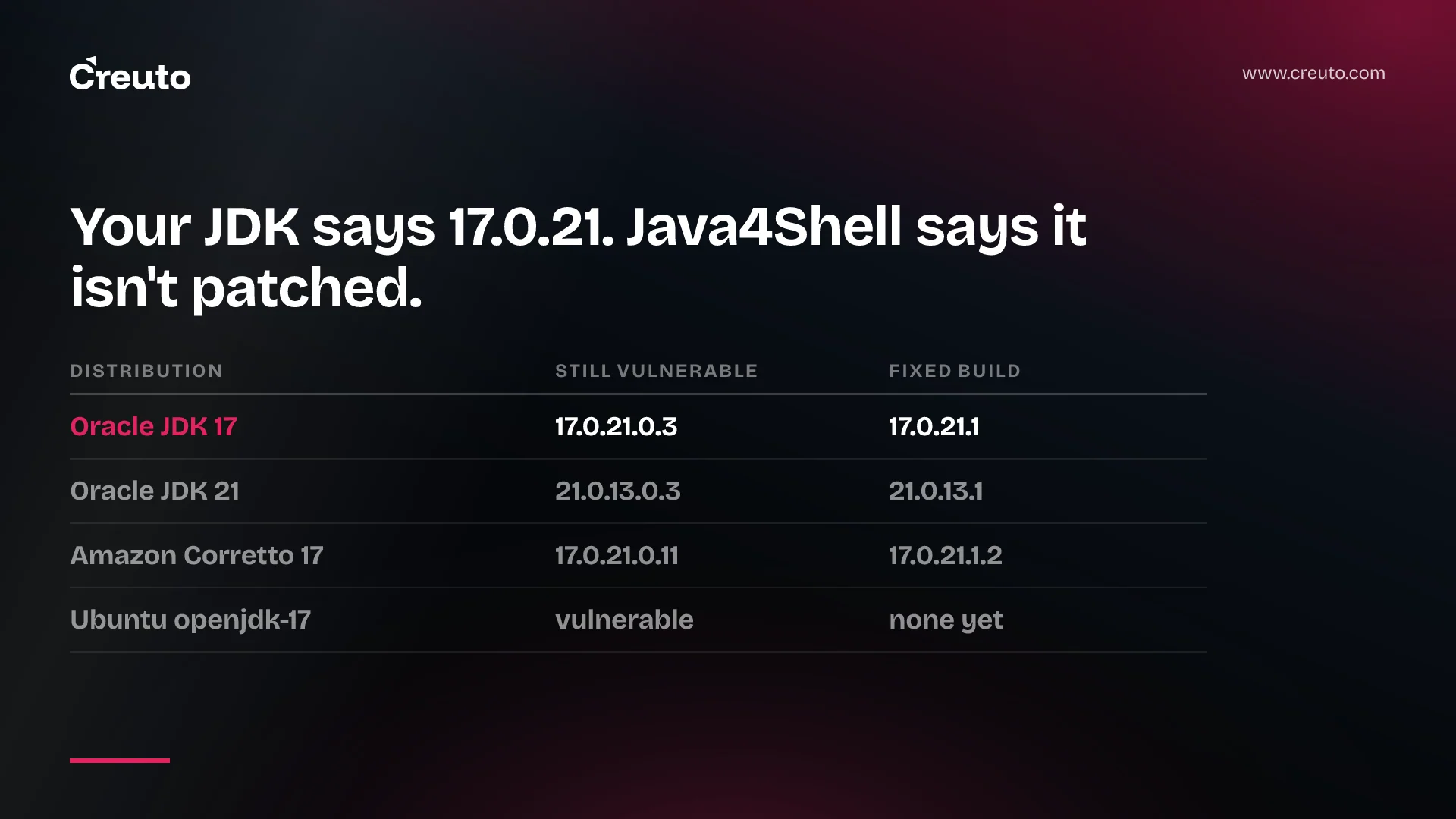
The Java security build that shipped in late October is on the vulnerable list. Oracle names Java SE 17.0.21.0.3, 21.0.13.0.3, 25.0.5.0.3 and 27.0.1.0.3 as affected by Java4Shell (CVE-2026-114938), and the fixed builds are 17.0.21.1, 21.0.13.1, 25.0.5.1 and 27.0.1.1. So how to fix Java4Shell comes down to the fourth version digit, a restart, and a rebuild of every image that carries its own JDK.
By the end of this post you will have the fixed build for each JDK vendor as of 18 November 2026, the vendors that had not shipped one yet, and an order for rolling it across VMs and containers.
| Fact | Detail |
|---|---|
| CVE | CVE-2026-114938, a memory-corruption bug in the x86-64 HotSpot Base64 decoder (CISA, 17 Nov 2026) |
| Fixes released | 17 November 2026, by Oracle and the OpenJDK Vulnerability Group (Calif) |
| Severity | 9.2 under CVSS 4.0 (Calif); 8.1 under CVSS 3.1 in vendor changelogs, which rate attack complexity High |
| Affected lines | OpenJDK 17.0.6 and later, 21, 25 and 27; standard Java 8 and 11 are not affected |
| Hardware condition | x86-64 CPUs with AVX-512 VBMI; ARM64 is not affected |
How to fix Java4Shell: upgrade to your vendor's fixed build, then restart
The fix for Java4Shell is a JDK update, and nothing else closes it. Every major distribution is built from the same OpenJDK source, which is why Calif lists Corretto, Temurin, Microsoft, Azul Zulu, Liberica, SapMachine, Red Hat and Oracle builds as affected. What differs is the version string each vendor stamps on the fix, and the day it ships. Tenable puts it plainly: "Each vendor releases fixed builds on its own schedule."
The upgrade does nothing until the process restarts. Qualys warns that "a patch or a flag takes effect only when the JVM restarts, so verify the running process and not only the installed package." A package manager that reports the new JDK while last week's JVM keeps serving traffic is the most likely way to close a ticket on a host that is still exposed.
Which Java version fixes Java4Shell, vendor by vendor
The table below lists the fixed build for each distribution we could confirm from the vendor's own release notes or advisory on 18 November 2026. Vendor builds that add a suffix, such as Corretto's trailing .2, are the vendor's packaging of the same upstream fix.
| Distribution | 17 | 21 | 25 | 27 | Source |
|---|---|---|---|---|---|
| Oracle Java SE | 17.0.21.1 | 21.0.13.1 | 25.0.5.1 | 27.0.1.1 | Tenable, from Oracle's advisory |
| Amazon Corretto | 17.0.21.1.2 | 21.0.13.1.2 | 25.0.5.1.2 | 27.0.1.1.4 | Corretto changelogs, all 17 Nov |
| Eclipse Temurin | 17.0.21.1+2 | 21.0.13.1+2 | 25.0.5.1+2 | 27.0.1.1+4 | Adoptium, 18 Nov |
| Microsoft Build of OpenJDK | 17.0.21.1 | 21.0.13.1 | 25.0.5.1 | not listed | Microsoft release notes |
| Azul Zulu (CA) | 17.70.201 | 21.54.201 | 25.38.201 | 27.30.201 | Azul November 2026 update |
| Red Hat OpenJDK | none listed | none listed | not assessed | not assessed | Red Hat CVE page |
| Ubuntu openjdk packages | vulnerable | vulnerable | vulnerable | vulnerable | Ubuntu CVE tracker |
Three details in that table catch teams out. Corretto confirms CVE-2026-114938 in the 17, 21 and 25 changelogs; for 27 we saw the 27.0.1.1.4 release dated 17 November but did not check its changelog. Temurin's post says binaries are "published as testing completes", and its Docker Hub images appear only once every binary for that JDK version is out, so a FROM eclipse-temurin:21 rebuild may pull an unfixed image for now. Azul stamps its own build numbers; its November version table lists JDK 17.0.21.1+2 against Zulu 17.70.201, so match on the JDK version column rather than the Zulu number.
Oracle Java 8, GraalVM and the builds that need no change
Standard Java 8 and Java 11 do not contain the vulnerable code, and neither do Java 17.0.0 to 17.0.5, according to OX Security. Ubuntu marks its openjdk-8 and openjdk-lts packages as not affected. The one Java 8 exception is Oracle's Enterprise Performance Pack build 8u511b33-perf, fixed in 8u513-perf. Oracle GraalVM for JDK 17.0.21.0.3 and 21.0.13.0.3, and GraalVM Enterprise Edition 21.3.20.0.3, are affected; Tenable and OX point to Oracle's November 2026 Critical Patch Update for the fixed GraalVM builds but give no version numbers, and we could not load Oracle's advisory to confirm them.
If you switch a JDK 21 fleet to Oracle's own build to get the fix sooner, check the license first: Oracle's JDK 21 updates moved to the OTN license from 21.0.13, which we covered in Oracle JDK 21 license: from 21.0.13, no longer free for all.
The Java4Shell patch has to reach images and bundled runtimes
Updating the host JDK leaves most of an estate untouched. CISA's alert asks teams to inventory "all JDKs and Java runtimes, including those bundled with third-party applications, container images, and appliances", noting they may not show up as separate inventory entries. OX adds that the JDK reported by java -version on a host may differ from the runtime a product uses, because Jira, Confluence, Jenkins, Keycloak and Elasticsearch often ship their own.
For containers, the fix is a rebuild. OX's advice is to "rebuild container images on patched base images", and to update bundled runtimes by upgrading the product or replacing its embedded JRE. In practice that means bumping the base image tag or digest to a fixed build, rebuilding every service image downstream of it, and redeploying. If your CI/CD pipeline pins base images by digest, the pin has to move; if it uses floating tags, check the tag actually resolves to a fixed build before you trust the rebuild.
To confirm a running process rather than an image, jcmd <pid> VM.version prints the version the live JVM loaded. For Qualys users, QIDs 389494 (OpenJDK), 389610 (Oracle CPU) and 389608 (Corretto) cover detection, though Qualys notes its findings are based on installed version.
Java4Shell patch rollout order across your estate
Patch internet-facing identity and developer tooling first. Qualys proposes this order, which matches the applications Calif showed exploitable before login:
- Internet-facing identity providers such as Keycloak and PingFederate.
- Internet-facing Jira, Confluence, Jenkins and Artifactory.
- Other internet-facing Java services that handle logins, tokens or file uploads.
- Internal systems, starting with Kafka, Solr, Elasticsearch, Gerrit and Spinnaker.
Artifactory has had its own chained flaws to patch, which we wrote up in Artifactory vulnerability chain: patch now, assume breach. For services behind a load balancer, a rolling restart one instance at a time keeps them available while each JVM picks up the new build.
The CPU condition can rank this list but should not shorten it. Only x86-64 hosts with AVX-512 VBMI (Intel Ice Lake through Granite Rapids, AMD Zen 4 and newer) are exploitable, and Qualys says to "use the CPU check to rank work, not to close findings". Autoscaling groups and container schedulers can move a workload onto newer hardware tomorrow.
Where a fixed build is not available yet
Red Hat had listed no errata and Ubuntu marked its openjdk-17, 21, 25 and 27 packages vulnerable with no fixed version as of 18 November. Temurin, Qualys and OX all name -XX:-UseBASE64Intrinsics as the interim JVM flag, and it needs a restart like the upgrade does. Tenable notes that neither Oracle nor the OpenJDK Vulnerability Group mentions the flags in its advisory, and Qualys says neither flag replaces the patch. Our companion post on the workaround covers the flag in detail. Qualys also advises assigning an owner and a remediation deadline to every system still waiting on a vendor build.
Plan the Java4Shell fix as an image and restart problem
As of 18 November there is no public report of exploitation and CVE-2026-114938 is not in CISA's Known Exploited Vulnerabilities catalog, according to Tenable. That is a window, not a reason to wait: Calif has published a proof of concept that triggers the bug, and the fixed builds for Oracle, Corretto, Temurin, Microsoft and Azul are already out.
The hard part is rarely the version number. It is finding every Dockerfile, AMI and vendor appliance that ships its own JDK, moving each one to the right vendor string, and restarting without an outage. If your estate mixes Corretto, Temurin and Oracle across VMs and Kubernetes, our DevOps and cloud engineering team can build the runtime inventory, move base images to fixed builds and run the rolling restarts with you.
Frequently asked questions
The fix for Java4Shell is to upgrade every affected JDK to its vendor's November 2026 fixed build, such as Oracle 17.0.21.1 or Corretto 17.0.21.1.2, rebuild any container image or product that bundles its own runtime, and restart each JVM so the running process loads the patched code.
Oracle's fixed Java versions for Java4Shell are 17.0.21.1, 21.0.13.1, 25.0.5.1 and 27.0.1.1, plus 8u513-perf for the Java 8 Enterprise Performance Pack. Other vendors use their own strings: Corretto 17.0.21.1.2 and Temurin 17.0.21.1+2, for example. The October builds ending in .0.3 are still vulnerable.
Patches for CVE-2026-114938 were released on 17 November 2026 by Oracle and the OpenJDK Vulnerability Group, and Corretto, Temurin, Microsoft and Azul had published fixed builds by 18 November. Red Hat had listed no errata and Ubuntu still marked its OpenJDK 17, 21, 25 and 27 packages vulnerable.
A restart is required after the Java4Shell patch. Qualys notes that a patch or JVM flag takes effect only when the JVM restarts, so a host can report the new package while an old process keeps running. Verify the running JVM version, not just the installed package, and use rolling restarts behind a load balancer.
Standard Java 8 and Java 11 builds are not affected by Java4Shell, and neither are Java 17.0.0 to 17.0.5, according to OX Security. The exception is Oracle's Java 8 Enterprise Performance Pack build 8u511b33-perf, which is affected and fixed in 8u513-perf.
Updating the Docker base image fixes Java4Shell only after every service image built on it is rebuilt and redeployed on a fixed JDK. Temurin publishes its Docker Hub images only once all binaries for a JDK version are released, so confirm the tag resolves to a fixed build before trusting the rebuild.