How to choose the right custom software development company?
How to choose the right custom software development company: define requirements, shortlist, test expertise and process, check contracts and references.
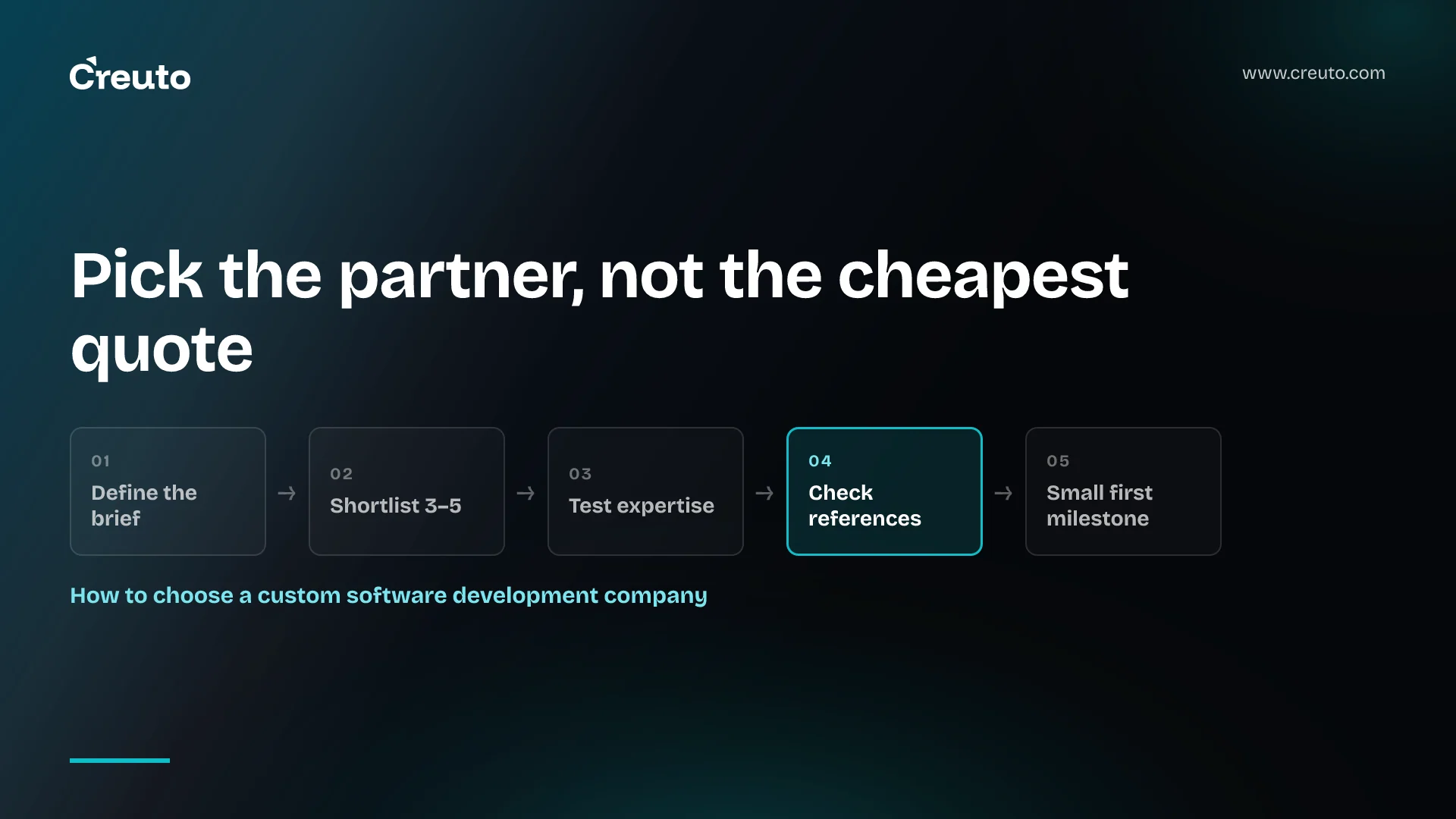
Choosing a custom software development company is one of the highest-stakes decisions a business makes about technology. The right partner turns your requirements into software that works and keeps working. The wrong one costs months, money and, often, a rebuild. With thousands of firms competing for the work, here is a step-by-step way to choose well.
1. Define your requirements
Before you contact anyone, write down the what, why, when and how: the problem you are solving, who will use the software, the must-have features, systems it must connect to, your budget range and your deadline. You do not need a full specification — a clear brief is enough — but you do need clarity on outcomes. A partner can help refine the rest.
2. Research and shortlist
Look for companies with experience in similar projects or your industry. Review portfolios and case studies, read client reviews on independent platforms, and check how long they have been operating. Shortlist three to five firms.
3. Assess technical expertise
Ask about their technology stack and why they would choose it for you, how they approach architecture and scalability, and how they handle security, testing and deployment. Ask to speak to the engineers who would work on your project, not only the sales team. Our checklist for what CTOs should look for in a development partner goes deeper.
4. Evaluate communication and process
Good partners respond clearly, ask thoughtful questions and explain trade-offs. Ask how they run projects: sprint length, demos, progress reporting, who your point of contact is and how problems are escalated. Iterative delivery with regular demos reduces risk; see the benefits of Agile.
5. Consider cultural fit
A partner that shares your standards and way of working makes the collaboration easier. Consider time zones, language and how they handle disagreement.
6. Review pricing and contract terms
Compare how they price — fixed price, time and materials, or phased budgets — and what each estimate includes. Check that the contract gives you ownership of the code, documentation and infrastructure accounts, sets out support and warranty terms, and explains how changes are handled. The cheapest quote is rarely the cheapest project.
7. Check references
Speak to past clients, ideally ones with projects similar to yours. Ask what went wrong and how the company handled it — that tells you more than what went right.
8. Ask about AI tools and data handling
Most development teams now use AI coding assistants. Ask which ones, whether they retain or train on your code, and how secrets are protected. The ZCode case shows why.
9. Start with a small engagement
A paid discovery phase or a small first milestone lets you see how a company works before committing to the whole project.
Red flags
- A detailed fixed quote without any discovery.
- No questions about your business or users.
- Reluctance to share references or introduce the delivery team.
- Vague answers on testing, security or code ownership.
For a shorter list of questions to take into calls, see questions to ask before hiring a software development partner. If you would like to see how we work — discovery, process, ownership and all — our custom software development team is happy to walk you through it.
Frequently asked questions
Define your requirements, shortlist three to five firms with relevant experience, assess technical expertise and process, check communication and cultural fit, review pricing and contract terms including code ownership, speak to references, and start with a small paid engagement.
A software development contract should cover scope and how changes are handled, pricing model, milestones, ownership of code and documentation, access to infrastructure accounts, testing and acceptance, warranty and support terms, and confidentiality.
No. The cheapest quote often leads to the most expensive project through delays, poor quality and rework. Compare what each estimate includes, the team's experience and process, and the total cost including maintenance.
Red flags include detailed fixed quotes without discovery, no questions about your business, reluctance to share references or introduce the delivery team, and vague answers on testing, security or code ownership.