How to choose an LLM for business: 4 decisions
How to choose an LLM for business: price one request per model, decide the region, API or open-weight, then run 50 of your own questions. Nov 2026 prices.
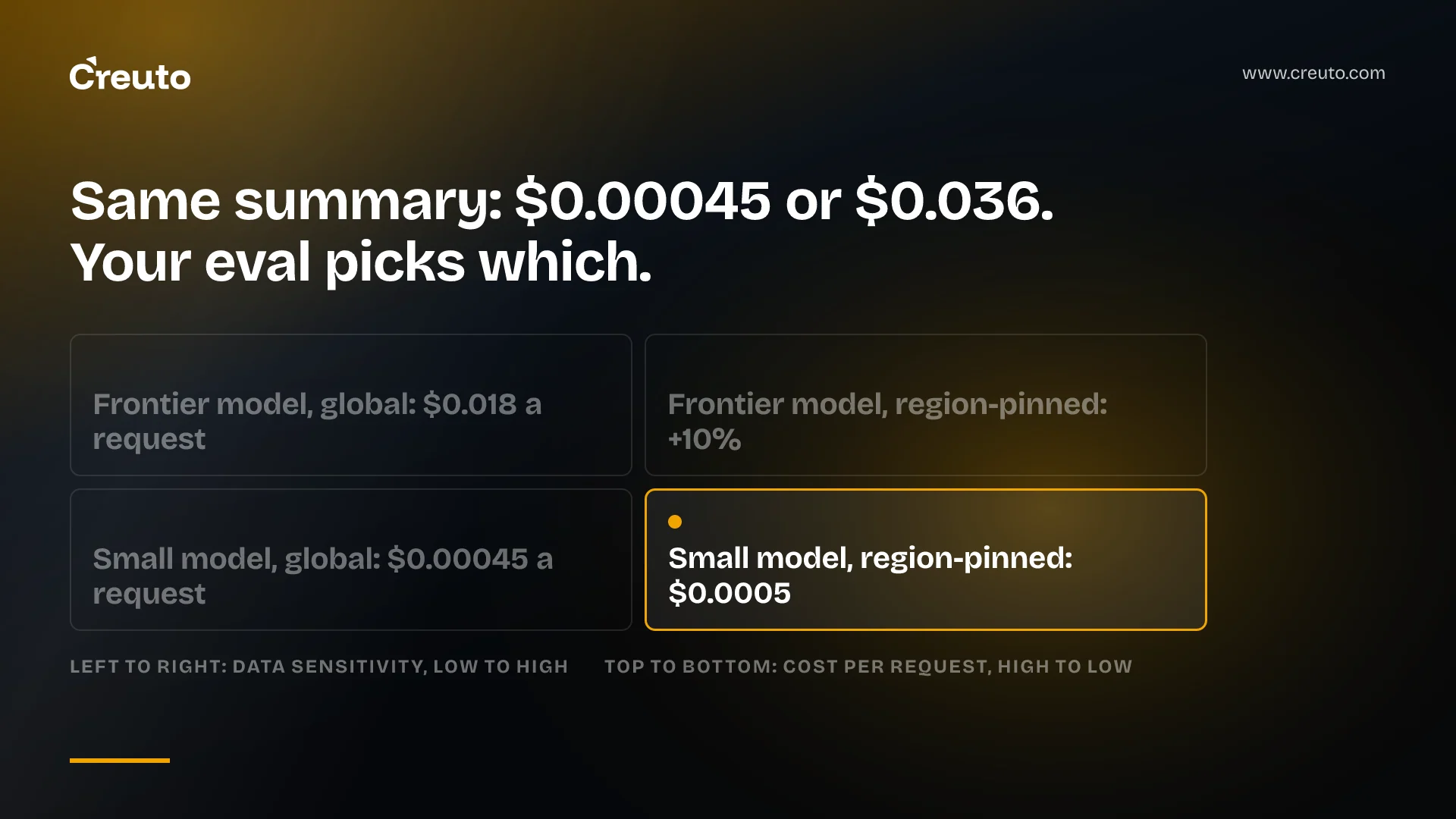
A large language model (LLM) is software trained to predict the next piece of text, which is what lets it summarize, extract, classify and draft. How to choose an LLM for business comes down to four decisions you can price before testing anything: cost per request, where inference runs, API or open-weight, and a 50-question eval.
The leaderboard is not one of the four. On the vendors' own pricing pages, the same support-ticket summary costs anywhere from $0.00045 to $0.036 depending on the model, an 80-fold spread inside OpenAI's current lineup alone. This post explains what an LLM is in plain terms, then walks through the four decisions with prices read on 20 November 2026.
What an LLM is, in plain terms, and what it is not
An LLM reads text as tokens, which are short pieces of words, and produces new text one token at a time based on patterns learned from a very large body of writing. That single ability covers most of what a business wants from it: turning a long support thread into three lines, pulling the invoice number and due date out of a PDF, sorting emails into categories, or drafting a reply for a person to check.
An LLM is not a database. It does not know your prices, your customers or your policies unless your application puts that text into the request, which is what retrieval-augmented generation does. It is not deterministic either: the same question can produce different wording, and it can state something wrong as fluently as something right. Those two facts are why the fourth decision, testing on your own data, matters more than any public ranking.
Vendors bill by the token, with input and output priced separately, usually per million tokens. Token counts are not comparable across vendors or even across model generations: Anthropic says the tokenizer in Claude 4.7 and later models produces approximately 30% more tokens for the same text. The context window is the most text a model can take in one request; Anthropic includes the full 1M-token context window at standard pricing on Claude 4.6 and later models, except Haiku 5.5.
How to choose an LLM for business: four decisions, in this order
- Cost per request at your volume. Price one real request on each tier, then multiply by your monthly volume.
- Where inference runs. Decide whether customer data must be processed in a particular region, and what that costs.
- API or open-weight. Decide whether to call a vendor's API or run an open-weight model on hosting you control.
- Your own eval. Run 50 of your real tasks through the two or three candidates that survive the first three decisions, and pick the cheapest one that passes.
The order matters. The first three decisions remove candidates on paper in an afternoon; the fourth is the only one that costs engineering time, so you want as few models in it as possible.
How much does an LLM cost per request? Price one request, not a leaderboard
An LLM API call costs a fraction of a cent on a small model and a few cents on a frontier model. To compare, take one realistic request: summarizing a support ticket with 3,000 tokens of input (instructions plus the thread) and a 300-token summary. Here is that request on each vendor's current list prices, standard processing, as of 20 November 2026.
| Model | Input / output per million tokens | One request | 100,000 requests a month |
|---|---|---|---|
| Claude Haiku 5.5 | $0.10 / $0.50 | $0.00045 | $45 |
| OpenAI gpt-6-luna | $0.10 / $0.50 | $0.00045 | $45 |
| gpt-oss-120B on Together AI serverless | $0.15 / $0.60 | $0.00063 | $63 |
| Gemini 3.8 Flash | $0.75 / $3.75 through 31 December 2026 | $0.0034 | $338 |
| Claude Sonnet 5.5 | $2 / $10 | $0.009 | $900 |
| OpenAI gpt-6.2-sol | $2.00 / $10.00 | $0.009 | $900 |
| Gemini 4 Carbon | $2 / $10 through 30 November, $4 / $20 from 1 December 2026 | $0.009, then $0.018 | $900, then $1,800 |
| Claude Opus 5.5 | $4 / $20 | $0.018 | $1,800 |
| OpenAI gpt-6.2-astra | $8.00 / $40.00 | $0.036 | $3,600 |
The spread inside one vendor is the number to notice: Claude Opus 5.5 costs 40 times Haiku 5.5 per token, and gpt-6.2-astra costs 80 times gpt-6-luna. The table also dates quickly. Google's page lists Gemini 4 Carbon doubling on 1 December 2026, eleven days after we read it, and Gemini 3.8 Flash doubling to $1.50 / $7.50 from 1 January 2027, which our post on Gemini 3.8 Flash pricing doubling on 1 January covers. Take prices from the live pages on the day you approve a budget, never from a comparison article, including this one.
Two discounts that move the table more than the model choice
Work that does not need an answer in seconds can go through a batch API: Anthropic's Batch API gives a 50 percent discount on both input and output tokens. Requests that repeat the same long instructions can use prompt caching, where cache hits on Claude Sonnet 5.5 and Opus 5.5 are priced at 0.05x the base input price. If your requests share a large fixed prompt, read our guide to prompt caching as an LLM cost cut before comparing tiers.
Small vs large LLM cost per request: when the cheap tier is enough
A small model is enough when the task is narrow and the output is checkable: classification, field extraction, short summaries. A large model earns its price on multi-step reasoning, long documents with conflicting facts, and drafting that a customer reads without review. You find out which side your task is on from the eval, not from the model card.
Does choosing a data region cost more on LLM APIs? About 10%
Pinning where inference runs costs roughly 10% more at both Anthropic and OpenAI, and the regions on offer are narrower than most buyers expect. On the Claude API, the inference_geo parameter has two values, global and us, and US-only inference applies a 1.1x multiplier on all token pricing categories. Workspace data at rest is currently US-only as well. A company in India or the UAE cannot pin Claude first-party inference to its own country today.
OpenAI charges a 10% uplift on regional processing (data residency) endpoints for models released on or after 5 March 2026. Which regions each vendor actually offers, and what each keeps or retains, is a vendor-by-vendor question we answer in Claude vs GPT vs Gemini on residency and rate limits, with the India and UAE detail for OpenAI in OpenAI data residency in India and the UAE. For this decision, the useful rule is simple: if a contract or regulator names a region, check that the region exists for the model you want before you evaluate it, and add 10% to its row in the cost table.
Open-weight model vs API: the volume where hosting starts to pay
An open-weight model is one whose weights you can download and run yourself, such as OpenAI's gpt-oss-120B. You can still rent it per token: Together AI lists gpt-oss-120B on serverless at $0.15 input and $0.60 output per million tokens, which is our $0.00063 request above. Or you can rent a dedicated GPU: Together lists an NVIDIA HGX H100 at $5.49 per GPU per hour on demand, about $4,008 for a 730-hour month, before you add a second GPU for redundancy.
That $4,008 equals about 6.4 million gpt-oss-120B serverless requests, or about 445,000 Claude Sonnet 5.5 requests, at our request size. A company adding its first LLM feature is rarely near either figure. Dedicated hosting earns its place for control: fixed weights that never change under you, a region you choose, and data that never reaches a model vendor. It is not, at first-feature volumes, a way to save money.
How do you evaluate an LLM before choosing it? Fifty of your own questions
You evaluate an LLM by running your own tasks through it and grading the answers automatically, not by reading benchmarks. Anthropic's evaluation guidance gives three rules worth adopting whichever vendor you pick: be task-specific and mirror your real-world task distribution including edge cases; automate grading where possible, through multiple-choice, string match, code-graded or LLM-graded checks; and "prioritize volume over quality", meaning more questions with slightly noisier automated grading beat a few hand-graded ones.
In practice, collect 50 real inputs, such as past support threads or documents, with the answer you would accept for each. Include the awkward ones: sarcasm, typos, missing fields. Run the cheapest candidate first. If it passes your bar, you are done and the cost table already tells you the budget. If you grade with another model, treat that grader as something to check against a sample of human grades, not as the final word.
The strongest case for just picking the top model
The best argument against all of this is that at low volume, model choice barely matters to the bill. At 10,000 requests a month our support summary costs $180 on Claude Opus 5.5 and $4.50 on Haiku 5.5. A founder could reasonably decide that $175 a month is less than the cost of anyone's time spent on an eval, and buy the safest answer quality instead.
That argument is right below roughly 10,000 requests a month, and choosing carefully is the wrong use of time there: pick a mid tier, ship, and revisit when volume grows. It stops being right at 100,000 requests, where the same choice is $1,755 a month, and it was never right about residency, which no amount of answer quality fixes after launch.
Approve a model and a budget with one table
The output of these four decisions is a short table: two or three candidate models, the cost per request for each at your volume with the region uplift applied, whether you call an API or host, and the eval score on your 50 questions. That is enough for a founder or product head to approve a model and a monthly budget without becoming an ML specialist. If you are about to approve your first LLM feature, our generative AI team can build that 50-question eval with you and price the winning model at your volume and region; a focused MVP of a feature like this typically takes 6-10 weeks.
Frequently asked questions
An LLM, or large language model, is software trained on a very large body of text to predict the next piece of text. That lets it summarize, extract fields, classify and draft. An LLM does not know your company's data unless your application includes it in the request, and it can be confidently wrong.
An LLM API call for a support-ticket summary of 3,000 input and 300 output tokens costs about $0.00045 on Claude Haiku 5.5 or gpt-6-luna, $0.009 on Claude Sonnet 5.5, and $0.036 on gpt-6.2-astra, at list prices on 20 November 2026. Batch processing and prompt caching cut those further.
An LLM API is usually cheaper for a first feature. A dedicated H100 on Together AI costs about $4,008 a month, which equals roughly 445,000 Claude Sonnet 5.5 requests of our size. An open-weight model on your own hosting is worth it for control over weights, region and data, not for savings.
Choosing a data region costs about 10% more on the major LLM APIs. Anthropic applies a 1.1x multiplier for US-only inference on Claude, its only pinned option besides global, and OpenAI adds a 10% uplift on regional processing endpoints for models released on or after 5 March 2026.
You evaluate an LLM by running about 50 of your real tasks through each candidate and grading the answers automatically. Anthropic's guidance is to make the eval task-specific with edge cases, automate grading where possible, and prioritize volume over hand-graded quality. Pick the cheapest model that passes your bar.