How to build a healthcare app: three rulings come first
How to build a healthcare app: settle HIPAA business associate status, the FTC breach rule and FDA device status before you brief a development team.
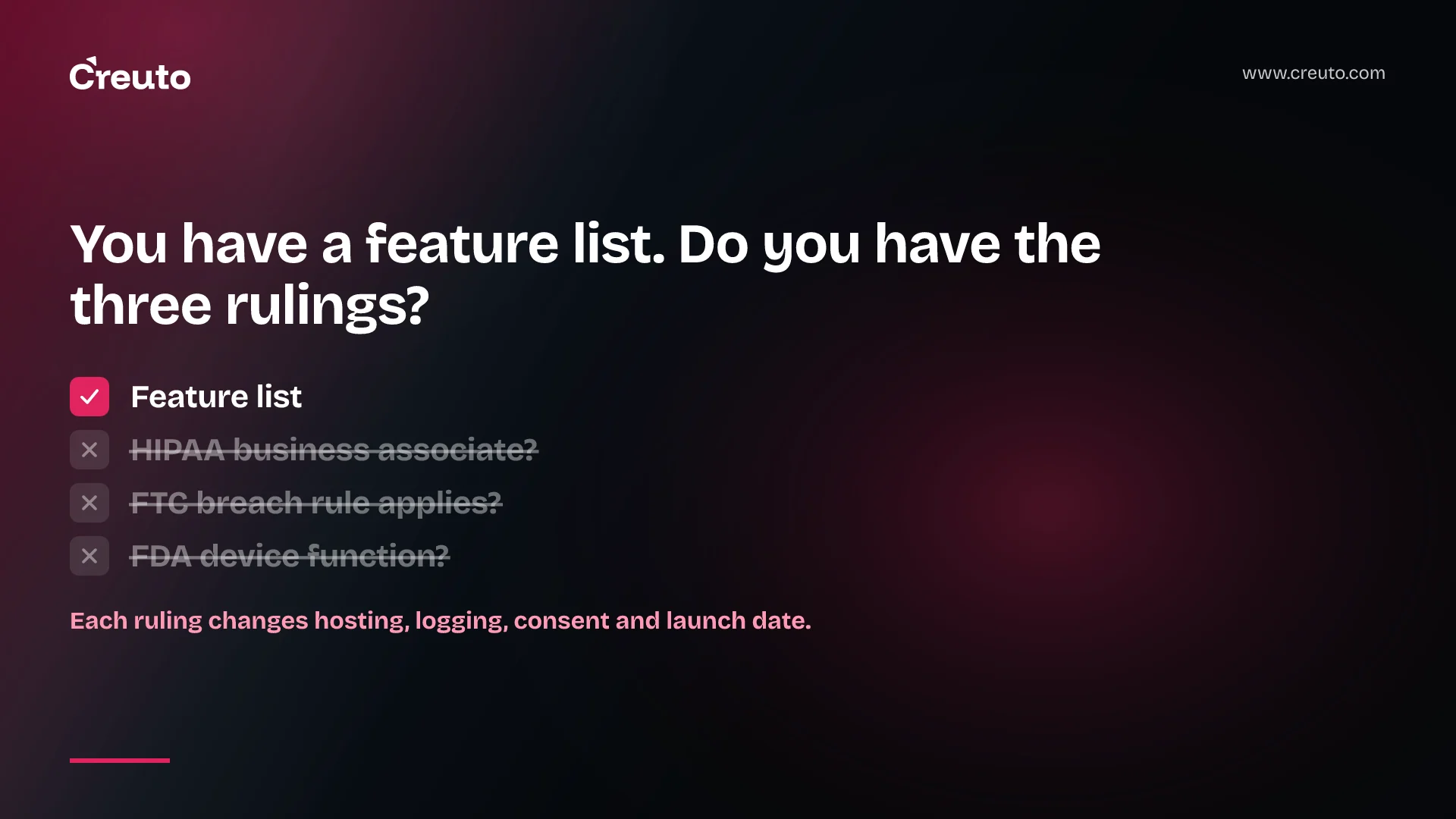
The same health app can be a HIPAA business associate for one customer and outside HIPAA entirely for another, and HHS says so in its own health app scenarios. That is why the answer to how to build a healthcare app starts with three rulings, not a feature list: HIPAA status, the FTC Health Breach Notification Rule, and FDA device status. Each one changes your hosting, logging, consent flows and launch date.
By the end of this post you will know which of the three applies to your app, what each one forces into the architecture, and which questions to put to your lawyer before you brief a development team. This is a map of primary sources, not legal advice; every determination here is fact-specific, and the regulators say so themselves.
| Ruling | Who decides it | The question |
|---|---|---|
| HIPAA business associate | HHS Office for Civil Rights | Do you handle protected health information on behalf of a provider or health plan? |
| Health Breach Notification Rule | Federal Trade Commission | If HIPAA does not apply, do you hold a personal health record? |
| Device software function | FDA | Does what you claim, display or alert on make the software a medical device? |
How to build a healthcare app: answer who you work for before what you build
The first ruling turns on your customer, not your code. HHS guidance says only health plans, health care clearinghouses and most health care providers are covered entities, and that an app developer becomes a business associate when it creates, receives, maintains or transmits protected health information on behalf of one of them, per the OCR document Health App Use Scenarios & HIPAA (February 2016, still linked from the HHS health apps page reviewed April 2026).
The scenarios are blunter than most agency blog posts. A consumer who logs her own blood glucose readings in an app does not make the developer a business associate. A doctor recommending an app does not either. But when a provider contracts the developer for remote counseling, patient messaging and EHR integration, and patient inputs flow into the provider's record, the developer is a business associate.
Does my health app need HIPAA compliance if it sells to both clinics and consumers?
Possibly only half of it. In the HHS scenario where a health plan offers a branded version of an app and the developer also sells a direct-to-consumer version, the developer is a business associate for the plan's version and not for the consumer one, provided it keeps the health information attached to the two versions separate. That sentence is an architecture requirement. If you expect to sell to clinics and to patients directly, the data separation has to exist in the schema, the tenancy model and the analytics pipeline from the first sprint, not be retrofitted when the first clinic asks for a business associate agreement.
The cloud bill comes with a contract
Once you are a business associate, your hosting provider usually becomes one too. The HHS guidance on HIPAA and cloud computing says a cloud service provider that stores ePHI is a business associate even if it holds only encrypted data and lacks the decryption key, and that the parties must sign a HIPAA-compliant business associate agreement (BAA). The conduit exception covers transmission-only services, not storage. In practice this narrows your vendor list: every service that stores patient data, including logging, crash reporting and backup tools, needs either a BAA or to never see the data.
The current Security Rule then sets the floor. Under 45 CFR 164.312, audit controls that record and examine activity in systems holding ePHI are a required standard, while encryption at rest and in transit are still labelled "addressable". Documentation of your policies must be kept for six years under 164.316, and a business associate must tell its covered entity about a breach no later than 60 calendar days after discovery under 164.410.
The 2025 Security Rule overhaul is still a proposal
As of 21 November 2026, HHS has not finalized its Security Rule amendments. The notice of proposed rulemaking was published on 6 January 2025 with comments closing on 7 March 2025, and it remains the only rulemaking document the Federal Register lists under its regulation number. The 2026 Unified Agenda entry moved it to long-term actions with final action targeted for July 2027.
Several compliance vendors write about "the 2026 HIPAA Security Rule" as if it were in force. It is not. What the proposal would do is still worth designing for: it would remove the required-versus-addressable distinction, require encryption of all ePHI at rest and in transit with limited exceptions, require a written technology asset inventory and network map reviewed at least every 12 months, and require procedures to restore critical systems and data within 72 hours. If finalized as proposed, the rule would take effect 60 days after publication with compliance 180 days after that.
The strongest argument against building to a proposal is that it may change, and it may. Our answer is that encryption at rest, a documented asset inventory and tested restores cost little when they are in the first architecture diagram and a great deal when they are retrofitted into a live app. Don't confuse it with the HIPAA Privacy Rule final rule published on 19 November 2026, which takes effect on 19 January 2027 and changes how PHI is shared for care coordination, not the Security Rule's safeguards.
If HIPAA does not apply, the FTC breach rule probably does
Falling outside HIPAA does not mean falling outside federal health privacy law. The FTC's Health Breach Notification Rule covers vendors of personal health records that HIPAA does not cover. A personal health record, in the FTC's reading, is an electronic record that can draw information from multiple sources and is managed by or primarily for the individual. The FTC's own example is a diet app that takes a user's weight and pulls calorie counts from restaurant menus.
The 2024 amendments took effect on 29 July 2024, according to the final rule in the Federal Register. The part that catches product teams is the definition of a breach. The FTC says a breach "is not limited to cybersecurity intrusions" and includes a company disclosing covered information without the person's authorization. Notice to individuals is due within 60 calendar days of discovery; for 500 or more people the FTC must be told at the same time; and the civil penalty is up to $53,088 per violation after the January 2025 inflation adjustment.
This is not theoretical. The FTC's first enforcement action under the rule, in February 2023, was against GoodRx, which agreed to a $1.5 million civil penalty after the FTC alleged it shared users' prescription and health condition data with advertising platforms including Facebook, Google and Criteo. Nobody hacked anything. An analytics or advertising SDK in your app can be the breach.
The architecture consequence: treat every third-party SDK as a data recipient that needs a lawful basis and, where required, the user's affirmative authorization before any event leaves the device. That means a consent layer in front of the analytics pipeline, an event schema that excludes health data by default, and a release check that lists what each SDK transmits. If the app is a HIPAA business associate instead, the same SDK question becomes a BAA question.
Is a health app regulated by the FDA? Your claims decide, not your code
FDA status turns on intended use, and intended use is read from what you say and what the app does on screen. The FDA Policy for Device Software Functions and Mobile Medical Applications (September 2022) says the agency focuses oversight on software that meets the device definition and could pose a risk to patient safety if it did not work as intended. Its list of functions it regulates includes software that changes infusion pump settings and software that analyzes patient-specific measurements to flag a possible heart attack.
A wide middle band sits under enforcement discretion: software that may meet the device definition but that FDA does not intend to enforce against because it is lower risk. FDA's examples include medication trackers with user-configured reminders, historical trending of vital signs, and apps that collect blood pressure data and upload it to a personal or electronic health record. Reminder and results-trending features in a clinic app look closer to this band than to the regulated list, but where your app sits is a question for a regulatory adviser, not your developer.
The January 2026 wellness guidance draws the line at the user interface
FDA reissued General Wellness: Policy for Low Risk Devices on 6 January 2026, superseding the 2019 version. It now allows non-invasive products to estimate values such as blood pressure or oxygen saturation for wellness use, but a product is not general wellness if its labeling, advertising, user interface or functionality includes references to specific diseases or diagnostic thresholds, alerts that recommend specific clinical action, treatment guidance, or claims of clinical-grade accuracy.
That list reads like a design review checklist, because it is one. A notification telling a user that seeing a health professional may be helpful is permitted, provided it does not name a disease, call the reading abnormal, include clinical thresholds, or provide ongoing monitoring of a condition. One alert string written by a well-meaning product manager can move the app from wellness to device. Put user-facing health copy, push notification templates and app store text under the same review as code, and keep clinical features behind flags you can ship separately once the regulatory path is clear.
This is the wrong framing if your app's purpose is diagnostic or drives treatment decisions such as medication dosing. FDA lists those outputs as outside wellness entirely, and your schedule should then be built around the premarket pathway your regulatory consultant identifies, not around a store release date.
What the three rulings change in the build
| Ruling lands as | Hosting and vendors | Logging and data | Consent and copy |
|---|---|---|---|
| HIPAA business associate | Cloud and every PHI-touching vendor under a BAA | Audit controls on ePHI systems; six-year policy documentation | Client contract and BAA define permitted uses |
| FTC personal health record vendor | No BAA, but every SDK is a potential recipient | Event schema that excludes health data by default | Authorization before any health data is shared |
| Device software function | Depends on the pathway your consultant identifies | Validated values if you display physiologic readings | Claims, alerts and store text reviewed as regulated surface |
The rulings stack. A clinic-branded app with a direct-to-consumer version can be a business associate on one side and a personal health record vendor on the other, and a symptom feature added later can raise the FDA question on both. Write down the answer to each, with the facts it depends on, and revisit it when the business model changes.
What features should a healthcare app have?
The features follow the rulings, not the other way round. Before appointment booking, teleconsultation or results views, you need an identity and role model that separates patient, clinician and admin access; an audit trail on every read and write of health data; a consent record you can show a regulator; and an export path, since the FTC Mobile Health Apps Interactive Tool also flags the 21st Century Cures Act information blocking rules for some developers. If you integrate with an EHR, ask early whether it exposes an HL7 FHIR API and who signs for access. The cross-platform choice comes after; our React Native vs Flutter verdict covers that decision on its own terms.
Building outside the US changes the questions, not the method
The three US rulings do not apply to an app serving only Indian or Gulf patients, but the method does: find the regulator, find the trigger, and design for it. In India, the government notified the DPDP Rules on 14 November 2025 with an eighteen-month phased compliance period. The PIB summary notes that verifiable parental consent for a child's data is not needed where processing relates to essential services such as healthcare, and that penalties reach ₹250 crore for failing to keep reasonable security safeguards. Our post on DPDP consent manager rules covers the consent build in detail, and clinical decision features in India raise the medical device question covered in healthcare AI software development under CDSCO.
For the UAE, a virtual care app needs more than one approval; we cover that in telemedicine app development in Dubai.
Settle the rulings, then hire the team
We have not built a regulated healthcare app, and we won't pretend otherwise. What we do have is the engineering that these rulings turn into: role-based access, audit trails, consent layers, and mobile releases where copy and feature flags are controlled like code. The budget question has no honest universal answer; we found no primary source that puts a reliable percentage on compliance, so we won't quote one.
Take the three questions to your counsel first, and to the FTC's Mobile Health Apps Interactive Tool, updated November 2024. Then bring the answers to a build team. If you are scoping a patient-facing app and want an engineering partner who will design the tenancy split, the SDK consent layer and the release review around those answers, our mobile app development team can turn them into an architecture and a phased plan before a single feature is estimated.
Frequently asked questions
A health app needs HIPAA compliance when its developer handles protected health information on behalf of a provider, health plan or clearinghouse. HHS guidance says an app a consumer chooses and fills with her own data usually falls outside HIPAA, though the FTC Health Breach Notification Rule may then apply instead.
A health app is regulated by the FDA when its intended use makes it a device function that could put patients at risk, such as controlling an infusion pump or flagging a heart attack. Medication reminders and vital-sign trending sit under enforcement discretion, and low-risk wellness apps fall outside active oversight.
The proposed HIPAA Security Rule amendments are not in effect as of November 2026. HHS published the proposal in January 2025, and the 2026 Unified Agenda targets final action for July 2027. The existing Security Rule, where encryption is still an addressable specification, remains the law until a final rule is published.
The FTC Health Breach Notification Rule applies to apps that offer personal health records and are not covered by HIPAA. A record that draws health data from more than one source, such as user entries plus a connected device, can qualify, and sharing that data without authorization counts as a breach.
No primary source gives a reliable share of a healthcare app budget for compliance, because the cost depends on which rulings apply. A HIPAA business associate pays for BAAs, audit logging and documentation, while an FDA device function adds a premarket pathway that changes the schedule more than the build.