How to build an LMS: pick your content standards first
How to build an LMS that plays real courses: what SCORM 1.2 and 2004, xAPI, cmi5 and LTI 1.3 each force you to build, and which parts to license.
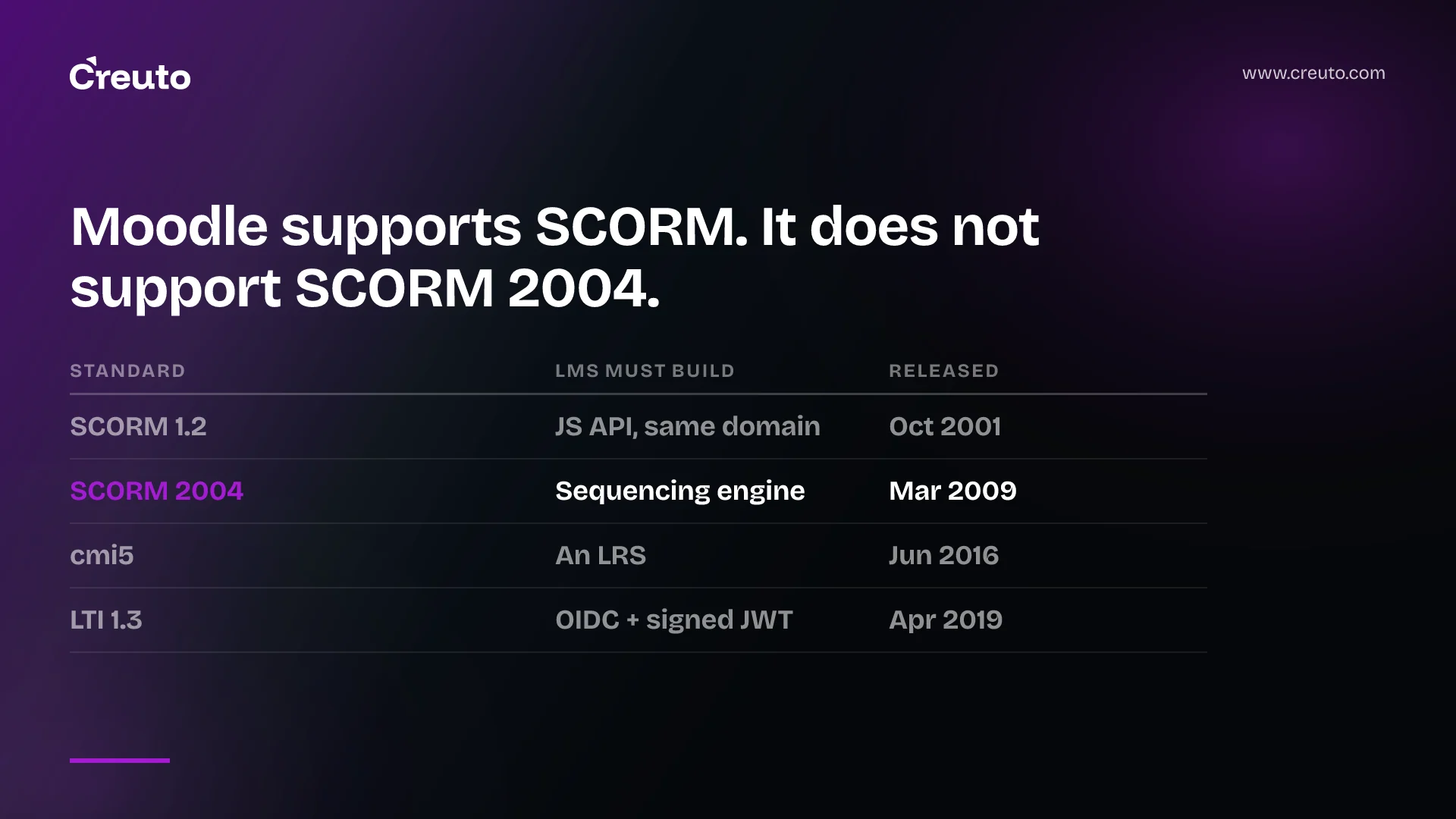
Moodle, the open-source LMS most teams compare a custom build against, does not support SCORM 2004. Its own SCORM FAQ says development on native SCORM 2004 support "has stopped" and bugs are closed as won't fix. That is the first lesson in how to build an LMS: the content standards you must play decide most of the engineering, so scope from them, not from a feature list.
This post is for the CTO or head of learning technology whose off-the-shelf LMS cannot handle dealer, partner or customer training, and who is now asking what a custom build involves. By the end you will know what SCORM 1.2, SCORM 2004, xAPI, cmi5 and LTI 1.3 each oblige your platform to build, which of them you can license instead, and the order to scope them in. If the question is still whether to build at all, we cover that in AI in corporate training: buy an LMS or build?; this post assumes you are leaning towards building and need to know what that commits you to.
How to build an LMS: list the content first, then the standards it forces
Every course your learners will open arrives in a format someone else chose: an authoring tool export, a vendor library, a partner's catalog. Each format implies a runtime contract your LMS has to honor. The table below is what each standard asks of the platform side, taken from the specifications themselves.
| Standard | What your LMS must build | Status (as of November 2026) |
|---|---|---|
| SCORM 1.2 | A JavaScript API object named API in a parent window of the course, plus a zip importer that reads imsmanifest.xml | Released October 2001; still "the industry workhorse" per Rustici's SCORM history |
| SCORM 2004 | The same API pattern under the name API_1484_11, plus the Sequencing and Navigation rules engine | 4th Edition, March 2009, the latest edition |
| xAPI | A learning record store (LRS) that accepts, stores and serves statements over a REST API | Standardized as IEEE 9274.1.1-2023, published 6 October 2023 |
| cmi5 | An LRS, a launch service with one-time auth tokens, a course-structure importer and completion rules | Quartz, 1st Edition (June 2016); IEEE work still an active project |
| LTI 1.3 | OpenID Connect login, signed JWT launches, key exchange and per-integration deployment IDs | Final Release 16 April 2019; LTI 1.0 to 2.0 support ended 30 June 2022 |
The practical point is that these are not features you toggle. SCORM is a browser runtime, xAPI is a data service, cmi5 is a launch protocol on top of that data service, and LTI is an identity and trust handshake between two systems. Supporting all five is four different pieces of infrastructure.
SCORM compliant LMS development is a browser runtime, not an upload button
SCORM content talks to the LMS through JavaScript in the learner's browser and nothing else. Rustici's run-time reference says the LMS must provide "a specifically named JavaScript object in a specific location within the browser's DOM": API for SCORM 1.2 and API_1484_11 for SCORM 2004, in a window that is a parent of the course. It adds that content "cannot communicate through web services, form posts, database writes or any other mechanism."
That design has a hosting consequence most first scopes miss. Rustici states plainly on its cross-domain page that "SCORM requires that the content and player reside in the same domain." If you planned to serve course files from a CDN or a separate storage domain, the browser's same-origin rules will block the course from reaching your API. The workarounds are proxying, central hosting with proxy files, or relaying calls with HTML5 postMessage, and each one is work you should put in the estimate.
The import side is simpler. A SCORM package is a zip, which Rustici calls a package interchange file, and the manifest file imsmanifest.xml "must always exist at the root of the content." Your importer parses it for resources, the organization tree and, in SCORM 2004, sequencing rules.
Does a custom LMS need SCORM 2004, or is 1.2 enough?
SCORM 1.2 is the safer default, and SCORM 2004 is where the cost hides. Rustici describes sequencing as "a VERY complicated specification," and notes that SCORM 1.2 had no sequencing at all. The data limits differ too: SCORM 1.2 caps suspend data at 4,096 characters, against 64,000 in SCORM 2004 3rd and 4th Editions, which matters for long courses that save learner progress.
Moodle shows what the trade-off looks like in a mature product. Its SCORM FAQ says SCORM 1.2 passes all tests in ADL's conformance test suite 1.2.7, while SCORM 2004 "is not supported," even though some packages "may appear to work." That last phrase is the risk. A demo with one SCORM 2004 course proves little; ask for the edition and test the sequencing-heavy course in your library, not the simplest one.
xAPI LRS integration: the LMS becomes a data service
xAPI records learning as statements, an actor, a verb and an object, in the spec's words the "I", the "did" and the "this" in "I did this." Those statements go to a learning record store, which the xAPI specification defines as a server "responsible for receiving, storing, and providing access to Learning Records." Unlike SCORM, the content can live anywhere, including a mobile app or a simulator, because it talks to the LRS over HTTP.
Building the LRS is a real API project. The communication part of the spec defines the Statements, State, Activity Profile, Agent Profile and About resources, and says the LRS "MUST reject requests without a version header." xAPI itself is now formal: IEEE 9274.1.1-2023, approved 30 March 2023, standardizes xAPI version 1.0.3.
The catch is that plain xAPI says nothing about how a course is launched, who the learner is, or when a module counts as complete. Two vendors can both "support xAPI" and still not interoperate on any of that. That gap is what cmi5 fills.
cmi5 vs SCORM for a custom LMS
cmi5 gives xAPI the launch and completion rules SCORM had, without the browser API. The cmi5 specification is direct about the cost: "The LMS MUST have an LRS as part of its implementation." On top of the LRS, your platform must:
- launch each assignable unit with query-string parameters for
endpoint,fetch,registration,activityIdandactor; - serve a fetch URL that is "one-time use" and returns an auth token limited to the duration of the session;
- import a course structure file named
cmi5.xml, from packages in both Zip32 and Zip64 formats; - apply each unit's
moveOnrule (Passed, Completed, CompletedAndPassed, CompletedOrPassed or NotApplicable) using the nine cmi5-defined verbs, from launched to satisfied.
The strongest case for SCORM over cmi5 is reach: nearly every authoring tool exports SCORM 1.2, and Rustici still calls it the workhorse. The answer is that you rarely choose one. If you sell or share training with outside organizations, cmi5 lets content run off your domain and report richer data; if you ingest a vendor catalog, you need whatever that catalog ships in. Note too that cmi5's formal standardization is unfinished: IEEE P9274.3.1 has been an active project since its approval on 15 February 2023, and the current release on the AICC repository is still Quartz, 1st Edition (June 2016).
LTI 1.3 integration for LMS: decide which side you are building
LTI is not a content format; it connects your LMS to tools that run elsewhere, or connects your tool to other people's LMSs. The LTI 1.3 specification (Final Release, 16 April 2019) calls these two roles the platform and the tool, and you build very different code depending on which you are.
As a platform, your LMS acts as an OpenID provider. The spec moves "away from the use of OAuth 1.0a-style signing" to "OpenID Connect, signed JWTs, and OAuth2.0 workflows." In practice that means a third-party initiated login flow, a client_id created at registration, an immutable deployment_id per integration, and launch messages of type LtiResourceLinkRequest with version 1.3.0, carrying the user's roles from the LIS vocabulary. 1EdTech's LTI overview groups three services under LTI Advantage: Assignment and Grade Services for posting scores, Names and Role Provisioning Services 2.0 for rosters, and Deep Linking 2.0 for picking content from a tool.
Skip LTI 1.1 entirely. 1EdTech's deprecation schedule says support for LTI 1.0 through 2.0 ended on 30 June 2022, and the large platforms are now enforcing it: Blackboard announced in August 2026 that it blocks new LTI 1.0 and 1.1 registrations from 1 January 2027 and turns all such tools off on 30 September 2027. If your training must also appear inside a university's or a customer's LMS, you build the tool side as well, and that is a separate scope line.
Build the player or license it: the decision inside the build
A custom LMS does not have to mean a custom SCORM player. Rustici Engine, a commercial library that embeds in your application, lists support for SCORM 1.2 and SCORM 2004 2nd, 3rd and 4th Editions, AICC, xAPI, cmi5 and LTI 1.1 and 1.3, and includes a conformant LRS. It is sold as a term license with an initial and an annual fee that depend on learner numbers and whether the platform is licensed to others. Moodle's FAQ points to a Rustici plugin as its own answer for full SCORM 2004.
The case for writing your own player is control: no per-learner fee, no third-party runtime in your stack, and a data model you own. It holds when your content is SCORM 1.2 and cmi5 only, which are well-bounded specifications. It is the wrong choice if your library depends on SCORM 2004 sequencing, because that is the part even a long-lived open-source LMS stopped building. The split we recommend is to build what differentiates you, the learner records, roles, certification rules and reporting, and license the runtime where the spec is hardest.
Where certification is part of the product, the credential is its own standard too; we covered that in Open Badges 3.0 implementation: what the spec leaves to you.
How much does it cost to build an LMS?
The cost to build an LMS is set mostly by the standards row count in the table above, then by integrations such as SSO and HR systems, then by the learner-facing apps. We will not quote a figure without your content list, because the same feature set costs very differently with and without SCORM 2004 sequencing or a self-built LRS. The planning numbers we do publish: a focused MVP typically takes 6-10 weeks, and larger enterprise platforms 3-6 months depending on complexity, integrations and scope.
Our nearest first-hand reference is the AI-powered sales training platform we built for Škoda Auto's dealership network: more than 100 dealerships served, 3 platforms built, 4 AI-powered features and 20 weeks to market, on Flutter, React, TypeScript, Node, PostgreSQL and AWS. It is a useful calibration for a multi-platform training product with a real network behind it, not a price list for yours.
If you cannot yet name the formats in your library, that inventory is the first deliverable, before any estimate. We set out what a short scoping phase should hand you in paid discovery phase software: what to own before you build.
Scope a custom LMS in this order before anyone writes code
- Inventory the content. Count courses by format and edition: SCORM 1.2, SCORM 2004 (which edition, and does it use sequencing), xAPI, cmi5, video, PDF.
- Decide where the content will be hosted. SCORM must share a domain with the player; cmi5 and xAPI do not.
- Decide on the LRS. cmi5 requires one; build it, embed a licensed one, or run a standalone one.
- Decide your LTI role. Platform, tool or both, and only LTI 1.3.
- Only then list features. Enrollment, roles, certificates, reporting and the learner apps are where a custom build earns its keep.
If your off-the-shelf LMS is failing your dealer, partner or customer training and you are weighing a build, our custom software development team can take your content inventory and existing systems and turn them into a standards-first scope, with a clear line between what we would build and what you should license.
Frequently asked questions
Building an LMS starts with an inventory of the course formats it must play, such as SCORM 1.2, SCORM 2004, xAPI and cmi5, then decisions on content hosting, the learning record store and LTI 1.3. Features like enrollment, certificates and reporting are scoped after those standards are settled.
A custom LMS needs SCORM if any course you must run is exported as a SCORM package, which most authoring tools still produce. SCORM 1.2 is the common baseline. SCORM 2004 adds a complex sequencing engine, so support it only if your library actually uses 2004 sequencing.
SCORM tracks courses through a JavaScript API in the browser and requires content on the same domain as the player. xAPI sends learning statements to a learning record store over HTTP. cmi5 is an xAPI profile that adds launch, session and completion rules, and requires the LMS to include an LRS.
The cost to build an LMS depends mainly on which content standards it must support, whether you build or license the SCORM player and learning record store, and the integrations and apps required. Creuto quotes a focused MVP at 6-10 weeks and larger enterprise platforms at 3-6 months.
LTI 1.1 is not a sound choice for a new LMS. 1EdTech ended support for LTI 1.0 through 2.0 on 30 June 2022, and Blackboard will turn off all LTI 1.0 and 1.1 tools on 30 September 2027. New integrations should use LTI 1.3 and LTI Advantage.
