AI Isn't Just for Big Companies : Here's How SME's Can Leverage it Today
How SMEs can leverage AI today: practical uses from admin automation and customer support to forecasting, how to start cheaply, and the risks to watch.
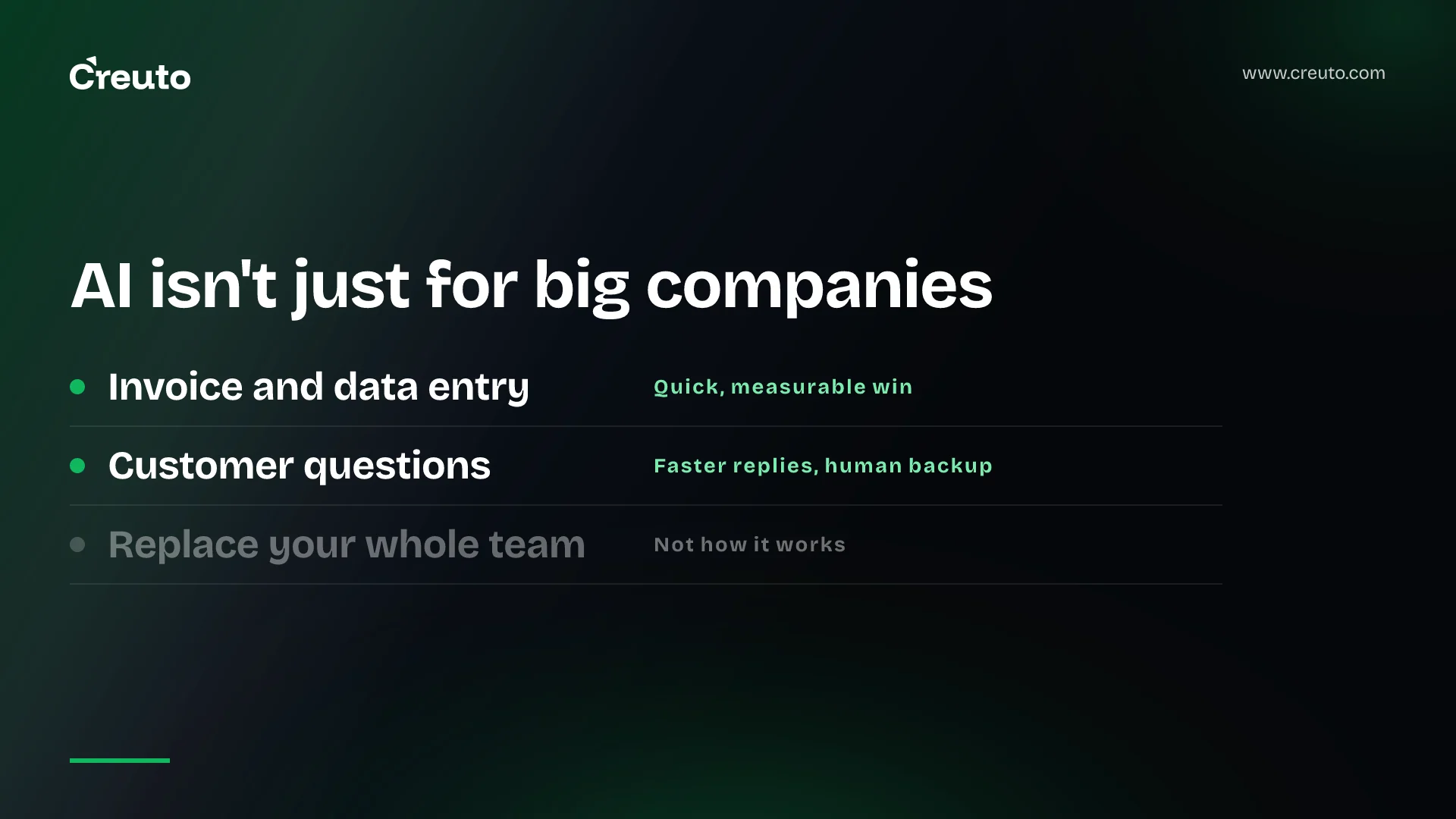
When people hear "artificial intelligence", they often picture large corporations with research labs and big budgets. That picture is out of date. Many of the most useful AI tools are now affordable, available as ordinary software, and designed for small teams. This guide explains, without jargon, how SMEs can leverage AI today — and how to start without wasting money.
Why AI matters for SMEs
For a small or medium business, AI is simply software that can read, write, summarise, classify and predict. That lets a small team:
- automate repetitive tasks;
- respond to customers faster;
- understand sales and customers better;
- forecast demand and stock more accurately;
- produce first drafts of documents and marketing content.
In short, AI helps a small team do more without adding headcount — when it is applied to the right problems.
Practical ways SMEs can use AI today
1. Automate routine admin
Invoice and receipt entry, email sorting, meeting notes, appointment scheduling and follow-up reminders. These are often the quickest wins because the time saved is easy to see.
2. Answer customer questions faster
AI assistants on your website or messaging channels can answer common questions, check order status and collect details before a person takes over. Keep a clear route to a human.
3. Understand customers better
AI can group customers by behaviour, spot those likely to stop buying, and suggest offers based on what they have viewed or bought.
4. Improve marketing
Drafting posts and emails, suggesting subject lines, testing variations and identifying which campaigns bring real customers. A person should review anything published under your brand.
5. Forecast sales and inventory
Using past sales, seasons and promotions to predict demand helps avoid both overstocking and running out.
6. Get answers from your own data
Dashboards and AI-assisted reporting can answer questions such as "which products sold best last quarter?" in minutes instead of hours of spreadsheet work.
How to start without breaking the bank
- List repetitive, time-consuming tasks and estimate hours spent each week.
- Pick one with clear volume and an easy way to measure success.
- Try an existing tool first — many accounting, CRM and support products now include AI features.
- Measure time saved and errors reduced over a month or two, against a baseline.
- Consider custom integration when off-the-shelf tools do not connect to your systems or fit your process.
For a more detailed look at costs and savings, see how AI can cut operational costs for SMBs.
Things to watch
- Data privacy. Know what customer and business data you are sending to AI tools, and choose business plans with clear data terms. The ZCode case shows why this matters.
- Accuracy. AI can be confidently wrong. Keep people checking outputs that matter.
- Running costs. Usage-based pricing grows with volume; see LLM cost optimisation.
Takeaway
AI is not reserved for large companies. Start small, measure honestly and expand what works. When you are ready to connect AI to your own systems and data, our AI engineering services team helps SMEs build practical, affordable solutions.
Frequently asked questions
Small businesses can use AI to automate routine admin such as invoice entry and scheduling, answer customer questions faster, understand customer behaviour, draft marketing content, forecast sales and inventory, and get quick answers from their own data.
Yes. Many AI features are now built into affordable accounting, CRM, support and marketing tools, and usage-based AI services let SMEs pay for what they use. Starting with one measurable task keeps costs low while proving value.
The best first AI project is a repetitive, time-consuming task with clear volume and an easy way to measure success, such as invoice entry, sorting emails or answering common customer questions.
SMEs should consider data privacy and where customer data is sent, the accuracy of AI outputs, usage-based running costs, and keeping a person responsible for anything customer-facing or published under their brand.