How AI Can Cut Operational Costs by 40% - A Practical Guide for SMBs
How AI can cut operational costs for SMBs: where savings near 40% are realistic, where they are not, what AI costs to run, and how to measure the result.
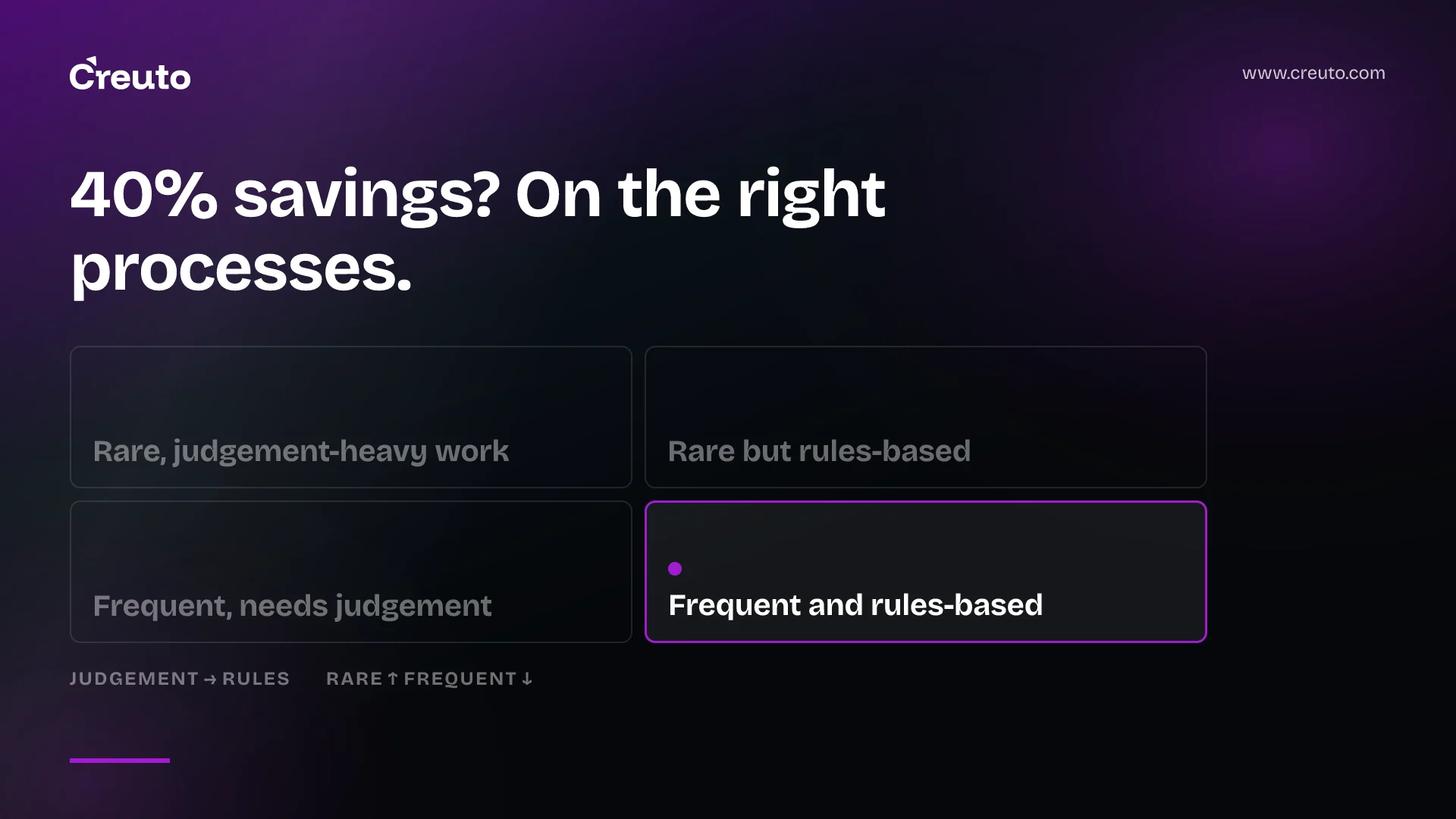
Can AI really cut a small business's operational costs by 40%? For a whole business, rarely — and anyone promising that across the board is selling something. For specific, repetitive processes, savings of that order are realistic when the work is well suited to automation. This practical guide shows where AI can reduce operational costs for SMBs, where it cannot, and how to measure the result honestly.
Where the 40% is realistic, and where it is not
AI and automation save the most on high-volume, rules-heavy tasks that follow a pattern: reading documents, answering routine questions, sorting and routing requests, reconciling records. On those tasks, a large share of the manual effort can often be removed. On judgement-heavy work, relationship management or anything involving new situations, AI assists people rather than replacing the work.
So the useful question is not "how much will AI save the business?" but "which of our processes are costly, repetitive and measurable?" Start there.
Six areas where SMBs save money with AI
1. Document and data-entry work
Invoices, purchase orders, delivery notes and forms can be read and entered automatically, with a person checking exceptions. This is often the fastest win because the before-and-after time is easy to measure.
2. Customer support
AI assistants can answer common questions, track orders and collect details before handing over to a person. The saving comes from handling routine questions instantly and giving staff fewer, better-prepared conversations. Channels such as WhatsApp, which many Indian and Gulf customers prefer, need careful integration — see our guide to WhatsApp Business API integration.
3. Inventory and demand forecasting
Forecasting from sales history, seasonality and promotions helps reduce overstock and stock-outs. Accuracy depends on clean data; a business with messy product and sales records should fix those first.
4. Reporting and decisions
Automated reports and AI-assisted analysis replace hours of spreadsheet work each week and surface problems earlier — slow-moving stock, late payers, margin leaks.
5. Marketing operations
Drafting content, segmenting customers and testing campaigns can be faster with AI. Keep a person responsible for anything published under your name.
6. Internal workflows
Approvals, scheduling, onboarding checklists and follow-ups can be routed and reminded automatically, reducing delays that cost money without anyone noticing.
What AI costs to run
AI is not free once it is running. Model usage is billed per request or per token, and costs grow with volume. Choosing the right model for each task makes a large difference — cheaper models handle routine work well, while premium models are best kept for complex tasks. We explain how teams manage this in LLM cost optimisation. Also budget for integration, monitoring and a person to review exceptions.
How to start implementing AI in your SMB
- List your most expensive repetitive tasks. Estimate hours per week and error costs for each.
- Measure the baseline. Record time, cost and error rate before changing anything. Without a baseline, you cannot claim a saving.
- Pick one process. Choose the one with the clearest volume and the easiest measurement.
- Keep a person in the loop. Have staff review exceptions and low-confidence outputs, especially at the start.
- Measure after 60–90 days. Compare against the baseline, including running costs.
- Scale what works. Move to the next process only when the first one pays off.
Common mistakes
- Starting with a chatbot because it is visible, rather than with the costliest process.
- Automating a broken process instead of fixing it first.
- Ignoring data quality, which limits every AI tool.
- Counting time saved but not the cost of running and supervising the system.
For a broader view of how smaller businesses can adopt AI, see how SMEs can leverage AI today. If you want help finding and automating your most expensive processes — and measuring the saving properly — our AI engineering services team works with SMBs to start small and prove value before scaling.
Frequently asked questions
AI can cut costs by a large share on specific high-volume, repetitive processes such as data entry, routine support questions and document handling. Across an entire business, savings are usually smaller, so measure a baseline for each process before and after automation.
SMBs should start with processes that are costly, repetitive and easy to measure, such as invoice and document entry, routine customer questions, reporting and scheduling. These give clear before-and-after results and lower risk than judgement-heavy work.
AI costs for a small business include tool or model usage fees that grow with volume, integration work, monitoring and staff time to review exceptions. Matching cheaper models to routine tasks and reserving premium models for complex work keeps running costs down.
Measure AI cost savings by recording time, cost and error rates for a process before automation, then comparing after 60 to 90 days, including the running cost of the AI tools and supervision. Without a baseline, savings claims cannot be verified.