Hot wallet security after Binance: no key leaked, $6.3B gone
Binance found no private key leak, yet $6.3B left its wallets. Hot wallet security now means the signing path: pipelines, containers and VARA's Section D.
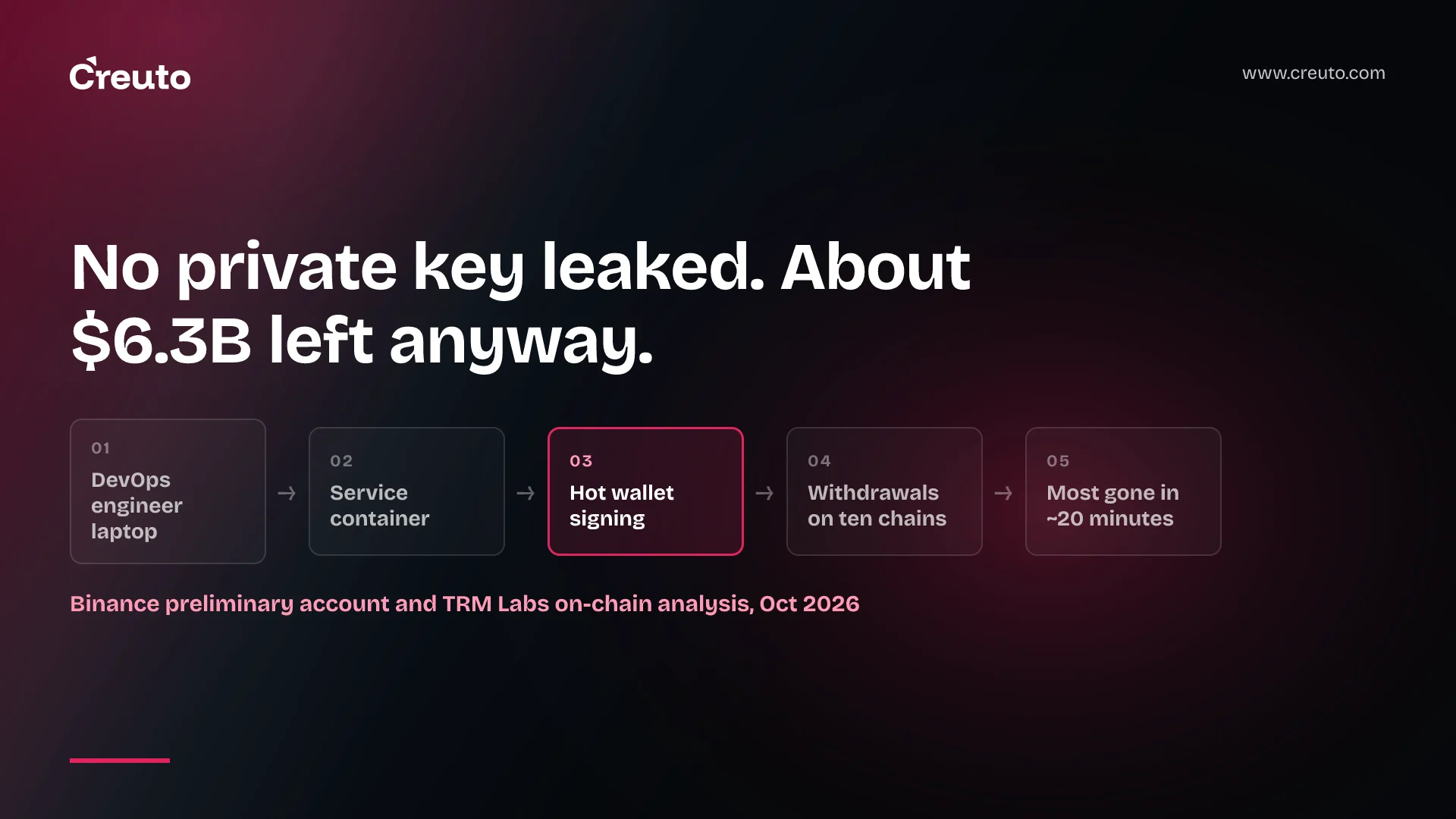
Binance says it found "no evidence of any wallet private key leak", yet around $6.3B left its wallets on 29 October 2026. That one fact reframes hot wallet security: the keys can stay secret while the signer is made to work for someone else. By the end of this post you will know what the public record actually says, what VARA's wallet rules require of a Dubai-licensed platform, and which six controls on the signing path to review before an auditor or an attacker does.
The short version, as of 3 November 2026:
| Item | What the sources say | Source |
|---|---|---|
| Preliminary cause | "a compromised DevOps engineer's laptop, which allowed an attacker to gain access to a service container and submit unauthorized withdrawal transactions" | Binance, 30 Oct |
| Amount | About $6.3B (Binance); about USD 6.36B across ten chains (TRM Labs) | TRM Labs, 29 Oct |
| Speed | Most of it moved "in about 20 minutes starting at 20:05 UTC" | TRM Labs |
| Private keys | No evidence of a leak | Binance |
| Losses covered | Approximately 95% of the impacted amount; withdrawals reopened in phases from 1 November | Binance Recovery Update #4 |
| Root cause | Not yet published; Binance has promised a technical post-mortem | Binance; TRM Labs |
How did the Binance hack happen? What the record says so far
Binance's own explanation is preliminary and short. Its 30 October security incident update says the incident "may involve a compromised DevOps engineer's laptop, which allowed an attacker to gain access to a service container and submit unauthorized withdrawal transactions." It suspended withdrawals and "revoked the affected address authorisation".
The laptop is not the whole story, and Binance has said so. Co-CEO Richard Teng said "the attacker did not simply use one engineer's permissions, and this was not a single 'one-click' action", and a separate Binance update, reported by The Hacker News, said the investigation "uncovered additional points of breach". Anyone treating this as a single stolen laptop is ahead of the evidence.
The on-chain view comes from TRM Labs. It reports that the attacker moved approximately USD 6.36 billion out of Binance wallets on ten blockchains, most of it in about 20 minutes. On nine of those chains, Binance wallets "sent funds to the attacker through ordinary signed transfers".
The EIP-7702 delegation sweeper on Ethereum
Ethereum was different. TRM says "the attacker used an EIP-7702 delegation to turn a Binance hot wallet into a sweeper it controlled, with 50 pre-signed authorizations prepared in advance." EIP-7702 is the Ethereum change that lets an ordinary account "set the code in their account" by attaching signed authorisation tuples; the specification recovers the authorising account from a signature over each tuple.
That detail matters for defenders. An EIP-7702 authorisation is signed by the account it delegates, so 50 of them prepared in advance point back at whatever signs for that wallet. TRM's reading is explicit: "In TRM's assessment, this points to a compromise of Binance's hot wallet signing infrastructure." TRM also notes that "Binance has yet to publish a root cause."
Were Binance private keys stolen? The sources point to something worse
No source so far says the keys were taken. Binance found no evidence of a key leak, and Elliptic put it plainly: "Rather than stealing Binance's private keys, the attacker appears to have been able to get Binance's own systems to sign transactions on their behalf."
That is worse for most security programmes, not better. A stolen key is a problem you can scope: rotate it, move funds, done. A signer that will sign whatever an authorised caller sends is a problem with your whole access graph, because every system that can reach the caller is now inside the boundary. If the preliminary account holds, the boundary at Binance ran through an engineer's laptop.
The sources disagree on almost everything else, which is normal one week in and worth stating rather than smoothing over:
| Question | Figures and positions |
|---|---|
| How much was taken | Binance about $6.3B; TRM Labs about USD 6.36B; Elliptic $6.43B; Chainalysis, in an early estimate, about $5.912B at time of theft (The Hacker News) |
| How much is frozen | Binance "~$3 billion frozen on-chain so far"; TRM "roughly USD 2.7 billion" |
| Who did it | TRM attributes it to TraderTraitor; CNBC reports the FBI identified the operation as TraderTraitor; Elliptic urged caution on attribution, citing laundering differences and the missing root cause |
The customer side held up. Binance covered losses through a partial deployment of SAFU, part of its futures insurance fund and its corporate treasury, reaching about 95% by 1 November. When withdrawals reopened, CNBC reports $4.65 billion in withdrawals against $1.01 billion in deposits between 06:00 and 15:30 UTC, net outflows of $3.64 billion, or 2.1% of Binance's $171 billion in total assets. Most exchanges reading this do not have a balance sheet that can absorb the same event.
Hot wallet security is now a deployment-pipeline problem
The useful question is not "where are our keys?" but "what can ask our signer to sign, and what can reach that thing?" For most platforms the answer includes service containers, the CI/CD system that deploys them, the cloud roles they run under, and the laptops of the engineers who operate all three.
The strongest counter-argument deserves a fair hearing. Exchanges already use MPC or HSMs so that no single machine holds a whole key, keep most funds in cold wallets, and accept that a hot wallet is exposed by design. On that view, a breach of the hot tier is a sized, insured risk, and Binance's recovery shows the model working.
The answer is that MPC and HSMs protect key material, not intent. An HSM will sign a well-formed request from an authorised service; that is its job. If a compromised path can submit requests as that service, the key never leaves the hardware and the funds leave anyway. The same is true of cold-wallet ratios: they cap the loss, they do not stop it. We do not know Binance's internal architecture, and its post-mortem may show a different chain. The general lesson does not depend on those details.
This is where DevOps and security meet. Our DevOps and cloud engineering work is mostly about who and what can deploy, assume a role or reach a production service, and that is the same question in a different industry. We have written before about treating build infrastructure as compromised in our post on the Artifactory vulnerability chain; a signing service deserves the same assumption.
What does VARA require for crypto wallet security?
Dubai's Virtual Assets Regulatory Authority sets wallet controls in Section D of its Technology and Information Rulebook, Cryptographic Keys and VA Wallets Management. Read against the Binance account, several clauses stop being abstract.
- Paragraph 1 requires the governance framework to address "the signing and approval of transactions" and "the storage of cryptographic keys", as separate things. A framework that only describes key storage is incomplete.
- Paragraph 2(a) requires "no single point of failure in the VASP's access to, or knowledge of, Virtual Assets". One compromised service identity that can submit withdrawals is a single point of failure, wherever the key sits.
- Paragraph 2(b) requires that keys stored online or in one physical location be "insufficient to conduct a Virtual Asset transaction, unless appropriate controls are in place".
- Paragraph 2(c) requires "strict access management controls to manage access to keys, including an audit log detailing each change of access to keys."
- Paragraph 2(d) requires procedures "to immediately revoke a key signatory's access", plus internal audits "on a quarterly basis concerning the removal of user access".
- Paragraph 2(e) requires regular assessment of "the security of their information technology systems or software integrations with external parties".
- Paragraph 4 limits system access to "individuals with a demonstrable business need" and requires an access log.
Section D does not set a hot-to-cold ratio, so do not let anyone sell you one as a VARA requirement. What it does ask is whether online access alone can move assets, and how fast you can cut a signatory off. An engineer laptop that can reach a container that can submit withdrawals is the case paragraph 2(b) was written for. We covered the wider licensing picture in VARA compliant platform development in the enforcement year.
How do you secure a hot wallet signing service? Six controls to review
A hot wallet signing service is secured by narrowing what can submit a request, checking each request against policy the caller cannot change, and detecting abuse in minutes rather than hours. These six are recommended controls, not a list of what Binance lacked; its root cause is unpublished.
| Control | The question to ask | Evidence an auditor can check |
|---|---|---|
| Engineer endpoints | Can any laptop reach the signing service, its containers or its deploy path directly? | Network policy and access logs showing no direct path; managed-device requirement for production access |
| CI/CD and deployment access | Can one person change the code or config of a signing caller and ship it? | Required reviews, protected branches, signed builds, separate approvers for signing-path services |
| Service-container identity | Which workloads hold credentials that the signer accepts, and could another workload in the cluster borrow them? | Per-workload identity, short-lived credentials, an inventory of every caller the signer trusts |
| Per-transaction policy | Does the signer enforce destination allow-lists, value limits and transaction-type rules on its own, outside the caller? | Policy engine configuration, change log, and a rule that treats delegation authorisations as a high-risk type |
| Anomaly detection | Would a drain at TRM's reported pace trip an alert, and would anything stop signing automatically? | Velocity thresholds, an automatic pause, and a tested alert route that reaches a human at night |
| Revocation speed | How long does it take to revoke a signatory or service identity, end to end? | A timed drill, plus the quarterly access-removal audits VARA's paragraph 2(d) already requires |
Securing the CI/CD pipeline for fintech signing services
The pipeline is the control most teams under-scope. A container image that can call the signer is part of the signing path, so the repository, the build runner and the deploy credentials that produce it are too. Treat them that way: separate approvers, no long-lived deploy keys on laptops, and an audit trail you could hand to a regulator. Our CI/CD implementation work on AWS, Docker and Kubernetes starts from that inventory of who can ship what.
When this is the wrong emphasis
This framing applies when a server can move customer funds without a human approving each transaction in a separate path. If every withdrawal above a trivial amount already needs an independent approval the caller cannot forge, your priority is probably the approval path itself, and the rest of this list becomes a review rather than a rebuild.
What to change before Binance's post-mortem lands
Binance has promised a detailed technical post-mortem, and it may change parts of this picture. It will not change the decision in front of you: draw the real boundary around your signer, including every laptop, pipeline and container that can ask it to sign, and prove that boundary holds to the standard in VARA's Section D.
Start with the inventory: every identity the signer accepts, every path that can deploy those identities, and how long revocation takes. If you want a second pair of eyes on that, our DevOps and cloud engineering team reviews pipeline, access and signing-path design on AWS, Docker and Kubernetes, and tells you which paths reach your signer that you did not intend.
Frequently asked questions
The Binance hack of 29 October 2026 began, on Binance's preliminary account, with a compromised DevOps engineer's laptop that gave an attacker access to a service container able to submit withdrawal transactions. Binance's co-CEO said it was not a one-click action, and the full root cause has not yet been published.
Binance says it found no evidence of any wallet private key leak in the 2026 hack. Elliptic's reading is that the attacker got Binance's own systems to sign transactions instead, and TRM Labs assesses a compromise of the hot wallet signing infrastructure rather than theft of the keys themselves.
VARA's Technology and Information Rulebook, Section D, requires no single point of failure in access to virtual assets, online keys that are insufficient on their own to move assets without further controls, an audit log of access changes, immediate revocation of signatories and quarterly audits of access removal.
A hot wallet signing service is secured by limiting which workloads can submit signing requests, keeping engineer laptops off that path, protecting the CI/CD pipeline that deploys callers, enforcing per-transaction policy inside the signer, alerting on fast outflows and rehearsing how quickly a compromised identity can be revoked.
TRM Labs reports that on Ethereum the Binance attacker used an EIP-7702 delegation, with 50 pre-signed authorizations prepared in advance, to turn a Binance hot wallet into a sweeper it controlled. EIP-7702 lets an ordinary account set code through authorisations signed by that same account.