Hire developers Dubai, or engage a studio: the real cost
Hire developers Dubai-side or engage a studio? The honest comparison is total cost of employment and time-to-capability, not salary against day rate.
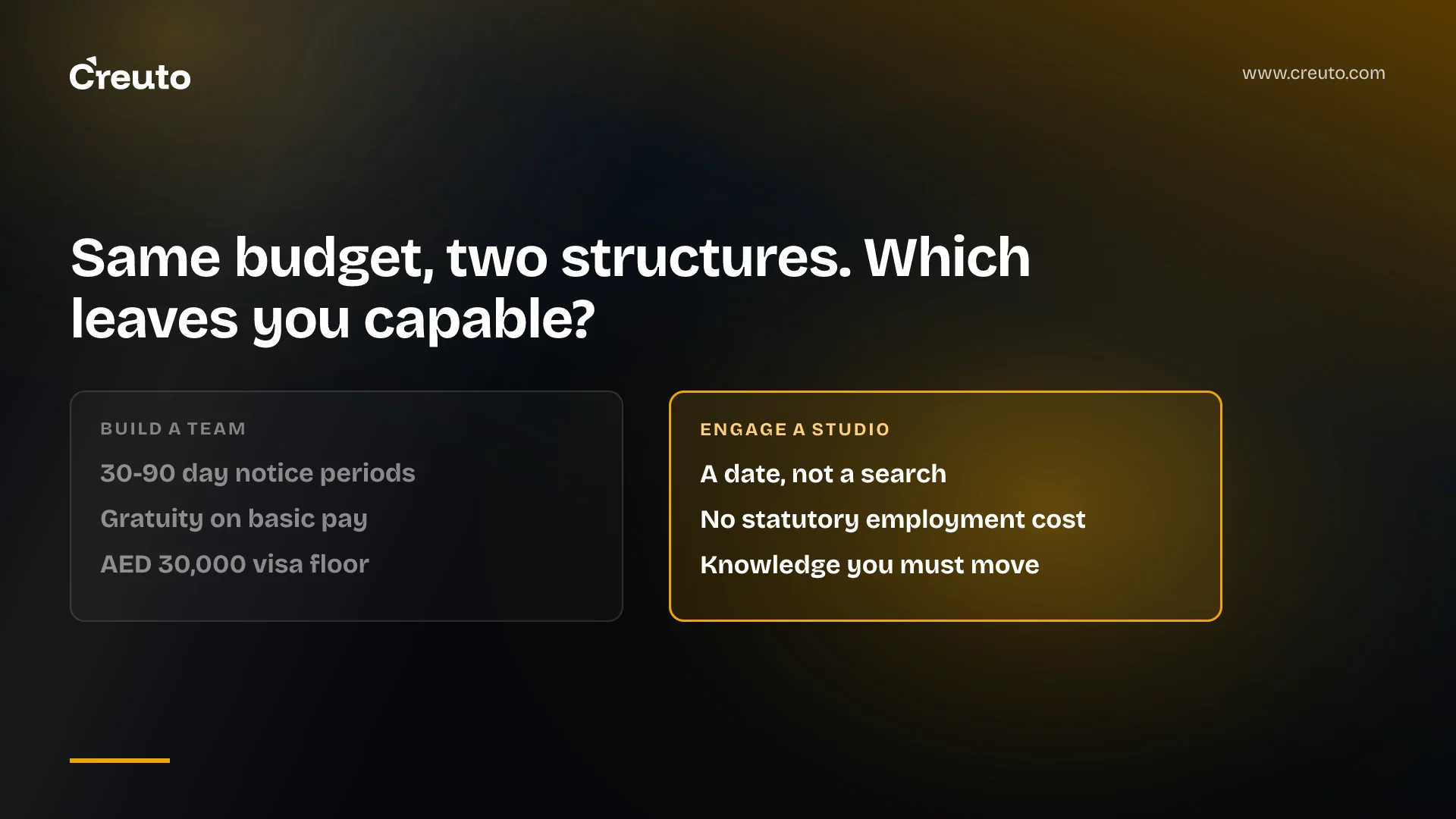
Decide whether to hire developers Dubai-side or to engage a studio, and the first figure you meet — an annual salary set against a day rate — is the least useful number on the page. The UAE's work permit itself costs AED 250 to AED 3,450, and which end of that range you pay depends on your own company's compliance record, not on the engineer you are hiring. Everything genuinely expensive sits somewhere else.
This piece prices what a Dubai employer actually carries after the offer is signed: probation and notice rules, end-of-service gratuity, the Golden Visa salary threshold at the senior end, and the replacement cost when a hire does not work out. It also says plainly where building in-house is the better answer — for a long-lived core product, it usually is.
One limit, stated up front. We have no delivery history in the UAE. Creuto is an India-headquartered engineering company, and everything below about UAE employment rules comes from reading the published rules — the federal portal, MOHRE's classifications, the GDRFA's residence conditions — not from having sponsored a visa ourselves. Where we draw on our own experience it is engineering experience, and we name the market it happened in.
The comparison is total cost of employment against time-to-capability
A salary-versus-day-rate sum compares two things that are not alike. A salary buys you a person for a year, plus a set of statutory obligations that outlive the person's usefulness to the project. A studio engagement buys you a working increment of software by a date, with the employment obligations sitting on someone else's balance sheet.
The two numbers that actually decide this are total cost of employment — salary plus everything the law and the market attach to it — and time-to-capability, meaning the date on which the thing you are buying starts working. A team that is cheaper per head but arrives four months later is not cheaper. That is the whole argument, and the rest of this post is the arithmetic behind it.
Is it cheaper to hire developers Dubai-side or to engage a studio?
It depends almost entirely on how long the work lasts and how certain you are about what you are building. Here is the honest split of who carries what.
| What you carry | Building a team in Dubai | Engaging a studio |
|---|---|---|
| Statutory employment cost | Gratuity, notice pay, work permit, visa and insurance per head | None — it sits with the supplier |
| Time to first working software | Search, notice period, relocation, then ramp-up | Contract, then delivery; no immigration path to wait on |
| Risk of a wrong hire | Yours, and the replacement restarts the clock | Contractual — you change the team, not the employee |
| Domain knowledge after 18 months | Inside the company, in people you employ | Inside the supplier unless you deliberately move it |
| Cost when demand drops | Fixed; reducing headcount has its own legal cost | Variable; you stop buying |
Read the last two rows together, because they are the trade. A studio is cheaper and faster to start and stop. An in-house team is the only route that reliably leaves the knowledge in your building. If both rows matter equally to you, you probably want a studio for the first version and a team for the decade after it.
What the UAE labour law puts on your side of the ledger
These are the obligations a Dubai employer takes on, and none of them appear in a salary benchmark. End-of-service gratuity accrues at 21 days' basic pay for each of the first five years and 30 days for each year after that, capped at two years' wage, and it is calculated on basic salary only — allowances such as housing and transport are excluded. That exclusion matters more than it looks, because Dubai packages are routinely structured with a large housing component.
There is also a voluntary alternative that converts the liability into a monthly cost. Under the savings scheme described on the same federal page, an employer contributes 5.83% of monthly basic salary for employees with under five years' service and 8.33% after five years, and stops accruing traditional gratuity for anyone enrolled. If you are modelling a five-year team, model it both ways.
Notice periods are set by the labour law at not less than 30 days and not more than 90 days, with full pay throughout and, where the employer terminates, one unpaid day a week for the employee to look for work. On the hiring side, that same rule is why a good candidate already in the UAE is two to three months away from starting, not two weeks.
Probation is the part most comparisons miss. The federal portal's guidance on employment contracts in the private sector sets probation at no more than six months with no extension, requires 14 days' written notice if the employer ends it, and requires an employee leaving for another UAE employer during probation to give a minimum of one month's written notice — after which the new employer has to compensate the current employer for the employee's recruitment cost unless agreed otherwise. That rule cuts in your favour when someone poaches your new hire, and against you when you are the poacher. Either way it is a line item, and it is one that payroll and visa compliance obligations such as the UAE Wages Protection System rules sit alongside rather than replace.
The Golden Visa threshold your senior offer may not clear
At the senior end, residence status becomes part of the offer, and the thresholds are specific. Dubai's GDRFA lists the golden residence route for skilled workers at higher professional levels as requiring a valid UAE employment contract or salary certificate, a bachelor's degree, six months of bank statements showing salary transfers, and a monthly salary of no less than AED 30,000. The permit runs for 10 years. Abu Dhabi's government portal states the same AED 30,000 figure for skilled professionals, adding that the role must sit at MOHRE classification Level 1 or Level 2 — a band that explicitly includes information technology.
Two things are worth noting precisely. First, the official pages are not perfectly consistent with each other: the GDRFA requirements list says "no less than AED 30,000" while the terms and conditions on the same page say "approximately AED 30,000". Second, the primary pages say "monthly salary" without defining it, while immigration counsel reads the rule more narrowly — Fragomen's note on Golden Visa changes for highly skilled professionals states that as of May 2024 applicants must show a monthly basic salary of AED 30,000 excluding any allowances. If that reading is the one applied to your candidate, an AED 30,000 package built from a AED 20,000 base plus allowances does not qualify, and the gratuity arithmetic above does not work in your favour either. Confirm the current treatment with the GDRFA or the ICP before you put a visa promise in an offer letter.
Below that tier, the GDRFA's green residence permit for high-skilled workers sets a lower floor: MOHRE classification levels one to three, a bachelor's degree or equivalent, and a monthly salary of not less than AED 15,000, for five years without an employer as sponsor. The practical consequence for an employer is that the visa you can offer — and therefore how portable your hire's life is — steps up sharply between a mid-level and a senior package.
How tight is the Dubai market? What is sourced, and what is not
The figure circulating in this genre is 2.5 open positions for every qualified candidate. It appears in a 2026 Dubai tech hiring guide published by the recruiter Quantalent, which states that "for every qualified candidate available, Dubai companies have 2.5 open positions". We could not find a methodology, a sample or an underlying dataset behind it, and the company publishing it sells Dubai technology recruitment. Treat it as a vendor estimate, not a market statistic. The same page is the source of the annual package range of AED 120,000 to AED 780,000 that also circulates widely; its salary table credits the Hays 2026 GCC Salary Guide, the Robert Half 2026 Middle East Salary Guide and its own placement data, and we could not retrieve either guide's technology bands to check the derivation.
What is verifiable is that the UAE government treats developer supply as a constraint and legislates accordingly. The federal National Program for Coders commits to attracting and training 100,000 coders, granting Golden Visas to 100,000 of the world's best coders, and establishing 1,000 digital companies within five years. A state does not build a 100,000-visa pipeline for a skill it has enough of. That is a sounder basis for your planning assumption than an unsourced ratio.
So plan on scarcity without pretending to a number. The decision-relevant consequence is the one you can derive from the rules above: a UAE-resident senior candidate carries a 30-to-90-day notice period, an overseas hire adds immigration and relocation on top, and a hire that fails inside probation puts you back at the start of that sequence with the market no less tight than it was.
When building in-house is the right answer
Three cases, and we mean them. A long-lived core product. If the software is the business and will be maintained for a decade, employment is the cheaper structure over that horizon, and the compounding knowledge of a team that has lived through its own incidents is not purchasable. Work that has to be in the room. If your engineers need to sit with a regulator, a hospital's clinicians, a port's operations staff or an enterprise customer's security team, presence in Dubai is a capability, not a cost line. Domain knowledge that must stay inside the company. If the valuable asset is the model of how your industry actually works, putting it in a supplier's heads and a repository you do not maintain is a strategic error however good the delivery is.
There is a fourth case that is not about strategy at all: if you cannot write down what you want built, a studio will deliver exactly what you specified and you will not like it. Discovery with a partner can fix that. An ambiguous brief and a fixed-price contract cannot.
What engaging a studio actually involves
A studio engagement is not a staffing substitute, and the comparison is dishonest if it is sold as one. You are buying a delivery commitment: a scope, a date, a named team, a repository you own, and a defined route by which the work and its documentation come back to you. Ours is custom software development run as product engineering, and we publish our delivery bands rather than quoting per head — a focused MVP typically takes 6 to 10 weeks, and larger enterprise platforms three to six months depending on complexity, integrations and scope. Set those against a 30-to-90-day notice period for a single senior hire and the time-to-capability argument makes itself.
If you are weighing this for a UAE business, the practical detail — how an engagement is structured, who you deal with, how time zones and working weeks are handled — is set out on our page for software development in Dubai. Read it with the limit above in mind: it describes how we work with UAE clients, not a portfolio of UAE deployments, because we do not have one.
What we can point at is the engineering pattern. The closest analogue in our own work is a dealer-network sales training platform we built for Škoda Auto — three platforms, 100-plus dealerships, 20 weeks to market — and it was delivered for the Indian market, not the Gulf. The transferable part is the shape of the engagement, not local knowledge of Dubai, and you should discount any studio's claim accordingly, including ours.
Run the comparison on your own numbers
Take your senior requisition and price it twice. On the build side: basic salary, allowances, gratuity accrual at 21 days of basic a year, the work permit band your company's classification puts you in, insurance, and the months between approving the requisition and the first merged pull request. On the engage side: the delivery commitment, the date, and what it costs to stop.
Then ask the question that actually settles it — which of the two leaves you with the capability you need in eighteen months. If the answer is a team that knows your domain and sits with your customers, hire. If the answer is a working product and a decision about what to build next, engage. Most companies need both, in that order, and the mistake is choosing the structure before deciding which one you are buying.
Frequently asked questions
A Dubai developer hire costs the salary plus statutory employment cost. The work permit itself is AED 250 to AED 3,450 depending on your company's MOHRE compliance classification, and gratuity accrues at 21 days' basic pay per year for the first five years. Published salary ranges come from recruiters, not official data.
A UAE-resident candidate is bound by a notice period the labour law sets at between 30 and 90 days, so a senior hire is realistically two to three months from offer to start. An overseas hire adds immigration and relocation time on top of that notice period.
Dubai's GDRFA lists a monthly salary of no less than AED 30,000 for the golden residence route for skilled workers at higher professional levels, alongside a bachelor's degree and six months of bank statements. Immigration counsel reads that as basic salary excluding allowances, so confirm before promising it.
Engaging a studio is cheaper to start and stop, because the statutory employment cost and the wrong-hire risk sit with the supplier. Employing a team is cheaper over a decade and is the only route that reliably keeps domain knowledge inside your company. The honest answer depends on how long the work lasts.
Hire locally when the software is a long-lived core product, when engineers must sit with regulators or customers, or when the domain knowledge must stay in-house. Engage a studio when you need a working product by a date and the scope is clear enough to commit to.