Healthcare AI software development under CDSCO
Healthcare AI software development in India starts with CDSCO's 2026 test. Which AI features are medical devices, which are not, and what a license adds.
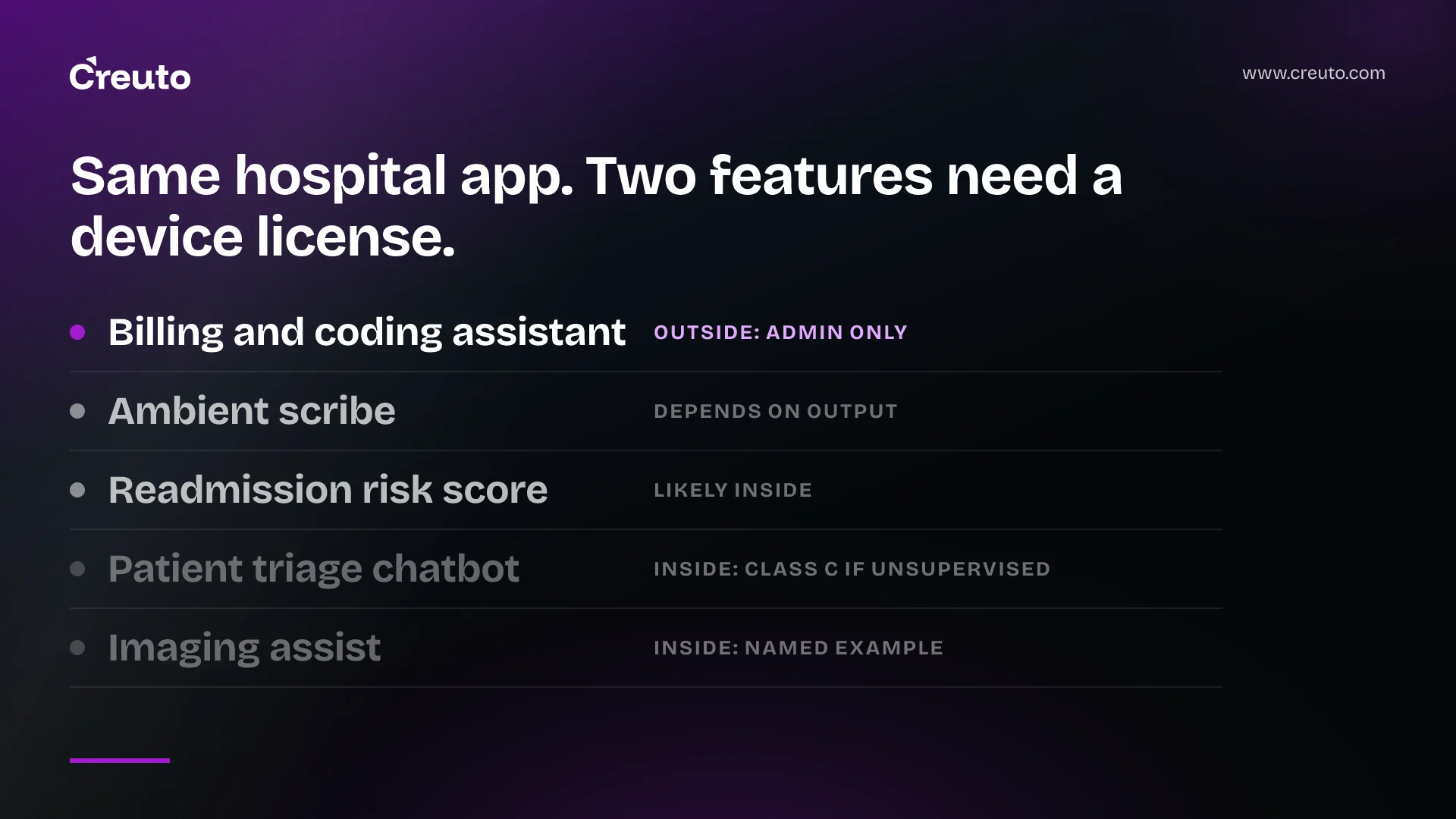
Healthcare AI software development in India starts with a classification question, not a model choice. CDSCO's Medical Device Software guidance, issued on July 21, 2026, names an AI/ML triage tool as a medical device and excludes software that only schedules appointments, bills or stores patient records. Where each feature lands sets your scope, timeline and cost.
This post runs five features from a typical hospital AI roadmap through CDSCO's test: a billing and coding assistant, an ambient scribe, a readmission risk score, a patient triage chatbot and imaging assist. It then sets out what a feature inside the device boundary adds to the build. We have not shipped a healthcare product, so everything here rests on the regulator's text, which we read in full. Status is as of November 20, 2026.
| Item | What the record shows |
|---|---|
| Document | Guidance Document on Medical Device Software, Doc No. CDSCO/MD/GD/MDSW/01/2026 |
| Issued | Circular dated July 21, 2026, after a draft dated October 21, 2025 |
| Legal basis | Medical Devices Rules, 2017, which have covered all medical devices since notification S.O. 648(E) of February 11, 2020 |
| Test | Function and intended use, not product category |
| Risk classes | A (low) to D (high) |
The CDSCO guidance adds no new law, which is why it matters now
The guidance says it "should not be misconstrued as a new regulatory control" on medical device software. Its covering circular explains why: since the 2020 notification, all medical devices, software intended for medical purposes included, have been regulated under the Drugs and Cosmetics Act, 1940 and the Medical Devices Rules, 2017. What the July 2026 document adds is clarity on how CDSCO reads those rules for software. That clarity removes the excuse that the rules were too vague to apply to an AI feature.
The test is functional. "Not all software used within healthcare settings qualify" as medical device software, the guidance says, and where a system mixes device and non-device functions, the non-device functions "may not be regulated," though the manufacturer must explain how they affect the device function. Nishith Desai Associates puts it well: "The exclusion is function-specific rather than product-specific." A hospital platform can therefore hold one licensed feature and ten unlicensed ones, if the boundary between them is designed in.
How CDSCO classifies medical device software: Class A to D
Software that drives or influences a hardware device takes that device's class. Standalone software is classified on two axes: how serious the healthcare situation is, and how much weight the software's output carries in the decision. This is Table 2 of the guidance:
| Situation or condition | Treat or diagnose | Drive clinical management | Inform clinical management |
|---|---|---|---|
| Critical | D | C | B |
| Serious | C | B | A |
| Non-serious | B | A | A |
"Drive clinical management" covers software used "to aid in diagnosis by analyzing relevant information to help predict risk of a disease or condition" and "to triage or identify early signs of a disease." "Inform clinical management" covers output that "will not trigger an immediate or near term action," such as aggregated clinical information.
One note under the table changes the answer for patient-facing products. Software used by non-clinical users in a serious condition "without the support from specialized professionals, may be considered" as used in a critical one. A symptom checker in a patient app can therefore move up a row. If several rules apply, the strictest wins, and CDSCO confirms the class on review.
The class decides who licenses you. Under Table 5 of the guidance, a State Licensing Authority grants manufacturing licenses for Class A and B, and the Central Licensing Authority for Class C and D. Import licenses for every class come from the central authority. Non-sterile, non-measuring Class A devices are exempt from licensing and need only registration.
Five hospital AI features run through the CDSCO test
The guidance does not mention ambient scribes, chatbots or large language models by name, so the verdicts below are our reading of its text. They are a starting point for your regulatory adviser, not a classification.
| Feature | What the guidance text says | Our reading |
|---|---|---|
| Billing, scheduling and revenue-cycle coding assistant | Hospital information systems for admission, scheduling, insurance and billing are not medical device software | Outside, if it stays administrative |
| Ambient clinical scribe | Storing and transferring documented clinical observations is excluded; aiding diagnosis is not | Depends on whether it only records or also suggests |
| Readmission risk score | Prediction is a medical purpose; predicting the risk of a disease drives clinical management | Likely inside if clinicians act on it |
| Patient triage chatbot | Triage drives clinical management; non-clinical users can push the condition to critical | Inside |
| Imaging assist | Computer-aided detection on X-rays or ECGs, and AI triage of cancer lesions, are named examples | Inside |
Which AI features in a hospital app are not regulated as medical devices?
Administrative AI sits outside the boundary. The guidance excludes hospital and clinical information systems "intended only for patient admission, for scheduling patient appointments/visits, for insurance and billing/invoicing purposes," along with software that only transfers, stores, converts or searches data. A coding assistant that turns a signed discharge summary into billing codes stays on that side, provided its output goes to the claim and not back to the clinician as a suggested diagnosis.
The boundary moves when a function does. CDSCO's note is explicit: if an information system gains "image analysis/modification as an aid in diagnosis, quantification of physiological parameters for clinical decision-making, real-time patient monitoring," it "may be considered as a medical device."
Is a hospital AI chatbot a medical device?
A chatbot that books appointments and answers questions about visiting hours is administrative. A chatbot that asks about symptoms and tells a patient how urgently to seek care is triage, which the guidance places under "drive clinical management." Used by patients without a clinician in the loop, it can be read as a critical-condition device, which is Class C on the table above. The interface is the same in both cases. The license depends on the conversation it is built to have.
Ambient scribes and risk scores sit on the line
A scribe that transcribes a consultation into a note the doctor signs resembles the excluded function of storing "documented clinical observations." Add a differential diagnosis, a flagged lab value or a suggested order, and it begins to aid diagnosis. A readmission score used only for bed planning is arguably operational. The same score shown to a physician to decide follow-up predicts the risk of a condition. For both features, the intended use statement you write decides the answer, so write it before you write the prompts.
What CDSCO requires for AI and machine learning medical software
Once a feature is inside, the AI-specific evidence is detailed. From the guidance's submission requirements:
- Method and role. Whether the software is rule-based or AI/ML, "fixed or adaptive," and whether it aids a clinician or replaces part of current practice.
- Datasets. Composition of training, validation and test data, "including demographic distribution, geographic origin, and clinical diversity," and whether data is real-world or synthetic. Emergo by UL's summary of the final guidance lists the same disclosures.
- Indian applicability. "Where models are trained or validated in non-Indian settings, justification shall be provided for applicability to Indian clinical environments," with evidence on bias and robustness across sub-populations relevant to India.
- Standards. The quality system rests on IEC 62304, ISO 14971 and IEC 82304-1. The list of applicable standards also names ISO/IEC 42001 and ISO/IEC 23894 for AI, and the guidance asks for a software bill of materials.
Algorithm Change Protocol under CDSCO: a locked model or a plan for change
An Algorithm Change Protocol "may be devised, wherever applicable." It contains a data management plan, a performance monitoring plan, a retraining plan, a software update plan and a rollback plan. It is not a blanket pre-approval. Changes made under an approved protocol still need an approval request or notification, and "addition of a new clinical claim or a new data input type" counts as a major change that needs approval.
That is a real architecture decision. A locked model with version pinning keeps change control simple but freezes performance. A retraining pipeline needs dataset lineage, a held-out Indian test set and an automated comparison against the approved baseline before any version ships.
After launch: drift, hallucination and a 15-day reporting clock
Post-market surveillance for AI includes "drift monitoring for AI," and Table 8 asks manufacturers to watch for "AI-related hallucinations," defined as "creation of a factually false or fabricated data by an AI model with high confidence." License holders must report suspected unexpected serious adverse events "within 15 days," and collect real-world evidence from Indian healthcare settings.
In engineering terms, that means logging every input, output and model version, sampling outputs for clinician review, and building a recall path. CDSCO defines a software recall as halting distribution or "uninstalling/decommissioning the said software." If you cannot switch off one model version across every hospital deployment, you cannot meet that.
How much healthcare AI software development costs depends on the boundary
No published figure prices a CDSCO-licensed AI feature, and we will not invent one. The cost structure is clear from the text, though. A feature outside the boundary is ordinary product engineering: a focused MVP typically takes 6-10 weeks. A feature inside it adds a documented quality system, dataset documentation, a risk management file, possibly clinical investigation, a post-market surveillance plan and licensing time. That puts it closer to enterprise platform timelines of 3-6 months before any regulatory clock starts.
The strongest argument against all this is that intended use is what the manufacturer claims, so careful labeling keeps an AI feature administrative. There is something to it: the classification really does turn on intended use. But CDSCO reads intended use from "labelling details, including instructions for use manuals, websites, promotional material," so your sales deck counts. General wellness claims "should not be making any reference to diseases or disorders." A triage bot marketed as a "health assistant" is still triage.
The opposite mistake is just as costly. Building a scheduling or billing assistant to device-grade quality is the wrong choice: you buy a quality system for a feature no regulator asked about. Regulators are also still catching up with generative AI. The US FDA says it "will explore methods to identify and tag medical devices that incorporate foundation models," from large language models to multimodal architectures. A clinical feature built on a language model is ground with little precedent.
Two further notes. The guidance asks device software to support consent-driven data access compliant with the DPDP Act, 2023, which we cover in what apps must build for DPDP before 2027. And CDSCO's test is India's alone. In Dubai, DHA splits the platform from the care, as we set out in telemedicine app development in Dubai.
Scoping healthcare AI software development feature by feature
Before you brief a partner, write a one-paragraph intended use statement for each AI feature, place it on the CDSCO table, and separate the device functions from the administrative ones in the architecture. That document is worth more than any feature list, and a paid discovery phase should leave you owning it.
We have not built a licensed medical device, and we will say so in any proposal. What our AI engineering team does build is the machinery the guidance asks for: model version control, evaluation sets, decision logging, drift monitoring and a clean boundary between regulated and unregulated features. If you are deciding which of your planned AI features to ship first, we can map each against the CDSCO test and scope the administrative ones you can build now.
Frequently asked questions
AI software needs CDSCO approval in India when it is intended for a medical purpose such as diagnosis, triage, monitoring, prediction or treatment, because it then counts as medical device software under the Medical Devices Rules, 2017. Software used only for scheduling, billing or storing records is excluded under CDSCO's July 2026 guidance.
A hospital AI chatbot is a medical device in India when it triages patients or identifies early signs of a disease, which CDSCO's guidance treats as driving clinical management. A chatbot that only books appointments or answers administrative questions falls under the excluded hospital information system functions and needs no device license.
Medical device software in India is classified from Class A, low risk, to Class D, high risk. Standalone software is placed on CDSCO's table by the seriousness of the condition and whether its output treats or diagnoses, drives clinical management or informs it. Software driving hardware takes that hardware's class.
CDSCO requires AI and machine learning medical software applicants to state whether algorithms are fixed or adaptive, disclose training, validation and test dataset composition, justify models trained outside India, and show bias and robustness evidence for Indian sub-populations. After launch, CDSCO expects drift and hallucination monitoring as part of post-market surveillance.
An Algorithm Change Protocol under CDSCO's medical device software guidance is an optional plan, devised where applicable, covering data management, performance monitoring, retraining, software updates and rollback. Changes made under an approved protocol still need an approval request or notification, and a new clinical claim or data input type is a major change.