GPT-Live-1 pricing: what a $0.05-a-minute voice agent costs
GPT-Live-1 bills $0.05 a minute for voice, then charges your backend model again. A worked per-call cost, phone support, and the gpt-realtime shutdown.
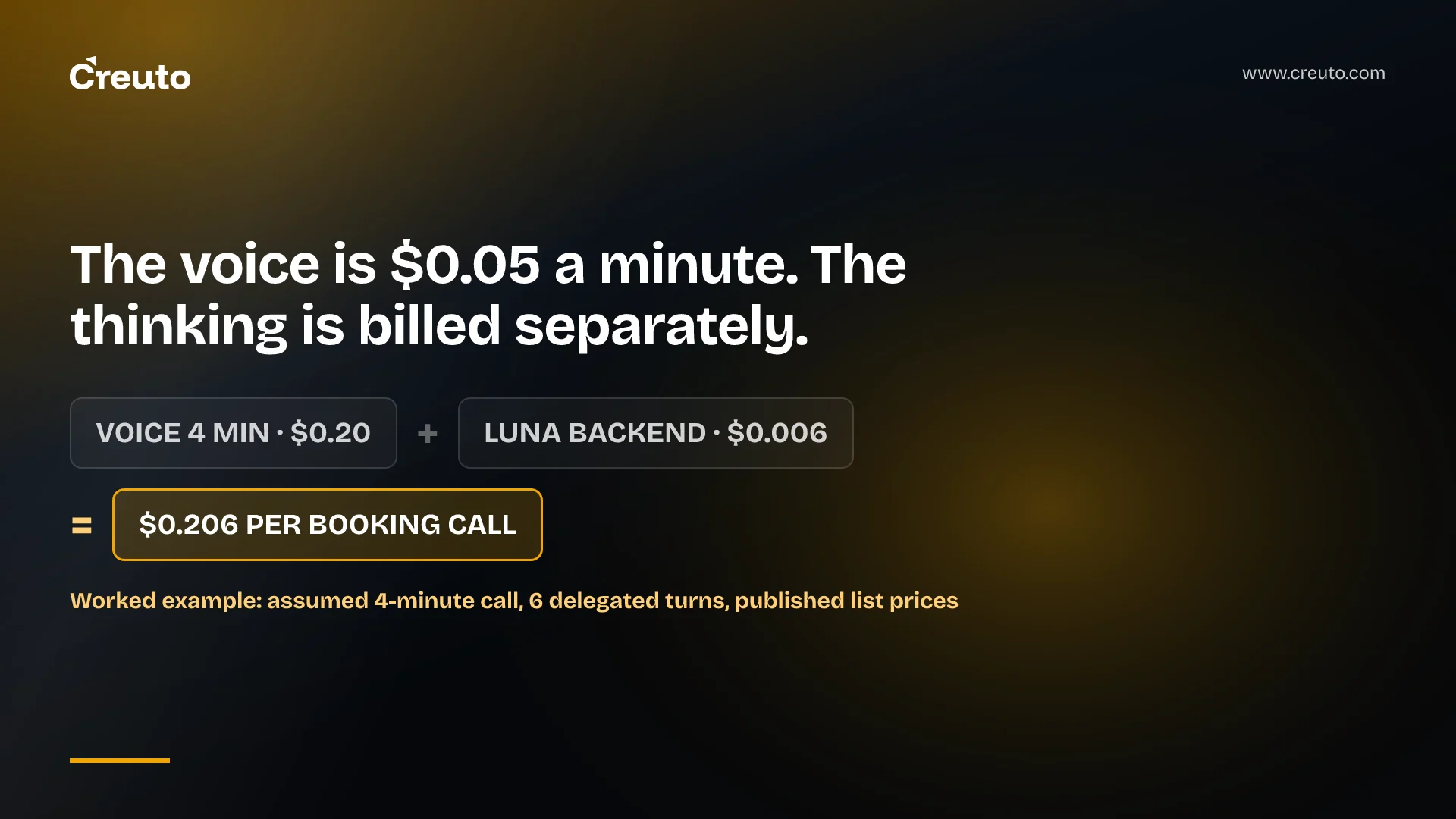
GPT-Live-1 bills $0.05 per minute of voice session, per second, and that rate covers only the talking. Every question the voice model hands to a backend model is billed again at that model's token rates. On our worked example below, a four-minute booking call costs about 21 cents with GPT-5.6 Luna behind the voice and about 31 cents with GPT-5.6 Sol.
This post sets out what GPT-Live-1 is, which parts of a call you pay for, how the backend model changes the total, and what the January and February 2027 shutdowns of older OpenAI audio models mean if you already run a voice product. Prices are OpenAI's published list prices as of 21 September 2026.
| Key fact | Detail |
|---|---|
| General availability | 10 September 2026, on v1/live/sessions |
| Voice price | $0.05 per minute, billed per second, not rounded up |
| Also billed | Backend model tokens and tool calls, at normal rates |
| Concurrency | 25 sessions at Tier 1, 500 at Tier 5; Free tier unsupported |
| gpt-realtime family shutdown | 20 January 2027 |
| whisper-1 and gpt-4o-transcribe shutdown | 26 February 2027 |
What GPT-Live-1 actually is
GPT-Live-1 is a full-duplex voice model: it can listen and speak at the same time, so a caller can interrupt or add a detail while the assistant is still talking. The 10 September changelog describes it as a model for conversations that continue while a backend model or agent handles reasoning and tools.
That split is the whole design. OpenAI's GPT-Live guide says the live model handles conversation and decides when to ask for help, while the backend reasons, uses tools and returns results. OpenAI calls the handoff delegation, and there are two modes. With Responses delegation, OpenAI runs a Responses model you choose. With client delegation, you connect your own agent, harness or another provider's model.
The live model itself is narrow. Its model page lists audio and text in and out, no image input, a 31 July 2025 knowledge cutoff, function calling, and no structured outputs. Anything that needs current facts or your data has to come from the backend.
How much does an OpenAI voice agent cost with GPT-Live-1?
An OpenAI voice agent on GPT-Live-1 costs the voice duration plus the backend. OpenAI's cost optimization guide gives the formula: billable voice seconds divided by 60, times the per-minute rate, plus backend costs. Its own illustration is a 90-second session at $0.075 plus $0.02 of backend work, $0.095 in total.
Three details in that guide change real bills:
- Silence is billed. Active session time includes when the user speaks, the assistant speaks, both are silent, or the backend is working. Muting the microphone does not close the session.
- WebRTC sessions bill 15 seconds up front. Creating a WebRTC session charges 15 seconds while it initializes, credited against the running session. It matters when you create sessions before the user is ready to speak, or reconnect often.
- Tool fees are separate from tokens. The pricing page lists web search at $10 per 1,000 calls, one cent a call, which is a fifth of a minute of voice. Your own function tools carry no OpenAI fee beyond tokens.
Your phone provider's charges sit on top of all of this and are not part of OpenAI's price.
A worked example: a four-minute booking call
Every price below is published; the call shape is an assumption, so replace it with your own measurements. Assume a four-minute appointment call in which the voice model delegates six times, and each backend turn sends 3,000 input tokens and returns 300 output tokens, including reasoning. That is 18,000 input and 1,800 output tokens per call, with no caching.
| Backend model | Voice (4 x $0.05) | Backend input | Backend output | Per call | Per 10,000 calls |
|---|---|---|---|---|---|
| GPT-5.6 Luna ($0.20 / $1.20) | $0.20 | $0.0036 | $0.00216 | $0.206 | $2,058 |
| GPT-5.6 Terra ($2 / $12) | $0.20 | $0.036 | $0.0216 | $0.258 | $2,576 |
| GPT-5.6 Sol ($4 / $20) | $0.20 | $0.072 | $0.036 | $0.308 | $3,080 |
With Luna the voice minutes are 97% of the bill; with Sol they are 65%. So for a simple booking or order-status line, the lever is call length, not backend model. For a line that has to reason through policy, eligibility or a complicated account, the backend grows quickly and the model choice starts to matter.
When to delegate to Luna, Terra or Sol
OpenAI's delegation guide says to start with GPT-5.6 Terra, or try GPT-5.6 Luna for cost-sensitive workloads, and compare answer quality and latency on your tasks. The Responses backend supports function definitions and web search, plus max_output_tokens, service_tier and reasoning settings.
The strongest argument against always picking the cheapest backend comes from the same guide: a larger backend model can cost less overall if it finishes the task faster, because every minute the caller spends waiting is another $0.05. It gives the reverse case too: a cheaper model can cost more if it takes longer, repeats tool calls or fails the task. The number to compare is cost per successful call, including retries.
Our default for a new line would be Luna at low reasoning effort for lookups and confirmations, with a route to Terra or Sol for the turns that fail on Luna in testing. Measure those turns, not the averages. We covered the tracing and spend caps this needs in AI agent observability, and scoring the whole call rather than the last answer in AI agent evaluation.
Can OpenAI voice agents answer phone calls?
Yes. The telephony and SIP guide describes two paths: direct SIP, where your provider's trunk sends call audio to OpenAI and your backend handles webhooks and business logic, or a WebSocket relay through your own application. Direct SIP requires SRTP for call audio, and GPT-Live SIP support has to be enabled for your project.
Two limits matter for planning. The direct SIP flow accepts inbound calls only; outbound calls go through a partner integration, and OpenAI lists LiveKit, Twilio, Telnyx and Daily/Pipecat. And concurrency is capped by tier, from 25 simultaneous sessions at Tier 1 to 500 at Tier 5, so a support line that peaks above that needs a queue or a higher tier.
What replaces gpt-realtime? Not necessarily GPT-Live-1
OpenAI's deprecations page lists 20 January 2027 as the shutdown date for the gpt-realtime, gpt-realtime-mini and gpt-4o-realtime families. The recommended replacements are gpt-realtime-2.1 and gpt-realtime-2.1-mini, not GPT-Live-1. It is easy to read GPT-Live as the Realtime successor; the deprecation table does not say that.
The two are different architectures. OpenAI's voice agents guide places the Realtime API as one model interpreting audio, deciding and replying in a single session, and GPT-Live as a voice front end with a separate backend. If your Realtime model currently picks the tools, a move to GPT-Live means splitting your prompt between voice and backend, which OpenAI's migration guide walks through.
Billing differs too. Realtime charges tokens: on gpt-realtime-2.1, audio is $32 per million input tokens and $64 per million output, and the cost guide counts assistant audio at one token per 50 milliseconds, so one minute of assistant speech is 1,200 output tokens, or $0.0768, before any input. Realtime's voice activity detection also filters out empty audio. GPT-Live's flat rate is easier to forecast, but it bills silence, so a line with long pauses can come out cheaper on Realtime.
whisper-1 deprecation in February 2027
On 26 February 2027, whisper-1, gpt-4o-transcribe, gpt-4o-mini-transcribe and gpt-4o-transcribe-diarize leave the API. The listed replacements are gpt-live-transcribe or gpt-transcribe, and they are priced very differently: gpt-live-transcribe is a streaming model at $0.017 a minute, while gpt-transcribe is $0.0045, against Whisper's $0.006. If you transcribe recorded calls after they end, gpt-transcribe is cheaper than what you pay today; switching to the streaming model by default nearly triples the rate.
A GPT-Live session does not need either for its own transcript. The session guide delivers input and output transcript deltas as session events.
The decision in front of you
If you run gpt-realtime today, you have until 20 January 2027 and two paths: the like-for-like move to gpt-realtime-2.1, or the architectural move to GPT-Live-1 with a backend you can swap. Pick by where your logic lives. If it already sits in a text agent, GPT-Live adds a voice to it with client delegation, and it is the pattern we reach for first in generative AI builds. If the voice model is the agent, the like-for-like upgrade is less work before the deadline, and you can evaluate GPT-Live afterwards on recorded calls, at cost per successful call.
Frequently asked questions
GPT-Live-1 costs $0.05 per minute of voice session, billed per second without rounding up to a whole minute. Backend model tokens and tool calls are billed separately at their normal rates, and time when both sides are silent or the backend is working still counts as active session time.
OpenAI lists gpt-realtime-2.1 as the recommended replacement for the gpt-realtime and gpt-4o-realtime families, and gpt-realtime-2.1-mini for the mini models, all shutting down on 20 January 2027. GPT-Live-1 is an alternative architecture with a separate backend, not the listed like-for-like replacement.
OpenAI voice agents built on GPT-Live-1 can answer phone calls through direct SIP from your telephony provider or through a WebSocket relay in your application. The direct SIP flow handles inbound calls only; outbound calling goes through partner integrations such as Twilio, Telnyx, LiveKit or Daily/Pipecat.
OpenAI suggests starting a GPT-Live-1 backend on GPT-5.6 Terra, or GPT-5.6 Luna for cost-sensitive workloads, then comparing quality and latency on your own calls. A larger model can cost less overall if it shortens the call, because each extra minute of waiting adds $0.05 in voice charges.
OpenAI will remove whisper-1, gpt-4o-transcribe, gpt-4o-mini-transcribe and gpt-4o-transcribe-diarize from the API on 26 February 2027. The recommended replacements are gpt-live-transcribe at $0.017 per minute for streaming audio, or gpt-transcribe at $0.0045 per minute for file transcription, which is cheaper than Whisper's current $0.006 per minute.