GPT-6 Sol at $2: OpenAI halved the price of a good model
GPT-6 Sol is $2 input and $10 output per 1M tokens from 22 September 2026, half of GPT-5.6 Sol. Which workloads to move, and what to re-test first.
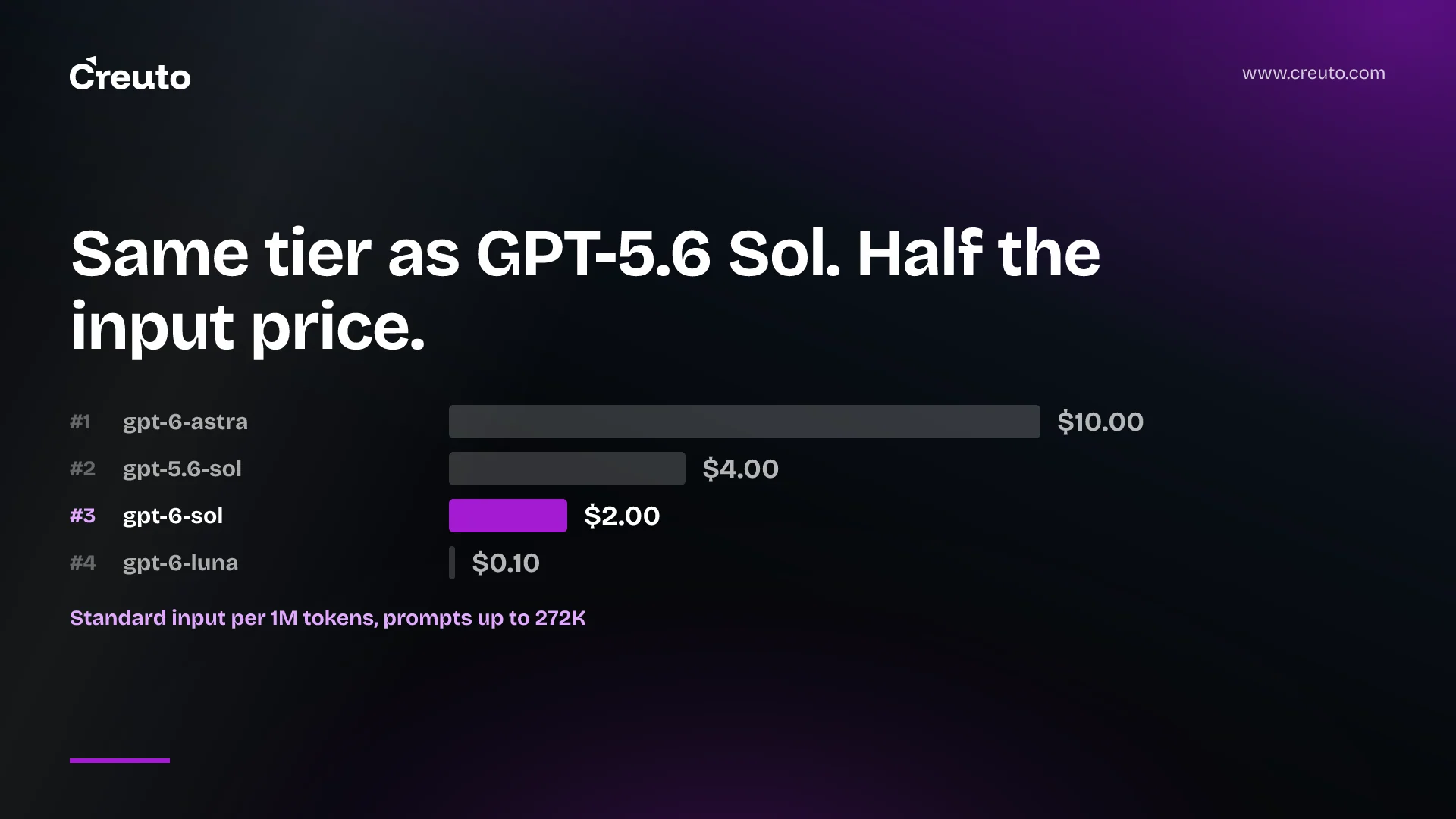
OpenAI released GPT-6 Sol on 22 September 2026 at $2 per million input tokens and $10 per million output. That is half the standard rate of GPT-5.6 Sol and a fifth of GPT-6 Astra. GPT-6 Luna arrived the same day at $0.10 and $0.50. Both are reasoning models that take text and images.
The interesting part is not the headline rate. It is that the cached-input rate came down with it, which changes the shape of the bill for anything with a long, stable system prompt. Here is what the two models cost, against the models you are probably running today.
| Model | Input / 1M | Cached input / 1M | Output / 1M |
|---|---|---|---|
| gpt-6-astra | $10.00 | $1.00 | $50.00 |
| gpt-5.6-sol | $4.00 | $0.40 | $20.00 |
| gpt-6-sol | $2.00 | $0.20 | $10.00 |
| gpt-6-luna | $0.10 | $0.01 | $0.50 |
Every figure above is the Standard-processing rate for prompts up to 272K input tokens, as published on 23 September 2026. Go past 272K input tokens and the whole request is billed at 2x the input and cache rates and 1.5x the output rate — not just the overflow.
What GPT-6 Sol costs against the model you are running now
Take a service that burns 10M input tokens and 1M output tokens a day with no caching. On gpt-5.6-sol that is $60 a day. On gpt-6-sol it is $30. On gpt-6-astra it would have been $150. On gpt-6-luna, $1.50. The arithmetic is trivial; the decision is not, because the four models are not interchangeable.
One caveat on the comparison baseline. GPT-5.6 Sol's $4 and $20 are promotional rates available at least through 21 November 2026. If they lapse, the gap widens rather than closes — but it does mean the number you are comparing against is not a fixed one.
The two new models share a spec sheet: a 1,050,000-token context window, 922,000 maximum input tokens and 128,000 maximum output tokens. They differ on training data — Sol's knowledge cutoff is 20 April 2026, Luna's is 18 May 2026 — and on rate limits, which matter more than most teams expect. At Tier 5, Luna allows 30,000 requests and 180M tokens per minute against Sol's 15,000 and 40M. If your bottleneck is throughput rather than intelligence, that ratio is the real argument for Luna.
Which workloads to move first
Move the work where the job is bounded and the output is checkable. In the systems we build, that is usually classification, extraction into a schema, summarisation over retrieved chunks, rerank, and the first-pass draft in a review loop where something else checks the result. These are the workloads where a cheaper model either passes your evals or does not, and you find out in an afternoon.
Hold back the work where failure is expensive and hard to detect: long agent trajectories with irreversible tool calls, anything touching money, and anything where a subtly wrong answer ships without a human seeing it. Price is the weakest reason to change the model behind those.
Luna is worth a test wherever you are currently running a small model on volume. At $0.10 input it is half the rate of gpt-5.6-luna and a twentieth of gpt-6-sol, and it supports the same Responses API tool set — web search, file search, code interpreter, MCP and computer use among them. A cheap model that can still call your tools is a different proposition from a cheap model that cannot.
Cached input changes the arithmetic more than the rate cut does
GPT-6 Sol's cached-input rate is $0.20 per million, ten per cent of the uncached rate. Cache writes cost $2.50, 1.25x uncached. Take the same 10M input, 1M output day and assume 80% of input tokens hit a warm cache: input drops to $5.60, the total to $15.60. That is roughly a quarter of what the same traffic costs today on gpt-5.6-sol without caching.
Which means the ordering matters. A team that switches models and skips caching captures the smaller half of the saving. If you have not already restructured prompts so the stable part comes first, prompt caching is the cheaper cost cut to make first, and it compounds with the new rate rather than competing with it.
Two more multipliers sit on top. Batch and Flex are half the Standard rate, so batch on gpt-6-sol is $1 and $5 — worth knowing before you decide the new price is not low enough, and covered in our comparison of the Batch API against Flex processing. Regional processing adds ten per cent, and for GPT-6 Sol and Luna, EU data residency is only available on Standard processing. If you are pinned to an EU endpoint, Fast mode and the discounted tiers are not all on the table.
What to re-test before you switch traffic
A price drop is not a behaviour guarantee, and nothing in the changelog claims parity with the model you are leaving. Four things are worth putting on a list before any traffic moves.
- Effort. Both models expose
reasoning.effortatnone,low,medium(the default),high,xhighandmax. The level you pick changes how many tokens a request produces, so a cost comparison only holds if you hold effort fixed and re-measure. Run the sweep; do not carry a setting across. - Endpoint behaviour. On Chat Completions, function calling works only with
reasoning_effortset tonone. Built-in tools and function calling belong on the Responses API. An integration still on Chat Completions may have to move before it can use the model properly. - Your evals, on your data. Not a public benchmark. The set of cases that broke in production last quarter is a better test than any leaderboard, and it is the one that tells you whether the cheaper model is cheap for you.
- Output length. Reasoning models vary how much they emit; a model that answers correctly but at twice the length is not half-price in practice.
Where this does not apply
If your bill is dominated by output tokens from a workload that already runs on a small model, GPT-6 Sol is a step up in cost, not down. If you are on GPT-6 Astra because you tried the tier below and it failed your evals, a cheaper model in that same tier does not change the finding — re-test it, but expect the previous answer. And if your traffic is low enough that the whole monthly bill is a rounding error against an engineer's time, the migration is not worth the week. We make that argument at length in our comparison of GPT-6 Astra and GPT-5.6, and it survives this release intact.
One last thing worth saying plainly: everything above is dated. OpenAI has changed the price of a shipping model three times since July 2026 and added two model families in the same window. Pin your model IDs, keep the rate you assumed written down next to the code that assumes it, and re-read the pricing page before you quote a number to a finance team. If you want a second pair of eyes on which workloads should move, that is the kind of question our AI engineering practice gets asked most weeks.
Frequently asked questions
GPT-6 Sol costs $2 per million input tokens, $0.20 per million cached input tokens and $10 per million output tokens on Standard processing, for prompts up to 272K input tokens. Prompts above 272K are billed at twice the input rate and 1.5 times the output rate for the whole request.
GPT-6 Sol is half the price of GPT-5.6 Sol on both sides of the meter: $2 against $4 for input, $10 against $20 for output. GPT-5.6 Sol's rates are promotional and published as available at least through 21 November 2026, so that baseline may move.
GPT-6 Luna costs $0.10 per million input tokens and $0.50 per million output tokens, a twentieth of GPT-6 Sol. It suits high-volume, bounded tasks, and its Tier 5 rate limits are higher than Sol's at 30,000 requests and 180M tokens per minute.
As of September 2026, GPT-6 Sol is the sensible default for general production work, with GPT-6 Luna for high-volume bounded tasks and GPT-6 Astra reserved for work that failed your evals on the tier below. Verify the choice against your own eval set, not a benchmark.
GPT-6 Sol works on both the Responses and Chat Completions APIs, but Chat Completions supports function calling only when reasoning_effort is set to none. Integrations that rely on built-in tools or function calling with reasoning should use the Responses API.
Cached input on GPT-6 Sol is billed at $0.20 per million tokens, ten per cent of the uncached rate, with cache writes at $2.50. A workload where 80 per cent of input tokens hit a warm cache pays roughly $5.60 per 10M input tokens instead of $20.