Google core update 2027: when to launch a site migration
No Google core update 2027 is announced yet. Three years of Google's dashboard history show which months to avoid for a site migration or replatform.
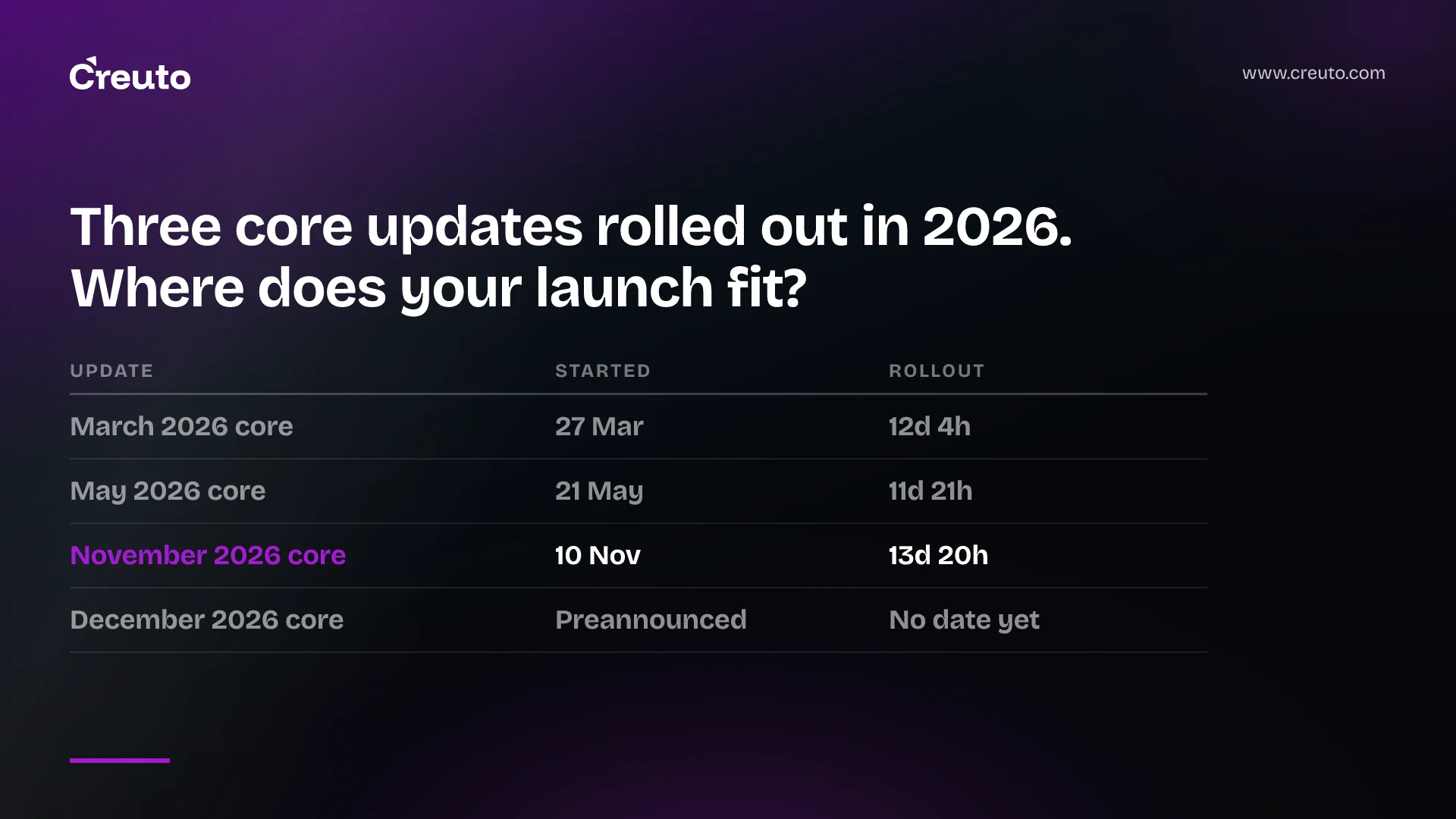
No Google core update 2027 has been announced, so nobody can tell you when it lands. What Google's own dashboard does show is a pattern: in each of 2024, 2025 and 2026 a core update started in March, another started in November or December, and one landed between May and August. If you are launching a site migration in 2027, that history is enough to plan around.
By the end of this post you will know which 2027 windows the last three years left quiet, why a migration that overlaps a core update becomes impossible to diagnose, and what to build into the cutover so that an unannounced update doesn't cost you the answer. Everything here is taken from Google's Search Status Dashboard ranking history and Google's own guidance, read on 27 November 2026. None of it is a prediction about what Google will reward.
| 2026 ranking update | Started | Rollout |
|---|---|---|
| March 2026 spam update | 24 Mar | 19 hours, 30 minutes |
| March 2026 core update | 27 Mar | 12 days, 4 hours |
| May 2026 core update | 21 May | 11 days, 21 hours |
| June 2026 spam update | 24 Jun | 2 days, 1 hour |
| August 2026 spam update | 18 Aug | 2 days, 16 hours |
| September 2026 spam update | 24 Sep | 13 days, 16 hours |
| November 2026 core update | 10 Nov | 13 days, 20 hours |
| December 2026 core update | Preannounced 24 Nov | No start date given |
Source: Google Search Status Dashboard, Ranking history. The February 2026 Discover update is left out because it affected Discover, not web ranking.
How many core updates did Google release in 2026? Three rolled out, a fourth is waiting
Google released three core updates in 2026: March, May and November. It is easy to count four, because the December 2026 core update already sits on the dashboard, but it has not started. Google preannounced it on 24 November and said only that it "is scheduled to be released in December 2026".
The November update is the one most teams will have just lived through. It began on 10 November and was complete as of 24 November, applying "globally and to all languages". Alongside the three core updates, Google ran four spam updates in 2026, and their combined rollout time was a little over 19 days. Add the core updates and something in ranking was rolling out for roughly 57 days of the year, before you count the week of waiting Google recommends after each core update.
Google core update 2027: what three years of dashboard history show
Ten core updates completed between March 2024 and November 2026, and their start months cluster tightly. That clustering, not any statement from Google, is the basis for a 2027 plan.
| Year | Core update starts | Rollout durations |
|---|---|---|
| 2024 | 5 Mar, 15 Aug, 11 Nov, 12 Dec | 45 days; 19 days 4 hours; 23 days 13 hours; 6 days 4 hours |
| 2025 | 13 Mar, 30 Jun, 11 Dec | 13 days 21 hours; 16 days 18 hours; 18 days 2 hours |
| 2026 | 27 Mar, 21 May, 10 Nov (December preannounced) | 12 days 4 hours; 11 days 21 hours; 13 days 20 hours |
Read across the rows and three things repeat. Every year opened its core-update calendar in March. Every year had a core update start in November or December. And every year had one in the middle, though the month moved from August to June to May. January, February, September and October saw no core update start in any of the three years.
Don't treat that as a rule. The same dashboard lists an October 2023 core update that started on 5 October, followed by a November 2023 one. Three years is a short series, and Google has never committed to a schedule.
How long do Google core updates take to roll out?
Google core updates have taken between 6 days 4 hours and 45 days to roll out since 2024, and eight of the last ten finished in 11 to 24 days. Google's November 2026 status message said the rollout "may take up to 2 weeks", and all three 2026 core updates came in just under that. The 45-day March 2024 update is the outlier worth remembering: a long rollout can swallow a whole launch window.
Why a site migration during a core update can't be diagnosed
A site migration and a core update produce the same symptom in Search Console: pages lose positions and clicks over a few weeks. Google's guide to debugging drops in Search traffic lists algorithmic updates and site moves as separate causes, but the reports it sends you to, from Performance to Page indexing, show the outcome rather than the cause.
The timelines overlap badly. Google's site move guidance says that for medium-sized sites "it can take a few weeks or more" for new URLs to show, and that "you may experience ranking fluctuations while Google recrawls and reindexes your site". A core update adds roughly two weeks of rollout, and Google's core updates guidance recommends "waiting at least a full week after a core update completes" before analysing. Stack those and a migration needs something like six clear weeks to produce a clean read. That figure is our arithmetic from Google's numbers, not a Google threshold.
The baseline moves too. SE Ranking tracked about 100,000 keywords and found that 32.20% of domains that lost their top-10 spots after March 2026 were back in the top 10 after the May update. Its "March" period combines the March spam and core updates. If you had migrated between those two updates and measured against March, you would have been comparing against a number that was about to change.
This matters more for the engineering team than for marketing. When traffic drops after cutover, the first question is whether to roll back. If a core update is rolling out at the same time, nobody can answer that question with evidence, and teams end up reverting good redirects or keeping broken ones.
The 2027 windows the 2026 history leaves open
If the 2024-2026 pattern holds, the quietest stretches for a 2027 launch are mid-January to February and September to October. Both come with conditions.
- January to February. No core update has started in these months since 2024. The risk is a tail: the December 2026 core update has no start date, and the December 2025 update ran 18 days from 11 December. Leave a week after it completes before you treat January as clean.
- September to October. No core update started here in 2024-2026, but the September 2026 spam update ran 13 days 16 hours from 24 September, and October 2023 had a core update. This window is quiet on core updates, not on everything.
- March, and November to December. These are the months to avoid. A core update started in March and in November or December in every one of the last three years.
- May to August. Treat it as a gamble. One core update landed here each year, in a different month each time.
Engineering calendars rarely line up this neatly, and the window is only useful if the work is ready inside it. A cutover planned for February needs its redirect map, crawl tests and rollback path finished in January, which means the build work for a February launch is already due.
Preannouncements help, but don't schedule around them
Search Engine Roundtable describes preannouncing a core update as new for Google, and the reason looks regulatory. It reported that Google's notice cites the UK CMA's fair ranking conduct requirements: "for changes where UK users may experience a significant ranking shift, we provide advance notice". Google's new page on staying informed on ranking updates says it posts pre-announcements, rollout start dates and completion notices on the dashboard, and that the dashboard has a feed you can subscribe to.
The notice does not give you a date, though. Google told Search Engine Roundtable: "We don't have a date yet -- we will announce it as usual the day it starts rolling out." It also said the update was "not imminent", even while the status page listed it as active. A preannouncement tells you a month, not a day, so it is a reason to keep a go/no-go checkpoint in the week before launch, not a substitute for choosing the window early.
The strongest case for ignoring the calendar
The best argument against all of this starts with Google's own tone. Its core updates guidance says a small drop, such as "dropping from position 2 to 4", needs no "drastic action", and, the argument goes, a well-executed migration with complete 301 redirects has nothing to fear from an update. On that view, timing is a distraction from getting the redirects right.
That argument is right about risk and wrong about diagnosis. Timing doesn't make the migration safer. It makes the result readable, so that if something did break, such as a template that dropped canonical tags or a CDN rule that blocks Googlebot, you find it in days rather than arguing about it for a quarter.
Timing is the wrong priority in three cases. If organic search is a small share of your traffic, the diagnosis problem barely matters. If you face a hard vendor deadline, like the end-of-support dates in our Adobe Commerce to Shopify migration breakdown, the deadline wins. And if the current platform is failing in production, waiting for a quiet month costs more than a messy read.
What to build in case an update lands mid-migration
An unannounced update can still start the day after cutover. These steps keep the answer recoverable when it does.
- Export a baseline before launch. Pull Search Console Performance data for the "Last 16 months", the range Google's traffic-drop guide uses for comparisons, broken down by page. That window rolls forward, so the export is the only pre-launch baseline you will still have a year later.
- Migrate in slices, not all at once. Moving one section or locale first leaves the rest of the site on the old stack as a control group. If both slices drop together, suspect the update; if only the migrated slice drops, suspect the migration. A staged cutover, like the proxy-routed rollout in our WordPress replatform write-up, gives you the routing layer to do this.
- Check the CDN before Googlebot does. Google's November 2026 post on CDNs warns that a new CDN starts with a cold cache and that "leaving blanket bot protection enabled without exempting verified crawlers" serves crawlers error pages. It recommends allowing verified bots by Google's published IP ranges and using 429 or 503 only as a temporary brake. Our DevOps and cloud engineering team treats that as part of the cutover checklist, not an afterthought.
- Subscribe to the dashboard feed and log every update. Annotate the start and completion dates against your launch timeline so the post-launch review compares like with like.
- Wait a full week after any core update completes before you judge the migration, as Google's core updates guidance recommends, and avoid "quick fix" changes in the meantime.
Plan the cutover first, then pick the month
The next decision is not which month to launch in. It is whether your migration can be split into slices, rolled back per slice and measured against a baseline you exported beforehand. If it can, the calendar becomes a preference: aim for February or September 2027 and keep a go/no-go check in the week before. If it can't, a quiet month only lowers the odds of a muddy result.
If you are planning a 2027 replatform, domain move or headless rebuild and want the cutover built in slices with a rollback path for each, our legacy application modernisation team scopes the migration plan, redirect mapping and staged rollout before any launch date goes on the calendar.
Frequently asked questions
Google has not announced any core update for 2027, and it gives no schedule in advance. Its dashboard shows that in 2024, 2025 and 2026 a core update started every March and another in November or December, so March 2027 is a sensible month to keep clear of launches, though that is a pattern, not a promise.
Google rolled out three core updates in 2026, starting on 27 March, 21 May and 10 November. A fourth, the December 2026 core update, was preannounced on 24 November with no start date. Google also ran four spam updates in 2026, in March, June, August and September.
Google core updates have taken between six days and 45 days to roll out since 2024, according to the Search Status Dashboard. Eight of the last ten finished in 11 to 24 days, and the three 2026 core updates each took just under two weeks to complete.
A site migration launched during a Google core update is hard to diagnose, because both cause ranking changes over the same few weeks. Unless a vendor deadline or failing platform forces the date, launch outside a rollout and wait at least a week after any core update completes before judging the migration's effect.
Based on Google's 2024 to 2026 dashboard history, January to February and September to October had no core update starts, which makes them the quietest windows for a website migration. Google's site move guidance also suggests timing a move to coincide with lower traffic, so check your own seasonality too.