GitHub Copilot model deprecation: six models go 19 October
The GitHub Copilot model deprecation on 19 October retires six models across chat, agent mode and completions. Check what your team has pinned before then.
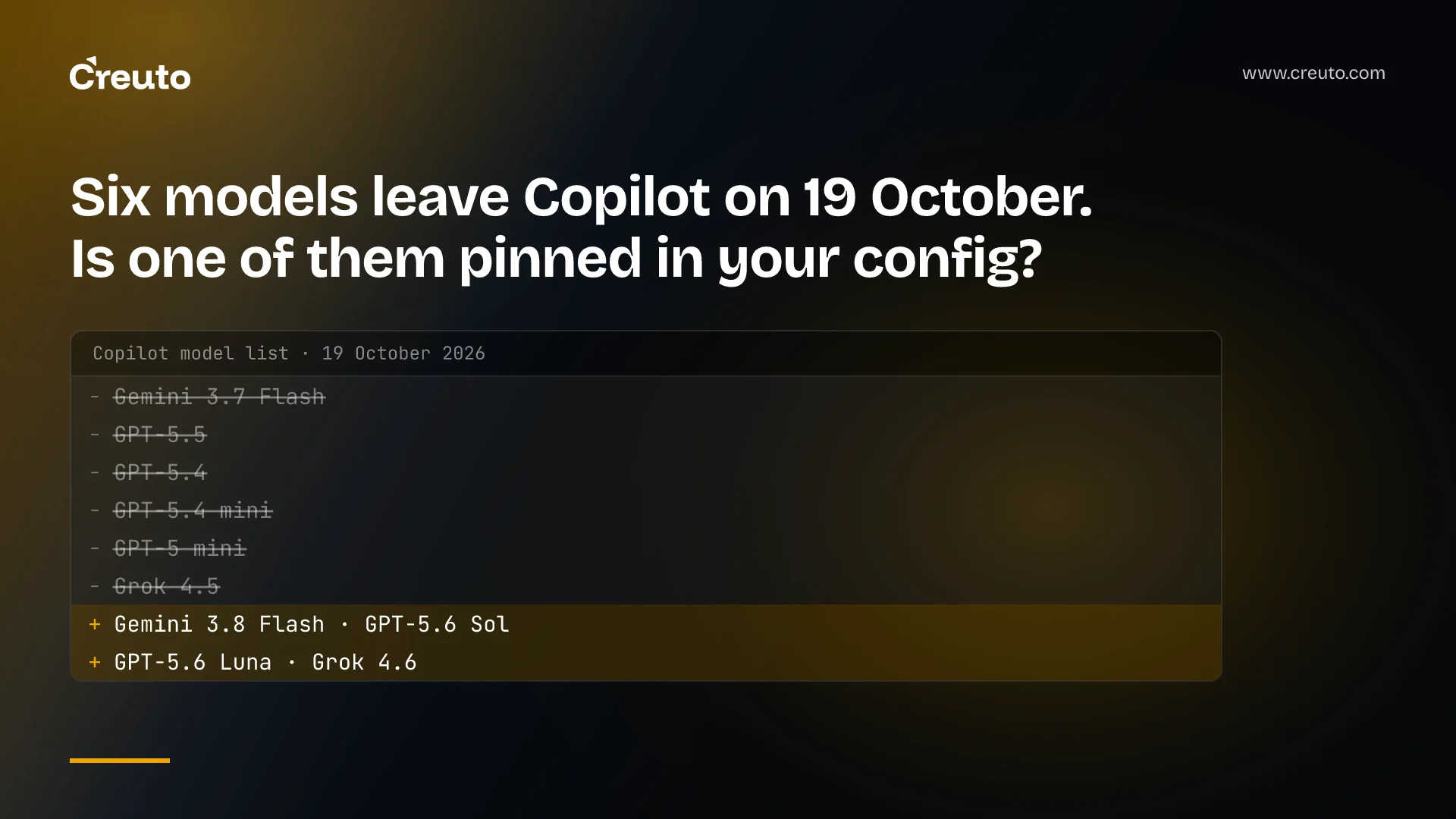
GitHub has announced a GitHub Copilot model deprecation taking effect on 19 October 2026. Six models are being retired across every Copilot experience — Copilot Chat, inline edits, ask and agent modes, and code completions. Nothing breaks before that date, and nothing needs uninstalling after it. What needs attention is anywhere your team has named a specific model and forgotten about it.
GitHub Copilot model deprecation: the full list
| Model | Deprecation date | Suggested alternative |
|---|---|---|
| Gemini 3.7 Flash | 2026-10-19 | Gemini 3.8 Flash |
| GPT-5.5 | 2026-10-19 | GPT-5.6 Sol |
| GPT-5.4 | 2026-10-19 | GPT-5.6 Sol |
| GPT-5.4 mini | 2026-10-19 | GPT-5.6 Luna |
| GPT-5 mini | 2026-10-19 | GPT-5.6 Luna |
| Grok 4.5 | 2026-10-19 | Grok 4.6 |
Look at the right-hand column rather than the left. Six models map to four replacements. GPT-5.5 and GPT-5.4 both become GPT-5.6 Sol; GPT-5.4 mini and GPT-5 mini both become GPT-5.6 Luna. Two models collapsing into one is not a version bump — it means at least one group of users is getting a model that behaves differently from the one they chose, and the word "suggested" in GitHub's table is doing real work.
What happens automatically, and what does not
For Copilot Enterprise and Copilot Business customers under default model enablement, the suggested alternatives are enabled automatically. Two exceptions: if an administrator has turned off the global default, or has explicitly disabled a model, it will not appear. In that case someone has to enable the replacements manually before users can select them.
GitHub is explicit that no action is required to remove the deprecated models after the date — they simply stop being offered. The action it does ask for is to update workflows and integrations to supported models beforehand.
Where a model actually gets pinned
This is the part worth half an hour. In most teams the model is not chosen once — it is chosen in several places, by different people, at different times, and nobody has a list. The usual suspects:
- Editor settings committed to the repository. Somebody set a preferred model in a shared configuration file two sprints ago and it has been the team default ever since.
- Organization policy. Admins who curated an allowlist of permitted models will find that list contains names that are about to stop existing.
- Automation and integrations. Any script, workflow or service that names a model explicitly when it calls Copilot. These fail quietly in the sense that nobody is watching them the way they watch their editor.
- Evaluation harnesses. If you benchmark prompts against a fixed model to keep results comparable, your baseline is about to disappear. This one bites later than the others and hurts more, because it invalidates comparisons rather than breaking a call.
A five-minute grep across your repositories and CI configuration for the six retiring model names will find most of it. Doing that now is much cheaper than working out on 20 October why an agent job started behaving oddly.
Treat it as a behaviour change, not a rename
The reason to test rather than trust the mapping is that model swaps rarely fail loudly. A replacement model does not throw an error — it returns something slightly different. In agent mode that shows up as different tool-calling decisions, different willingness to make multi-file edits, different verbosity in diffs. In completions it shows up as suggestions your developers accept at a different rate. None of that appears in a log.
The two collapsed pairs deserve particular attention. If your team standardised on a mini model for speed and cost, both mini options now land on GPT-5.6 Luna, and the thing you were optimising for — latency in inline suggestions, tokens spent per agent run — is the thing most likely to have moved. Measure the run, not just the output. An agent that reaches the same answer while making twice as many tool calls has changed your bill without changing your diff.
If you have a prompt set you already use to check quality, run it against both the outgoing and incoming model this month while you can still run both. That comparison window closes on 19 October and does not reopen. This is the same reason we argue for scoring the trajectory an agent takes rather than only its final answer — the difference between two models usually lives in the path, not the result.
If you do not have a prompt set, this is a reasonable excuse to start one. Ten representative tasks from your own codebase, run against both models, with someone reading the output, will tell you more than any benchmark. Keep it in version control alongside everything else the agents rely on, for the same reason you would keep agent knowledge in git.
What this says about pinning models at all
Deprecations on this cadence are now normal, and they will keep coming. The structural answer is not to pin harder — it is to make the model a configuration value rather than a fact scattered through your codebase. One place that names the model, everything else asking that place. Teams that route model access through a gateway rather than hard-coded identifiers handle this kind of announcement in a single change instead of an audit.
That is the honest lesson here. The deprecation itself is well-handled: a month's notice, a clear table, automatic enablement for most customers, no cleanup required. The pain teams feel will be proportional to how many places they wrote a model name down.
The short version
- Grep for the six model names across repositories, CI and integrations.
- If your admin turned off the global default, enable the replacements manually.
- Run your prompt set against old and new before 19 October, while both exist.
- Move model selection to one configurable place so the next announcement is a one-line change.
We run model-pinned agent workflows on our own AI engineering work, and the grep step has caught something every single time. It is rarely where anyone expected.
Source: GitHub's changelog entry on the upcoming deprecation of selected GitHub Copilot models, and GitHub's documentation on supported AI models in Copilot, as of September 2026.
Frequently asked questions
Six models retire on 19 October 2026: Gemini 3.7 Flash, GPT-5.5, GPT-5.4, GPT-5.4 mini, GPT-5 mini and Grok 4.5. The deprecation applies across all Copilot experiences, including Copilot Chat, inline edits, ask and agent modes, and code completions.
GitHub suggests Gemini 3.8 Flash for Gemini 3.7 Flash, GPT-5.6 Sol for both GPT-5.5 and GPT-5.4, GPT-5.6 Luna for both GPT-5.4 mini and GPT-5 mini, and Grok 4.6 for Grok 4.5. Two pairs collapse into a single replacement, so behaviour will differ for some users.
No action is needed to remove the models themselves. You should update any workflow, integration or configuration that names a retiring model explicitly. Enterprise and Business customers under default model enablement get the alternatives automatically unless an admin disabled the global default or that model.
Not in the sense of an outage. The retired models stop being offered and users fall back to available ones. The risk is quieter: automation that names a deprecated model, and evaluation baselines that assumed a fixed model, will behave differently without raising an error.
Run a set of ten or so representative tasks from your own codebase against both the outgoing and incoming model before 19 October, while both are still available, and have someone read the results. Pay attention to agent tool-calling decisions and diff behaviour, not just final answers.