Gemini 3.8 Flash pricing doubles on 1 January 2027
Gemini 3.8 Flash pricing doubles to $1.50/$7.50 per 1M tokens on 1 Jan 2027, and Google already routes your gemini-3.7-flash calls to it.
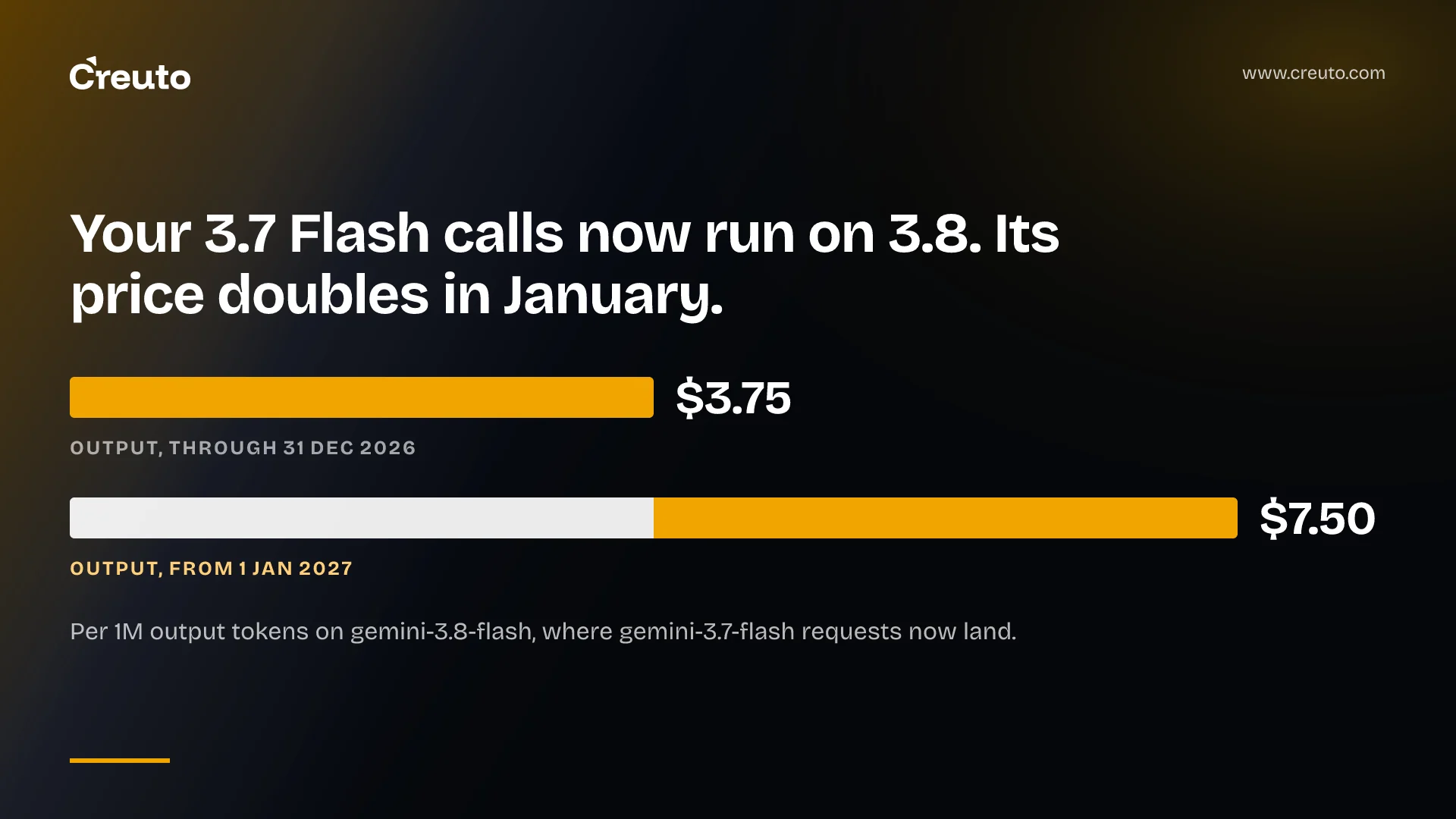
Gemini 3.8 Flash pricing doubles on 1 January 2027: standard input goes from $0.75 to $1.50 per million tokens and output from $3.75 to $7.50, according to Google's Gemini API pricing page. If your code still calls gemini-3.7-flash, that applies to you too. Google deprecated 3.7 Flash on 8 October and now sends its traffic to 3.8 Flash. By the end of this post you'll know what changed, what it costs from January, and what to re-test before your 2027 budget is set.
The key facts, as of 25 October 2026:
- 8 October 2026: Google's changelog states that "API requests to gemini-3.7-flash are automatically routed to gemini-3.8-flash." The same entry routes
gemini-3.5-flashtogemini-3.6-flash. - No shutdown date: the deprecations page says the 3.7 Flash endpoint "is not shutting down" and lists its shutdown as N/A. Your calls keep working; a different model answers them.
- 31 December 2026: the introductory 3.8 Flash rates end. The same doubling applies to Gemini 3.6 Flash, so the 3.5 Flash route goes the same way.
- Who is affected: anyone who pinned
gemini-3.7-flashorgemini-3.5-flashon the Gemini API, and anyone budgeting 2027 on 2026 Flash rates.
Gemini 3.8 Flash pricing before and after 1 January 2027
Every 3.8 Flash paid tier doubles on the same date. These figures come from Google's pricing page (last updated 22 October 2026), in US dollars per million tokens. Output prices include thinking tokens.
| Rate (per 1M tokens) | Through 31 Dec 2026 | From 1 Jan 2027 |
|---|---|---|
| Standard input | $0.75 | $1.50 |
| Standard output (incl. thinking) | $3.75 | $7.50 |
| Context caching (cached input) | $0.075 | $0.15 |
| Cache storage (per 1M tokens per hour) | $0.50 | $1.00 |
| Batch and Flex input / output | $0.375 / $1.875 | $0.75 / $3.75 |
| Priority input / output | $1.35 / $6.75 | $2.70 / $13.50 |
The free tier stays free for input, output and caching, but Google's pricing page notes that free-tier content is "used to improve our products". That rules it out for most production data.
The auto-route means a different model, not just a new name
Google's changelog says gemini-3.7-flash "is deprecated and has been replaced by gemini-3.8-flash" and asks developers to update the model string. The redirect is quiet by design: nothing errors, so a team that pinned a model ID to freeze behaviour has had a different model answering its traffic since 8 October.
That matters if you've noticed your 3.7 Flash output reads differently. Google's What's new in Gemini 3.8 Flash page says the model "can use more tokens on longer running and complex tasks, by design", and the 3.8 Flash model card adds that it "might use more tokens to maximize performance, especially at higher effort levels." The same model card reports that safety performance in non-English languages "regressed slightly relative to 3.7 Flash".
Some things did not change. Both model pages list low, medium and high thinking levels, state that minimal "is not supported and returns an error", and give the same 1,048,576-token input limit and 65,536-token output limit (3.8 Flash, 3.7 Flash). Google's What's new page gives medium as the default thinking level on 3.8 Flash.
Re-run evals after model auto-routing
Treat 8 October as a model release you didn't schedule. Re-run your eval set against gemini-3.8-flash explicitly, then compare output tokens per task as well as pass rates. If you serve users in languages other than English, include those cases, given the model card's note on safety. Then change the model string in code, so your logs name the model that actually answered.
"3.8 costs the same as 3.7" is true, and still misleading
Several summaries say 3.8 Flash costs the same as 3.7 Flash. That checks out. The 3.8 Flash model card lists both models at $0.75 input and $3.75 output, with "$1.50 regular" and "$7.50 regular" beside each. Google's August changelog entry for 3.7 Flash also called its rate "an introductory price through December 31, 2026."
So the doubling isn't a penalty for being moved to 3.8. You'd have hit it on 3.7 Flash too. What the summaries leave out is the date, and the fact that equal per-token rates don't make equal bills. FullStack's comparison makes the same point: 3.8 may spend more thinking tokens, steps or tool calls per task, and every one bills at the output rate. If you see a 2027 cached-input rate of $0.075 anywhere, it's the 2026 figure: Google lists $0.15 from 1 January.
What the doubling does to a monthly bill
Here's a worked example. The workload is an illustrative assumption, not a measurement: 10,000 requests a day for 30 days, 3,000 input tokens and 800 output tokens (thinking included) per request. That's 900 million input tokens and 240 million output tokens a month.
| Scenario (illustrative) | Input cost | Output cost | Monthly total |
|---|---|---|---|
| Standard, 2026 rates | 900 × $0.75 = $675 | 240 × $3.75 = $900 | $1,575 |
| Standard, 2027 rates | 900 × $1.50 = $1,350 | 240 × $7.50 = $1,800 | $3,150 |
| Standard 2027, output 20% higher (hypothetical) | 900 × $1.50 = $1,350 | 288 × $7.50 = $2,160 | $3,510 |
| Batch or Flex, 2027 rates | 900 × $0.75 = $675 | 240 × $3.75 = $900 | $1,575 |
The 20% row is a sensitivity test, not a measured figure. Google hasn't published how many more tokens 3.8 Flash uses, so measure your own. The last row is more useful: in 2027, Batch or Flex costs exactly what standard costs today. If a workload can tolerate latency, moving it there keeps your current unit cost. We compare the two OpenAI equivalents in Batch API vs Flex, and the trade-offs carry over.
Gemini 3.8 Flash context caching price
Caching gets more valuable in 2027 even though it doubles too. Cached input stays at a tenth of standard input ($0.15 against $1.50), so every repeated system prompt or document you move into a cache saves twice as many dollars as it does today. Our guide to prompt caching covers how to find those repeated prefixes. Remember the storage charge doubles to $1.00 per million tokens per hour, so long-lived caches of rarely used content cost more to keep.
Is Gemini 3.8 Flash cheaper than Claude Haiku 5.5?
Not per token. Anthropic's pricing page lists Claude Haiku 5.5 at $0.10 input and $0.50 output per million tokens for prompts up to 100,000 tokens, and $0.50 / $2.50 above that. Run the illustrative workload above through it and you get $90 + $120 = $210 a month, against $3,150 for 3.8 Flash in 2027.
That comparison is the strongest case for switching, and it's incomplete. The two models use different tokenizers, so the same prompt won't produce the same token counts. They also aren't positioned as equivalents: Google pitches 3.8 Flash at "long-horizon software engineering, autonomous agents, and complex enterprise workflows". Switching is the wrong choice if 3.8 Flash passes evals that the cheaper model fails. The number that decides it is cost per completed task on your own eval set, not price per token.
What to do before 1 January
- Search your code and config for
gemini-3.7-flashandgemini-3.5-flash. Replace them with the model you actually tested. - Re-baseline cost per task on 3.8 Flash using real traffic, including thinking tokens, then project it at the 2027 rates.
- Move latency-tolerant jobs to Batch or Flex, and cache stable prefixes.
- Set spend alerts for January. Our post on AI spend monitoring covers catching a jump before the invoice does.
This isn't Google's only price step this winter. Its pricing page shows Gemini 4 Argon doubling earlier, on 1 December 2026, from $2.00 to $4.00 input and $10.00 to $20.00 output. Our Gemini 4 Argon breakdown covers that model. We build LLM features on Gemini, Claude and OpenAI APIs as part of our AI engineering services. If you can't yet say what one completed task costs you, that's the number to start measuring this quarter.
Frequently asked questions
Gemini 3.8 Flash costs $0.75 per million input tokens and $3.75 per million output tokens, thinking tokens included, through 31 December 2026. From 1 January 2027, Google's pricing page lists $1.50 input and $7.50 output. Batch and Flex are half the standard rate, and Priority costs more.
Gemini 3.7 Flash is deprecated but not shut down. Google's deprecations page says the endpoint is not shutting down and lists no shutdown date. Since 8 October 2026, API requests to gemini-3.7-flash are automatically routed to gemini-3.8-flash, and the model is no longer selectable in Google AI Studio.
Gemini 3.7 Flash output changed because Google has routed gemini-3.7-flash requests to gemini-3.8-flash since 8 October 2026. Google says 3.8 Flash can use more tokens on longer and complex tasks by design, so response length, reasoning and cost per task may shift. Re-run your evals against 3.8 Flash.
Gemini 3.8 Flash will cost twice as much from 1 January 2027. Standard input rises from $0.75 to $1.50 per million tokens, output from $3.75 to $7.50, cached input from $0.075 to $0.15, and cache storage from $0.50 to $1.00 per million tokens per hour, according to Google's pricing page.
Gemini 3.8 Flash is not cheaper than Claude Haiku 5.5 per token. Anthropic lists Haiku 5.5 at $0.10 input and $0.50 output per million tokens for prompts up to 100,000 tokens. The models use different tokenizers and target different work, so compare cost per completed task on your own evals.
Gemini 3.6 Flash pricing also doubles on 1 January 2027. Google's pricing page lists it at the same rates as 3.8 Flash: $0.75 input and $3.75 output per million tokens through 31 December 2026, then $1.50 and $7.50. Requests to gemini-3.5-flash are now routed to gemini-3.6-flash.