Foundation Models framework iOS 27 guide: on-device, cloud or Claude?
The Foundation Models framework iOS 27 release runs Apple's on-device model, Private Cloud Compute or third-party LLMs behind one API. How to use it.
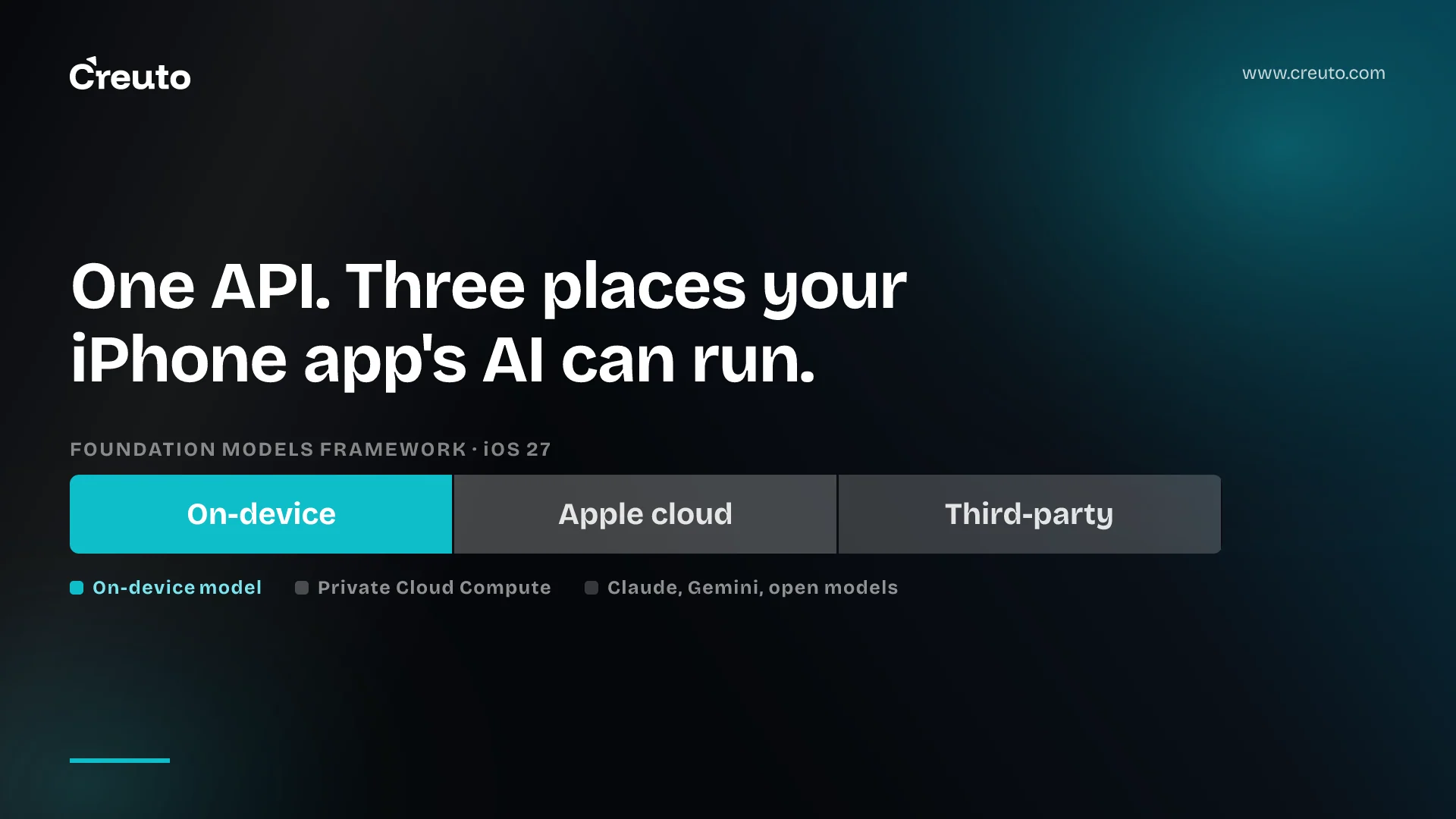
With iOS 27 now on customers' iPhones, the features Apple announced at WWDC in June are shippable — and for app builders the headline is the Foundation Models framework iOS 27 release and how much it has grown. It started as a way to call Apple's small on-device model. It is now a single API that can run Apple's on-device model, Apple's larger model on Private Cloud Compute, or third-party models such as Claude and Gemini, with built-in tools for images, barcodes and search. That changes how iPhone apps should add AI features.
What the Foundation Models framework iOS 27 release adds
Apple's WWDC26 session "What's new in the Foundation Models framework" covers the main changes:
- A rebuilt on-device model, better at logic and tool calling, plus APIs (from iOS 26.4) to inspect context size and count tokens so apps can adapt to the device they run on.
- Vision. The on-device model can now take images as input.
- Private Cloud Compute for developers. A new model option runs Apple's larger server model, the same one that powers many Apple Intelligence features. Apple says there is no account setup, authentication or API key to manage, no prompts are stored, and independent researchers can verify the privacy claims.
- Third-party and open-source models. A new LanguageModel protocol lets almost any local or server model back a session. Apple's separate session, "Bring an LLM provider to the Foundation Models framework", shows how model providers implement it.
- System tools: a barcode reader, an OCR tool that extracts structured text from images, and a Spotlight-powered search tool for local retrieval.
- Dynamic profiles, which let one session switch models, instructions and tools as a task changes — for example from quick on-device analysis to deeper reasoning on Private Cloud Compute.
- An Evaluations framework for measuring the quality of intelligence features.
Underneath, Apple's third-generation foundation models are a family of five, built in collaboration with Google, spanning on-device models and server models on Private Cloud Compute.
Is Apple's Private Cloud Compute model free for developers?
For most apps, yes. Apple says Private Cloud Compute is available with no cloud API costs to developers whose apps have fewer than 2 million first-time downloads. Each user gets a daily allowance, which is higher for iCloud+ subscribers. It requires an entitlement, covered in Apple's dedicated session. For many small and mid-sized apps, that removes the per-token bill that usually comes with adding generative features.
On-device vs cloud: which tasks go where
| Task | Good fit | Why |
|---|---|---|
| Summarise a note, tag a photo, extract text from a receipt | On-device | Private, offline, instant, no cost |
| Longer reasoning, richer writing, broader knowledge | Private Cloud Compute | More capable, still private, no API keys |
| Specialised or frontier capabilities, or cross-platform consistency | Third-party LLM | Same model on iOS, Android and web; your own contract and costs |
The pattern is the same one we recommend for server-side AI: route each task to the cheapest model that meets its quality bar, as described in LLM cost optimisation. Dynamic profiles make that routing a first-class feature of the framework.
Can iOS apps use third-party LLMs in Foundation Models?
Yes, through the new LanguageModel protocol. That matters for teams that already use a provider such as Claude or Gemini on their backend or Android app: the iOS app can use the same model behind Apple's session API, alongside Apple's models, instead of maintaining a separate integration. Data sent to a third-party model follows that provider's terms, so the privacy story differs from Apple's own models — design and disclose accordingly.
What about React Native and Flutter apps?
The framework is a Swift API, so cross-platform apps reach it through a native module. The practical approach is to keep AI features behind your own interface: native Foundation Models on iOS, and an equivalent model on Android, with the same prompts and evaluation set. Many teams will do this work alongside their iOS 27 upgrade.
Keeping the prompts, expected outputs and evaluation examples in one shared place — rather than inside each platform's code — makes it much easier to keep the iOS and Android behaviour aligned as models change underneath. It also means a model swap on one platform can be tested against the same examples before release.
How to add AI to an iOS app with Foundation Models
- Pick one feature with clear user value — search, summarising, extracting data from photos.
- Start on-device and measure quality with a small evaluation set.
- Escalate to Private Cloud Compute or a third-party model only for cases the on-device model handles poorly.
- Handle availability. Not every device supports Apple Intelligence; design a fallback.
- Measure with Apple's Evaluations framework or your own tests, before and after each change.
Our iOS app development and AI engineering teams build AI features that use on-device models where they are good enough and cloud models where they are needed — and keep them consistent across iOS and Android.
Frequently asked questions
The Foundation Models framework is Apple's Swift API for adding generative AI to apps. On iOS 27 it can use Apple's on-device model, Apple's larger model on Private Cloud Compute, or third-party and open-source models through a common session API.
Yes. Apple's new LanguageModel protocol lets nearly any local or server model, including third-party providers, back a Foundation Models session, alongside Apple's own models. Data sent to a third-party model follows that provider's terms.
Apple says Private Cloud Compute is available with no cloud API costs to developers with fewer than 2 million first-time downloads, with a daily allowance per user that is higher for iCloud+ subscribers. It requires an entitlement.
The on-device model works offline and keeps data on the iPhone. Private Cloud Compute and third-party models require a network connection, so apps should design fallbacks and route only suitable tasks to cloud models.