Form 138 TDS return: what your payroll export must change
Form 138 TDS return for Q2 is due 31 October. The new salary section codes, the remapped FVU column layout, and why the late fee is section 427, not 234E.
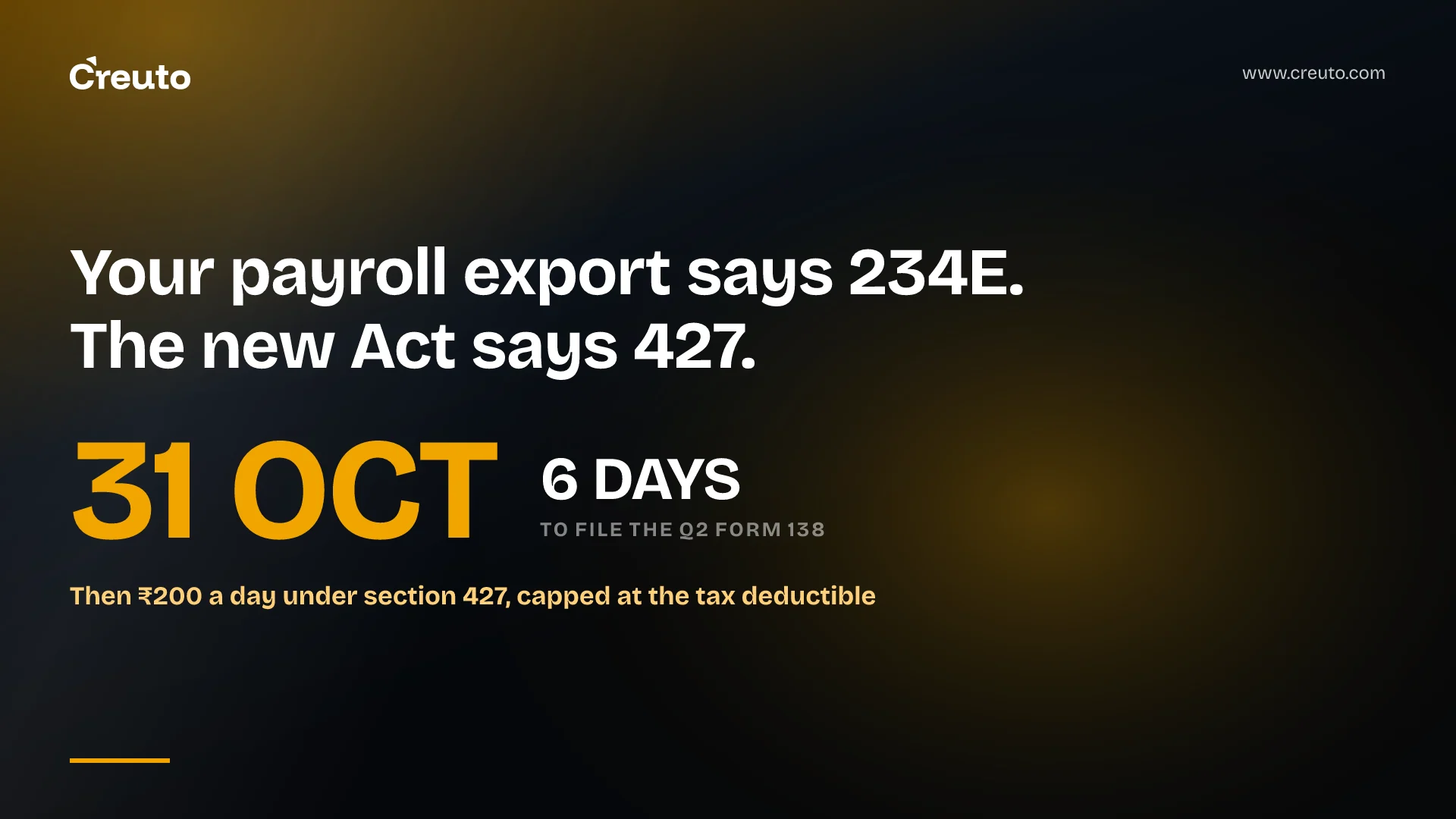
The Form 138 TDS return for July to September 2026 is due on 31 October, and many guides still quote 1961-Act sections for what happens if you miss it. Form 138 replaces Form 24Q, and a payroll export built for 24Q now needs different section codes, a remapped column layout and the current validation utility. This post sets out exactly what changes, from the primary documents.
The Income Tax Department's Form 138 FAQ puts the late fee under section 427 and penalties under sections 461 and 465(2)(g). Guides published as recently as September 2026 still cite 234E and 271H. The amounts they quote are right. The section numbers are not, and the codes and columns underneath them have moved too.
Form 138 TDS return: the key facts for Q2
The official FAQ and the Form 138 explanatory note both map the old references to the new ones, and both give the same quarterly calendar. As of 25 October 2026, this is what applies to tax year 2026-27.
| Item | Under the 1961 Act and 1962 Rules | Under the Income-tax Act, 2025 and Rules, 2026 |
|---|---|---|
| Quarterly salary TDS statement | Form 24Q | Form 138 |
| Section requiring the statement | 200(3) | 397(3)(b) |
| Rule | 31A | 219 |
| TDS on salary | 192 | 392 (other than 392(7)) |
| Late filing fee | 234E | 427 |
| Penalty for late or incorrect statement | 271H | 461 (and 465(2)(g), per the FAQ) |
The due dates, per the FAQ: Q1 (April to June) by 31 July, Q2 (July to September) by 31 October, Q3 (October to December) by 31 January, and Q4 (January to March) by 31 May after the tax year ends. Annexure I goes with every quarter. Annexure II (salary detail for employees) and Annexure III (specified senior citizens) go only with Q4.
This is not a niche filing. The explanatory note says that on average 22.5 lakh original forms were filed each year over the past five years.
Which section code for salary TDS in Form 138? 1001, 1002 or 1003
The notified Form No. 138 lists four section codes for Annexure I, and the old "192" value is not one of them.
| Section | Nature of payment | Code |
|---|---|---|
| 392 | Government employees other than Union Government employees | 1001 |
| 392 | Employees other than Government employees | 1002 |
| 392 | Indian Government employees | 1003 |
| 393(1) [Table: Sl. No. 8(iii)] | Specified senior citizen | 1032 |
A private-sector employer will put 1002 against almost every row. The trap is code 1004. Secondary code tables, such as this one, list it next to the salary codes, but describe it as EPF withdrawal. It does not appear in Form 138's own code list, so a payroll system that copied a "1001 to 1004 means salary" range from a blog has a lookup table that is wrong.
The column layout moved, so position-based exports break
This is the change most likely to break a working export. Protean's key-features note for RPU and FVU version 1.1 renumbers the Form 138 columns from the old three-digit numbers to letters, and drops some columns entirely:
- Challan details: old columns 301 to 312 become A to K, and column 303 is removed. Old 308 becomes J, 309 becomes G and 311 becomes H, so the order changes as well as the labels.
- Surcharge, Education Cess and Penalty/Others are removed from challan details. Interest and Fee become "Total Interest" (C) and "Total Fee" (D).
- Annexure I: old columns 321 and 322 are removed, and 315 and 316 now come before 314.
- The lower-deduction certificate column now refers to section 395(1), not section 197.
- A contact number with country code is added for the deductor and for the person responsible, and "Financial Year" becomes "Tax Year".
The version 1.2 note, the latest we found on Protean's site, adds 'Interest Allocation' and 'Others Allocation' columns under challan details, with matching FVU checks. It also requires the date of payment under DD details to fall within the quarter and tax year being filed. Check Protean's download page for the current version on the day you file, not the one your team used in July.
There's one more mismatch. The notified form's Part B still prints a "Total penalty/others" column, while the utility notes say Penalty/Others was removed from challan details. If your export is generated from the printed form rather than the utility's file format, the two won't line up column for column. Build to the utility, because the FVU decides whether your file is accepted.
What Form 138 needs from payroll every quarter, and what waits for Q4
Annexure I is the quarterly deductee break-up. Per the notified form, each row carries the challan reference, employee PAN and name, the employer's employee reference number, section code, dates of payment and deduction, amount paid, tax deducted and deposited, the reason for any lower, nil or higher deduction, and the section 395(1) certificate number. Total tax in column J is tax plus surcharge plus Health and Education Cess, as one figure.
Annexure II is where Q4 gets heavy, and it's worth building now rather than in May. The notified form asks for perquisites and profits in lieu of salary under sections 17 and 18 "as per Form No. 123", a Yes/No on opting out of taxation under section 202(1), salary reported from other employers under section 392(4), and the landlord's PAN where rent paid in the tax year exceeds one lakh rupees. It also needs the lender's PAN for housing-loan interest where the lender is not a financial institution or the employer. Every deduction section is renumbered too, for example health insurance under section 126 and rent under section 134.
Annexure II matters beyond the return itself. According to the explanatory note, TRACES prepares Form 130, the salary TDS certificate, from Annexure I and Annexure II, and the employer issues it by 15 June. Salary details in the employee's ITR are taken directly from Annexure II. A wrong figure in your Q4 file surfaces in every employee's tax return. We covered the certificate side in Form 130 replaces Form 16.
The note also lists field-level changes. Token No. is replaced by Return Receipt Number, TAN Registration No. is deleted, and surcharge and cess are consolidated under challan or book adjustment. Government deductors enter PANNOTREQD in place of a PAN, per the form's notes.
Late fee for Form 138: section 427, not 234E
Here the popular coverage and the primary source part ways. A Q2 Form 138 guide dated 22 September 2026 tells employers the late fee is "₹200 per day under Section 234E" and the penalty falls under Section 271H. A July 2026 Q1 guide uses the same two sections. The department's own FAQ names section 427 for the late filing fee and sections 461 and 465(2)(g) for penal proceedings.
To be fair to those guides, the money is the same. Section 427 charges ₹200 for every day the statement under section 397(3)(b) is late, capped at the tax deductible, and the fee must be paid before the statement is delivered. Section 461 lets the Assessing Officer impose ₹10,000 to ₹1,00,000 for a late statement or incorrect information. It waives the late-filing penalty if the tax, fee and interest were paid and the statement was filed within one month of the due date. We could not read section 465(2)(g) in the enacted text, so we won't paraphrase it.
So why does the section number matter to an engineering team? Because software prints it. Fee lines, compliance dashboards, reminder emails and notice-handling workflows that say "234E" are wrong documents, and the form itself tells you where the fee goes: the notified form's Note 5 says the fee paid under section 427 belongs in the "Total Fee" column (D). For Q2, the practical deadline is 31 October. Pay the tax, fee and interest and file within a month of that date, and you stay inside section 461's waiver for lateness. Incorrect information has no such waiver.
Can Form 138 be revised? Correction statements and the two-year window
A submitted Form 138 cannot be edited. The FAQ says you file a correction statement, and only after CPC-TDS has processed the original. The window is two years from the end of the tax year in which the statement was due. The FAQ's own example: a correction to Q3 of tax year 2026-27 can be filed up to 31 March 2029.
For the data model, that means three things. Store the Return Receipt Number of every original statement, because Part A of the form asks for it when the statement has been filed earlier. Keep the source data for each quarter immutable for at least that two-year window. And keep the old 24Q mappings alive alongside the new ones for any correction to statements filed under the 1961-Act rules, rather than overwriting them.
RPU, FVU and the upload: the department describes it two ways
The explanatory note sets out the filing process. Deduct tax on salary under section 392, and pay it to the government by the dates in Rule 218. Prepare the statement in the RPU provided by TIN-NSDL, then validate it with the FVU, which produces a .fvu file if there are no errors. Upload that file on the e-filing website or at a TIN facilitation centre, after which CPC-TDS processes it.
The FAQ describes the last step differently. It says that after filing Form 138 "on the TRACES portal", the deductor receives an Acknowledgment Receipt Number, while the form itself refers to a Return Receipt Number. These may describe the same flow from two angles, but don't hard-code one portal or one receipt format into your workflow. Record whichever receipt comes back, against the quarter and TAN, and treat the FVU-validated file as the artefact your payroll system owns.
What to change in a payroll codebase before 31 October
If your Q2 file is generated by a payroll or ERP system rather than typed into the RPU by hand, this is the order we would work in:
- Replace the section code lookup with 1001, 1002, 1003 and 1032, keyed on employee type, and delete any "1004 is salary" mapping.
- Regenerate the export against the version 1.2 column layout: letters, not 301 to 327, with the removed columns gone and the new allocation columns present.
- Collapse surcharge and cess into total tax, and route any late fee to Total Fee (column D) labelled section 427.
- Add the country-code contact fields for the deductor and the responsible person.
- Validate last quarter's data through the current FVU and reconcile challan BSR codes, dates and serial numbers against TRACES.
- Start the Annexure II field mapping now: Form 123 perquisites, landlord and lender PANs, prior-employer salary under section 392(4).
This is the wrong priority if a TDS filing provider builds your return from a spreadsheet you send them. In that case, your export only needs the right inputs, and the code and column work is theirs. Ask them which FVU version they validated against.
Our Nomina payroll platform was built on the premise that statutory rules change: the case study describes TDS worksheets generated each pay cycle and Form 16 at year end, from an engine designed to be updated when government rules change. That's the design choice this transition rewards. Systems that hold section codes, column layouts and form names as dated configuration absorb a new Act as a data change. Hard-coded ones need a project, as they did for the EPF wage ceiling change in September. If your payroll module is in the second group, our custom software development team can scope the fix.
The decision for this week is narrow. Either your Q2 file passes the current FVU with the new codes by 31 October, or you budget ₹200 a day and plan to file inside the one-month window section 461 allows.
Frequently asked questions
Form 138 is the quarterly statement an employer files to report tax deducted at source from salaries under section 392 of the Income-tax Act, 2025. It replaces Form 24Q, is required by section 397(3)(b) and is filed under Rule 219 of the Income-tax Rules, 2026, from tax year 2026-27.
Form 138 is due quarterly: 31 July for April to June, 31 October for July to September, 31 January for October to December, and 31 May after the tax year ends for January to March. The Q2 Form 138 for tax year 2026-27 is therefore due on 31 October 2026.
Form 138 does the same job as Form 24Q, but it is not a renamed copy. Section references, the salary section codes 1001, 1002, 1003 and 1032, the utility's column numbering and several challan fields have changed, so a payroll export built for 24Q must be updated to match the current FVU.
For a private-sector employer, the Form 138 section code for salary TDS is 1002, covering employees other than Government employees under section 392. Code 1001 covers Government employees other than Union Government employees, 1003 Indian Government employees, and 1032 specified senior citizens. Code 1004 is not in the list.
The late fee for Form 138 is ₹200 for every day the statement is late, under section 427 of the Income-tax Act, 2025, capped at the tax deductible and payable before filing. A separate section 461 penalty of ₹10,000 to ₹1,00,000 can apply, waived for lateness if dues are paid and filing is within one month.
A submitted Form 138 cannot be edited, but the deductor can file a correction statement once CPC-TDS has processed the original. The correction must be filed within two years from the end of the relevant tax year, so a correction to a tax year 2026-27 quarterly statement can be filed up to 31 March 2029.