Fisheries product passport: what is proposed, what is law
The fisheries product passport is proposed, not required. SIMP and MPEDA enrolment are in force, and the EU catch certificate excludes farmed shrimp.
A fisheries product passport for Indian seafood does not exist yet. No notification, no scheme, no draft instrument — one unnamed official told a news agency India needs one. Meanwhile the rules that do bind exporters today are American and Indian, not European, and the EU rule everyone is preparing for excludes farmed shrimp outright.
That last point is the expensive one. If you are scoping a traceability build against the EU catch certificate regime because your product is shrimp, you are building against a regulation that does not apply to you.
What is actually in force, and what is only proposed
| Requirement | Status | Who it binds |
|---|---|---|
| US SIMP entry reporting and chain-of-custody records | In force since 31 December 2018 for shrimp | The US importer of record |
| MPEDA aquafarm enrolment certificate | In force | All export-oriented aquaculture farms |
| MPEDA pre-harvest testing | In force; EU-bound raw material only since June 2014 | Farms supplying EU consignments |
| EU catch certificate via CATCH | Mandatory from 10 January 2026 — wild-caught marine products only | Not farmed shrimp |
| Fisheries product passport | Proposed. Advocated by an official; no instrument published | Nobody, yet |
Why the EU catch certificate does not apply to your farmed shrimp
The IUU Regulation, Council Regulation (EC) No 1005/2008, defines "fishery products" at Article 2(8) as products under Chapter 03 and headings 1604 and 1605 of the Combined Nomenclature "with the exception of the products listed in Annex I of this Regulation". Commission Regulation (EU) No 202/2011 replaced that Annex with a list headed "List of products excluded from the definition of 'fishery products'". The first entry on it is "Aquaculture products obtained from fry or larvae".
Farmed vannamei and monodon are stocked from hatchery post-larvae. They are obtained from fry or larvae, so they sit outside the definition, so no catch certificate attaches. NOAA Fisheries' guidance on EU certification states the precondition plainly: the product must be "wild-caught (not aquaculture)". Note the Regulation's own wording is narrower than the common restatement — it excludes aquaculture products obtained from fry or larvae, not "aquaculture" as a flat category. For shrimp the distinction makes no practical difference, but quote the right clause if you are writing a compliance memo.
The January 2027 date now circulating is being misread as well. The European Commission confirms CATCH became mandatory for imports on 10 January 2026, under Regulation (EU) 2023/2842. What arrives on 10 January 2027 is the revised simplified catch certificate under Commission Implementing Regulation (EU) 2025/1522, which amends Regulation (EC) No 1010/2009 — and it is for third-country fishing vessels under 12 metres without towed gear, or under 8 metres with. It is a small-boat simplification for wild capture. It has nothing to do with aquaculture.
The conflation appears to originate in the coverage itself. The article that prompted the product passport discussion says products sold in the bloc need to be digitally traceable "from the boat or farm", which runs the catch certificate regime together with EU food hygiene and health certification. They are different instruments with different scopes.
SIMP is the rule that actually reaches into your farm records
The US Seafood Import Monitoring Program, 50 CFR § 300.324, puts shrimp and abalone in a heavier tier than the original eleven species groups: entry data reporting and the International Fisheries Trade Permit and recordkeeping requirements. Farmed product is squarely in scope. The entry data set at § 300.324(b) requires the "Name(s) of farm or aquaculture facility", the "Area(s) of wild-capture or aquaculture location", the "Location of aquaculture facility", and the points and dates of first landing, transshipment or delivery, filed through the Automated Commercial Environment.
Two retention obligations run for two years from the date of the import: the entry information under § 300.324(d), and separately, under § 300.324(e), records "containing information on the chain of custody of the fish or fish products sufficient to trace the fish or fish product from point of entry into U.S. commerce back to the point of harvest". NOAA dates shrimp compliance from 31 December 2018.
Worth knowing what did not happen: NOAA withdrew its proposed SIMP expansion rule and opened a programme review instead, so the thirteen species groups stand. A separate proposed domestic rule covering US-farmed shrimp is sometimes cited as if it bound importers. It does not.
The obligation formally sits on the US importer of record. In practice it lands on you, because the importer cannot produce a farm name and an aquaculture location two years after the fact unless the Indian side recorded them at the time and can hand them over on request.
What MPEDA already requires at the farm gate
India's farm-level traceability spine exists. MPEDA's aquafarm enrolment scheme states that it "shall apply to all export oriented aquaculture farms producing raw material for export" and that "all export oriented farms irrespective of their registrations with other agencies/departments have to get Enrolment Certificate from MPEDA for export traceability". Enrolment involves physical verification, recorded GPS coordinates, and a system-generated farm identification number. The farm must not use prohibited antibiotics and "shall maintain proper records of inputs used, production, disposal/sale etc so as to ensure traceability".
Pre-harvest testing is the enforcement edge. MPEDA runs sixteen ELISA screening laboratories testing for chloramphenicol and nitrofuran metabolites before harvest. Introduced in April 2009 and extended to all aquaculture exports by notification, it was "restricted to raw material meant for export to EU countries only" from June 2014. Hatchery enrolment, by contrast, is worded as eligibility rather than obligation — a distinction worth preserving when you write requirements.
So the record-keeping duty is already there. The question is whether the records are true.
The hard part is trustworthy event capture, not the database
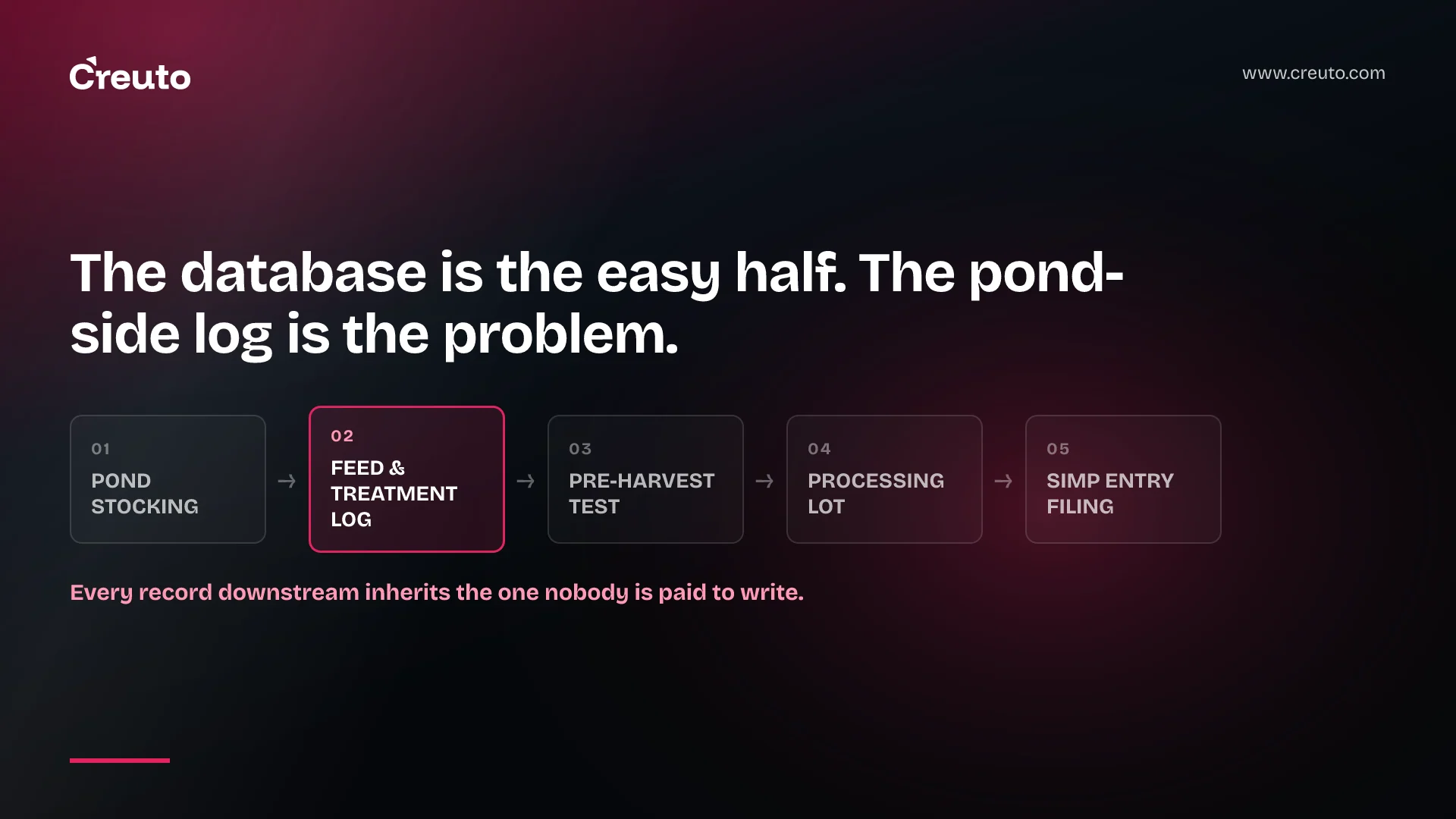
We built Aquapulse, an aquaculture platform live across Odisha, Andhra Pradesh and West Bengal, and the lesson that generalises is this: a traceability system is a chain of claimed events, and the chain is exactly as strong as its first link. Everything downstream — the lot code, the processing batch, the health certificate, the SIMP entry filing — inherits whatever the pond-side record said. Nothing downstream can repair it.
The first link is also the only one nobody is paid to maintain. A processing plant has a QA function, an audit schedule and a customer who withholds payment. A pond has a farmer or a hired caretaker, at a bund, often after dark, with a phone that may have no signal, being asked to record a feed quantity and a treatment that will only ever be used to catch him out. The incentive on the first link points the wrong way.
That shapes what you build, in ways a database-first design misses:
- Offline-first is not a feature, it is the baseline. Capture has to complete and queue locally, survive app restarts and days without connectivity, and reconcile on sync without silently dropping or duplicating events. If a recorder has to retry, they stop recording.
- Timestamps have to be defensible. A record written three weeks later is not evidence. Device time is trivially wrong and trivially changed. Capture both device time and server receipt time, keep them separate, and let the gap be visible rather than quietly normalised.
- Bind the event to the place. MPEDA already geolocates enrolled farms. Carrying the GPS fix on the event itself, alongside the farm identification number, is the difference between a claim and a corroborated claim.
- Make capture pay the recorder something. The only logs that stay accurate are the ones the recorder reads back. Water quality trends, feed conversion, a disease advisory that arrives because yesterday's reading was entered — these are what keep a feed log honest when nobody is watching. Compliance data as a by-product of something useful survives; compliance data as a chore does not.
- Design for the lot, not the pond. Traceability fails at aggregation. Harvests merge, peeling sheds pool, processing lots combine sources. Decide early whether you can defend a one-to-many mapping from export lot back to farm identification numbers, because that is the join a SIMP chain-of-custody request walks.
The same problem appears everywhere farm-level data meets a regulator — it is why consent-based farmer registries are hard, and it is the question underneath shrimp export traceability after the FDA delay. The schema is a weekend. The field capture is the product.
The numbers, and which vintage you are quoting
India exported 19,72,018 tonnes of marine products worth ₹73,890.46 crore, or US$8,455.76 million, in FY 2025-26, on MPEDA's own export data as updated on 28 September 2026. Frozen shrimp was 792,647 tonnes and US$5,624.48 million of that — about 40% of volume and 67% of value. The USA took 279,193 tonnes worth US$2,328.74 million, roughly 14% of volume and 28% of value.
If you have seen different figures, both sets are MPEDA's. A government release in April 2026 gave ₹72,325.82 crore and 19.32 lakh tonnes, described there as provisional, and recorded US shipments "declining by 19.8% in volume and 14.5% in value". The September table is the settled series. Cite the vintage, not just the number.
On duties, two determinations are stable enough to plan against. The 2024-25 antidumping administrative review on certain frozen warmwater shrimp from India set weighted-average margins of 4.04% for the Devi group, 7.01% for Sandhya Aqua, and 5.53% for companies not individually examined. The countervailing duty order published in December 2024 set 5.87%, 5.63% and 5.77% all-others. The broader US tariff position on India changed more than once during 2026, so verify the current stack with your customs broker rather than from any article, including this one. MPEDA's production data shows why it matters: vannamei output reached 1,304,779 tonnes in 2025-26, an all-time high.
What to do while the fisheries product passport is a proposal
Build for SIMP and MPEDA, because those are real, and treat a future product passport as a consumer of the same event stream rather than a separate system. Every credible version of a passport will need the same primitives: an identified farm, dated stocking and input events, a harvest tied to a test result, and a defensible mapping from export lot back to source. If you capture those honestly today, a passport is a reporting surface. If you do not, it is a rewrite.
The decision in front of most exporters is not which standard to target. It is whether the feed log at the pond is written by someone who benefits from writing it. That is a product problem before it is a software problem we can help with, and it is the one worth solving first.
Frequently asked questions
A fisheries product passport is a proposed digital record carrying a consignment's traceability, quality and sustainability credentials from farm or vessel to consumer. An Indian official has advocated one, but no notification, scheme or draft instrument has been published, so it binds nobody at present.
No. Annex I to the IUU Regulation, as replaced by Commission Regulation (EU) No 202/2011, excludes aquaculture products obtained from fry or larvae from the definition of fishery products. Farmed shrimp stocked from hatchery post-larvae therefore fall outside the catch certificate regime entirely.
SIMP requires the US importer to file harvest and landing data at entry, including the farm or aquaculture facility name and location, and to keep both the entry information and chain-of-custody records for two years from the date of import, traceable back to the point of harvest.
Yes, for export-oriented aquaculture farms. MPEDA states that all export oriented farms, irrespective of their registration with other agencies or departments, must obtain an Enrolment Certificate for export traceability. Enrolment involves physical verification by a deputed officer, recorded GPS coordinates and a system-generated farm identification number.
A revised simplified catch certificate under Commission Implementing Regulation (EU) 2025/1522 applies from 10 January 2027, for third-country fishing vessels under 12 metres without towed gear or under 8 metres with. It covers wild capture from small boats, not aquaculture.
Capture offline-first, queue events locally and reconcile on sync, recording device time and server receipt time separately so delays stay visible. Bind each event to a GPS fix and the farm identification number, and give the recorder something useful back so the log stays accurate.