Fintech app development DIFC: what the DFSA rulebook adds
Fintech app development DIFC: the DFSA rules that shape your build — client-money reconciliation, audit trails and a monthly crypto token return.
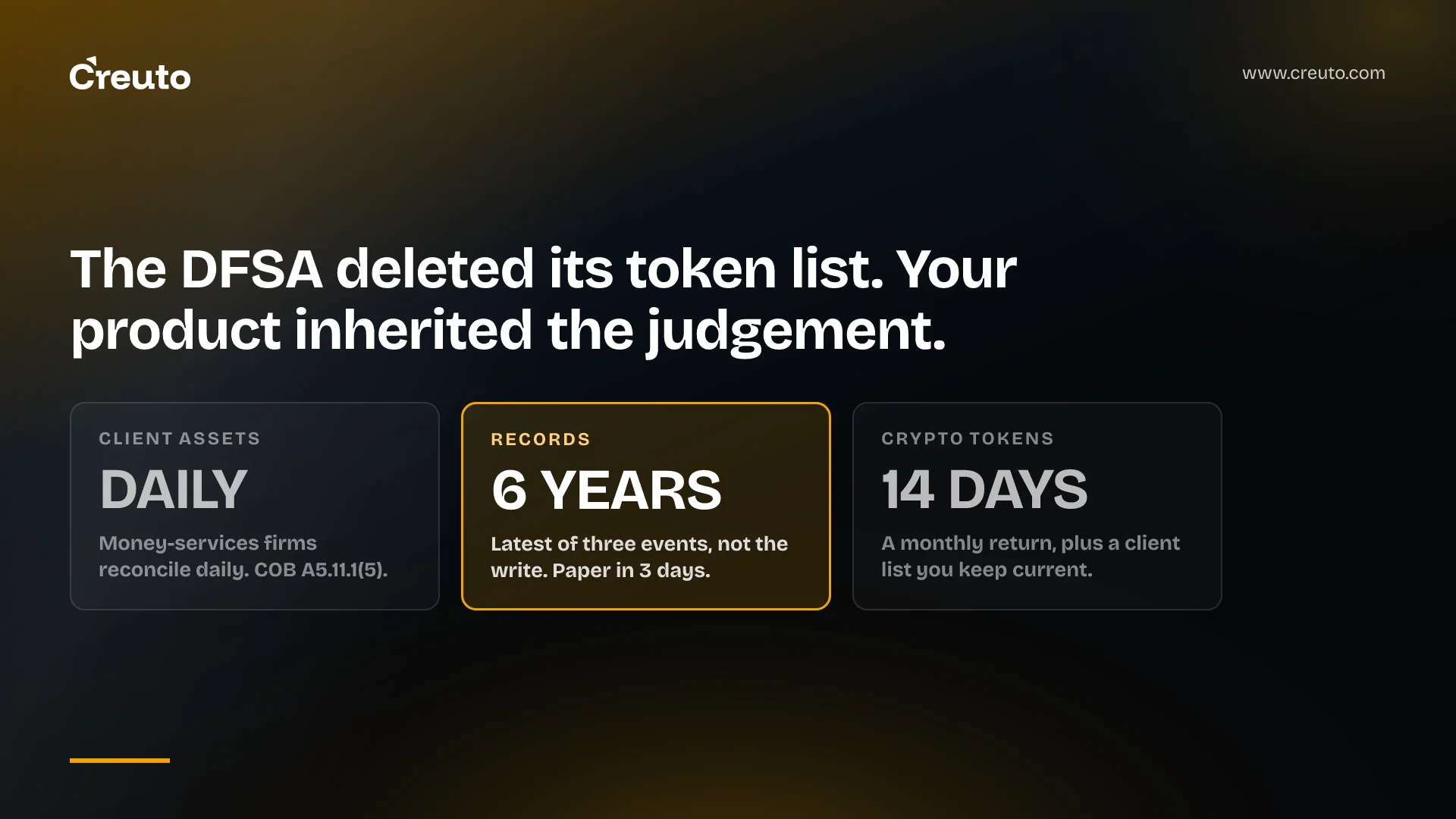
On 12 January 2026 the DFSA stopped publishing a list of acceptable crypto tokens. Firms in the Dubai International Financial Centre now make that call themselves, publish the result to their clients, and file a return on it every month. Fintech app development DIFC work is mostly that shape: not features, but the evidence a regulated firm must be able to produce on request.
Everything below is read off the DFSA Rulebook and DIFC's own legislation rather than off summaries, with the rule numbers in the text so you can check each one.
First, confirm who regulates you — the DFSA or VARA
This is the cheapest mistake to avoid and the most expensive to make late. The DFSA regulates financial services in and from the DIFC. VARA, in the DFSA's own words, regulates "the virtual assets sector in the Emirate of Dubai and its free zones excluding the DIFC" — the phrasing is from the DFSA's 15 October 2025 release on the two regulators' memorandum of understanding, which covers cooperation on licensing, supervision, enforcement and financial crime but does not merge the two rulebooks. A firm that incorporated in the wrong place has a licensing problem, not a build problem, and no amount of engineering closes it.
The Innovation Licence is a commercial licence, not permission to run a financial service
Two things are both called innovation here, and conflating them costs a quarter. The DIFC Innovation Licence is described by DIFC as "a commercial licence with a subsidised fee structure", open to firms across AI/ML, FinTech, InsurTech, RegTech and other technology sectors at USD 1,500 per annum. It is how a software company sets up in the centre, not an authorisation to carry on a Financial Service. The regulated route is the DFSA's Innovation Testing Licence under GEN chapter 13, which demands a Test Plan of twelve specified items.
Here is the part teams get wrong: that sandbox is not a holiday from the evidence layer. GEN 13 paragraph 16 says the DFSA is "not likely to waive or modify" rules on holding and controlling Client Assets — COB sections 6.11 to 6.13 — and paragraph 17 says it will not waive requirements grounded in Federal law, naming AML. The two heaviest pieces of build work survive the sandbox intact, so plan them into the first sprint.
Fintech app development DIFC work is mostly an evidence layer
A regulated firm's system is judged on what it can prove, not on what it can do. Four obligation groups carry nearly all of that weight, and each is a schema decision before it is a compliance one.
Client money segregation and reconciliation
COB A5.11.1 requires a system that reconciles Client Accounts at least monthly, performed within 10 days of the date it relates to. For an Authorised Firm that Provides Money Services, both the system and the reconciliation move to at least daily under A5.11.1(5). If you are building payments or remittance, read that as a nightly close with an owner, not a month-end spreadsheet.
The rule also names the contents: individual segregated client credit and debit ledger balances, unpresented cheques and outstanding lodgements, cash book balances, and formal statements from any Third Party Agent. A5.11.1(3)(b) then requires a specific assertion — that the Client Accounts balance at the previous close of business was at least equal to the aggregate of individual credit ledger balances at that same close. That is a check across two independent ledgers, so you need both, a shared close-of-business timestamp, and an investigation path for every shortfall.
An audit trail that reconstructs a decision and its inputs
COB A1.1.1 sets the minimum contents of a transaction record at the moment an order is received or a discretionary decision is taken: the identity and account number of the client; the date and time in the jurisdiction in which the instruction was received or the decision was taken; the identity of the employee who received it or made it; the investment or crypto token, including number or value and any price limit; and whether it is a purchase or a sale.
Two of those fields are where builds fail audit. "The identity of the Employee" means a service account writing system into the actor column is not a record — you need the human, or the authorising principal behind an automated decision. And "the date and time in the jurisdiction" means a UTC timestamp alone will not do; you must render local civil time at the point of receipt, which needs a stored zone identifier, not a conversion applied at read time after the zone rules have moved.
AML 14.4.1 goes further, asking for "sufficient records of transactions to enable individual transactions to be reconstructed", plus internal findings and analysis "whether or not it results in a Suspicious Activity Report". The analysis you did and discarded is as much a record as the one you escalated.
AI quietly raises that bar. The DFSA Artificial Intelligence Survey 2025 records adoption rising from 33% in 2024 to 52% in 2025 — state the denominator, because most coverage does not: 661 responding DFSA Authorised Firms at an 88% response rate, not every entity registered in the DIFC. A model that scores a transaction or raises an alert still has to be reconstructable under these two rules, so the model version, the feature values at inference and the human who authorised the policy belong in the same audit record as the outcome.
Suspicious activity captured where it happens
AML 13.3.1, as amended by DFSA RMI435/2026 and in force from 2 March 2026, requires that on receiving an internal notification the Money Laundering Reporting Officer without delay inquires into and documents the circumstances, determines and documents whether a Suspicious Activity Report must be made to the FIU, makes the report if required, and notifies the DFSA immediately following submission. Two of those three artefacts exist whether or not a report is filed. A queue that records only escalations loses the negative determinations, and those are exactly what a supervisor asks to see — so capture the alert, the reviewer, the reasoning and the outcome as one immutable row at the moment of decision.
Reporting producible on demand, not assembled by hand
This is the obligation teams underestimate, because nothing in a product demo exposes it. GEN 5.3.24 requires records of regulated matters and dealings to be retained and, "however stored", to be "capable of reproduction on paper within a reasonable period not exceeding 3 business days". COB 6.7.2 adds prompt accessibility of all records, comprehensible form, and procedures to prevent unauthorised alteration. AML 14.4.2 requires the business and customer risk assessments and the determinations drawn from them to be given to the DFSA "immediately on request".
Three business days is generous for a query and brutal for cold storage with a restore queue. Treat it as a design budget: if your audit events sit in an archive tier that takes a week to rehydrate, you are non-compliant by architecture. Deriving a regulatory output from a reconstructable event log is the same problem as producing a statutory return from transactional data; our workflow management platform carries a comparable task audit trail, built for enterprise operations rather than a regulated firm.
The retention policy you cannot express as a fixed TTL
AML 14.4.1 requires due diligence documents, correspondence, transaction records, internal findings, Suspicious Activity Reports and risk assessments to be kept "for at least six years from the date on which the notification or report was made, the business relationship ends or the transaction is completed, whichever occurs last". The clock starts at the latest of those three events, so a six-year TTL on write is wrong by construction: a transaction record from year one, on a relationship that closes in year nine, must survive to year fifteen. The retention key is the relationship, not the row — an explicit retention anchor on the customer aggregate, and a deletion job that reads it rather than the record's own timestamp. One further constraint that catches distributed teams: GEN 5.3.25 requires records to be maintained in English, with a narrow exception for business carried on from an establishment outside the DIFC.
| Obligation | Rule | What the build must do |
|---|---|---|
| Client account reconciliation | COB A5.11.1 | Monthly within 10 days; daily for Money Services firms |
| Transaction record contents | COB A1.1.1 | Client, local date and time, employee, instrument, value, side |
| SAR determinations | AML 13.3.1 | Document circumstances and decision, filed or not |
| Reproduction on request | GEN 5.3.24(2) | Any record on paper within 3 business days |
| Retention | AML 14.4.1 | Six years from the latest of three events |
The crypto token rules that changed on 12 January 2026
The DFSA issued the updated rules on 15 December 2025, in force 12 January 2026, and the change transfers work rather than removing it. The DFSA no longer prescribes a list of Recognised Crypto Tokens. Under GEN 3A.2.1(2)(a) a firm must itself conclude on reasonable grounds that each token is suitable, weighing its purpose, governance and founders, its regulatory status elsewhere, its market's global liquidity, its technology, and whether using it could prevent the firm complying with DFSA-administered legislation.
The companion rule is the one with product consequences. GEN 3A.2.1A, new with the same instrument, requires a firm to prominently disclose to clients a current list of every token it has assessed as suitable, with each token's name, its identifier and the DLT or other technology it operates on; to continuously monitor each assessment and, where it is no longer satisfied, immediately cease the activity and update the published list; to demonstrate the grounds of each assessment to the DFSA; and, if it is an Authorised Person, to file a Crypto Token information return each month, within 14 days of the following month.
That is a customer-facing page driven by the same table that drives a monthly regulatory return, with a kill switch between them. Build it as a CMS page a compliance officer edits by hand and the two will diverge — and the divergence is the finding. Build it as one token registry, with an assessment record per token, a status field, a published projection and a return generator, and it becomes ordinary API development and integration work.
Fiat Crypto Tokens are the exception: the DFSA still assesses those itself under GEN 3A.2.1(2)(b). The Annex to its Policy Statement on Fiat Crypto Tokens of 15 December 2025 names three — Circle Euro Coin (EURC), Circle USD Coin (USDC) and Ripple USD (RLUSD) — against criteria including reserves at least equal to the notional value of tokens in circulation, denominated in the reference currency, valued daily, and held in segregated accounts under AML regulation equivalent to the FATF Recommendations. Three is the whole list, so a product that assumes a wider set of stablecoins is available for DFSA-regulated activity is assuming wrong.
Data protection in the DIFC is a different statute, and that is the advantage
A DIFC entity told the UAE federal Personal Data Protection Law binds it has been told something the statute denies. Article 2(2)(g) of Federal Decree-Law No. 45 of 2021 excludes from the law's application "companies and establishments located in free zones in the Country and have special legislations regarding Personal Data protection". DIFC has such legislation — DIFC Law No. 5 of 2020 — so a DIFC company sits outside the federal law and inside the DIFC one. The carve-out is conditional on the zone actually having its own regime, so it does not generalise to every free zone.
The commercial consequence is in what each regime has published. Article 26 of the DIFC Data Protection Law lets the Commissioner of Data Protection determine that a third country offers an adequate level of protection, and Article 26(4) requires him to "pass Regulations to provide details of his determinations". Article 27(2)(c) recognises standard data protection clauses where no such determination exists, and the Commissioner has published two sets of DIFC Standard Contractual Clauses under it. Watch which set you pick up: DIFC's page warns these are not the Article 24(8) clauses, which govern the controller–processor relationship rather than the export.
The federal position is different because the PDPL's Executive Regulations have never been issued. Article 28 required the Cabinet to issue them within six months of promulgation, Article 29 starts the compliance clock only "as of the date on which its Executive Regulations are issued", and Article 23(2) defers the federal transfer controls to those same regulations. So there is no federal adequacy list and no federal standard clauses to lean on.
Read that list before you sign a vendor, because the absences bite. Appendix 3 to the DIFC Data Protection Regulations carries 47 jurisdictions as consolidated, while the Commissioner's published list on the DIFC website now runs to 50, having added Israel and the Qatar Financial Centre. The two disagree, and Appendix 3 clause 1.2.1 resolves it in favour of the website, "the most up to date version of the above list". Either way, India is on neither — so a DIFC-licensed firm sending personal data to an engineering team, a support desk or a hosted service in India is transferring to a non-adequate jurisdiction and needs an Article 27 safeguard, most practically the Commissioner's standard clauses. We are an Indian engineering company and we say that plainly: settle it at architecture time, not at go-live.
One scope note, because it is widely misattributed: DIFC's AI and data instrument, Regulation 10, is enforced by the DIFC Commissioner of Data Protection, not by the DFSA, which appears in it once as a source of design principles. Both regimes can reach the same feature, but they are separate rulebooks with separate regulators.
The case against the DIFC, and where to start anyway
Put the objection at its strongest: the obligations above are real engineering months, a company on the mainland ships a wallet or a lending product faster, and a startup should buy speed now and regulatory surface later. That holds exactly as far as your product is not a financial service. Once it is, VARA is a regulator too rather than the absence of one, so the comparison is one rulebook against another, plus the transfer instruments the mainland lacks. And re-incorporating later is not a port — new licence, new client agreements, a rebuilt evidence layer carrying the records you already hold. The honest version of "later" is "twice".
So pick the regulator before the stack. Then, in order: the client-asset model and its reconciliation cadence, because A5.11.1(5) decides whether you need a daily close; the transaction record schema, because its actor and local-time fields are expensive to backfill; the retention anchor, because a fixed TTL is wrong by construction; and only then the features. If you are weighing where to put the team that builds it, our Dubai engineering practice page sets out what we do, and our read of Dubai's agentic AI mandate covers the instrument most often mistaken for the DFSA's rules.
The question for your next architecture review is not which rules apply. It is whether, asked today for any record from the last six years, your system could put it on paper inside three business days without anyone assembling it by hand.
Frequently asked questions
A DFSA-regulated fintech platform must produce evidence on demand: client-account reconciliations under COB A5.11.1, transaction records with the client, local date and time, employee and instrument under COB A1.1.1, documented suspicious-activity determinations under AML 13.3.1, and any record reproducible on paper within three business days.
Building software in DIFC needs only the DIFC Innovation Licence, a commercial licence at USD 1,500 per annum. Carrying on a Financial Service needs DFSA authorisation, or the DFSA's Innovation Testing Licence under GEN chapter 13. The commercial licence is not permission to run a regulated financial service.
The Annex to the DFSA's Policy Statement on Fiat Crypto Tokens of 15 December 2025 names three Fiat Crypto Tokens assessed as suitable: Circle Euro Coin (EURC), Circle USD Coin (USDC) and Ripple USD (RLUSD). The DFSA assesses fiat tokens itself rather than leaving them to firms.
No. Article 2(2)(g) of Federal Decree-Law No. 45 of 2021 excludes companies in free zones that have their own personal data protection legislation, and DIFC has DIFC Law No. 5 of 2020. A DIFC company is governed by the DIFC law and its Commissioner of Data Protection instead.
No. The DFSA describes VARA as the regulator for the virtual assets sector in the Emirate of Dubai and its free zones excluding the DIFC. Inside the DIFC, virtual asset activity falls to the DFSA. A firm incorporated in the wrong place has a licensing problem, not a build problem.
AML 14.4.1 requires records to be kept for at least six years from whichever happens last: the notification or report being made, the business relationship ending, or the transaction completing. Because the clock starts at the latest of three events, a fixed six-year retention period set on write is wrong.