Employees Enrolment Campaign 2026 closes 31 October: ₹100
The Employees Enrolment Campaign 2026 closes 31 October: flat ₹100 damages, the member's share waived, and a gazette giving two start dates.
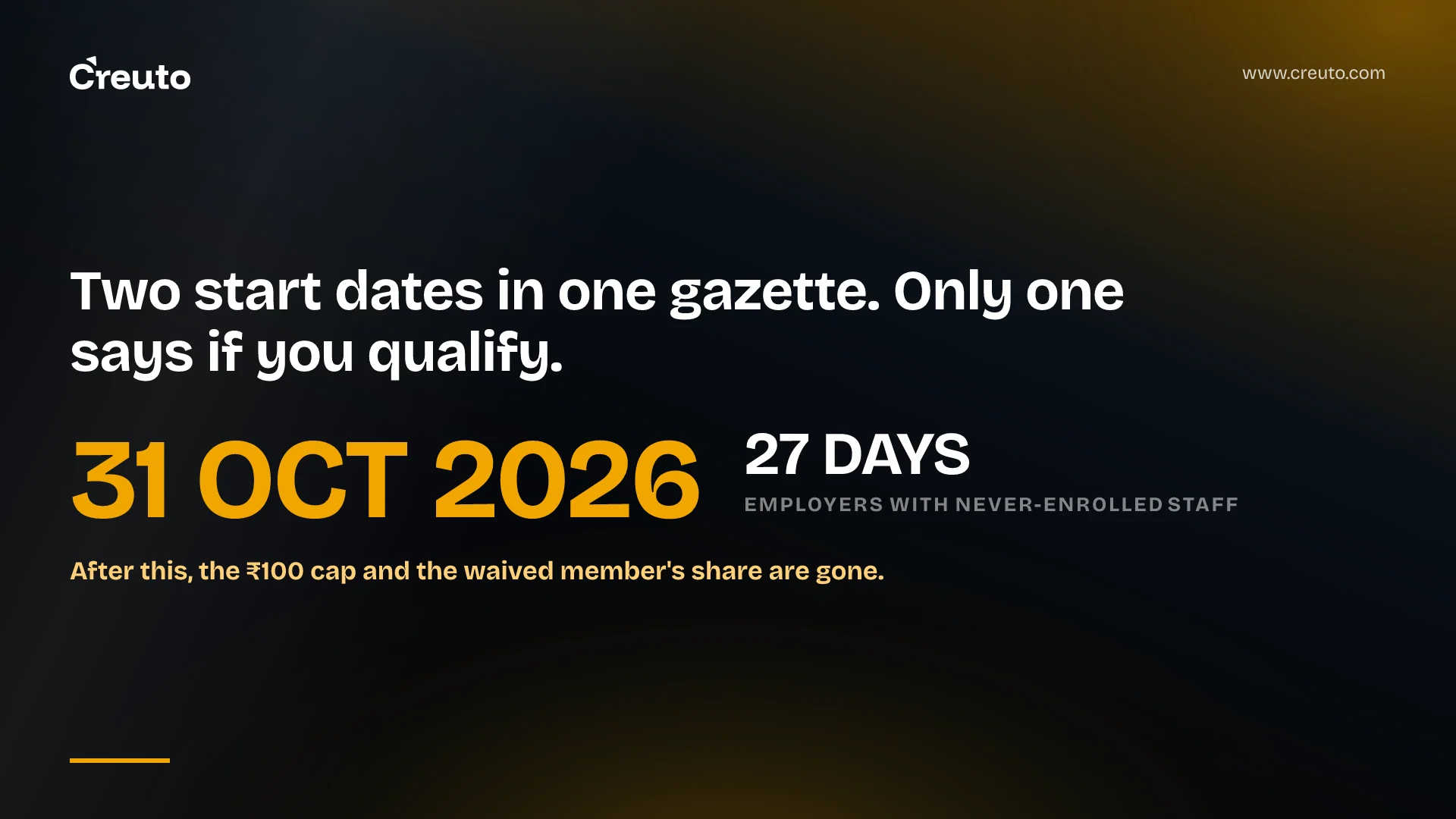
The Employees Enrolment Campaign 2026 closes on 31 October, and it lets an employer declare staff who were never enrolled in EPF at all for a flat one hundred rupees in damages, with the member's share waived where it was never deducted from wages. The gazette gives two different start dates in two different clauses. Which one governs decides what you do about a 2009 joiner.
Here are the facts you need before you decide whether to file, all of them from the instrument itself or from EPFO:
| What | Where it comes from |
|---|---|
| Campaign runs 1 July 2026 to 31 October 2026 | Gazette clause A(1); EPFO puts the start at 1 July |
| Employees who joined 1 April 2009 to 31 March 2026 may be enrolled | Gazette clause A(2)(b) |
| Damages: one hundred rupees, lump sum | Gazette clause A(6) and the Table at A(18) |
| Member's share waived if never deducted | Gazette clause A(13)(b) and A(17) |
| Employer still pays its own share, interest and administrative charges | Gazette clause A(13)(c) |
| Filing is online only, through the EEC-2026 module | Gazette clause A(7); EPFO |
The instrument is G.S.R. 525(E), the Employees' Provident Funds Scheme, 2026, notified by the Ministry of Labour and Employment on 29 June 2026 under the Code on Social Security, 2020 and e-gazetted on 1 July 2026. The campaign is Part A of the Annexure to that Scheme. Part B of the same Annexure is VISHWAS, 2026, which is a different scheme for a different problem — more on that below, because conflating the two is the expensive mistake here.
What the Employees Enrolment Campaign 2026 actually permits
The campaign is for employees who were never brought into EPF at all. Clause A(2) lets any employer, "whether previously covered or not under the Code", both apply for coverage and enrol employees who joined between 1 April 2009 and 31 March 2026, "who are employed as on date of declaration, but who, for any reason, were not enrolled under the Scheme earlier".
Two conditions in that sentence do most of the work. The person must have joined inside the window, and the person must still be on your payroll on the day you declare. EPFO's Kolkata zonal office puts it plainly in a press release of 13 August 2026: the declaration applies to employees "who are alive and actively working in the establishment on the date of declaration", and exited employees are excluded.
That exclusion sounds like a gap, and it is not quite one. Clause A(15) says EPFO will initiate no action against an employer who takes the campaign in respect of employees who had already left before the declaration — but only if the establishment files an undertaking that all existing and eligible employees have been declared, and that no deducted member's share is sitting undeposited. You buy peace on the leavers by declaring everyone who is still there. A partial declaration, picked to keep the cost down, forfeits it.
The waiver is the real money. Clause A(13)(b) waives the employees' share if the employer never deducted it, and clause A(17) states the waiver period as "beginning the 1st day of April, 2009 and ending the 31st day of March, 2026". Where the employer did deduct and then kept the money, none of this applies; clause A(3) makes that explicit, and so does the undertaking in A(15).
The gazette gives two start dates, and only one of them is in the damages table
This is the detail an employer with a long-serving workforce has to resolve, and the instrument does not resolve it.
Three clauses in Part A carry a date range. Clause A(2)(b), which decides who may be enrolled, says employees who joined "between 1st day of April, 2009 and 31st day of March, 2026". Clause A(17), which defines the period over which the member's contribution is waived, says "beginning the 1st day of April, 2009 and ending the 31st day of March, 2026". The Table under clause A(18), which prices the period of default at one hundred rupees, says something else: "Between the 1st day of July 2009 to the 31st day of March 2026".
So two of the three say April 2009 and one says July 2009. That matters because the three clauses govern different things. Eligibility to be enrolled is A(2)(b). The waiver of the member's share is A(17). The rate of damages attaching to a period of default is the Table. They are not alternative statements of one rule, and the Table has exactly one row — it prices no other period at all.
Read strictly, an employee who joined in May 2009 is eligible to be enrolled, their member's share is waived, and the first three months of the resulting default period fall outside the only period the Campaign's damages Table prices. The instrument never reconciles that, and our reading is that the July 2009 date in the Table is the outlier rather than the rule, because the two clauses that define the campaign's own scope both say April.
There is a practical reason the discrepancy may never bite. EPFO describes the hundred rupees not as a monthly rate but as a lump sum — "a lump-sum damage of ₹100 per defaulting establishment across all three schemes", in the Kolkata release, and "a lump-sum damage of ₹100" in a 17 August 2026 release from PIB Pune. EPFO used the same "₹100 per establishment" formulation for the preceding campaign in 2025. If the figure is a single lump sum for the declaration, the Table's start date never operates as a per-month boundary and the three months are academic.
That is a reading of EPFO's communications, not of the instrument, and the instrument is what binds. If your earliest eligible joiners date from April, May or June 2009, the right move is to ask your jurisdictional regional office in writing which date governs, and to file on the answer. Clause A(18) says the Commissioner "may levy" damages at the Table rate, which is discretionary language; you do not want to discover how that discretion is exercised after you have declared. Everyone whose earliest joiner is from July 2009 onward can ignore the whole question.
The hundred rupees is not the bill
The headline figure is the damages, and damages are the smallest line. Clause A(13) requires the employer to deposit contributions for declared employees "for past periods from their respective date of joining". The employer's own share is payable in full. Clause A(13)(c) adds interest for the past period under section 127 of the Code, together with administrative charges. Nothing in Part A reduces either.
For an employee who joined in 2010 and was never enrolled, that is roughly fifteen years of employer contributions plus interest. The hundred rupees buys you the member's share and the damages, which is a genuine concession, but an establishment that budgets for the campaign by multiplying headcount by a hundred has mis-scoped it by orders of magnitude.
There is a second trap, and it is written into the text rather than reported anywhere. Clause A(10) says all establishments are eligible to participate irrespective of whether inquiries under section 125 of the Code or section 7A of the repealed Act are pending, and clause A(12) confines the benefit in such cases to limiting damages to the notional campaign rate. But clause A(4) says that where such an inquiry is pending and the employer opts for the campaign, "both the employee and the employer contribution shall be payable as per provisions of the Code and Schemes made thereunder".
Taken together: if you are already under inquiry, you keep the hundred-rupee damages cap and you lose the member's-share waiver. That is a materially different deal from the one in the press coverage, and it is the single most expensive thing in Part A that the ₹100 headline conceals. Clause A(14) also excludes assessments already concluded. And clause A(16) makes a declaration void from the outset if it was made by misrepresentation or suppression about which employees are eligible — which raises the stakes on the question of who, exactly, was never enrolled.
How to enrol employees under the campaign: UAN, Face Authentication and an ECR
Clause A(5) sets the sequence, and it is not optional. Before declaring anyone, the employer must create a Universal Account Number "authenticated with Face Authentication Technology through UMANG Application" for each eligible employee being declared, and pay their contribution through an Electronic Challan-cum-Return. Only then, under clause A(6), does the employer make the declaration online and link it to the ECR's Temporary Return Reference Number.
EPFO's Kolkata release sets out the portal steps: generate UANs using Face Authentication via the UMANG app for each declared employee, open the EEC-2026 module on the employer portal, enter employment details and link the ECR with a TRRN, then generate the EEC challan, remit payment and submit the declaration authenticated by DSC or eSign. Clause A(7) makes the designated portal the only accepted route, and clause A(8) permits multiple declarations rather than forcing one filing.
Face Authentication per employee is the step that sets the real timetable. It is a per-person act requiring that person's presence and a working phone, and it cannot be batched by an administrator. Declaring thirty people who were never enrolled means thirty individual authentications before a single rupee moves. With four weeks left as of 4 October 2026, an establishment that has not started sequencing that has already lost the ability to treat it as a formality.
Finding who was never enrolled is harder than it sounds
We built Nomina, an enterprise HR and payroll platform, with thirteen core modules and five user roles, and the lesson that transfers directly to this campaign is that a payroll system tells you who is being paid, not who is missing from a statutory register. Those are different questions, and most establishments only have tooling for the first.
The reconciliation is a set difference: everyone on the active payroll on declaration day, minus everyone who appears in your EPF member register. It fails in practice for reasons that are structural rather than careless.
- Contractor-to-employee transitions. Someone engaged on a consultancy or retainer agreement, later absorbed onto the rolls, frequently carries the original engagement date in one system and the conversion date in another. Which date is the date of joining determines whether they fall inside the 2009-2026 window, and clause A(13) makes it the date from which contributions are owed.
- Employees assumed to be excluded. Staff above the wage ceiling at the time of joining were often simply never enrolled. The campaign's second proviso to clause A(6) preserves the exclusion for employees joining after 1 September 2014 whose salary exceeds the ceiling, but the assumption is frequently applied more broadly than the rule supports.
- Multiple establishment codes. Branches and units registered separately mean an employee can be present in the group's payroll and absent from the register of the code they actually sit under.
- Acquisitions and absorbed units. A unit brought in with its own historical practice arrives with a member register that was never reconciled against the payroll it came with.
None of that is exotic, and all of it is the ordinary condition of a payroll that has been running since before 2009. The work is unglamorous: a single authoritative joining date per person, a stable identifier that survives the contractor-to-employee transition, and a register comparison you can rerun and defend. It is the same discipline behind our custom software and data reconciliation work, and the same discipline that per-state labour code compliance and the EPF wage ceiling change both demand.
Establishments discover the gap late for a predictable set of reasons: a section 7A notice arrives, a funding round or acquisition triggers diligence on statutory liabilities, an exiting employee claims a provident fund balance that does not exist, or a wage-ceiling revision forces a recount that surfaces people nobody had counted. Every one of those is a trigger that arrives on someone else's schedule. A campaign window is the rare case where the schedule is published in advance and you can still act before the trigger.
This is not VISHWAS 2026, and the difference is the deadline
Both schemes sit in the same Annexure to the same gazette, which is why they keep getting written about as one relief. They are not.
| Employees' Enrolment Campaign, 2026 | VISHWAS, 2026 | |
|---|---|---|
| Annexure part | Part A | Part B |
| The problem it fixes | Employees never enrolled at all | Damages on contributions paid late |
| Period covered | Joiners from 2009 to 31 March 2026 | Default prior to 14 June 2024 |
| Closes | 31 October 2026 | Six months from notification |
| Extension power in the text | None | Up to six further months, by the CPFC |
That last row is the one to act on. Clause B(3) gives the Central Provident Fund Commissioner an express power to extend VISHWAS by up to six further months for reasons recorded in writing. Part A contains no equivalent. Clause A(1) simply says the campaign "shall cease to operate on the 31st day of October, 2026", and nothing in the Annexure authorises anyone to move that date. As of 4 October 2026 EPFO has published no extension, and the gazette gives it no mechanism to publish one without a fresh notification.
If your problem is damages on contributions you paid late, you want VISHWAS 2026 and its December deadline, not this campaign, and the two are filed differently. If your problem is people who never entered the system, this campaign is the only one of the two that helps, and it closes first. An establishment can be in both positions at once; they are separate filings and separate scopes, and nothing about taking one affects the other.
The decision in front of you is not whether a hundred rupees is good value. It is whether you can produce a defensible list of never-enrolled employees, obtain a Face Authentication UAN for each of them, and fund fifteen years of employer contributions and interest, before 31 October. If you cannot do all four, the honest move is to start the reconciliation anyway — because the liability does not expire with the campaign, and the next notice decides the timetable instead of you.
Frequently asked questions
The Employees Enrolment Campaign 2026 ceases to operate on 31 October 2026. Clause A(1) of the Annexure to G.S.R. 525(E) fixes that date, and unlike VISHWAS 2026 in Part B of the same Annexure, the campaign carries no power for any officer to extend it.
Employees who joined the establishment between 1 April 2009 and 31 March 2026, who were never enrolled under the EPF Scheme earlier, and who are still employed on the date the employer makes the declaration. Employees who have already left the establishment cannot be declared.
Damages are one hundred rupees. EPFO describes this as a lump sum per defaulting establishment across all three schemes rather than a per-employee charge. Damages are the smallest line, because the employer still owes its own share of contributions plus interest and administrative charges.
The member's share is waived for the period from 1 April 2009 to 31 March 2026, but only where the employer never deducted it from wages. If an inquiry under section 7A or section 125 is already pending against the establishment, clause A(4) makes both the employee and employer contributions payable.
Yes. Clause A(5) requires the employer to create a Universal Account Number authenticated with Face Authentication Technology through the UMANG app for every employee being declared, before paying contributions through an Electronic Challan-cum-Return and filing the declaration online.
No. The enrolment campaign regularises employees who were never enrolled in EPF and closes on 31 October 2026. VISHWAS 2026 reduces damages on contributions that were paid late, covers defaults before 14 June 2024, and runs six months from notification with an express power to extend.