Ecommerce traffic drop after core update: audit templates
An ecommerce traffic drop after core update is usually one template, not your copy. Split Search Console by template and rule out the platform first.
Google's own guidance says you should not analyse the November 2026 core update until 1 December at the earliest, and the November rollout finished three days before Black Friday. Diagnosing an ecommerce traffic drop after core update rollouts starts with measurement, not copy. By the end of this post you will know how to split the drop by page template, how to rule out your own platform, and when the answer is a template rebuild rather than another round of product descriptions.
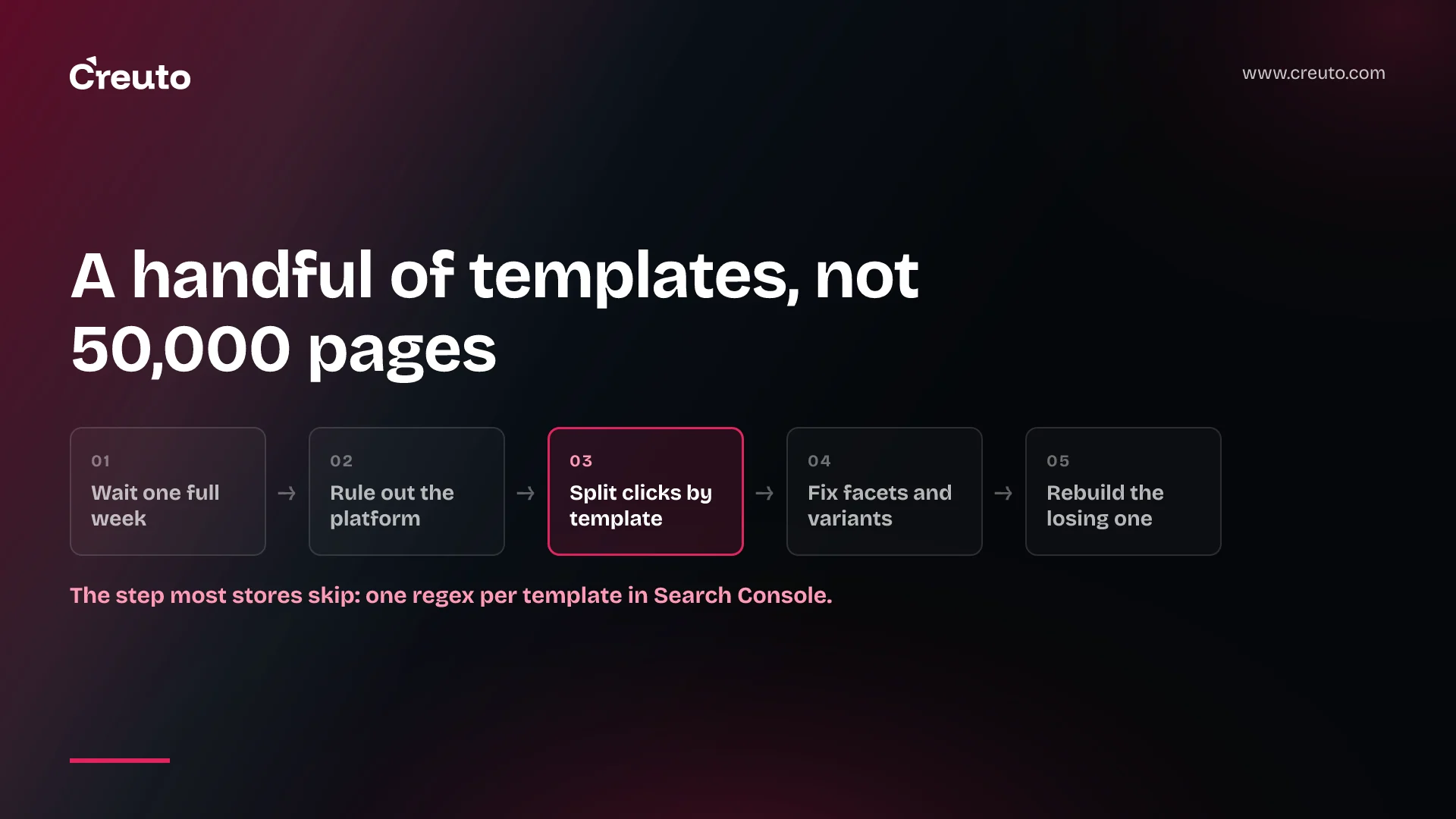
That matters because a store is not 50,000 individual pages. It is a handful of templates (category, product, filter and sometimes location pages) multiplied by a catalogue. A core update judges the output of those templates, so the recovery work on a catalogue site is mostly engineering.
| Fact | Date or figure | Source |
|---|---|---|
| November 2026 core update rollout | 10 Nov 10:06 to 24 Nov 06:03 US/Pacific | Google Search Status Dashboard |
| Earliest date Google suggests analysing | About 1 December (one full week after completion) | Google core updates guide |
| Black Friday 2026 | 27 November | Calendar |
| December 2026 core update | Preannounced 24 Nov, no start date given | Google Search Status Dashboard |
Wait until December before you read the November data
The November 2026 core update began on 10 November at 10:06 US/Pacific and was complete as of 24 November, according to Google's Search Status Dashboard. Google's core updates guide recommends "waiting at least a full week after a core update completes before analyzing your site in Search Console." That puts the earliest clean read at about 1 December.
Retail makes that window messier than it is for most sites. Google's guide to debugging traffic drops lists seasonality and changing interest as a cause in its own right, alongside algorithmic updates, technical issues, security issues, spam and site moves. A comparison of late November against early November mixes the update with Black Friday demand, so compare against the same weeks of last year as well. The guide suggests the Performance report's "Last 16 months" range for exactly that, and Google Trends to check whether a drop is industry-wide.
There is a second clock. On 24 November Google's status feed preannounced a December 2026 core update, "scheduled to be released in December 2026." A Google spokesperson told Search Engine Roundtable "We don't have a date yet" and "It's not imminent." As of 27 November it has not started. When it does, your before-and-after windows get shorter, so pull the November comparison as soon as the week has passed and save it.
Your store has five page types, not 50,000 pages
The fastest way to understand a catalogue site's drop is to group URLs by the template that rendered them. Search Console helps here: the Performance report aggregates data grouped by Pages by page, so a page filter gives you that template's own numbers. Since 2021 the page filter has accepted regular expressions, which is what makes a template-level read practical.
How do I find which page templates lost traffic?
Build one regex per template from your URL patterns, compare the period after the update with the same length of time before it, and record clicks, impressions and average position for each. The debugging guide also suggests sorting the Pages table by "Clicks Difference" to see which URLs moved most. A typical split looks like this, with your own patterns in place of the examples:
| Template | Example regex | What a loss there usually points to |
|---|---|---|
| Category pages | ^https://shop\.example\.com/c/[^?]+$ | Thin or interchangeable listing pages |
| Product detail pages | /p/ | Manufacturer copy, variant duplication |
| Faceted and filter URLs | \?.*(color|size|sort)= | Crawl waste, index bloat |
| Location or "X in city" pages | /stores/|-in- | Scaled pages with no unique content |
| Editorial and guides | /blog/|/guides/ | Ordinary content quality questions |
The pattern you are looking for is concentration. If one template carries most of the loss and the others are flat, you have a template problem, and rewriting copy page by page will not keep up with a catalogue. If every template fell by a similar share, the cause is more likely site-wide: demand, a technical change, or how Google sees the site as a whole.
Google's guide separates small drops from large ones. Its example of "dropping from position 2 to 4" comes with "There's no need to take drastic action", while "dropping from position 4 to 29" calls for "a deeper assessment". Run the regex table with average position, not just clicks, and you will know which kind you have per template.
Rule out the platform before you blame the update
List everything you changed in the stack in the weeks before peak: a new CDN, bot protection, caching rules, a deploy pushed through before the code freeze. Any of those can produce a drop that lines up with an update by coincidence.
Why did my online store lose Google traffic after the core update?
An online store can lose Google traffic in the same fortnight as a core update for reasons the update had nothing to do with. Google's debugging guide tells you to check the Crawl stats, Page indexing, Security Issues and Manual Actions reports and to use URL Inspection on affected pages before drawing conclusions. If Crawl stats shows a spike in server errors or a fall in crawl requests on a date that matches a deploy, start there.
CDN changes deserve a specific look. In a post from 11 November 2026, Google explained that a new CDN starts with a cold cache, so misses hit your origin while crawling ramps up, and that "leaving blanket bot protection enabled without exempting verified crawlers" leaves Googlebot looking at error pages. Its recommendations: allow verified bots using Google's published IP ranges, pre-warm caches at a controlled pace, and "use 429 or 503 if you need a temporary brake", for hours or a day or two at most. We covered a related failure, where a storefront moved between platforms loses things nobody listed, in what breaks a ported storefront.
Faceted navigation is a crawl problem first
Faceted navigation is the filter UI that turns one category into thousands of URLs: colour, size, brand, price, sort order and every combination of them. Google's documentation on managing faceted navigation URLs describes the cost in crawl terms: crawlers "will typically access a very large number of faceted navigation URLs", and "if crawling is spent on useless URLs, the crawlers have less time to spend on new, useful URLs."
Do faceted navigation pages hurt rankings?
Faceted navigation pages hurt crawling directly and rankings indirectly. Google's faceted navigation page frames the harm as overcrawling and slower discovery, not as a quality penalty, and we found no Google document that says facets cause core update losses. The honest reading is that facets waste the crawl your new and changed product pages need, and that thousands of near-identical indexed listings are poor evidence of a site worth ranking.
The fixes are template and routing decisions, which is why they belong to engineering rather than to the content team. Google's options include disallowing facet URLs in robots.txt, putting filters behind a URL fragment (Google "generally doesn't support URL fragments in crawling and indexing"), keeping filter order consistent so "no duplicate filters can exist", and returning "an HTTP 404 status code when a filter combination doesn't return results." A rel="canonical" "may, over time, decrease the crawl volume" of non-canonical versions, and nofollow only works if every anchor pointing to that URL carries it.
The counter-argument is real: some filter combinations are genuine landing pages people search for, such as a brand within a category. Keep those, give them their own indexable URL and real content, and treat them as category pages. The decision is per facet, and it should live in code as an allowlist rather than in a spreadsheet.
Programmatic category pages and the scaled content line
Every catalogue is programmatic, so the question is not whether your pages are generated. Google's spam policies define scaled content abuse as "when many pages are generated for the primary purpose of manipulating search rankings and not helping users." The test is purpose and usefulness, not the use of templates.
Are programmatic category pages scaled content abuse?
Programmatic category pages are not scaled content abuse by default. A category page that lists real stock with working filters exists to help a shopper. The risk sits in pages generated for search alone: "running shoes in" every city where you have no store, or thousands of keyword-variant categories with the same 12 products. Spam policy violations can be found by automated systems and human review and can lead to a manual action, which shows up in Search Console's Manual Actions report. If that report is empty, the November drop is a core update question, and the spam policy is a design constraint for the rebuild rather than the diagnosis.
Google's helpful content guidance asks, among its self-assessment questions, "Does the content provide original information, reporting, research, or analysis?" and says "Why" is "perhaps the most important question to answer about your content." Applied to a template, that becomes a build question: what data do you hold that a competitor's category page does not? Stock and delivery by postcode, fit and sizing data from returns, comparison tables built from real attributes. Those come from your systems, which is why they are template work.
Product variant pages and duplicate content
Product variant pages are the other common source of duplication. Google's ecommerce URL structure guidance says to "make sure that each variant can be identified by a separate URL" and, where optional parameters identify variants, to "use the URL with the query parameter omitted as the canonical URL." Google's canonicalisation guide calls rel="canonical" "a strong signal" and does not recommend noindex for choosing a canonical within a site, "because it will completely block the page from Search."
Then make the Product structured data agree with the URLs. Google's product variants documentation uses ProductGroup with hasVariant, variesBy and productGroupID, and for single-page setups "there must be only one distinct canonical URL for the overall ProductGroup". A template that emits one thing in markup, another in canonical tags and a third in the Merchant Center feed is the kind of inconsistency a rebuild should remove.
What an ecommerce traffic drop after core update tells you about a rebuild
The decision behind this post is whether you have a content problem or a platform problem. Google's guide warns against "quick fix" changes, says "deleting content is a last resort", and notes that some changes "can take effect in a few days, but it could take several months", sometimes not until the next core update. That argues against panic edits in December and for changes you would keep regardless of the update.
| What the template split shows | Likely problem | Next move |
|---|---|---|
| Every template down by a similar share, same as last year | Seasonality or demand | Wait, re-check after December |
| Drop matches a deploy date, crawl errors up | Platform or infrastructure | Fix and verify with URL Inspection |
| Facet and parameter URLs dominate indexed pages | Crawl waste | Facet allowlist, canonicals, 404 empty sets |
| Category or location template lost most, others flat | Template quality | Rebuild that template around unique data |
| Product pages lost, editorial held | Variant duplication or thin product data | Canonical and ProductGroup clean-up, richer attributes |
Set expectations with the one measured recovery figure we trust. SE Ranking's analysis of about 100,000 keywords across 20 niches found that 32.20% of domains that lost top-10 positions after March 2026 were back in the top 10 after the May update. It covers New York results and all niches, not stores specifically, so treat it as a sense of scale rather than a forecast for your catalogue.
This approach is the wrong one if your catalogue is small enough to edit by hand, or if the template split shows nothing concentrated. Then the content guidance applies page by page, and a rebuild would be a cost without a cause.
If the losing template is the platform, scope the rebuild
When the regex table points at one template, the work is a defined engineering project: a facet allowlist in routing, canonical and ProductGroup output that agree, and a category template that renders data your competitors do not have. These are the same kinds of catalogue templates we build for clients, for example in FlashNow's quick commerce app. We do not sell SEO and we will not promise rankings. If you have decided the problem is your platform, our e-commerce engineering team can scope the category, product and filter template rebuild with you, starting from the template split you just ran.
Frequently asked questions
An ecommerce traffic drop after a Google core update can come from the update itself, from Black Friday seasonality, or from a technical change such as a new CDN or bot protection. Google's debugging guide lists all of these causes, so check Crawl stats, Page indexing and Manual Actions before assuming the update did it.
Google recommends waiting at least a full week after a core update completes before analysing a site in Search Console. The November 2026 core update completed on 24 November 2026, so the earliest clean analysis window opens around 1 December 2026.
Faceted navigation pages mainly hurt crawling: Google says crawlers can spend their time on a very large number of filter URLs and have less time for new, useful pages. Google does not describe facets as a core update penalty, but crawl waste and index bloat weaken a catalogue site, so most stores should allowlist the facets worth indexing.
Programmatic category pages are not scaled content abuse simply because a template generates them. Google defines scaled content abuse as many pages generated primarily to manipulate rankings rather than help users. Category pages listing real stock with useful filters help shoppers, while city or keyword variants with identical products carry the risk.
To find which page templates lost traffic, create a page filter in the Search Console Performance report using a custom regular expression for each template's URL pattern. Compare equal periods before and after the update, then record clicks, impressions and average position for category, product, filter and location templates separately.