E-invoicing ERP integration UAE: what your ASP won't do
E-invoicing ERP integration UAE: your ASP mints the invoice UUID and rejections come from the buyer's provider. What that means for retries.
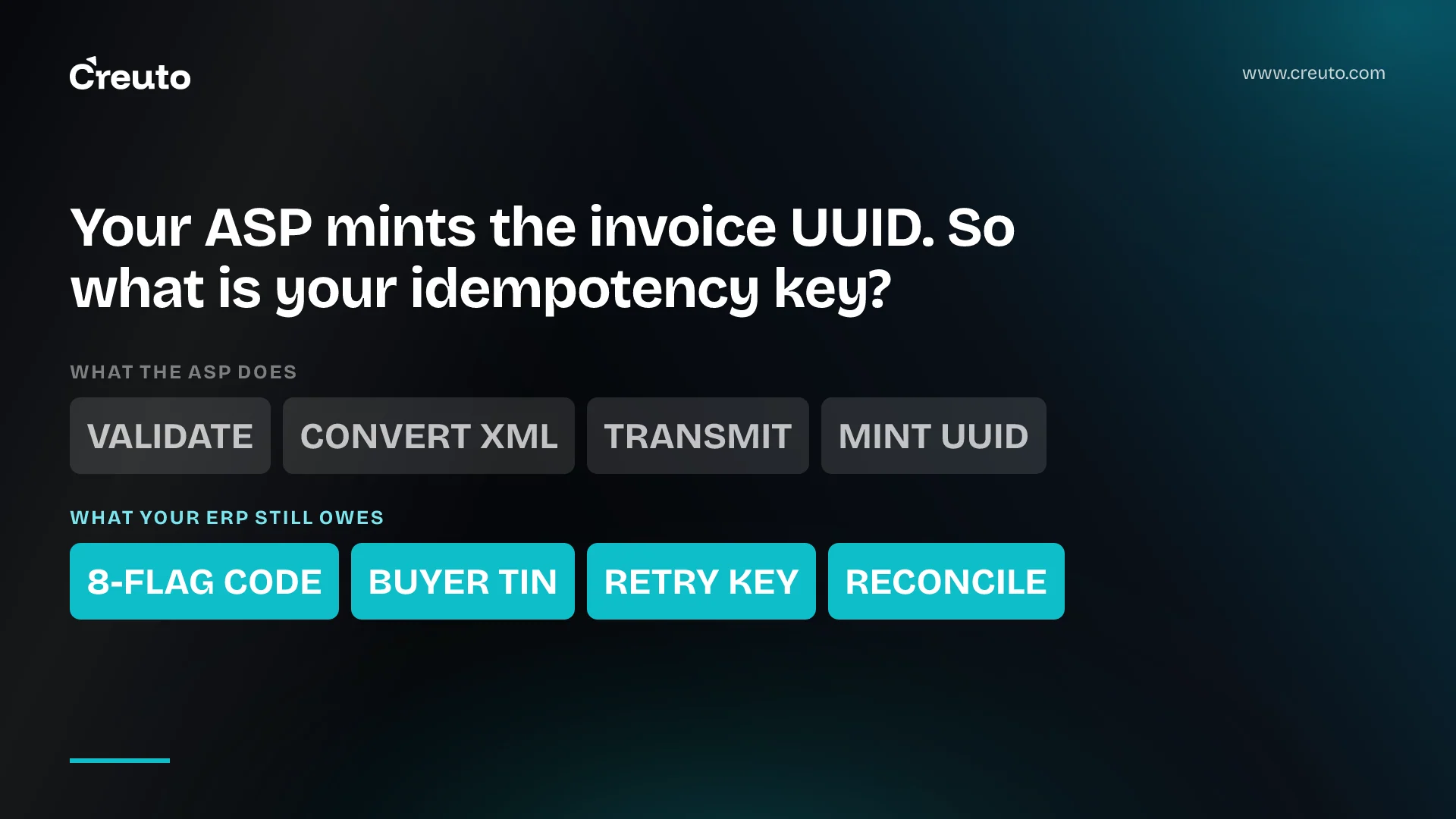
The UUID that uniquely identifies your UAE electronic invoice is generated by your accredited service provider, not by your ERP. The Ministry of Finance's own responsibility table hands "generating a UUID for every Electronic Invoice… to prevent duplication" to the ASP and marks the supplier and buyer "N". That single row is why e-invoicing ERP integration UAE is a separate project from appointing a provider rather than a line item inside it: the deduplication key is minted downstream of the system doing the retrying.
This post is about the build that follows the appointment: making an ERP emit a document the network accepts, then reconcile an acknowledgement that arrives later, out of band, from a company you have no contract with. We have not delivered a UAE e-invoicing integration. Everything below is read off the published rules, and we flag where a reading is ours.
The dates are settled, so stop re-litigating them
Two posts of ours already cover the calendar and the appointment — appoint an ASP by 30 October, live 1 January and what an accredited service provider is and how to shortlist one, including why the superseded 31 July date still circulates. Read either for the dates; this post does not repeat them beyond the table.
| Who | Appoint an ASP by | Implement by |
|---|---|---|
| Revenue at or above AED 50,000,000 | 30 October 2026 | 1 January 2027 |
| Revenue below AED 50,000,000 | 31 March 2027 | 1 July 2027 |
| Government entities | 31 March 2027 | 1 October 2027 |
| Source: Ministerial Decision No. 244 of 2025, Article 5, as amended for the first phase by Ministerial Decision No. 66 of 2026 |
Check which phase binds you before scoping anything. MD 244 defines Revenue as gross income per your financial statements, not VAT-taxable turnover, and business-to-consumer transactions stay outside the system until the Minister says otherwise — so a purely retail business may be out of scope entirely.
What e-invoicing ERP integration UAE work actually has to produce
The output is XML conforming to Peppol's PINT-AE billing specification, under the identifier urn:peppol:pint:billing-1@ae-1. There is no QR code and no barcode — worth saying to anyone who has read about Saudi or Indian e-invoicing and expects one. PDFs, Word files, scans and emails are explicitly not electronic invoices.
Most of the 41 mandatory fields for an electronic Tax Invoice are ones your ERP already holds. Four usually stop the project.
| Mandatory field | What it requires | Why the ERP usually cannot emit it |
|---|---|---|
| Invoice transaction type code | An eight-flag string: free trade zone, deemed supply, margin scheme, summary invoice, continuous supply, disclosed agent billing, supply through e-commerce, exports | No ERP ships a column for it. Each flag must be derived from master data or document type, and a wrong flag misstates the supply |
| Buyer electronic address and identifier | Scheme 0235 plus the buyer's ten-digit TIN | Customer records hold a TRN if anything, often as free text, often stale |
| Tax category breakdown | Taxable amount, tax amount, category code and rate per category | Rounding applies only at the invoice total, to two decimals, and is "not applicable at the tax category level or line-item level" — systems that round per line will not reconcile |
| Item type | G for goods, S for services, B for both | Product masters rarely carry it, and a GL account does not imply it |
None of this is work an ASP does for you. The Ministry's readiness checklist is blunt about the split: "Have you completed the necessary changes to your ERP/accounting applications to generate the necessary data points?" is addressed to you, and listed separately from selecting a provider.
Your ASP mints the UUID, so it cannot deduplicate your retries
The UUID exists "to prevent duplication of the same Electronic Invoice", and the ASP creates it on receipt. So if your integration posts an invoice, times out before reading the response and posts again, the provider has nothing to recognise the second request by — it mints a second UUID. Whether it catches the duplicate at all depends on logic your contract has to specify, because the standard does not.
So your idempotency key is the one field in the document that is yours: the invoice number, field 1, "a unique identification of the Invoice". Three design consequences follow, all worth settling before anyone writes code.
- The number has to be assigned before transmission, not after acknowledgement. Any ERP that allocates document numbers at posting time and then retries with a fresh number has made duplicate submission inevitable.
- Retries must be bounded by the statutory window, not by an HTTP timeout policy. Article 6 of Ministerial Decision No. 243 of 2025 gives 14 days from the date of the business transaction to issue and transmit, or the shorter VAT-law timeline if you are a registrant. That is your retry budget: generous per attempt, finite overall, and measured from a business event rather than from the first send.
- The ASP's UUID still has to be stored against your invoice. It is the only identifier the FTA and the buyer's provider will quote back at you, so it belongs in the record as a foreign reference, written on acknowledgement and never generated locally.
The rejection arrives from a company you have no contract with
In the Ministry's eleven-step description of the five-corner model the asynchrony is explicit. Your ASP (corner 2) validates and converts your invoice, transmits it to the buyer's ASP (corner 3) and in parallel reports tax data to the FTA (corner 5). Corner 3 then validates independently. If that fails, corner 3 "confirms electronically to Corner 2 as well as to Corner 5", and reports no tax data.
Two things follow, the second being our reading rather than the Ministry's text. First, the party that rejects your invoice is the buyer's provider: chosen by the buyer, accountable to the buyer, no contractual relationship to you. You cannot call them or ask them to replay a message, and your only channel is your own ASP forwarding whatever it was told. Second, because corner 2 reports tax data in parallel at step 4, a rejection at corner 3 leaves the FTA holding tax data for an invoice the buyer's side never accepted. We have not seen the Ministry address that asymmetry, and we would put it to a provider in writing before signing.
Design for it as you would for any acknowledgement you do not control. Every transmitted invoice gets a state machine, not a boolean: sent, accepted by corner 2, reported to corner 5, accepted by corner 3, rejected. A scheduled sweep then picks up documents stuck in a non-terminal state past a threshold you set, because nothing will arrive to tell you that nothing arrived.
That sweep is not optional diligence. Article 12 of MD 243 requires both issuer and recipient to notify the FTA of a system failure within two business days of its occurrence, and Cabinet Decision No. 106 of 2025 prices a late notification at AED 1,000 for each day of delay. A clock that starts when something breaks is only meetable if you detect breakage automatically. Late transmission is AED 100 per invoice, capped at AED 5,000 a month — the smaller number, and the one that keeps running while you investigate.
You cannot edit an issued invoice, which changes your ledger of record
Article 6 of MD 243 lists the cases in which an electronic credit note must be issued, and the fourth is "where an administrative or numerical error has occurred". There is no amend path and no void path: a fat-fingered line item is corrected by issuing a credit note that references the preceding invoice.
For most ERPs that is a behavioural change, not a field mapping. Finance teams routinely open an unpaid invoice, fix a quantity and reprint. Once the document has been transmitted, that operation becomes a credit note plus a replacement invoice, both legs visible in the ledger and referencing each other. The guidelines are equally firm that provisional invoices get no special category: every one is an electronic invoice, and adjustments come as credit notes or additional invoices.
So "what is the system of record" has to be answered before integration, not during it. Our own view, from building a single-ledger custom ERP for an industrial client — an India deployment with no UAE regulatory component — is that the ledger should emit and the connector should be dumb transport. Where the connector holds state the ERP does not, reconciliation becomes a report nobody can reproduce.
What does my ERP need for UAE e-invoicing from the buyer?
It needs the buyer's participant identifier, and the Ministry puts that squarely on you: "contacting the buyer and gathering their Peppol participant identifier" is marked Y for supplier, N for the ASP.
Our reading differs here from how this is usually described. The identifier is not an opaque token the buyer must look up: the guidelines define it as scheme 0235 followed by the buyer's ten-digit TIN, and the TIN is the first ten digits of the fifteen-digit TRN you may already hold. So the master-data problem is narrower than "collect a Peppol ID from every customer" — validate and structure the TRNs you have, then establish the one genuinely external fact: whether that buyer is onboarded yet.
That fact is a branch in your emission logic, and the requirement most likely to be missed. Where a buyer has not implemented e-invoicing and has no participant identifier, the guidelines require the predefined endpoint 0235:9900000098 on the electronic invoice and a regular tax invoice — a PDF — in addition. With phases going live six and nine months apart, a mid-sized supplier will have both kinds of customer at once. Your ERP needs a per-customer onboarding flag, two output paths, and a rule for when the flag flips.
How long does e-invoicing ERP integration take?
The published ranges disagree by close to an order of magnitude, and the disagreement is more informative than any single number.
| Published estimate | Scope measured | Source |
|---|---|---|
| 4–8 weeks | Direct API integration, "with clean data" | ClearTax |
| 8–12 weeks | Middleware integration | ClearTax |
| 2–6 weeks | Certified ERP connector | ClearTax |
| 6–12 months | "Full implementation" for an enterprise | Alaan, attributing KPMG UAE |
Both are vendor publications, and we could not locate the KPMG material Alaan cites for the six-to-twelve-month figure, so treat that attribution as second-hand. The gap is not really about effort. A connector timeline measures the transport layer; an enterprise programme measures master-data remediation, the eight-flag transaction code, credit-note rework, reconciliation, sandbox testing and a parallel run. Quoting the short number for the long scope is how a programme ships a transport in six weeks and discovers in month four that nobody can tell which invoices were accepted. Ask any bidder which of the two they are pricing.
We cannot add a figure of our own. Our published benchmarks are a focused MVP in six to ten weeks and larger enterprise platforms in three to six months, and none of those was a UAE compliance integration — our UAE practice is young, and this post is us reading the rules rather than reporting delivery. The closest pattern we have shipped is Indian GST e-invoicing, where the IRN comes back from the portal rather than from a bilateral network, which makes the acknowledgement path materially simpler than the UAE's.
Where two Ministry documents appear to disagree on storage
Article 11 of MD 243 says a person subject to the system "shall store all Electronic Invoices, Electronic Credit Notes, and any associated data within the State". The guidelines, describing how Article 11 is met, say it is satisfied where "the storage infrastructure, whether located inside or outside the UAE, enables the Taxpayer to provide the required records promptly upon request".
Both are Ministry of Finance publications and we will not reconcile them for you. The conservative design — a retrievable copy inside the UAE, retained five years after the relevant tax period, plus the four extra years the guidelines attach to a dispute or audit — satisfies the stricter reading at modest cost. If your architecture depends on the looser one, get it in writing.
The strongest case for not building any of this
Appointing a provider is mandatory; integrating is not. Every accredited provider offers a portal. A company issuing eighty invoices a month can key them in, keep its ERP untouched and spend nothing on a project with a hard date attached. The integration budget buys convenience, not compliance.
That argument is correct, and more often than integration vendors admit. It stops being correct where the invoice originates in a system rather than in a person — recurring billing, continuous supply, a sales order pipeline, anything with contract-driven line items. Dual entry then becomes a divergence risk rather than an operational cost: two populations of invoices that must agree, reconciled by hand, against a penalty clock. It also fails if auditors will ask which invoices were accepted at corner 3 and when, because a portal will not answer that against your ledger.
The test is not company size. It is whether an invoice can exist in your ERP that a human never looked at. If it can, the acknowledgement has to come back to the ERP, and you are doing an integration whether you scoped one or not.
What to decide this quarter
Settle three things before signing an integration statement of work. Which system holds the invoice state machine, and whether the provider's API exposes every transition or only success and failure. Who is accountable when corner 3 rejects — because under the Ministry's own footnote "the compliance obligation remains with the supplier" however the work is divided, so the answer cannot be "the ASP" whatever the contract says. And whether your customer master can produce a validated ten-digit TIN for every B2B account, because that is the gating dependency and the one you cannot buy your way out of in December.
If you are scoping that work, our custom ERP development practice is where the ledger-side questions sit — and we would rather tell you which of them we have not solved in this jurisdiction than pretend the connector is the whole project.
Frequently asked questions
Published estimates disagree by close to an order of magnitude. ClearTax puts a direct API integration at four to eight weeks with clean data and middleware at eight to twelve, while Alaan, citing KPMG UAE, treats a full enterprise implementation as a six to twelve month programme. The two are measuring different scopes.
Almost no ERP supports it out of the box, because the UAE requires an eight-flag invoice transaction type code covering free zone, deemed supply, margin scheme, summary, continuous supply, disclosed agent billing, e-commerce and export status. That field has no standard ERP column and must be derived from your master data.
The question mis-states where rejection happens. Under the UAE five-corner model the buyer's accredited service provider validates the invoice and can reject it, confirming the failure to your provider and to the Federal Tax Authority. That party is chosen by your buyer and has no contract with you.
It needs the buyer's Peppol participant identifier, which the guidelines define as scheme 0235 followed by the buyer's ten-digit Tax Identification Number. It also needs to know whether that buyer is onboarded yet, because an invoice to one who is not requires the predefined endpoint 0235:9900000098 plus a conventional tax invoice.
For low invoice volumes keyed in by a person, yes, and that is a legitimate choice the mandate permits. It stops working where invoices originate in a system rather than a person, because two populations of invoices then have to be reconciled by hand against a penalty clock.
No. Article 6 of Ministerial Decision No. 243 of 2025 requires an electronic credit note where an administrative or numerical error has occurred, so there is no amend or void path. Corrections become a credit note referencing the preceding invoice, which changes how an ERP must model invoice edits.