Dubai free zone vs mainland software: who regulates it
Dubai free zone vs mainland software: which regulator sees your product, what the PDPL free-zone carve-out really says, and what DIFC adds.
Dubai free zone vs mainland software decisions get argued as tax and ownership. The part that lands on your engineering plan is different: incorporation decides which regulator may look at your product, which cross-border transfer machinery you can actually use, and which clients you may invoice. All three are checkable against published rules.
Business-setup firms answer this question commercially and stop at the licence. What follows is the engineering half, read off the regulators' own pages. We are not your counsel and none of this is tax advice — whether a rule applies to your entity is a question for your lawyers. What we can do is show you where the seams fall in a system design.
Dubai free zone vs mainland software: the boundary both regulators publish
The sharpest line in Dubai is not free zone against mainland. It is DIFC against everything else, and both regulators state it in the same terms. VARA's own site says it is "the sole authority regulating virtual assets across Dubai's free zones and mainland, except within the jurisdiction of Dubai International Financial Centre (DIFC)". The DFSA described the same boundary from its side when the two regulators signed a memorandum of understanding on 15 October 2025, calling VARA the specialist regulator for "the Emirate of Dubai and its free zones excluding the DIFC".
Read both sentences closely, because the scope is narrower than the summaries suggest. Each is about virtual assets. If your product does no virtual asset activity, VARA is not your regulator in a free zone and is not your regulator on the mainland either. Incorporating outside DIFC does not place you under VARA; doing virtual asset work does. That distinction decides whether the VARA rulebooks are a constraint on your architecture or simply not your problem.
The PDPL free-zone carve-out is narrower than almost everybody writes
The UAE's federal data protection law carries an exemption that gets quoted constantly and qualified almost never. Article 2(2)(g) of Federal Decree-Law No. 45 of 2021 disapplies the law to "companies and establishments located in free zones in the Country and have special legislations regarding Personal Data protection."
Three things about that sentence change what you can conclude from it.
- It is conditional. The carve-out requires the free zone to have its own data protection legislation. Being in a free zone is not the qualifying fact.
- It is entity-scoped, not data-scoped. The exemption attaches to companies located in a free zone. It does not travel with a dataset, so it says nothing about a mainland counterparty processing the same records.
- It therefore does not generalise. DLA Piper's country guide identifies the preserved regimes as those of the financial free zones, DIFC and ADGM, plus Dubai Healthcare City's rules for health data.
So "we are in a free zone, the PDPL does not apply to us" is a conclusion you have to earn by naming your zone's own legislation. Most of Dubai's commercial free zones are not financial free zones. If yours has no data protection law of its own, the federal law is your law, and the residency questions that follow from it apply to you in full.
What incorporating inside DIFC actually buys the build
One difference between the two regimes is not a matter of interpretation at all: DIFC publishes the operative instruments for moving personal data out, and the mainland does not.
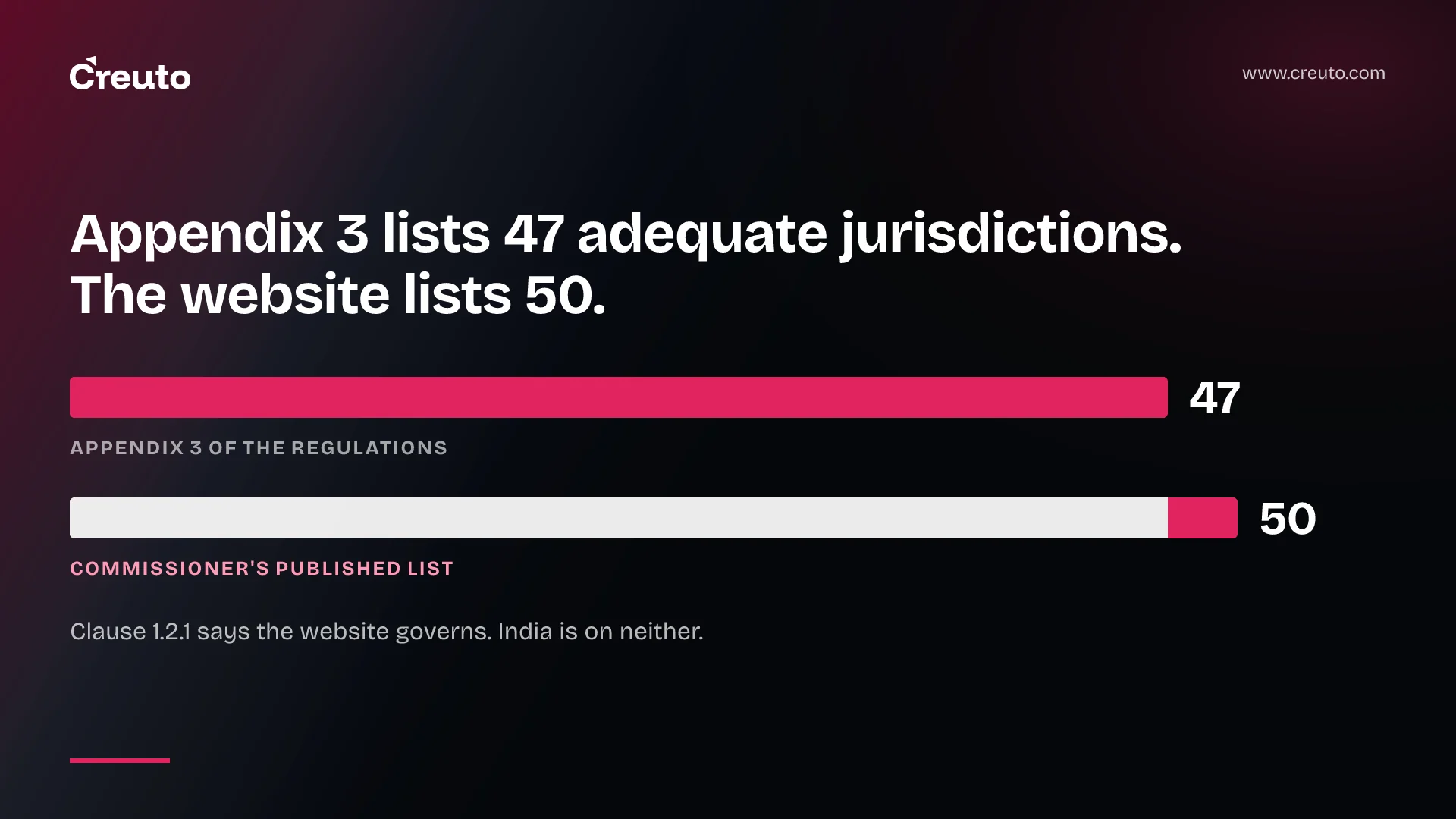
The DIFC Commissioner of Data Protection publishes a List of Adequate Data Protection Regimes — 50 entries as of October 2026, counting 30 EU and EEA states and 20 other jurisdictions and frameworks, including California, ADGM, Israel and the Qatar Financial Centre. Alongside it, the Commissioner publishes two sets of DIFC standard contractual clauses, recognised by Article 27(2)(c) of the DIFC Data Protection Law, that you can sign today.
There is a discrepancy worth knowing before you rely on either. Appendix 3 of the DIFC Data Protection Regulations lists 47 adequate jurisdictions, not 50. Appendix 3 resolves its own conflict: clause 1.2.1 states that the Data Protection section of the DIFC website "contains the most up to date version of the above list." The website governs. Check it, not the PDF.
The mainland has no counterpart list. The PDPL does set the test — Article 22 permits transfer where the destination has data protection legislation, "in the following cases approved by the Bureau", and Article 23 allows a contractual route where it does not — but the law defers the operative detail to Executive Regulations at point after point. DLA Piper's guide records that as of 6 January 2025 those "have not yet been published", and we could not locate them on the UAE Legislation portal. Practitioner sources disagree: several compliance sites assert implementing rules are in force, naming different instruments, and none cites a primary gazette reference. Treat the mainland transfer mechanism as live law with no published adequacy list, and plan for your counsel to construct the safeguard rather than select it.
| Where you incorporate | Data protection law | Published transfer tools |
|---|---|---|
| DIFC | DIFC Data Protection Law No. 5 of 2020 | Adequacy list (50 entries) and two sets of DIFC standard clauses |
| Dubai mainland | Federal PDPL | Statutory test only; no published adequacy list |
| Other Dubai free zone | PDPL unless your zone has its own legislation | Whatever that zone publishes, if anything |
This is the seam that implicates us, so we will say it plainly. India is on neither the 47-entry appendix nor the 50-entry website list. A DIFC entity sending personal data to an engineering team in India is transferring to a non-adequate jurisdiction and needs an Article 27 safeguard. That is a document and a recorded assessment, not a blocker — but it belongs in the architecture review, not in a contract annex discovered three weeks before launch.
The DIFC Innovation Licence is not permission to do regulated things
DIFC's own page is unambiguous: "The DIFC Innovation Licence is a commercial licence with a subsidised fee structure", subsidised for two to five years at USD 1,500 per annum, open to firms across AI and machine learning, FinTech, RegTech, HealthTech, PropTech and others. It is issued by the DIFC Authority. It is a cheap way to be a technology company inside the DIFC.
It is not an authorisation to carry on a Financial Service. If your product does something the DFSA regulates, the sandbox route is the DFSA's Innovation Testing Licence — a restricted licence whose eligibility criteria sit in Rule GEN 13.4 of the DFSA Rulebook, with a USD 5,000 service fee and a pre-application stage before you may even apply. Two different bodies, two different licences, one commonly conflated name. If you are building regulated finance, the rulebook obligations that attach to DFSA authorisation are the real scope driver, not the Innovation Licence fee.
What the Dubai Unified Licence actually unifies
The D33 "unified commercial licence" is the Dubai Unified Licence, and it is not a licence that replaces anything. Dubai's Department of Economy and Tourism describes it as "a unique commercial identification provided to all businesses in Dubai", issued to businesses operating with either a mainland or a free zone licence, with each business "allocated a licence number specific to the mainland or free zone authority of their incorporation." It unifies the registry and lets you show a QR code instead of a paper certificate. Your underlying licence, and the authority that issued it, are unchanged.
What did change the invoicing answer is separate and more recent. On 8 October 2025 Dubai launched the Free Zone Mainland Operating Permit under Dubai Executive Council Decision No. 11 of 2025, letting eligible free zone companies that hold a DUL operate in mainland Dubai. The permit runs six months at AED 5,000 and renews for the same fee, the first phase covers non-regulated activities including technology, consultancy, design, professional services and trading, and holders pay 9% corporate tax on the related mainland revenue while keeping separate financial records to Federal Tax Authority requirements. So "can a free zone company invoice mainland clients" now has a priced, dated answer instead of a workaround.
Where this lands in the build
Two of these items change code and one does not. The UAE Pass question is the one that does not. Its published onboarding process asks private entities for a valid UAE trade licence and routes you to a team "based on the emirate you are registered", with the entity-type field set to Government or Private. The documentation draws no free zone against mainland distinction at all. Treat UAE Pass as an approval and use-case problem — which is what makes the approval, not the OAuth, the hard part — rather than an incorporation problem.
The strongest case against everything above is that it should not drive the decision. Ownership, visa quota, office cost and corporate tax are larger numbers than a transfer clause, and your advisers will weigh them properly. That case is right. The narrower claim is the one worth acting on: these constraints are usually discovered after the architecture is fixed, and two of them — which regulator reads your product, and which instrument legitimises your data egress — are expensive to retrofit.
Before the incorporation papers are signed, get three answers in writing from your counsel: does our product perform any activity VARA regulates, does our zone have data protection legislation of its own, and where will personal data physically go. Hand those to whoever is drawing the architecture. If you want to see how we work through that kind of constraint in a custom software build, or what we do for clients in the region, our Dubai page is the place to start.
Frequently asked questions
Free zone or mainland matters less than DIFC or not-DIFC. Incorporating in DIFC puts you under the DFSA and the DIFC Data Protection Law, with a published adequacy list and approved transfer clauses. Everywhere else in Dubai the federal PDPL applies unless your own free zone has its own data protection legislation.
VARA states it is the sole authority regulating virtual assets across Dubai's free zones and mainland, except inside the DIFC. That remit is virtual assets only, so if your product performs no virtual asset activity, VARA is not your regulator wherever in Dubai you incorporate.
Article 2(2)(g) of the UAE PDPL disapplies it to companies in free zones that have special legislations on personal data protection. The carve-out is conditional on your zone having its own law, and it is scoped to the entity rather than the data, so it does not cover every free zone.
The DIFC Innovation Licence is a commercial licence from the DIFC Authority, subsidised at USD 1,500 per annum for two to five years, open to technology firms across AI, FinTech, RegTech and similar sectors. It is not an authorisation to carry on a Financial Service, which requires DFSA authorisation.
Since 8 October 2025 eligible Dubai free zone companies holding a Dubai Unified Licence can apply for a Free Zone Mainland Operating Permit, costing AED 5,000 for six months and renewable. The first phase covers non-regulated activities including technology, and 9% corporate tax applies to the mainland revenue.
The published UAE Pass onboarding process asks private entities for a valid UAE trade licence and routes them to a team based on the emirate of registration. The documentation draws no free zone against mainland distinction, so UAE Pass access turns on approval of your use case, not on incorporation.