Dubai D33 agenda: what you can actually apply for
The Dubai D33 agenda is mostly targets, not programmes. Here is what a company can actually apply for today and what has no application route.
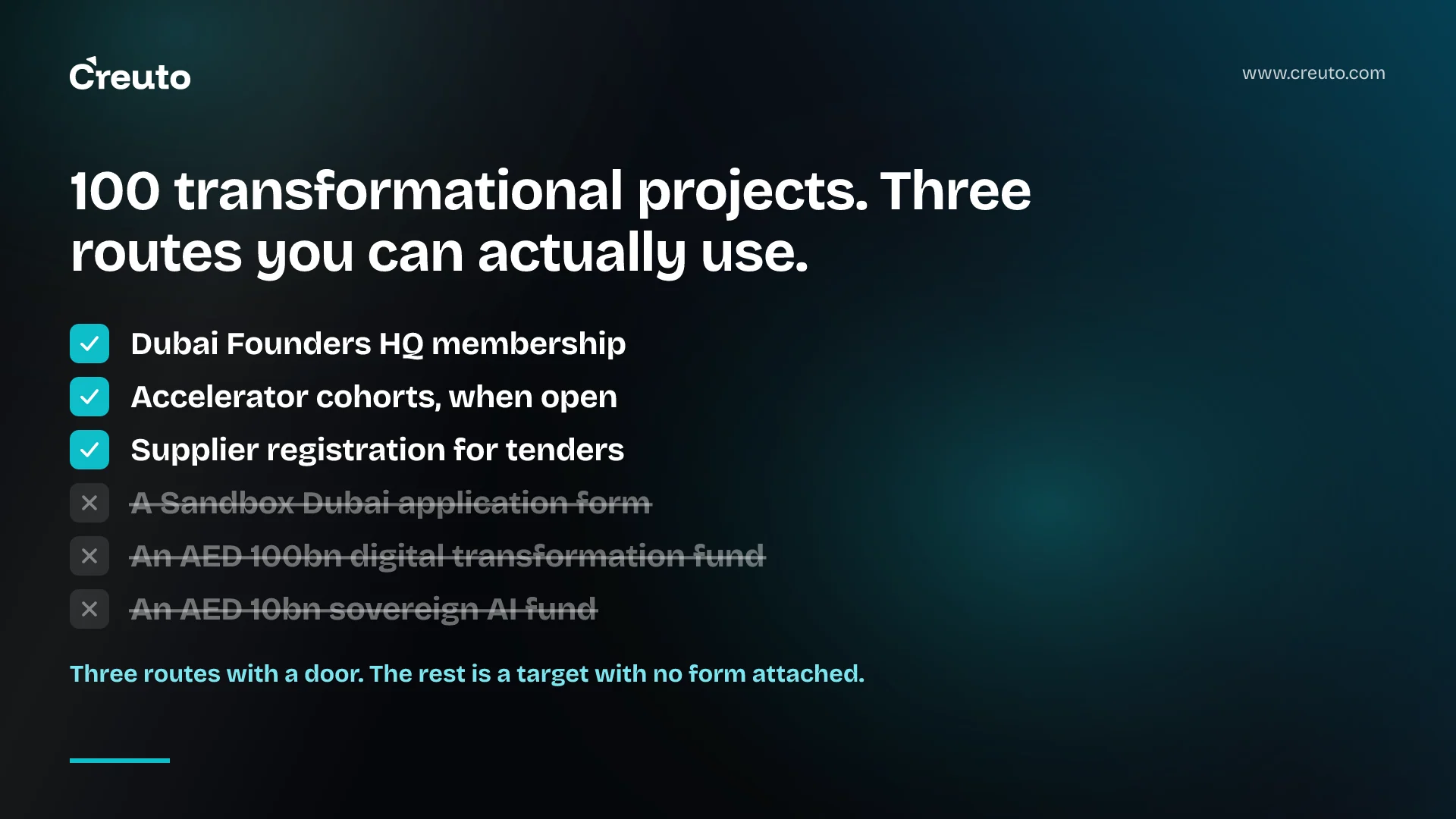
The Dubai D33 agenda contains 100 transformational projects, and a company reading it for something to act on will find roughly three routes with a door on them. Everything else is a target. Separating the two is the only useful thing you can do with this document, and almost no coverage does it.
That is not a criticism of the agenda. Economic agendas are supposed to set targets. The problem is that the targets get reported as if they were offers, so a CTO in Dubai ends up asking whether their build qualifies for something that has no qualification process.
What the Dubai D33 agenda actually commits to in the primary source
The Dubai Economic Agenda was launched on 4 January 2023 by Sheikh Mohammed bin Rashid, with economic targets of AED 32 trillion over the next 10 years and 100 transformative projects. The UAE government portal's breakdown of the same agenda names the component targets: foreign trade rising from AED 14.2 trillion to AED 25.6 trillion for goods and services, FDI reaching AED 650 billion by 2033, government expenditure rising from AED 512 billion to AED 700 billion, private sector investment from AED 790 billion to AED 1 trillion, domestic demand from AED 2.2 trillion to AED 3 trillion, and an annual contribution of AED 100 billion from digital transformation projects.
Four named projects in that list touch a technology business directly: Sandbox Dubai, the unified licence, a scale-up programme for 30 companies to become global unicorns in new economic sectors, and an SME scale-up programme identifying 400 high-potential companies. Those four are worth checking individually, because they behave very differently.
AED 32 trillion is not cumulative GDP, and the arithmetic shows it
Most secondary write-ups describe the AED 32 trillion as cumulative GDP. The business-setup firm whose explainer the industry keeps citing calls it "AED 32 trillion in cumulative GDP" in its own FAQ while describing it as cumulative economic output in the body of the same page. Dubai Media Office says "economic targets", not GDP, and the component breakdown explains why that distinction matters.
Add the published components and you get roughly AED 31 trillion, of which AED 25.6 trillion — about four fifths — is foreign trade in goods and services. Trade flows, investment flows and domestic demand are not GDP; counting them together double-counts by construction. It is a headline aggregate of ambitions, not a single measured quantity.
The size check settles it. Dubai's GDP for the first nine months of 2025 was about AED 355 billion, up 4.7%, on figures from the Dubai Data and Statistics Establishment at Digital Dubai. At that scale, a decade of Dubai GDP comes to single-digit trillions of dirhams even on the agenda's own doubling path. AED 32 trillion cannot be a GDP figure, and our reading is that reporting it as one makes the agenda sound like a different kind of promise than it is.
Information and communications, incidentally, contributed AED 16.6 billion of value added in that nine-month period and grew 4.8% — slower than construction, real estate, or financial and insurance activities. The sector the agenda talks about most is not the one currently growing fastest.
Sandbox Dubai exists, and there is no application form
Sandbox Dubai is the single most actionable-sounding item in the agenda, and the finding is that it is real but not open in the way the phrasing implies. D33 commits to "launching 'Sandbox Dubai' to allow testing and commercialisation of new technologies". It is run by the Dubai Future Foundation, and two sandboxes launched on 23 October 2024: a Gig Economy Sandbox and a PropTech Sandbox. Emirates Airline, Amazon, Careem and GEMS Education joined the gig economy track the following week.
The official Sandbox Dubai site offers "temporary regulatory relief during the experimentation phase" and lets innovators "test market-ready business models, products, services and technologies". As of October 2026 it publishes no application form, no eligibility criteria, no cohort dates and no deadlines. The only route it gives is a contact form under the line "Please get in touch if you are interested in learning more about Sandbox Dubai."
So the honest statement for a software buyer is this: Sandbox Dubai is an announced initiative with two sector-scoped tracks and a partnership model, not an open programme you apply to. If you are building gig-economy workforce software or proptech, a conversation is worth starting. If you are building anything else, nothing in it is scoped for you today.
The three routes a company can genuinely use today
Three things in the D33 ecosystem have a door you can walk through without an introduction.
Dubai Founders HQ. Launched on 6 October 2025 by Sheikh Hamdan bin Mohammed, a joint DET and Dubai Chamber of Digital Economy platform at the 25Hours Hotel in One Central. It carries the 30-unicorn and 400-SME targets, runs acceleration programmes with Endeavor and Plug and Play, and the release tells you to apply at dubaifoundershq.com. This is the clearest named route in the whole agenda.
Accelerator cohorts, when a cycle is open. DET and the Chamber of Digital Economy opened a three-month Plug and Play accelerator for post-revenue startups on 18 September 2025, with DHL, du and Visa as corporate partners across trade and logistics, connectivity and digital solutions, and fintech. The Dubai Centre for AI's "Future of AI in Government Services" accelerator runs eight-week cycles in Dubai; its second cycle closed registration in August 2025. Both are real and both are cyclical, so the answer to "can I apply" depends entirely on the month you ask.
Government procurement. If the point of your software is to be bought by a Dubai government entity, the route is supplier registration and tenders, and it predates the agenda. Digital Dubai's Smart Supplier platform gave registered suppliers access to data, contracts and bids across more than 50 Dubai Government entities from January 2020, three years before D33 was announced.
Note what is absent from that list: a grant, a tax incentive, and a fund you can draw on. We could not find a D33 instrument that transfers money to a private software company on application.
The unified licence is an identifier, not a permission
The Dubai Unified Licence is frequently described as something to obtain. It is better understood as a registry key. DET launched it with the Dubai Free Zones Council on 11 December 2023 as "a unique commercial identification provided to all businesses in Dubai", covering mainland and free zone licences alike, with over 50,000 issued at announcement.
Existing businesses "receive their unique 'Dubai Unified Licence' Number and associated QR codes upon completion of the data update process". New ones undergo validation, verification and screening. That is a data exercise, not a new licence class — and the release does not state that it is mandatory.
For an engineering team, the DUL is interesting for exactly one reason: it is a single consistent identifier for a Dubai legal entity across mainland and free zone registries, with consent-based data sharing between government entities and the private sector. If you are modelling customer entities in a product sold into Dubai, that is a better key than a trade licence number from whichever authority happened to issue it.
What the Dubai D33 agenda changes about buying or building software
Less than the headlines imply. The agenda creates no procurement preference, no technical standard you must meet, no certification, and no obligation on a private company. A target of AED 100 billion a year from digital transformation projects is a number the Department of Economy and Tourism and the Dubai Chamber of Digital Economy are measured against. It is not a number you can apply to.
The strongest version of the opposing case deserves stating, because it is not weak. Government expenditure is targeted to rise from AED 512 billion to AED 700 billion across the decade, the Chamber of Digital Economy reported 485 digital startups established or expanded in Q1–Q3 2024, up 380% year on year, and a named national target gives a procurement officer internal cover for a project that would otherwise sit in a queue. Direction of budget is a real commercial signal, and anyone who tells you the agenda is only words is wrong.
But a budget signal is not an application route, and it reaches you through an entity's own roadmap and tender pipeline, not through D33. The things that actually bind a software team operating in Dubai come from regulators and legislators, not from an economic agenda — which is why a reader should separate this document from, say, the Dubai agentic AI mandate and what it actually binds you to. One is a target. The other has scope.
So the build decision does not change. The reason to build custom software rather than configure a package is still that the workflow you have does not fit the package, and that argument is made on your operations, not on an emirate's GDP ambition. The engineering patterns do not change either: a municipal operations platform is a municipal operations platform, and the integration surface — vehicles, routes, field staff, audit trail — looks much the same wherever it runs. Our own IoT platform for waste management and urban operations was delivered in India, and what transfers is the architecture, not the jurisdiction.
If you want to see the shape of the work rather than the shape of the agenda, our Dubai practice page is the more honest place to start than any D33 explainer, including this one.
Where the figures in the coverage come from, and the two we cut
Two numbers circulate widely on this topic that we could not source to any primary release, and both are instructive.
The first is an AED 10 billion sovereign AI fund for Dubai. We found no Dubai Media Office, Dubai Future Foundation or Digital Dubai release announcing it. The nearest real things are Abu Dhabi vehicles denominated in US dollars, which is a different emirate and roughly four times the figure, and a Dubai AI ecosystem target reported by a property-marketing site. Treat the fund as unverified.
The second is a count of more than 3,500 startups valued above USD 28 billion. Published ecosystem valuations for Dubai disagree sharply depending on who counted and when — Startup Genome put the ecosystem above USD 23 billion at the end of 2023, a 2025 report produced with DET put the tech ecosystem at USD 43 billion, and commercial guides for 2026 give USD 32–38 billion. No primary government release we could find carries USD 28 billion. When four sources give four numbers, the useful statement is that nobody agrees on the denominator, not an average of them.
One domain warning, since this topic attracts lookalikes. Digital Dubai's site is digitaldubai.ae, and the older smartdubai.ae redirects to it. A similarly named .ai domain circulating D33 figures is not the government entity. Check the publisher before you quote the number.
The decision this leaves you with
If your question was "does D33 fund or fast-track my build", the answer as of October 2026 is no, with three exceptions that are programmes rather than entitlements: Dubai Founders HQ, an open accelerator cycle, and supplier registration if you sell to government. If your question was whether a regulatory sandbox will let you ship something the current rules do not allow, that depends on whether your product is gig-economy workforce software or proptech — and if it is, the next step is a contact form, not an application.
Everything else in the agenda is a target, and the right way to use a target is as evidence that budget is moving, not as a thing to qualify for.
Frequently asked questions
The Dubai Economic Agenda, D33, is a ten-year plan launched on 4 January 2023 by Sheikh Mohammed bin Rashid. Dubai Media Office states economic targets of AED 32 trillion over ten years across 100 transformational projects, including foreign trade, investment and digital transformation targets rather than company programmes.
Sandbox Dubai is a Dubai Future Foundation platform offering temporary regulatory relief for testing new technologies. It currently runs a Gig Economy Sandbox and a PropTech Sandbox, both launched in October 2024. As of October 2026 its site publishes no application form, only a contact form.
We could not find any D33 instrument that transfers money to a private software company on application. The agenda's named routes are programmes rather than grants: Dubai Founders HQ membership, accelerator cohorts run with Plug and Play and Endeavor, and government supplier registration for tenders.
The Dubai Unified Licence is a commercial identifier rather than a new licence class. DET launched it on 11 December 2023 with the Dubai Free Zones Council; existing businesses receive a DUL number and QR code once their registry data is updated, and the release does not state it is mandatory.
The D33 agenda creates no procurement preference, technical standard or certification binding a private company, so a build-or-buy decision does not change because of it. Its practical relevance is as a signal that government digital budget is rising, reachable through tenders rather than the agenda itself.