Delivery app development Dubai: your address field is wrong
Delivery app development Dubai: Makani returns a number per building entrance, not per building. Four constraints a ported ordering app breaks, ranked.
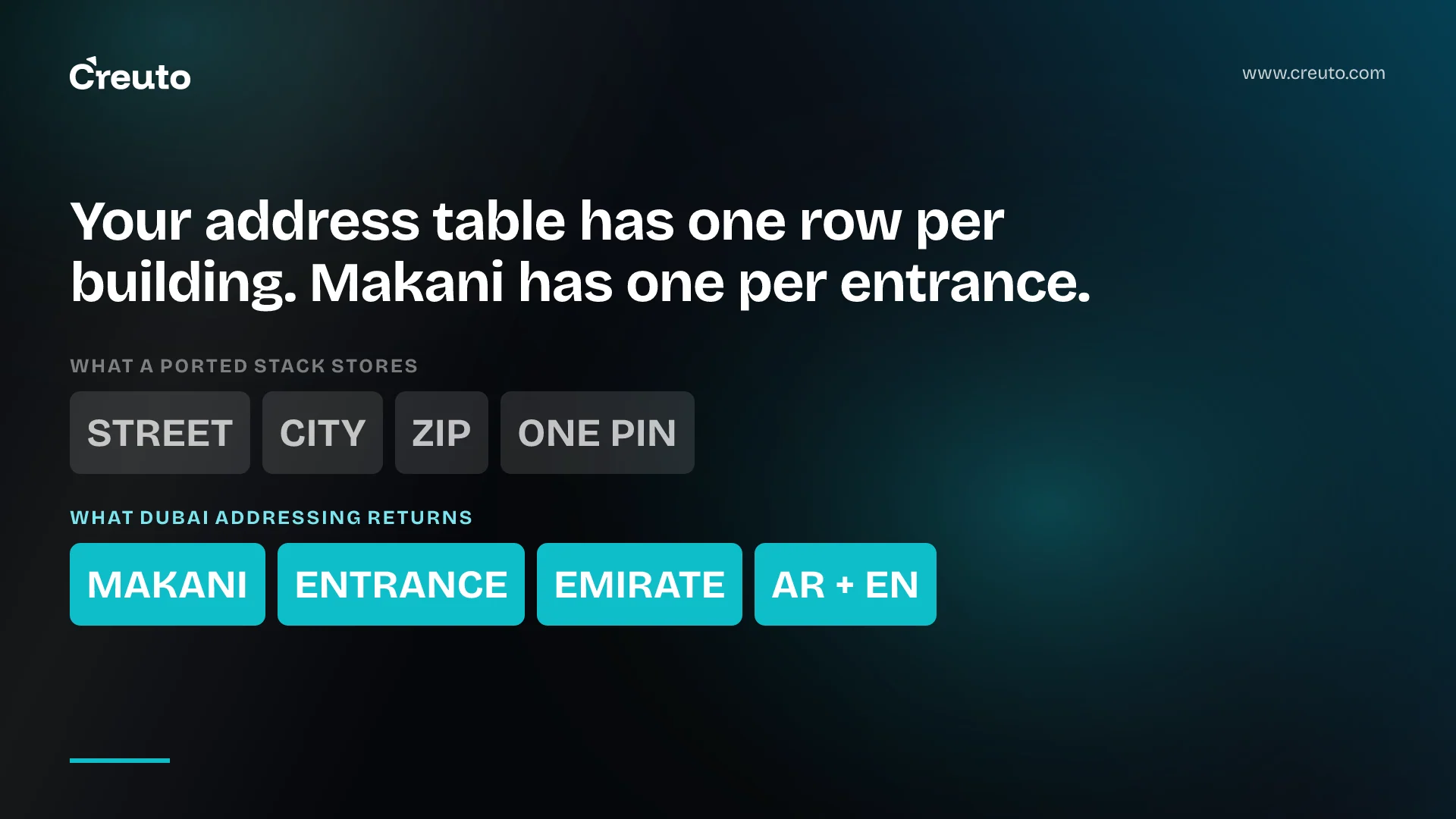
Ask Dubai Municipality's own addressing service where a building is and it does not hand you back an address. It hands you back an array. The documented response for the Municipality's head office contains two Makani numbers — 30032 95320 and 29969 95333 — because the building has two entrances, and the service returns one for each. That detail is the whole of delivery app development Dubai in miniature: the thing a ported ordering stack models as one row is, here, a set.
Below are the four constraints a template delivery app meets in this market, ranked by what they cost to fix after launch rather than before it. The regulatory reading comes from primary sources — Dubai Municipality's Makani web service manual, the RTA's own releases, and the VAT Executive Regulation — and every figure links to the page it came from.
Rank them by what it costs to retrofit, not what it costs to build
All four are cheap on a whiteboard. They diverge once there is production data, because two are schema decisions and two are integration decisions. A schema decision you got wrong migrates across every saved address, every order row and every historical route. An integration decision you got wrong is a sprint.
| Constraint | What it actually is | Cost to retrofit after launch |
|---|---|---|
| Addressing and geocoding | A schema decision: entrance-level identifiers, composite keys, bilingual place names | Highest — migrates saved addresses, order history and route logs |
| Service areas and assignment | Per-mode, per-area eligibility set by a regulator and revised without you | High — touches dispatch, pricing and merchant onboarding together |
| Arabic and English parity | A content-model decision first, a layout problem second | Moderate — additive in the data model, a rebuild in the layout |
| Wallet-first payment | An integration boundary | Lowest — the order model barely moves |
Tax-inclusive price display sits outside the table because it is not a build decision at all. It is a day-one legal break, and whether it is cheap depends on a choice you made months earlier.
How do delivery apps handle Dubai addresses? Not with a postcode
Dubai's geographic addressing system is Makani, which Dubai Municipality publishes as open data and describes as Dubai's smart address system. The Municipality's own framing is the design constraint: Dubai is "the first city in the world to use numbers to identify and locate building entrances." Entrances, not buildings. The number is ten digits — the Municipality's Makani app listing gives 30032 95320 as its worked example — and plates at the entrance carry a QR code resolving to the same identifier.
Read the Municipality GIS Center's manual for the Makani public web service and four things follow that a generic address model gets wrong.
One building is one-to-many
GetMakaniInfoFromCoord takes a latitude and longitude and returns, in the manual's words, "Makani number for all the entrances" where a building has more than one. Your addresses table almost certainly holds a single geocode and a single identifier. The rider does not arrive at a building; they arrive at an entrance, and in a tower with a retail podium those are different places several minutes apart.
The ten digits are not a primary key
GetMakaniDetails carries an explicit caveat: "In case Makani Number is available in more than one emirate, this method/function will list the emirates and their communities." The number is not globally unique. The emirate is part of the key, and the manual's QR-code table shows how — Dubai's short URL takes no emirate parameter, while Abu Dhabi, Ajman, Fujairah, Ras Al Khaimah, Sharjah and Umm Al Quwain each take an explicit one. Dubai is the implicit default; every other emirate needs a qualifier you did not store.
It is a string, and it has a space in it
The sample payloads return "MAKANI": "30032 95320" — with the space — while the QR short URL for that same entrance is m=3003295320, without it. The emirate examples include 0041085963 for Ajman. Store a Makani number as an integer and you lose the leading zero; normalise it one way and your QR scans stop matching your database. Ten minutes on day one, a data-cleaning project on day four hundred.
The licence constrains your cache
Makani open data is free and may be used commercially, but Dubai Municipality's terms are specific: you may not "sell MAKANI data to anyone or any entity", attribution to Dubai Municipality is required wherever the data appears, and the Municipality reserves the right to "amend the content of 'MAKANI' Open Data at any time" while declining to guarantee it is uninterrupted or free of inaccuracies. So you need a cache with an invalidation story, an attribution surface and a documented fallback. The manual also exposes IsValidMakani, so validation is a server round trip rather than a regular expression — and when we called the documented endpoint on makani.ae on 9 October 2026, our requests from outside the UAE timed out. Confirm reachability and latency from your own infrastructure before putting that call in a synchronous checkout path.
Two primaries also disagree about coverage. The web service manual lists QR URL forms for all seven emirates; the Municipality's own Makani app listing describes the system as adopted in Dubai, Ajman, Umm Al Quwain, Fujairah and Ras Al Khaimah. Design so an emirate without a Makani number degrades to a coordinate and a free-text note rather than failing.
The strongest case against all of this, and why it still loses
Hear the opposing argument properly, because it is good. Google Places autocomplete plus a draggable map pin works. It is what most apps here actually ship. Customers know their own buildings, riders call, and the big platforms run broadly the same stack everywhere they operate. Asking users to type an identifier they have never typed is friction in the one flow that cannot afford it.
That argument is right about the customer and wrong about everyone else. A map pin is a point; Makani is a point plus an entrance name in two languages, a community, a building name and an emirate. The pin survives checkout and then dies — in the rider app, in the support call, in the merchant's dispute, in the reconciliation of a failed delivery. The cheap version is not "make customers type ten digits". It is to keep a Makani field on the address record, populate it from the coordinate where the service can, show the entrance name you get back, and never make the customer its source.
Delivery app development Dubai means per-mode service areas, not one polygon
Where you may deliver depends on how you deliver, and the list is set by the regulator and changes. The RTA launched its e-bike delivery service as a trial in February 2026 in four areas — Al Karama, Al Hamriya, Umm Hurair and Al Mankhool — and on 27 July 2026 added seven more: Al Twar 1, Al Twar 2, Al Qusais 1, Sheikh Mohammed Bin Rashid Boulevard, Dubai Media City, Jumeirah Lakes Towers and Dubai Marina. Eleven named areas, chosen on criteria the RTA states — infrastructure and dedicated tracks, proximity to retail outlets and restaurants, business demand, and soft-mobility usage. The same release describes "amendments to the regulatory framework governing quality and licensing for delivery service companies".
Three consequences follow. Your serviceable area is not one polygon per city but a polygon set per fulfilment mode. That set is versioned by an external authority, so it belongs in configuration with an effective date, not in a constant. And mode eligibility has to resolve before you quote a fee and an ETA, not after you assign — a customer in an area where e-bikes are not permitted is a different cost and a different promise. Multi-emirate assignment compounds it: a rider pool spanning Dubai and Sharjah crosses a boundary where the addressing qualifier changes and the permitted modes differ, so treat the emirate as a first-class partition of the assignment problem rather than a field on an address.
The pattern is not exotic, and it is the one piece here we have built. On FlashNow, a quick-commerce and hyperlocal delivery platform, the problem was a fulfilment network with no centralised warehouses: four participant roles, no structured system for assigning delivery partners to orders, and no ETA calculation. That deployment is in India, and nothing in it is evidence about how Dubai's rules work. What transfers is the shape of the solution — an assignment layer treating eligibility, not just distance, as the constraint, so a new eligibility rule is configuration rather than a rewrite.
Arabic and English parity is a data-model decision before it is a layout problem
Most teams schedule Arabic as a localisation phase after launch. Here the authoritative address data is already bilingual, which moves the decision earlier. Every name field in the Makani response is doubled: COMMUNITY_E and COMMUNITY_A, BLDG_NAME_E and BLDG_NAME_A, ENT_NAME_E and ENT_NAME_A, EMIRATE_E and EMIRATE_A.
If your address record holds one building_name string, you have decided to discard half of what the authoritative source gave you, and you find out when a rider needs the Arabic building name to ask a security guard a question. Carry both from the first migration. The layout work — right-to-left mirroring, bidirectional text in a string mixing an Arabic community name with a Latin-digit Makani number, numeral form — is real and is a rebuild if you leave it late, but it is recoverable in a way a lossy schema is not.
Which payment methods matter in the UAE, and the price you may show
Two things get conflated: which instruments you accept, and how you may display a price. The second is not optional. Article 27 of the VAT Executive Regulation — Cabinet Decision No. 52 of 2017, consolidated to Cabinet Decision No. 149 of 2026 and effective 1 October 2026 — states that "in the case of a Taxable Supply, the published prices shall be inclusive of Tax." A consumer food or grocery app has no exception: the carve-outs in Clause 2 are supplies for export and cases where "the customer is a Registrant", and Clause 3 requires an exclusive price shown under that exception to be "clearly identified as being exclusive of Tax". So a B2B catering or wholesale flow may show ex-tax prices to VAT-registered customers; a consumer menu may not.
The cost of that break was decided months earlier. If your money model stores merchant prices ex-tax and adds tax at checkout, as most ported platforms do, going inclusive is not a formatting change: rounding moves to the line item, the merchant's menu price becomes the inclusive figure, and commission splits, promotions and refunds compute off a different base. Store the inclusive price and derive the tax component, and the regulation costs you nothing.
On instruments, the requirement is a payment layer that is scheme-agnostic rather than card-network-shaped. Jaywan, which Al Etihad Payments describes as "the UAE's domestic card scheme", states that it "securely processes and stores all payment-related data in the UAE". A gateway that only routes over international card networks will not route a domestic-scheme card. We will not quote a wallet-share figure we could not source primarily, so treat this as an architectural rule rather than a market claim: keep scheme routing behind an interface, and make tokenisation and stored-instrument handling a property of that interface rather than of one provider's SDK.
Autonomous delivery in Dubai is a pilot, so design for it and do not plan on it
The autonomous story is why this topic gets written about, and it is the part most coverage overstates. The RTA's own numbers are the correction. Its 19 August 2026 release reports Robotaxi operations passing 4 million kilometres at a 97% satisfaction rate — and, in the same text, "7,613 passenger trips since launch", a fleet of 144 vehicles of which 48 are in active operation, "completing around 50 trips daily". The RTA puts public transport, shared mobility and taxi ridership at 348 million in the first half of 2026, averaging 1.9 million trips a day. Fifty autonomous trips a day against 1.9 million is a trial, and the four-million-kilometre figure that circulates as proof of a mature service sits beside seven thousand passenger journeys in the authority's own release.
These are passenger robotaxis, not delivery. Dubai's stated target, named in RTA releases as the Dubai Smart Self-Driving Transport Strategy, is to convert 25% of all mobility journeys to autonomous trips by 2030. On 27 September 2026 the RTA and the Dubai Integrated Economic Zones Authority inaugurated Dubai Mobility Labs in Dubai Silicon Oasis — 248 test scenarios, public-road testing from Dubai Silicon Oasis to Al Qudra, operated by DEKRA for its first three years. That is testing and certification infrastructure: a strong signal, not a fulfilment channel you can schedule against. We looked for an RTA primary describing an autonomous food-delivery arrangement with a named platform and did not find one. The delivery items in the RTA's newsroom are about human riders — e-bike area licensing, and 40 air-conditioned rest areas confirmed operationally ready before the 2026 summer.
The design conclusion is narrow. Make the courier an abstraction in your assignment layer — a capability set, a service-area set, a cost function — rather than a person with a phone. Then a robot, an e-bike and a motorcycle are three courier types with different eligibility, and the day a pilot becomes a channel you add a row instead of rewriting dispatch. What justifies building that abstraction now is the per-mode e-bike rules that already exist, not the robots.
What to decide before the first migration
Three decisions here are effectively irreversible and all three are free this week. Put a nullable Makani field and an emirate qualifier on the address record, and store the number as a string. Carry Arabic and English name fields side by side instead of one string. Store prices tax-inclusive and derive the tax component. Gateway choice, service-area configuration and courier types are work you can do in a sprint whenever the market forces it.
If you are weighing a build against a port, the useful question is not which features you need. It is which of your assumptions is a schema. What we bring is the engineering side of that, through our e-commerce and ordering platform work and the same class of failure in ported storefronts, where the pattern is identical: the cheap fix is a field you did not add. You can see the rest of what we do from our Dubai page.
Frequently asked questions
A delivery app in Dubai needs entrance-level addressing through Makani rather than street numbering, service areas defined per fulfilment mode because the RTA licenses e-bike delivery area by area, Arabic and English name fields carried side by side in the data model, scheme-agnostic payment routing, and tax-inclusive price display.
Dubai uses Makani, a ten-digit geographic code that Dubai Municipality publishes as open data and describes as identifying building entrances rather than buildings. Its web service returns a number for every entrance, includes Arabic and English place names, and warns that the same number can appear in more than one emirate.
The architectural requirement matters more than any single method: keep scheme routing behind an interface. Jaywan, which Al Etihad Payments describes as the UAE's domestic card scheme, will not route over a gateway wired only to international card networks, so hard-coding two networks is the wrong abstraction.
No. The RTA's August 2026 release reports 7,613 Robotaxi passenger trips since launch and around 50 trips daily from 48 active vehicles, and those are passenger services rather than delivery. Dubai Mobility Labs, inaugurated in September 2026, is testing and certification infrastructure, not a fulfilment channel.