December 2026 core update: what to do before it lands
Google preannounced the December 2026 core update with no start date. What to baseline, freeze and fix in crawl and CDN rules before the rollout begins.
For the first time, Google has told site owners about a core update before it starts. The December 2026 core update was preannounced on the Search Status Dashboard on 24 November 2026, with no start date. By the end of this post you will know what Google has said, what it has not, and which engineering changes to finish, freeze or defer before the rollout begins.
That matters if organic search feeds your pipeline and your December roadmap includes a migration, a CDN switch or a template rebuild. The update itself is not something you can prepare content for in four weeks. Your ability to read what it did to you afterwards is something you can prepare for, and most of that work belongs to engineering.
| What | Detail (as of 27 November 2026) |
|---|---|
| Announced | 24 November 2026, 07:02 US/Pacific, on the Search Status Dashboard feed |
| Start date | None given. Google told Search Engine Roundtable "It's not imminent." |
| Stated focus | Longer and more complex questions, and personalized results for people who have personalization turned on |
| Scope | All locations and languages where Google Search is available |
| Why the notice | The UK CMA's fair ranking conduct requirements |
| Previous update | November 2026 core update, 10 to 24 November 2026 |
What Google has said about the December 2026 core update
Google's notice is short. It says the update "focuses on multiple improvements to how our systems understand and rank relevant content, including for longer and more complex questions" and adds "improving personalized results for people who have personalization turned on." It "applies to all locations and languages where Google Search is available" and "is scheduled to be released in December 2026." All three quotes are from the dashboard's Atom feed.
The notice went up minutes after the November update finished. The November 2026 core update incident records the rollout as complete at 06:03 US/Pacific on 24 November; the December preannouncement is timestamped 07:02 the same morning. Sites still reading the effects of November now have a second update queued behind it.
Is the December core update live yet?
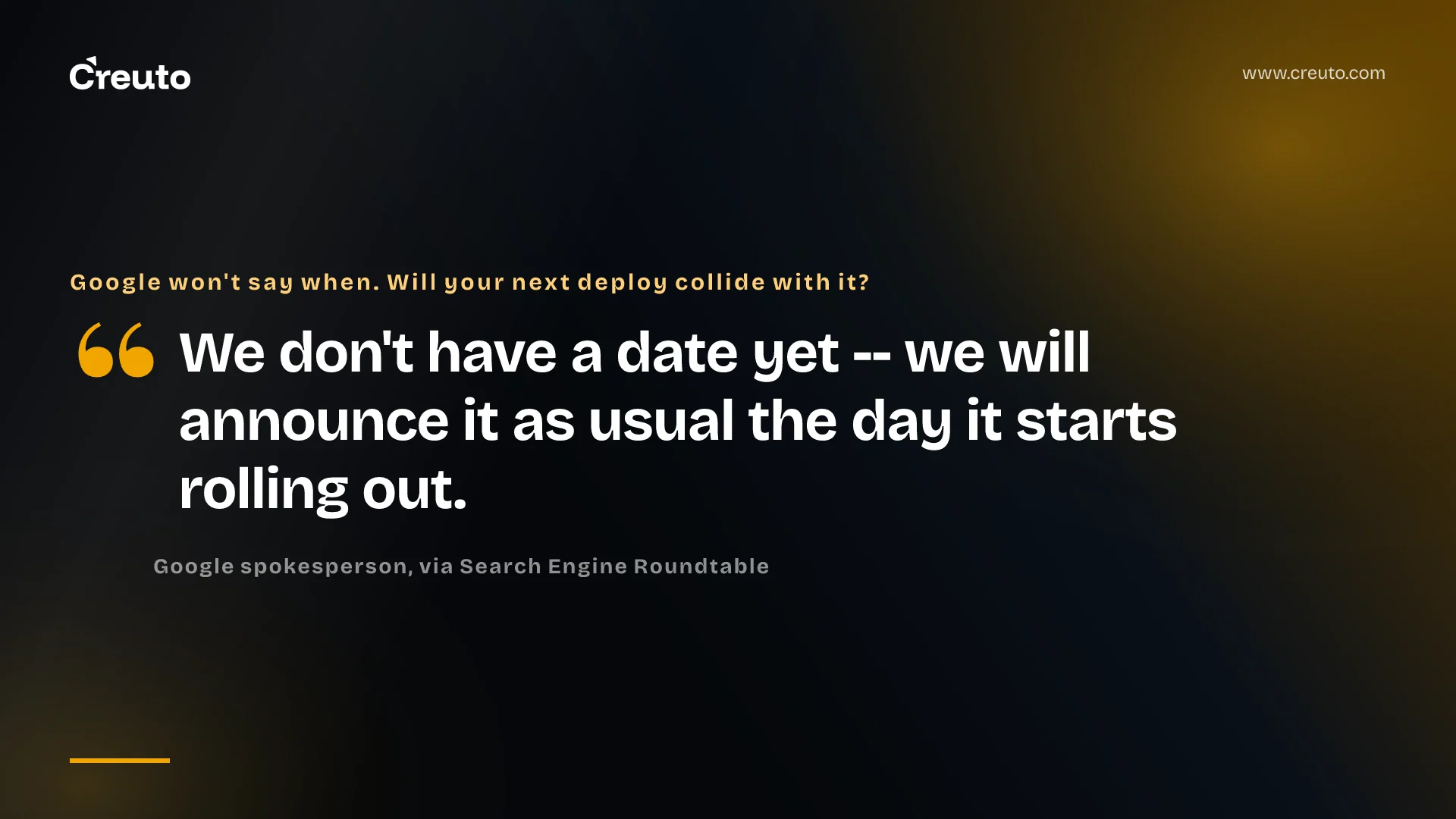
The December core update was not live as of 27 November 2026, and this is where the dashboard misleads. Search Engine Roundtable reported that the status page listed the update as active, while Google confirmed three times that it was "not live and not active." A Google spokesperson said: "We don't have a date yet -- we will announce it as usual the day it starts rolling out."
The ranking update history shows the same oddity. The December entry is dated 24 November, typed as Information and carries no duration, while every other 2026 core update shows a rollout length. If a rank tracker or an internal alert keys off that page, it may already be treating December as in progress. Ranking movement before Google announces a start date has some other cause.
Why Google preannounced this core update
The reason is regulatory, not editorial. Google's notice cites the UK Competition and Markets Authority, and a new Google page, Stay informed about Google Search updates, says that "for changes where UK users may experience a significant ranking shift, we provide advance notice to site owners" in accordance with "CMA's fair ranking conduct requirements for Google."
Read that page closely and it promises less than the headlines suggest. It commits to notice "based on the type of change" and to publishing "pre-announcements, rollout start dates, and completion notices" on the dashboard. It names no lead time. Expect a preannouncement for core updates from now on, but do not expect it to tell you when to stop shipping.
How long the rollout window will probably be
The 2026 core updates each took close to two weeks to roll out, according to Google's ranking update history:
| Core update | Started | Rollout length |
|---|---|---|
| March 2026 | 27 March | 12 days 4 hours |
| May 2026 | 21 May | 11 days 21 hours |
| November 2026 | 10 November | 13 days 20 hours |
| December 2026 | Not started | Unknown |
Google's own November notice said "the rollout may take up to 2 weeks to complete," and its core updates guidance recommends "waiting at least a full week after a core update completes before analyzing your site in Search Console." Add those together and the window to plan around is roughly three weeks from whatever start date Google announces. If December's rollout starts late in the month, the analysis falls in January 2027.
Should you freeze releases during a core update?
Freeze the changes that alter how Google crawls, renders and indexes your site, and keep shipping everything else. The point is diagnosis. Google's guide to debugging traffic drops lists algorithmic updates, technical issues, and site moves and migrations as separate causes of a drop. Ship a URL migration in the same fortnight as a core update and nobody can tell you afterwards which one moved the graph.
The strongest case against a freeze is Google's own. Its core updates page says changes "can take effect in a few days, but it could take several months," and warns against "quick fix" changes. If nothing you ship in December changes how the update treats you, a freeze costs a month of delivery in a busy season and buys no ranking. That is right about rankings. It is wrong about attribution, which is what the freeze protects.
A narrow freeze list for the rollout window, plus the week after it:
- URL structure changes, redirect maps and domain or subfolder moves
- robots.txt, meta robots, canonical and sitemap generation logic
- CDN, WAF or bot-management provider changes and new blocking rules
- Rendering changes, such as moving templates from server to client rendering
- Site-wide template rebuilds for category, product or article pages
Copy edits, new pages, bug fixes and features behind logged-in flows can keep going. If your team runs releases through a pipeline, a path-scoped gate in your CI/CD pipeline is easier to enforce than a calendar reminder. This is the wrong call if search is a minor channel for you, or if a migration is already half done. Finishing it before the rollout starts beats leaving it half live during it. If a rebuild is on the roadmap anyway, our web app development work usually starts with exactly this sequencing question.
What to do before the Google December core update starts
Everything on this list is cheaper to do now than after the rollout begins.
- Export a Search Console baseline. Google's debugging guide tells you to open the Performance report with "Last 16 months," compare periods, filter by search type and sort pages by "Clicks Difference." That comparison needs a clean before period. Export it by page and query now, and record the date range.
- Clear the Crawl stats and Page indexing reports. The same guide sends you to these reports first, along with Security Issues and Manual Actions. A crawl or indexing problem found in December should be fixed before rollout, not discovered in the middle of it.
- Check your CDN and WAF rules for Googlebot. Google's 11 November post on CDN moves warns that "leaving blanket bot protection enabled without exempting verified crawlers" leaves crawlers on error pages. It recommends allowing verified bots using Google's published IP ranges and using "429 or 503 if you need a temporary brake," for hours or one to two days at most.
- Log every deploy with a timestamp. Line releases up against the dashboard's start and end times so a drop can be matched to a cause. Good infrastructure monitoring already records this; a shared release log is enough if it does not.
The CDN item deserves more attention than it gets. The same post notes that a new CDN starts with a cold cache, so misses hit your origin, and that a faster edge raises crawl capacity, so crawling ramps up. A CDN move in December lands both effects inside the update window. If one is planned, our DevOps and cloud engineering team would pre-warm caches and verify crawler rules before it ships, not during the rollout.
Longer complex questions and personalization: what you can and cannot act on
Google has not said what the December update will reward, and anyone who tells you otherwise is guessing. The two named areas give limited direction. For longer, complex questions, Google's helpful content guidance is the standing reference, including the self-assessment question "Does the content provide original information, reporting, research, or analysis?" and its note that "Why" is "perhaps the most important question to answer about your content."
Personalization is harder to plan for. Google only said it is improving results for people who have personalization turned on. Our reading, not Google's statement, is that rank checks from logged-out tools may drift further from what signed-in users see, so treat clicks in Search Console as the number that matters and tracked positions as a rough guide.
Reading the results once the rollout finishes
Google draws a line between small and large drops. Its core updates page says a drop "from position 2 to 4" needs no drastic action, while "dropping from position 4 to 29" calls for a deeper assessment of the site as a whole and the pages most affected. It calls deleting content "a last resort."
Recovery is slow and uneven. One measured figure exists: SE Ranking's study of about 100,000 keywords found that 32.20% of domains that lost top 10 positions after the March 2026 updates were back in the top 10 after the May update. That is one vendor's sample, tracked from a single New York location, so treat it as direction rather than a forecast. Google's own guidance says a site that sees no effect after a few months may be waiting until the next core update.
Where engineering time is better spent this December
The practical decision is sequencing. Finish risky crawl and rendering changes before Google announces a start, take the baseline exports this week, and hold the freeze list until a week after the rollout completes. Everything else can ship.
If your December plan includes a replatform, a rendering change or a template rebuild that you now need to move either side of the update, our web app development team can scope what ships before the rollout and what waits for the analysis window, and build it so the next core update is easier to read.
Frequently asked questions
The December 2026 core update has no announced start date as of 27 November 2026. Google's notice says it is scheduled for release in December 2026, and a Google spokesperson told Search Engine Roundtable that it is not imminent and that Google will announce it on the day it starts rolling out.
The December core update was not live as of 27 November 2026. The Search Status Dashboard briefly listed it as active, but Google confirmed to Search Engine Roundtable that it was not live and not active. Watch the dashboard for a rollout start notice before attributing ranking changes to it.
Google preannounced the December core update because of the UK Competition and Markets Authority's fair ranking conduct requirements. Google's stay-informed page says it gives site owners advance notice for changes where UK users may experience a significant ranking shift, though it does not promise any particular lead time.
Site changes that affect crawling, rendering or indexing are best held until a week after a Google core update completes, because migrations and technical issues are separate causes of traffic drops. Content edits, bug fixes and new features can continue. Google also advises against quick-fix changes in response to an update.
A Google core update in 2026 took between about 12 and 14 days to roll out. The March update ran 12 days 4 hours, May ran 11 days 21 hours and November ran 13 days 20 hours, and Google recommends waiting another full week before analyzing results in Search Console.