Is Custom Software Worth the Investment? Here’s the ROI You Can Expect
Is custom software worth the investment? Where ROI comes from, how to estimate it honestly over five years, when it does not pay off, and how to maximise it.
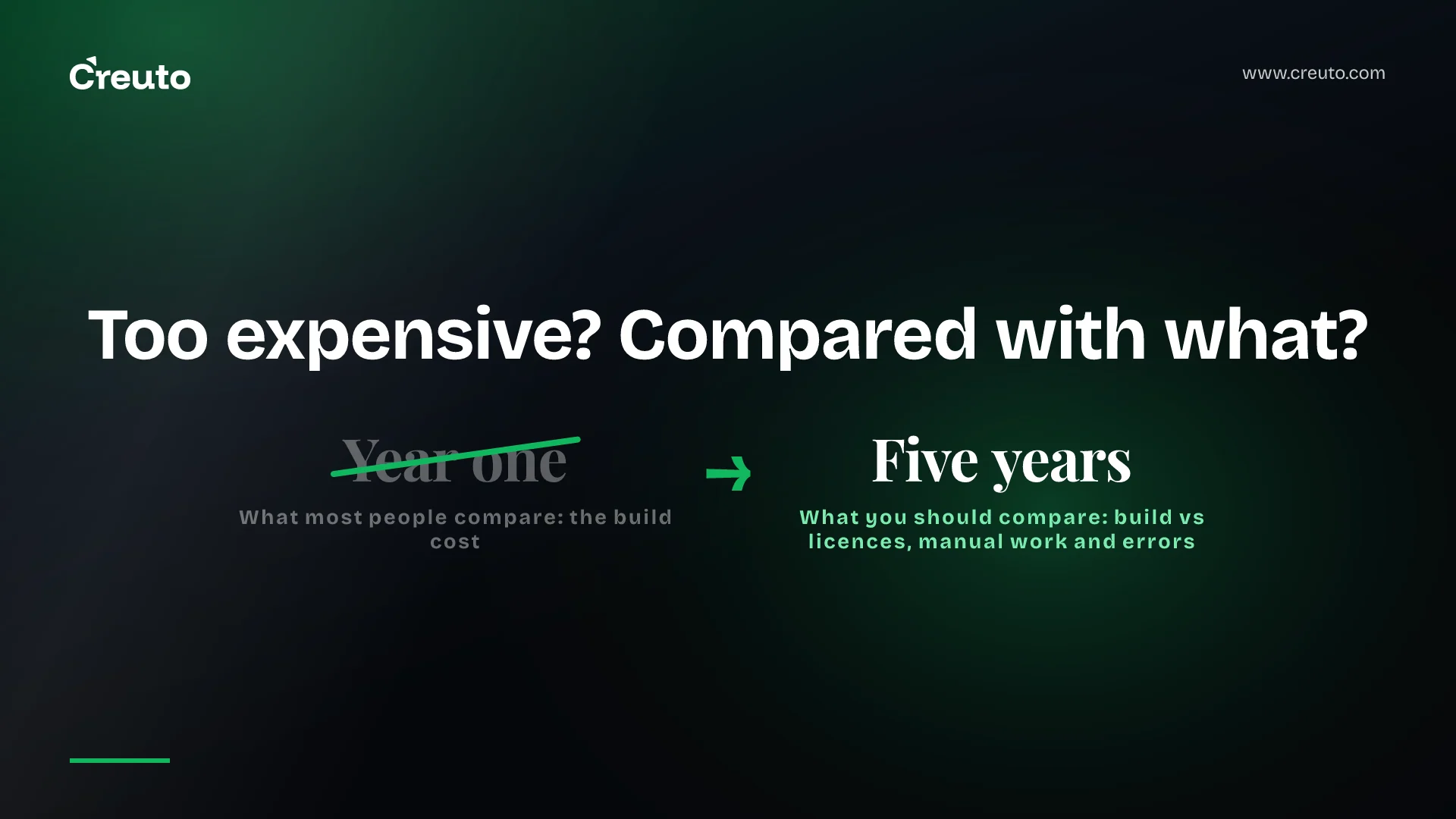
Custom software is often dismissed as "too expensive". Sometimes that is right. But the useful question is not what it costs to build; it is what it returns compared with the alternatives over several years. This guide explains custom software ROI: where the returns come from, how to estimate them honestly, and when the numbers do not add up.
Where the return comes from
1. Time saved on manual work
Manual data entry, re-keying between systems, chasing approvals and building reports by hand consume hours every week. Automating them is usually the largest and most measurable return.
2. Fewer errors
Every manual step is a chance for mistakes — wrong prices, missed orders, payroll errors. Their cost includes rework, refunds and lost customers.
3. Licence and tool costs avoided
Off-the-shelf products charge per user, and many businesses pay for several overlapping tools and features they never use. Custom software has no per-user fee, which matters more as headcount grows. We worked through real figures in Odoo vs custom ERP and Salesforce Core vs a custom CRM.
4. Growth without matching headcount
When systems absorb volume, the business can serve more customers without hiring at the same rate.
5. Better decisions
Reliable, timely data helps spot problems and opportunities earlier. This return is real but harder to measure, so do not build the business case on it alone.
6. Competitive advantage
Capabilities your competitors cannot buy off the shelf — a faster quoting process, a better customer app — can win and keep customers.
How to estimate ROI honestly
- Measure the current process: hours per week, people involved, error rates and their cost, and current tool subscriptions.
- Estimate the improvement per process, conservatively.
- Add up the full cost: discovery, build, hosting, support and enhancements over three to five years.
- Compare with the alternative — the off-the-shelf option or doing nothing — over the same period.
- Measure after launch against the baseline, and adjust the roadmap.
Be wary of anyone promising a specific ROI percentage before they have seen your processes.
When custom software does not pay off
- For standard functions, where good products already exist at reasonable prices.
- When the process is changing so fast that the requirements will not settle.
- When nobody will own the system internally after launch.
- When the scope is so large that the first value arrives too late.
Our guide to custom vs off-the-shelf software covers how to decide.
Maximising the return
- Start with the process that costs the most.
- Deliver in phases, so value arrives early and funds the next phase.
- Build on sound architecture to avoid a costly rebuild later; see the true cost of poor architecture.
- Track usage and outcomes after launch.
Conclusion
Custom software is an investment when it removes real, measurable cost or creates advantage you cannot buy. Measured honestly and delivered in phases, the return is visible. Our custom software development team can help you build the business case — and will tell you when buying is the better answer.
Frequently asked questions
Custom software is worth the investment when it removes measurable costs such as manual work, errors and per-user licences, or creates an advantage you cannot buy. For standard functions, off-the-shelf software is usually better value.
Calculate custom software ROI by measuring the current process in hours, errors and tool costs, estimating improvements conservatively, totalling build and running costs over three to five years, and comparing against the off-the-shelf alternative or doing nothing.
Custom software may not pay off for standard functions with good existing products, processes that change too quickly to specify, systems nobody will own after launch, or scopes so large that value arrives too late.
Maximise the return by starting with the most costly process, delivering in phases so value arrives early, building on sound architecture to avoid rework, and measuring usage and outcomes against a baseline after launch.