Custom vs. Off-the-Shelf Software: Making the Right Choice for Your Business
Custom vs off-the-shelf software: the real trade-offs, a five-year cost view, when to buy, when to build, and the hybrid approach many businesses choose.
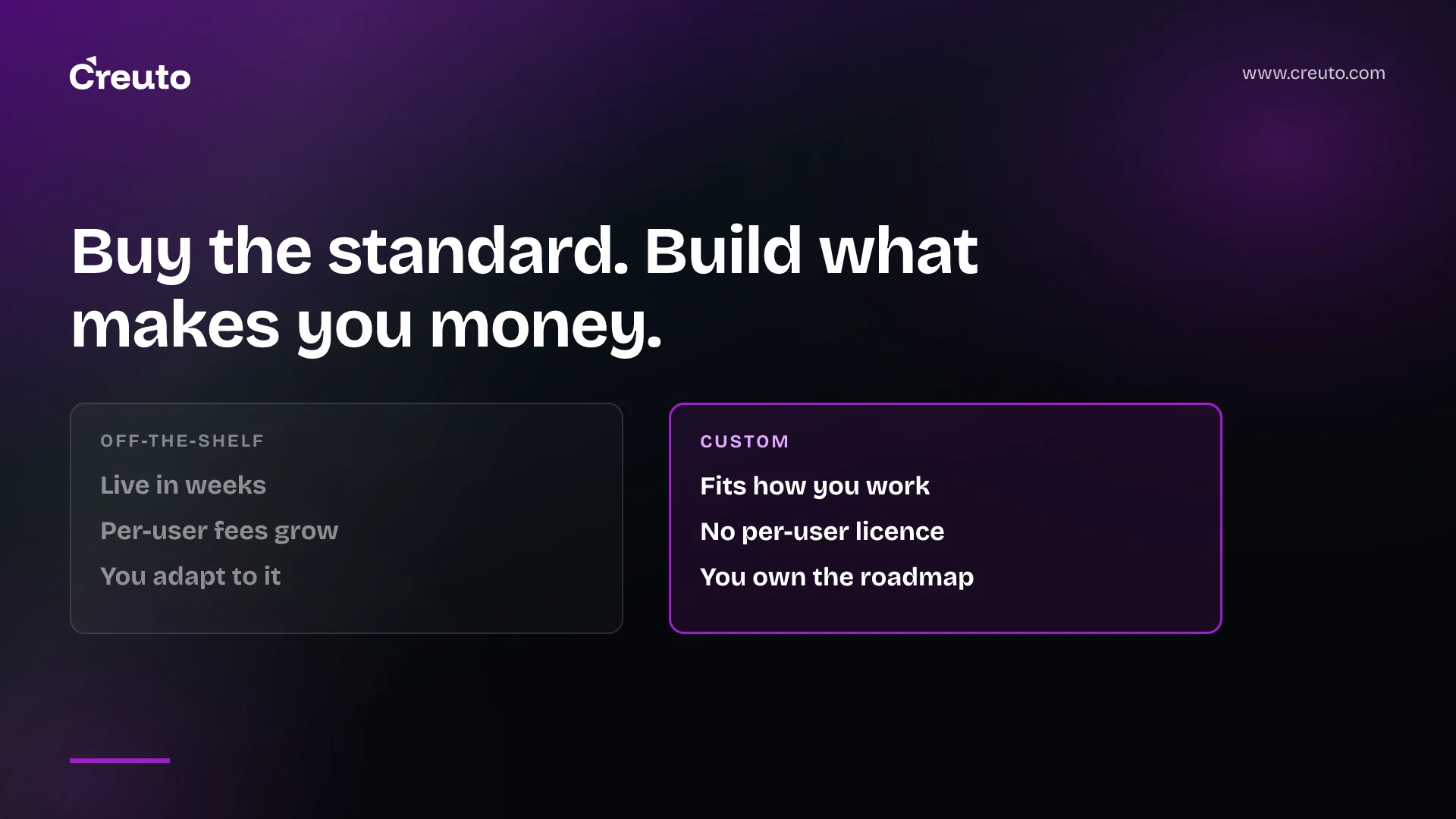
Every business eventually faces the same decision: buy a ready-made product or build software around how you work. Custom vs off-the-shelf software is not a question with one right answer. It depends on how standard your processes are, how fast you need to move, and what your costs look like over several years. This guide sets out the trade-offs honestly — including when buying is the better choice.
What is off-the-shelf software?
Off-the-shelf, or commercial, software is built for many customers with common needs and sold by licence or subscription: accounting packages, CRMs, HR systems, e-commerce platforms. Its strengths:
- Fast to start. Often usable within days or weeks.
- Lower upfront cost. Development is shared across many customers.
- Proven. Mature products encode common practice and are widely supported.
- Vendor-maintained. Updates, hosting and security are largely handled for you.
Its weaknesses: you adapt your process to the product, pay for features you do not use, depend on the vendor's roadmap and pricing, and face per-user costs that grow with headcount.
What is custom software?
Custom software is designed and built for your organisation's workflows, data and integrations. Its strengths:
- Fits how you work, including the processes that differentiate you.
- Integrates deliberately with the systems you already run.
- Grows with you without per-user licence fees.
- You own it — code, data and roadmap.
Its weaknesses: higher upfront cost, longer time to first use, and responsibility for maintenance, hosting and security, whether in-house or through a partner.
How to decide
1. How standard is the process?
Accounting, payroll basics and email are standard; buy them. The process that makes you money — how you quote, produce, deliver or serve — is where custom software earns its cost.
2. What does it cost over five years?
Compare licences × users × years, plus implementation and customisation, against build plus running and support. The comparison often flips as headcount grows. We worked through real numbers in Odoo vs custom ERP and Salesforce Core pricing vs a custom CRM.
3. How much would you customise the product?
Heavily customised off-the-shelf software combines the costs of both: licence fees plus custom code you must maintain through every vendor upgrade.
4. How quickly do you need it?
If you need something next month, buy — and plan to revisit the decision later.
5. How critical are integrations?
If the system must work tightly with machines, legacy systems or partner platforms, custom or a custom layer around a packaged core often works better.
The middle path
Many businesses do best with a hybrid: off-the-shelf products for standard functions, and custom applications for the differentiating process, connected through APIs. The integration then deserves as much design as either side.
Making an informed decision
- Map your processes and mark which are standard and which differentiate you.
- List every system the software must connect to.
- Estimate users and growth over five years.
- Price both options over that period, including customisation and maintenance.
- Get advice from someone who will tell you when the answer is "buy".
For the custom side of the argument in more depth, see why business owners invest in custom software. Our custom software development team will compare both paths with you — and recommend buying when that is the better answer.
Frequently asked questions
Off-the-shelf software is built for many customers with common needs and sold by licence or subscription. Custom software is designed and built for one organisation's workflows, data and integrations, and is usually owned by that organisation.
Custom software usually costs more upfront, while off-the-shelf software costs more over time through per-user licences and customisation. Comparing total cost over five years, including users, implementation and maintenance, shows which is cheaper for a given business.
Choose off-the-shelf software for standard processes such as accounting or email, when you need a solution quickly, when user numbers are modest, and when little customisation is needed to fit the product.
Custom software is worth it when the process is what differentiates your business, when off-the-shelf products would need heavy customisation, when per-user licence costs grow large with headcount, or when tight integration with other systems is essential.