Top 5 Reasons Growing Businesses Are Switching to Custom Software
Top 5 reasons growing businesses switch to custom software development: fit, scale, automation, competitive advantage and lower long-term cost.
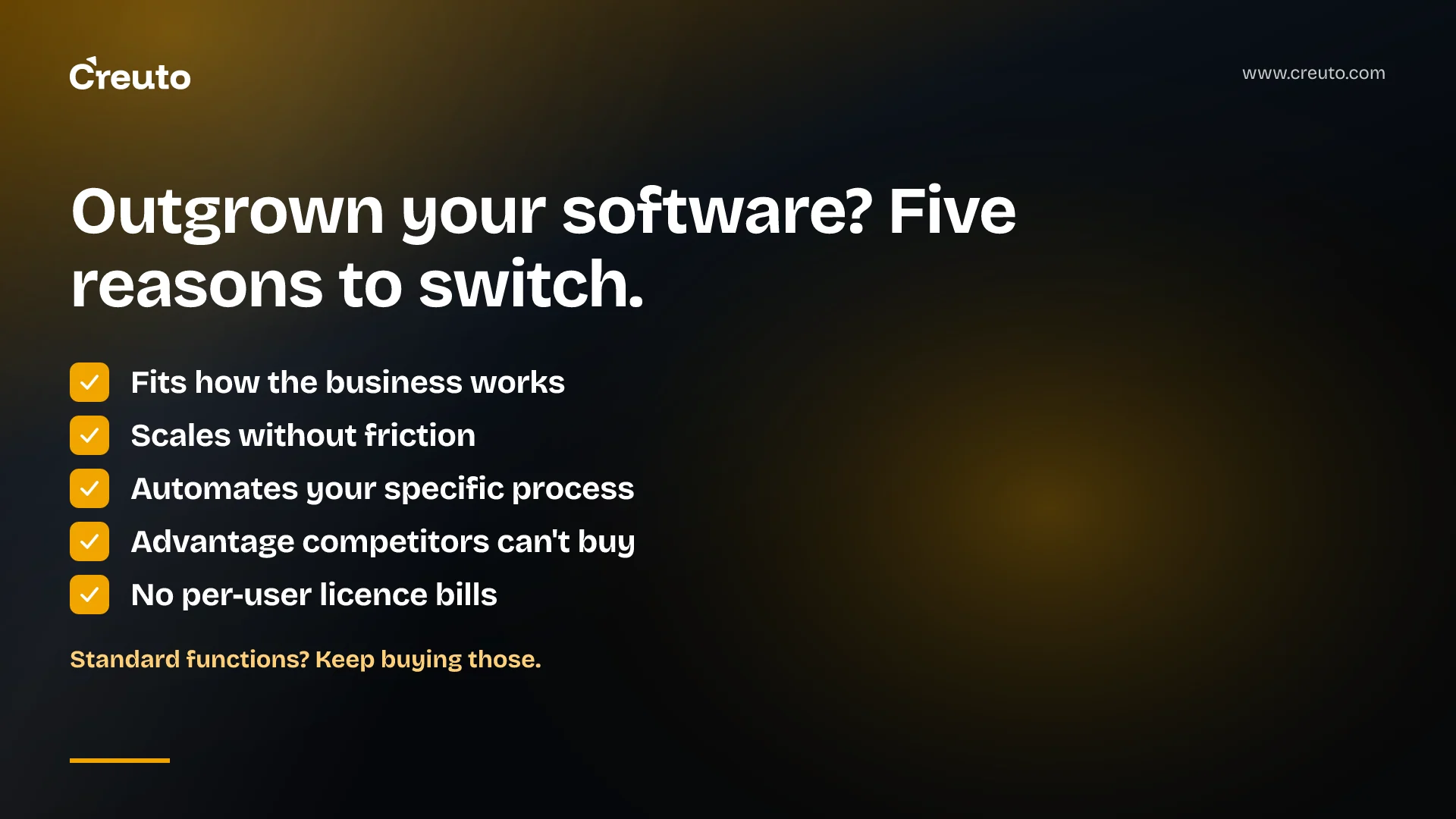
Off-the-shelf software is the right starting point for most businesses. But as companies grow, many find their tools holding them back: workarounds multiply, data is scattered and licence bills climb with every new hire. That is why growing businesses are increasingly moving key processes to custom software development. Here are the five reasons we hear most often — and the conditions under which each one applies.
1. Software that fits the business
Every business has its own workflows, rules and customer expectations. Generic software forces teams to adapt to it, which creates workarounds, spreadsheets on the side and missed steps. Custom software is built around the way the business works: its approval rules, pricing logic, reports and dashboards. The result is fewer workarounds, faster onboarding and a more consistent experience for staff and customers.
2. Scale without friction
Growth brings more users, more data and more systems to connect. Off-the-shelf products may cap customisation, charge more at higher tiers or struggle with volume. A well-architected custom system is designed for the growth you expect — new locations, products or markets — and can be extended rather than replaced. Architecture is what makes this possible; see scalable software architecture.
3. Efficiency through automation
Custom software can automate the repetitive steps specific to your business — order handling, approvals, payroll rules, reporting — and remove features nobody uses. Teams spend less time on admin and more on customers. The workflow management system we built is an example of replacing manual approval chains with tracked processes.
4. Competitive advantage
If every competitor uses the same software, it is hard to be different. Custom software can turn what makes you better — faster quotes, a better customer app, smarter fulfilment — into a capability competitors cannot simply buy. It also supports customer experiences tailored to your market.
5. Lower long-term cost
Custom software usually costs more upfront. Over time it can cost less: no per-user licence fees, no paying for unused features, fewer overlapping tools, and changes made without migrating to a new platform. Whether that holds for your business depends on user numbers and how much you would otherwise customise — which is why a five-year comparison matters; see custom software ROI.
When switching is not the right move
- For standard functions like accounting or email, good products are usually better value.
- If your process is still changing weekly, settle it before building around it.
- If nobody will own the system after launch, plan for that first.
Our full comparison is in custom vs off-the-shelf software.
How to make the switch safely
- Start with the process that causes the most pain or cost.
- Run a short discovery to map the workflow and integrations.
- Deliver in phases, keeping existing tools running until the new system is proven.
- Migrate data carefully and measure results against the old process.
Custom software as a growth strategy
For growing businesses, the move to custom software is less about technology than about removing limits: on process, on scale and on differentiation. Our custom software development team designs secure, scalable systems around how your business works — and tells you honestly which processes are worth building.
Frequently asked questions
Growing businesses switch to custom software because it fits their workflows, scales with growth, automates business-specific processes, creates capabilities competitors cannot buy and can cost less over time than per-user licences and heavy customisation.
Custom software can be cheaper in the long run by removing per-user licence fees, unused features and overlapping tools. Whether it is depends on user numbers and how much an off-the-shelf product would need customising, so compare costs over five years.
A business should not switch for standard functions like accounting or email, when its process is still changing rapidly, or when nobody will own and maintain the system after launch.
Switch safely by starting with the most costly process, running a short discovery, delivering in phases while existing tools keep running, migrating data carefully and measuring results against the old process.