Custom CRM vs Ready-Made CRM: What’s Right for Your Business?
Custom CRM vs ready-made CRM: the trade-offs, a five-year ROI view, when Salesforce, HubSpot or Zoho is the better choice, and when a custom CRM wins.
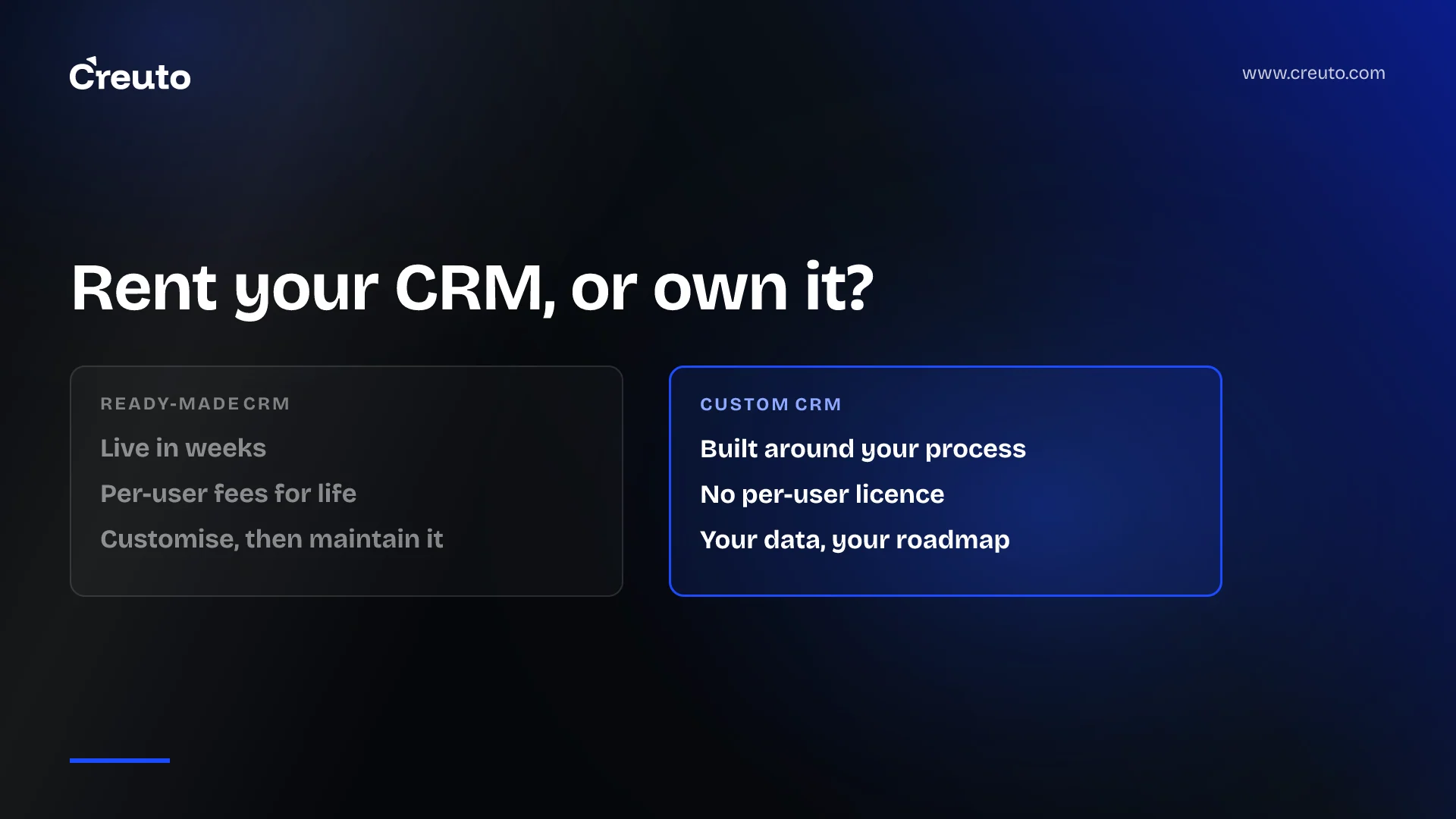
A CRM is no longer optional for a business that sells. It holds your leads, customer history, pipeline and follow-ups — the memory of your sales and service teams. The real question is whether to buy a ready-made product or build one around your process. Custom CRM vs ready-made CRM depends on how standard your sales process is, how many users you will have and how much you would need to customise.
What you get with a ready-made CRM
Products such as Salesforce, HubSpot and Zoho CRM are popular for good reasons.
- Fast to start — usable within days or weeks.
- Rich features — pipelines, email integration, reporting, mobile apps.
- Large ecosystems of integrations, consultants and administrators.
- Lower upfront cost.
The trade-offs: per-user subscription fees that grow with your team, features you pay for but do not use, customisation that must be maintained through vendor upgrades, and dependence on the vendor's roadmap and pricing. Prices change too — Salesforce's September 2026 repricing moved its mid-tier edition to $195 per user per month, as we analysed in Salesforce Core pricing vs a custom CRM. Platform API changes, such as HubSpot's API deprecation, also create integration work.
What you get with a custom CRM
A custom CRM is built around your workflows, customer touchpoints and data.
- Fits your process exactly, including unusual steps such as site surveys, approvals or dealer networks.
- Integrates tightly with your ERP, billing, WhatsApp and field apps.
- No per-user licence fees, so adding salespeople or partners costs little.
- You own the data and the roadmap.
The trade-offs: higher upfront investment, a longer time to first use, and responsibility for hosting, security and maintenance, in-house or through a partner.
Which delivers better ROI?
Compare the two over five years, not one:
- Ready-made: licences × users × years, plus implementation, customisation and integration upkeep.
- Custom: discovery and build, plus hosting, support and enhancements.
For small teams with a standard sales process, ready-made usually wins. For larger teams, specialised processes or heavy customisation, custom often wins over five years.
Choose a ready-made CRM when
- your sales process is close to standard;
- you need to be live quickly;
- your user count is modest;
- you will use the vendor's wider ecosystem.
Choose a custom CRM when
- your sales or service process is your competitive advantage;
- you have many users with simple needs, such as field reps or channel partners;
- you would otherwise customise a product heavily;
- tight integration with your own systems matters.
A middle path
Some businesses use a ready-made CRM for core sales and a custom app for a specialised process — a dealer portal or field-service tool — connected through APIs.
We built our own sales CRM on this reasoning. If you want both options compared honestly — including when to buy — our CRM development team will lay out the five-year numbers.
Frequently asked questions
A ready-made CRM such as Salesforce, HubSpot or Zoho is a subscription product built for many businesses. A custom CRM is built around one business's sales and service process, integrations and data, and is usually owned by that business.
A custom CRM costs more upfront but has no per-user licence fees. Over five years it can be cheaper for larger teams, specialised processes or heavily customised setups, while ready-made CRMs are usually cheaper for small teams with standard processes.
Build a custom CRM when your sales or service process is a competitive advantage, you have many users with simple needs such as field reps or partners, you would otherwise customise a product heavily, or tight integration with your own systems is essential.
A focused custom CRM covering core pipeline, contacts and reporting can be delivered in phases over a few months, with the first usable release earlier. Timelines depend on integrations, workflow complexity and mobile requirements.