Cost to build an app like Zomato: ₹2-44 lakh+
The cost to build an app like Zomato runs from ₹2 lakh to ₹44 lakh+. Price bands, timelines, and Zomato's own per-order margins from its Q2FY27 letter.
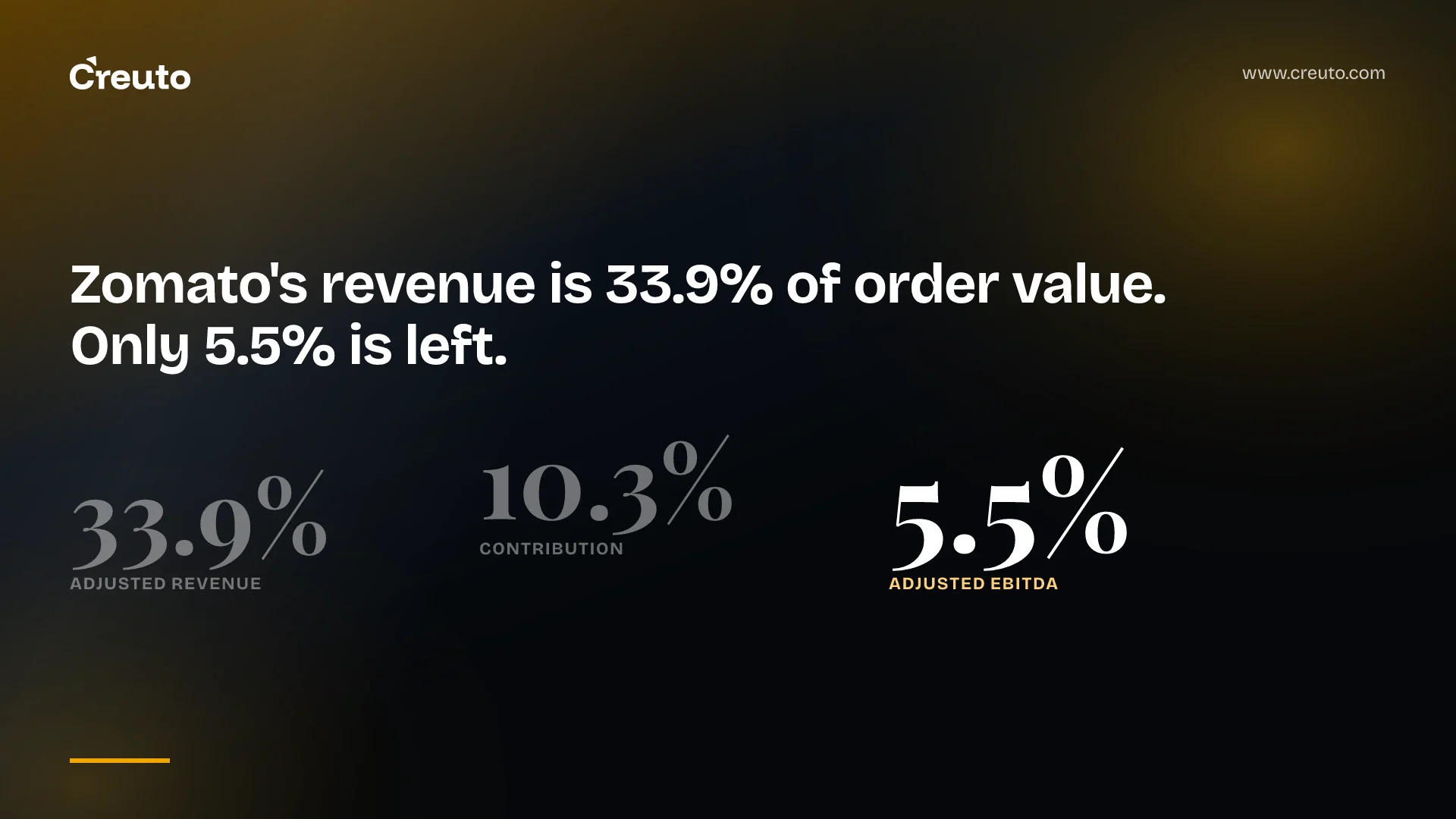
The cost to build an app like Zomato runs from ₹2 lakh for a one-restaurant ordering app to ₹44 lakh and up for a multi-city marketplace, on Indian vendors' own price lists. The build is the smaller number. Zomato's own filing shows a platform at its scale keeps 5.5% of order value as Adjusted EBITDA, so your app has to be costed per order.
By the end you will know which of four price bands your plan sits in, why the ranking guides contradict each other, what a white-label clone buys you, and how many orders it takes to earn back a build at Zomato's own margins. All figures are as of November 2026.
The cost to build an app like Zomato depends on which of four products you mean
"An app like Zomato" covers four different products. Comfygen, an Indian agency, publishes the clearest price ladder, in both rupees and dollars:
| Band | What you get | Comfygen price | Comfygen timeline |
|---|---|---|---|
| Single-restaurant app | An Android ordering app for one restaurant, with no restaurant or rider app | ₹2-6 lakh ($2,400-$7,000) | 3-6 weeks |
| White-label marketplace | Pre-built customer, restaurant and rider apps plus admin, rebranded | ₹13-22 lakh ($15,000-$25,000) | 2-4 weeks |
| Custom MVP | Four apps built to your model, with live tracking and payments | ₹22-44 lakh ($25,000-$50,000) | 8-12 weeks |
| Full marketplace | Multi-city, commission engine, AI recommendations, dining-out module | ₹44 lakh+ ($50,000+) | 16-24 weeks |
RaftLabs prices higher in dollars: $35K-$60K for a single-brand ordering system, $70K-$120K for a marketplace MVP and $120K-$220K for a full multi-city platform (page updated 12 November 2026). PerfectionGeeks, in its October 2026 update, gives $25,000-$60,000 for an MVP and $60,000-$150,000 for a full platform. Every number here comes from a company selling the thing it prices, so treat each one as a quote with a motive.
Why the Zomato app development cost guides contradict themselves
Several ranking pages disagree with themselves, not just with each other. MindInventory's body text says the cost is "somewhere around $18,000 to $20,000", while its FAQ says "around $18,000 to $25,000". Digittrix's total section starts "from USD 300 (INR 26,000) for a basic version", its FAQ says "$30000 to $200000", and the page itself calls its figures "legacy planning examples, not a current Digittrix quote".
Aalpha, last updated in January 2025, quotes "around $15,000-$18,000" and "one hundred hours" for the process, but its own hour breakdown adds to 89. PerfectionGeeks puts a food delivery marketplace at $50,000-$100,000 in one table and a marketplace at $150,000+ in another. Comfygen's FAQ puts Zomato and Swiggy "in the ₹13 lakh to ₹44 lakh range", which spans two of its own bands. The useful question for any quote is not "is this cheap" but "which band is this, and which features moved it there". Our four decisions that move the cost to build an app apply unchanged.
Where the build money goes: four apps and a dispatch engine
The admin panel and dispatch engine are the largest single line in a Zomato-style build. RaftLabs splits the budget as 30-40% for the admin panel and dispatch engine, 20-25% for the customer app, 20-25% for the driver app and 15-20% for the restaurant dashboard and kitchen display. It also says dispatch is "the part clone scripts fake the worst".
Comfygen is the only ranking page that prices features in lakh. Selected lines:
| Feature | Comfygen range |
|---|---|
| Admin dashboard | ₹4.4-8.8 lakh |
| Live GPS order tracking | ₹2.6-5.3 lakh |
| Delivery partner module | ₹2.6-5.3 lakh |
| Payment gateway with UPI | ₹1.8-4.4 lakh |
| Restaurant listings and menus | ₹1.8-3.5 lakh |
| Dining-out and table booking | ₹3.5-8 lakh |
| AI recommendations | ₹3.5-7 lakh |
Read it with care. The same page prices UPI and payments at ₹1.5-4 lakh in another section, and its feature list has no line for the restaurant partner app it calls essential. A quote built from this table will be short by that app.
Cost to build table reservation and food delivery app together
Zomato is not only delivery. Discovery and dining out are a large part of the product, and they are the part a delivery-only build leaves out. Comfygen prices dining-out and table booking at ₹3.5-8 lakh, as an add-on to a full marketplace. In practice it is a second operations product: live table status, floor layouts and reservations that restaurant staff run during service.
We built that shape for a dining super app covering restaurant discovery, ordering, reservations and restaurant operations. It serves five user roles, with a consumer app for iOS and Android, a restaurant management system, a multi-role web dashboard for branch managers, staff, admins and super admins, and an AI personalization engine. Five roles mean five permission models and five sets of screens, which is why the admin line above grows faster than any consumer feature.
How long it takes to build an app like Zomato
A Zomato-style marketplace MVP takes 16-22 weeks according to RaftLabs, and a full multi-city platform 24-38 weeks. Its phase plan gives two weeks to discovery, six to eight to the customer app and restaurant dashboard, eight to twelve to the dispatch engine and driver app, two to three to integrations and hardening, and two to four to a pilot with partner restaurants.
Comfygen's custom MVP is shorter, at 8-12 weeks, and PerfectionGeeks says three to four months. On our side, a focused MVP typically takes 6-10 weeks and larger platforms 3-6 months, depending on integrations and scope. The gap between eight weeks and nine months is scope: one city or several, delivery only or dining out too, one payment rail or many. RaftLabs prices each extra local payment rail, such as UPI, at $10K to $20K.
Is a Zomato clone script good enough to launch?
A white-label Zomato clone is good enough when the question is "will customers in this town order through us at all". Comfygen's white-label band is ₹13-22 lakh with launch in 2-4 weeks, against ₹22-44 lakh and 8-12 weeks for a custom MVP. That gets real restaurants and riders on the product months sooner, for about half the money.
It is the wrong choice in three situations:
- You are one restaurant brand, not a marketplace. A chain does not need restaurant onboarding or a commission engine. Comfygen's single-restaurant band (₹2-6 lakh) or RaftLabs' single-brand system ($35K-$60K, 10-14 weeks) is the honest comparison.
- Your edge is dining out or discovery. Reservations, floor management and personalized ranking are where a regional player can differ from Zomato, and a clone script ships the generic version.
- Your edge is dispatch. Batching, zone design and rider incentives decide delivery cost per order, and RaftLabs names dispatch as what clones fake worst.
The per-order math: what Zomato keeps from ₹100 of food
No ranking guide uses Zomato's own numbers, so we did. Eternal, Zomato's parent company, reported these figures for food delivery in its Q2FY27 shareholders' letter (quarter ending 30 September 2026, dated 21 October 2026):
| Food delivery, Q2FY27 | Value | Share of NOV |
|---|---|---|
| Net order value (NOV) | ₹11,445 crore | 100% |
| Adjusted Revenue | ₹3,879 crore | 33.9% (our division) |
| Contribution | ₹1,180 crore | 10.3% |
| Adjusted EBITDA | ₹627 crore | 5.5% |
| Monthly active restaurant partners | 334,000 | |
| Monthly active delivery partners | 736,000 |
Read the 33.9% correctly, because it is easy to misquote. It is not a restaurant commission rate. Eternal defines Adjusted Revenue as Revenue (commission and other charges, ad revenue, platform fee and subscription revenue) plus the delivery charges customers actually pay. Contribution then subtracts last-mile delivery cost, platform-funded discounts, payment gateway and cash-on-delivery handling, support, refunds and rider onboarding. Adjusted EBITDA is what remains after the company's other operating costs.
So from every ₹100 of food ordered, about ₹10.30 survives the cost of delivering it, and ₹5.50 is left after running the company. That is at a scale of 28.0 million monthly transacting customers. Dining out is harder still: Eternal's going-out segment, which includes dining-out and entertainment ticketing, posted Adjusted EBITDA of minus ₹64 crore on ₹3,259 crore of NOV in the same quarter.
How many orders it takes to earn back the build
Here is the model we would run before signing any build quote. Divide the build cost by your contribution margin to get the order value you need to recover it. Our assumptions: build costs from Comfygen's custom MVP band (₹22 lakh at the floor) and full marketplace floor (₹44 lakh), and two margins, Zomato's 10.3% and a regional 5%. For scale, Zomato's figures work out to about ₹1.14 lakh of NOV per active restaurant per month (our calculation: quarterly NOV over three months, divided by 334,000).
| Build cost | At 10.3% contribution | At 5% contribution |
|---|---|---|
| ₹22 lakh | ₹2.14 crore of orders, about 187 restaurant-months | ₹4.4 crore, about 385 restaurant-months |
| ₹44 lakh | ₹4.27 crore of orders, about 374 restaurant-months | ₹8.8 crore, about 770 restaurant-months |
A "restaurant-month" assumes each restaurant does Zomato's average volume, which a new platform will not. And contribution is before your team, marketing and hosting. That is why the decision is per order, not per feature: a regional app with 100 restaurants doing half Zomato's average volume earns about ₹2.9 lakh of contribution a month at a 5% margin, so it needs about 15 months to repay a ₹44 lakh build before it pays a single salary. These are our calculations from Eternal's figures, so rerun them with your own order value and margins.
Razorpay Route for a food delivery marketplace: what payments take
Split settlement is the line most quotes skip. Razorpay Route pays restaurants through linked accounts, and Razorpay's own worked example shows the cost. On a ₹1,000 order at a 2% plan, the gateway fee is ₹23.60 including 18% GST. Transferring ₹900 to the linked account costs a 0.25% fee of ₹2.66, also including GST. That leaves the platform ₹73.74 of a ₹100 commission.
That ₹26.26 is 2.6% of order value, a quarter of Zomato's whole 10.3% contribution margin, and Zomato's contribution already pays its own gateway costs. Settlement timing matters too: Eternal's letter notes its "weekly restaurant settlement cycle" moved payables at quarter-end. How we design payout schedules is covered in multi vendor marketplace development cost: payouts decide it.
Food delivery app running costs after launch
RaftLabs puts running costs at $8K-$25K a month for hosting, maps, payments, SMS and support tooling, and adds that "courier payouts are the largest operating line". Comfygen puts yearly upkeep at 15-20% of the build cost. Maps cost per order is its own model, which we built for ride-hailing in cost to build an app like Uber; the same per-request Google Maps billing applies to delivery riders.
What to decide before you take a quote for a Zomato-like app
Write down four answers before comparing quotes: marketplace or single brand, delivery only or dining out too, how many cities and payment rails at launch, and the order value and margin you expect in month twelve. The first three set the build cost. The last tells you whether the build ever pays back.
If you are weighing a Zomato-style marketplace against an owned ordering app for your restaurant group, our mobile app development team can scope both against those four answers, including the per-order payback model above rerun with your own numbers.
Frequently asked questions
An app like Zomato costs ₹2-6 lakh for a single-restaurant ordering app, ₹13-22 lakh for a white-label marketplace, ₹22-44 lakh for a custom MVP and ₹44 lakh or more for a multi-city marketplace, on Comfygen's published price list. RaftLabs prices a marketplace MVP higher, at $70K-$120K.
A Zomato-style marketplace MVP takes 16-22 weeks by RaftLabs' estimate and 8-12 weeks by Comfygen's, while a full multi-city platform takes 24-38 weeks at RaftLabs. The difference is scope: number of cities, payment rails, and whether dining out and table reservations ship in the first release.
A Zomato clone script is good enough to test whether customers in one town will order through you, at ₹13-22 lakh and 2-4 weeks on Comfygen's list. It is the wrong choice for a single restaurant brand, or when your edge is dining out, discovery or dispatch, which clones ship in generic form.
Zomato's food delivery business reported Contribution of 10.3% and Adjusted EBITDA of 5.5% of net order value in Eternal's Q2FY27 letter. Its Adjusted Revenue was 33.9% of order value, but that figure includes customer delivery charges and platform fees, so it is not a restaurant commission rate.
Food delivery apps in India often split payments with a marketplace product such as Razorpay Route, which transfers each restaurant's share to a linked account. In Razorpay's worked example, a ₹1,000 order costs ₹23.60 in gateway fees and ₹2.66 to transfer ₹900, both including 18% GST.
