Cost to build an app like Uber: 3 price bands
The cost to build an app like Uber runs from a $5K white-label setup to $300K+. Three price bands, timelines and the Google Maps bill per ride, India vs UAE.
The cost to build an app like Uber runs from a $5,000 white-label setup fee to past $300,000 for a multi-city platform, and most published estimates disagree because each vendor means a different product. This post sorts them into three price bands. It also prices the line every build quote leaves out: the Google Maps bill per ride.
By the end you will know which band your plan sits in, what each part of the build costs, how long it takes, and what maps will cost each month at 500 and 5,000 rides a day, in India and at global rates. All figures are as of November 2026.
The cost to build an app like Uber depends on which of three products you mean
An "app like Uber" is three different products with three different budgets. Here is what the vendors ranking for this query publish, sorted by what they are actually pricing:
| Band | What you get | Published price | Published timeline |
|---|---|---|---|
| White-label clone | A vendor's existing rider, driver and admin apps under your brand | $5,000 to $20,000 setup, plus a subscription the page does not price | "Weeks" |
| Single-city MVP | Rider app, driver app, admin panel, matching and payments for one city | $35K to $70K (RaftLabs) or $75,000 to $150,000 (Chop Dawg) | 12 to 18 weeks (RaftLabs); four to seven months (Chop Dawg) |
| Full or multi-city platform | Surge pricing, scheduled rides, several cities, fraud and compliance work | $70K to $120K for a full platform and $120K to $200K for multi-city scale (RaftLabs); past $300,000 (Chop Dawg) | 20 to 28 weeks, and 32 to 48 weeks for multi-city (RaftLabs) |
Cleveroad puts the average at $70,000-$120,000+, which lands in the middle band. Every figure in that table comes from a company selling the thing it is pricing, so read each one as a quote with a motive, not a benchmark.
Why one vendor's MVP is another vendor's starting price
The widest disagreement is over the MVP. RaftLabs, which builds custom, scopes a single-city MVP at $35K to $70K. Onde, which sells a white-label platform, writes that "a basic MVP for an Uber-like app typically starts at $150,000", and its own comparison table gives custom builds an initial cost of $150,000 to $600,000+. The same page says "$300,000 or more" for a production-ready custom build in its text.
A white-label vendor gains from a high custom number, and a custom studio gains from a low one. Neither is lying, exactly: they are pricing different scopes. The useful question for any quote is not "is this cheap" but "which band is this, and which features moved it there". Our four decisions that move the cost to build an app applies here unchanged.
Where the build money goes: the backend, not the two apps
The backend and matching engine are the largest single cost in an Uber-like app development cost breakdown. RaftLabs puts the backend and matching engine at 35-45% of the budget, against 20-25% for the rider app, 15-20% for the driver app and 10-15% for the admin panel.
Chop Dawg is the only ranking page that prices each component in dollars. Its bands assume a cross-platform React Native build with a shared backend:
| Component | Chop Dawg range |
|---|---|
| Rider app (iOS and Android) | $15,000 to $35,000 |
| Driver app (iOS and Android) | $15,000 to $35,000 |
| Real-time GPS and live tracking | $12,000 to $30,000 |
| Matching and dispatch engine | $15,000 to $40,000 |
| Payments and payouts | $10,000 to $25,000 |
| Admin and ops dashboard | $12,000 to $30,000 |
| Ratings, reviews and messaging | $6,000 to $15,000 |
| Surge pricing and promotions | $8,000 to $25,000 |
| Backend, infrastructure and security | $20,000 to $60,000 |
Source: Chop Dawg, July 2026.
Cost to build rider and driver app: one codebase or two
The rider and driver apps are cheaper than they look because they share a stack. Chop Dawg's $15,000 to $35,000 per app assumes React Native covering iOS and Android at once. Two native codebases means building each app twice. Flutter gives you the same one-codebase saving, and we set out how we choose between the two in React Native vs Flutter in 2027.
The three-sided shape here (customer app, driver app, operations panel) is the same one we built for FlashNow, a quick commerce platform with four roles across three platforms. In that shape the apps are the visible part. The dispatch and tracking logic behind them is the 35-45% backend line above.
Taxi booking app admin panel cost
The admin panel is the line founders cut first and regret first. Chop Dawg prices the admin and ops dashboard at $12,000 to $30,000, and RaftLabs puts it at 10-15% of the budget. It is where your operations team approves drivers, handles disputes and refunds, and sees which areas are short of cars. A ride-hailing service run from database queries does not survive its first busy weekend.
How long it takes to build an app like Uber
A single-city ride-hailing MVP takes 12 to 18 weeks with a team of four to six developers, according to RaftLabs. Its phase plan gives two weeks to discovery, six to eight to the rider and driver apps, eight to ten to the backend and matching, two to three to integration and hardening, and two to four to a beta with real drivers.
Chop Dawg's estimate is longer, at four to seven months for a focused MVP and a year or more for a full-scale platform. Onde says six to twelve months for a custom build from scratch. The gap between 12 weeks and 12 months is almost entirely scope: how many vehicle types, payment methods and cities the first release has to support. RaftLabs prices each additional local payment method at $10K to $20K, which is why "launch with one" is the cheapest decision you can make.
Is a white-label Uber clone worth it?
A white-label Uber clone is worth it when the question you are answering is "will riders in this city book through us at all". The case for it is strong. Onde quotes a $5,000 to $20,000 setup and launch in weeks, and RaftLabs separately prices clone scripts at $5K to $20K upfront. That is a small fraction of a custom MVP, and it gets real riders and drivers on the product months sooner.
It is the wrong choice in three situations:
- Your edge is in dispatch. If you win on how you match drivers (pooled rides, corporate fleets, two-wheelers, scheduled airport runs), that logic belongs to the vendor, and you are renting it.
- You need the data. Trip, pricing and driver data you cannot query freely is data you cannot build on.
- You cannot see the total cost. Onde's page describes "a relatively small setup fee followed by a predictable subscription" but does not publish the subscription. Compare the three-year cost, not the setup fee against a build quote.
The maps bill: what Google Maps API costs per ride
No ranking guide prices maps per ride, though RaftLabs warns that "at 500 rides per day, map costs alone are a five-figure monthly line." We priced it from Google's own lists. Four facts decide the bill, each from Google's billing documentation:
- Route Matrix is billed per element. Google bills Compute Route Matrix per element, origins multiplied by destinations. Checking ten nearby drivers against one pickup is ten billable events.
- Traffic makes it Pro. Requests using TRAFFIC_AWARE or TRAFFIC_AWARE_OPTIMAL routing bill at the Pro SKU, which costs twice the Essentials rate globally.
- Navigation bills per destination. The Navigation SDK charges per destination requested, with no extra charge for turn-by-turn guidance or reroutes after that.
- The map itself is free on mobile. "All mobile usage of the Maps SDK for Android is unlimited."
Our assumptions per ride are: five Places Autocomplete requests while the rider types a destination, without sessions, which bills per request. Then one traffic-aware route for the fare estimate, one matrix call against ten candidate drivers, and two navigation destinations (pickup and drop-off). Applied to the global price list and the India price list, with each SKU's free monthly cap deducted:
| Monthly maps bill | Global rates (UAE, UK, US) | India rates |
|---|---|---|
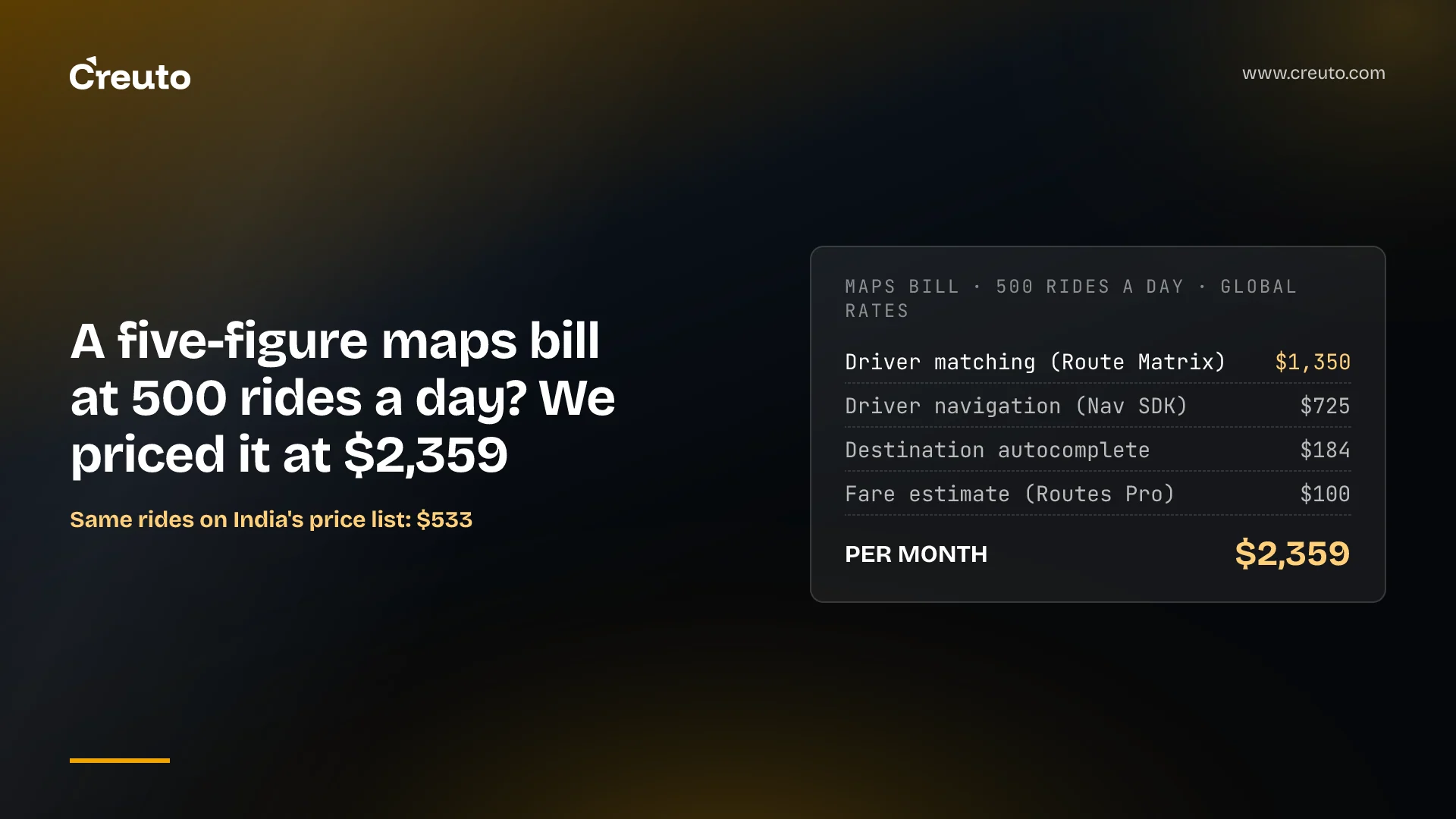
| 500 rides a day (15,000 a month) | $2,359 | $533 |
| 5,000 rides a day (150,000 a month) | $18,063 | $7,662 |
At 500 rides a day on global rates, the split is $1,350 for matching, $725 for navigation, $184 for autocomplete and $100 for fare estimates. On these assumptions maps cost about 16 cents a ride, not a five-figure month. Five figures arrives at roughly ten times that volume. These are our calculations from list prices, and your call pattern will differ, so treat them as a model to rerun with your own numbers.
Why India pays a third of the global rate
India has its own price list. Compute Routes Pro is $3.00 per 1,000 against $10.00 globally, Autocomplete is $0.85 against $2.83, and a Navigation request is $8.00 against $25.00. India's free caps are also larger: 70,000 a month on Essentials SKUs against 10,000. Google introduced the India pricing on 1 March 2025 for developers with an Indian billing address and most of their usage in India. A UAE operator pays the global list. One caution: the India page's tier table and its worked example use different tier boundaries, and we used the table.
What pushes the maps bill up
The matching matrix is 57% of the bill above, so it is the line to engineer. Every extra candidate driver per request adds an element, and re-matching after a declined ride repeats the call. Two cheap habits help: filter candidates by straight-line distance before asking Google for road ETAs, and refresh the rider's ETA on a timer rather than on every location ping, because each Compute Routes request is billed. Google also bills routes with more than ten waypoints and waypoint optimization at higher rates. At high volume, the Navigation SDK's pricing depends on your service agreement with Google, so get a quote before your model assumes list price.
Ride-sharing app running costs per month, beyond maps
Maps is one line of several. RaftLabs puts total monthly running costs (maps, hosting, payments and SMS) at $15K to $50K a month, and infrastructure alone at roughly $20K to $30K a month at 500 rides a day. Our maps figure suggests a large share of that range is hosting, payment processing and messaging rather than maps. None of the ranking pages prices those lines individually, so ask your vendor to.
Masked calling, so riders and drivers can phone each other without exchanging numbers, is one of them. Twilio's Proxy API, built for exactly this, is "currently available as a Public Beta product" and not covered by a Twilio SLA. That is a risk worth pricing before your launch depends on it. Then there is upkeep after launch, which we cover in why the 15-20% maintenance rule breaks.
What to ask before you take a quote for an Uber-like MVP
The band you land in is decided before anyone writes code. Before you compare quotes, write down four things: the number of cities and vehicle types in release one, the payment methods you must support at launch, whether your matching rule is standard nearest-driver or something you compete on, and the ride volume you expect in month six. The first three set the build cost. The last sets your maps and infrastructure bill.
If you are deciding between a white-label clone and a custom rider and driver build, our mobile app development team can scope both against those four answers. That includes the maps cost model above, rerun with your own call pattern and market.
Frequently asked questions
The cost to build an app like Uber ranges from a $5,000 to $20,000 white-label setup to $35,000-$150,000 for a single-city custom MVP and past $300,000 for a multi-city platform, based on published vendor estimates in 2026. The spread comes from scope: cities, vehicle types and payment methods.
A white-label Uber clone app typically costs $5,000 to $20,000 to set up, according to the white-label vendor Onde and to RaftLabs' figure for clone scripts. Onde adds a subscription it does not publish, so compare the three-year total cost, not the setup fee, against a custom build quote.
A single-city Uber-like MVP takes 12 to 18 weeks with four to six developers according to RaftLabs, and four to seven months according to Chop Dawg. A full multi-city ride-hailing platform takes 32 to 48 weeks or longer. The first release's scope decides where in that range you land.
Google Maps for a taxi app costs about $2,359 a month at 500 rides a day on global list prices, and about $533 on India's price list, on our model of autocomplete, a traffic-aware fare route, a ten-driver matching matrix and two navigation destinations per ride. Driver matching is the largest line.
A white-label Uber clone is worth it for testing whether riders in one city will book with you at all, because it launches in weeks for a small setup fee. It is the wrong choice when your advantage is in dispatch logic, when you need full access to trip data, or when the subscription cost is unclear.