Cost to build an app like Tinder: 3 price bands
The cost to build an app like Tinder runs from a $399 clone script to $200K. Three price bands, timelines, and what Apple and Google take from subscriptions.
The cost to build an app like Tinder runs from a $399 clone script to $200,000 for a scaled custom platform, and the three vendors ranking for it disagree with each other and with themselves. This post sorts their numbers into three price bands. Then it prices the line no build quote includes: what Apple and Google keep from every subscription.
By the end you will know which band your plan sits in, where the build money goes, how long an MVP takes, and what a month of app store fees costs next to photo moderation and selfie checks at 2,000 paying subscribers. All figures are as of November 2026.
The cost to build an app like Tinder falls into three price bands
An "app like Tinder" can mean a rebranded script, a focused MVP for one community, or a full platform with ranking and video. Here is what the ranking vendors publish, sorted by what each is actually pricing:
| Band | What you get | Published price | Published timeline |
|---|---|---|---|
| Clone script | A ready-made swipe app under your brand | $399 to $5K upfront, with a realistic two-year cost of $15K to $40K (RaftLabs) | Not published |
| Niche MVP | Profiles, swipe matching, chat, verification and an admin panel | $35K to $70K (RaftLabs); $25,000 to $50,000 (Cleveroad); $22K to $38K (Miracuves) | 12 to 16 weeks (RaftLabs); about 3 months (Cleveroad); 3 to 4 months (Miracuves) |
| Full or scaled platform | Learning-based ranking, video, community verification, more markets | $70K to $120K full and $120K to $200K scaled (RaftLabs); $50,000 to $150,000+ (Cleveroad); $70K to $110K (Miracuves) | 16 to 40 weeks (RaftLabs); 3 to 6+ months (Cleveroad); 6 to 9 months (Miracuves) |
RaftLabs updated its page on November 11, 2026, Cleveroad on February 6, 2026, and Miracuves on July 21, 2026. Each one sells the thing it prices, so treat every figure as a quote with a motive, not a benchmark.
Where the vendors contradict themselves
Cleveroad is the clearest case. Its table puts a simple dating app at $25,000 to $50,000. A few paragraphs later it says "$80,000 to $90,000+ per platform" and tells you to "double the price" for two. Its own per-stage build-up for one platform totals $81,000 to $87,000 at $50 an hour, which is above its own Central and Eastern Europe range of $40,000 to $80,000. Doubled for iOS and Android, that build passes the $150,000+ it gives for a complex app.
Miracuves runs the motive in the opposite direction from what you would expect. It sells clone-based platforms and refers in its FAQ to "white-label or clone solutions (like the ones offered by Miracuves)", yet it quotes custom MVPs at $22K to $38K, below RaftLabs' $35K to $70K. It never prices its own clone. RaftLabs, which sells custom builds, is the one that prices clones, and its "realistic two-year cost" of $15K to $40K is a number worth checking against a real vendor contract rather than taking from a competitor.
The honest reading: a swipe MVP with chat and basic verification lands somewhere between $25K and $70K, and the spread is scope plus hourly rate. If you want the drivers behind that spread for any app, our breakdown of the cost to build an app like Uber walks through the same three-band logic for a two-sided product.
Where the build money goes: matching and safety, not swiping
The backend for matching and safety is the largest line in a dating app budget. RaftLabs splits a niche MVP as 35-45% backend (matching and safety), 30-35% member app, 15-20% admin panel and 5-10% infrastructure and integrations. The swipe screen everyone pictures is the cheap part.
Cleveroad is the only page that prices the features in hours. At its $50 rate, swipe matching is 90 to 110 hours ($4,500 to $5,500) and chat is 120 to 140 hours ($6,000 to $7,000). Its feature table totals $21,500 to $29,500, while its own introduction gives the same scope as "$20,000 to $27,000+".
The lines that move a dating budget are trust features, and RaftLabs prices them individually:
| Feature | RaftLabs build cost |
|---|---|
| Selfie-based photo verification | $10K to $18K |
| Human moderation queue and admin tooling | $15K to $30K |
| Community verification | $8K to $15K |
| Learning-based ranking | $20K to $35K |
| Video profiles or video dates | $15K to $30K |
| Native iOS and Android instead of cross-platform | $20K to $40K, plus 4 to 6 weeks |
Source: RaftLabs, updated November 2026.
Matrimonial app development cost runs higher
Matrimonial apps cost more because verification is the product. RaftLabs prices a matrimonial MVP at $80K to $100K in 10 to 12 weeks, and says moderation takes 20 to 25% of the build budget on a properly built platform. If you are building for a community in India or the Gulf where families vet profiles, budget for the middle band from day one.
React Native dating app development cost: one codebase or two
RaftLabs' $20K to $40K premium for native apps is the cost of building the member app twice. A dating app has no hardware requirement that forces native, so React Native or Flutter covers iOS and Android from one codebase. We set out how we pick between them in React Native vs Flutter in 2027.
How long it takes to build a dating app
A niche dating MVP takes 12 to 16 weeks with a team of four to six people, according to RaftLabs. Cleveroad says about three months for a simple app, and Miracuves says three to four months for an MVP with basic features. A full product takes 16 to 24 weeks (RaftLabs) or six to nine months (Miracuves).
Our own delivery figure is that a focused MVP typically takes 6 to 10 weeks. The difference from the vendor ranges is scope: one city or community, one subscription tier, cross-platform from one codebase, and selfie verification bought as a service rather than built. Every extra market, tier or video feature pushes you toward the vendors' upper numbers.
Is a Tinder clone script worth it?
A Tinder clone script is worth it when the only question is whether people in your niche will sign up and swipe at all. At $399 to $5K upfront, it gets a product in front of real users for less than one custom feature costs, and a failed test costs you little.
It is the wrong choice in three situations:
- Trust is your edge. If you win on verified profiles, family involvement or community vetting, that logic is the product, and a script gives you someone else's version of it.
- You plan to charge subscriptions. Billing through Apple and Google, upgrades, grace periods and refunds need to work exactly right, and a script you cannot change is a risk to the line that pays for everything.
- You cannot see the two-year cost. RaftLabs' $15K to $40K two-year figure against $35K to $70K for custom means the gap narrows fast once hosting, fixes and customization land. Compare totals, not the upfront price.
The store cut: what Apple and Google take from dating app subscriptions
None of the three vendor guides prices the app store commission in dollars. Miracuves gives a "15-30% cut of revenue" and stops. RaftLabs' $3K to $12K monthly running cost covers SMS, photo scanning, hosting and moderation, and does not mention the stores at all. Yet for a subscription dating app, the store cut is larger than every safety line combined.
Here is what each store says, read from its own pages in November 2026:
- Apple, standard terms. "During a subscriber's first year of service, you receive 70% of the subscription price", rising to 85% after one year of paid service, according to Apple's subscriptions page.
- Apple, Small Business Program. Developers with up to $1 million in prior-year proceeds, and developers new to the App Store, pay a 15% commission. Enrolled developers receive 85% of a subscription from the first billing cycle. Under the EU alternative terms, subscriptions after their first year drop to 10%.
- Google Play, EEA, UK and US. For transactions with users in these regions, Google's service fees page lists auto-renewing subscriptions at "10% + 5% billing fee", effective June 30, 2026. The billing fee applies when the purchase goes through Google Play Billing. Australia and Japan follow on September 30, 2026.
- Google Play, everywhere else. For all remaining markets, including India and the UAE, the same page lists 15% for automatically renewing subscriptions, "regardless of revenue earned by the developer each year".
On Android, a subscription costs you 15% everywhere; the new US and UK terms only split it into two parts. On iOS, whether you lose 30% or 15% in year one depends on a program you have to enroll in.
A worked month at 2,000 subscribers
Our assumptions: 2,000 paying subscribers at $9.99 a month, split evenly between iOS and Android, all in their first year, on Google Play Billing. The app adds 10,000 new sign-ups a month, each uploading five photos. Every photo is scanned with AWS Rekognition DetectModerationLabels at $0.0010 per image, every sign-up gets a Face Liveness check at $0.015, and every sign-up verifies a phone number through Twilio Verify at $0.05 plus $0.0083 per US SMS. We ignore taxes and free tiers.
| Monthly line | Basis | Cost |
|---|---|---|
| Apple commission, standard terms | 30% of $9,990 | $2,997 |
| Google Play fee | 10% + 5% of $9,990 | $1,499 |
| Photo moderation | 50,000 images at $0.001 | $50 |
| Selfie liveness checks | 10,000 at $0.015 | $150 |
| Phone verification | 10,000 at $0.0583 | $583 |
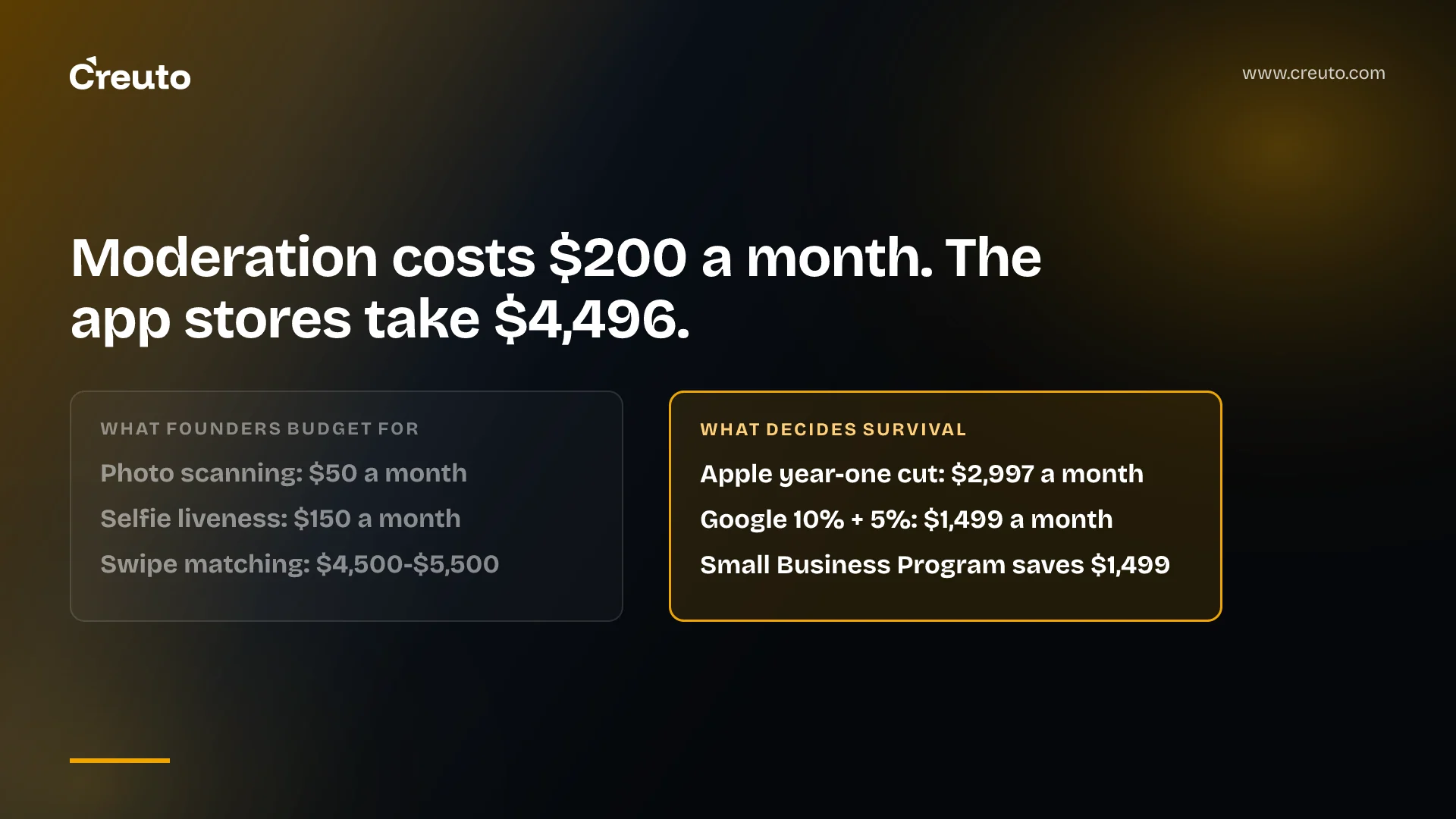
The stores take $4,496 of $19,980 in gross subscriptions. Automated photo moderation and liveness checks together cost $200, and the whole verification stack $783: the store cut is nearly six times larger. Enrolling in the Small Business Program cuts Apple's share to $1,499 and the stores' total to $2,997, a saving of $1,499 a month, which would pay for about 30 months of photo scanning at this volume. These are our calculations from list prices, so rerun them with your own price, platform split and sign-up rate.
What this changes in the build
Two decisions follow. First, enroll in the Small Business Program before launch: at $9.99 and 2,000 subscribers, annual gross is about $240,000, well under Apple's $1 million line. Second, notice that phone verification costs more than photo scanning and liveness combined. The API bill for safety is small; the real moderation cost is the people reviewing flagged profiles, which is why RaftLabs prices the review queue at $15K to $30K to build.
Dating app running costs per month, beyond the stores
RaftLabs puts monthly running costs at $3K to $12K, covering SMS, photo scanning, hosting and moderation, and its FAQ adds photo storage and push notifications. Our model above suggests photo scanning is a rounding error inside that range, so most of it is hosting, storage and human moderators.
Miracuves adds two lines the others skip: ongoing maintenance at about 15-20% of the build cost each year, and user acquisition at $3 to $10 per user. We explain why the flat maintenance percentage often misleads in why the 15-20% maintenance rule breaks. For a dating app, acquisition is the line that decides whether the subscribers in the model above ever arrive.
What to decide before you take a quote for a dating app MVP
Write down four answers before comparing quotes: the one community or city you launch in, whether verification is a feature or the product, which subscription price and tier you start with, and your expected iOS and Android split. The first two set the build band. The last two set what Apple and Google keep each month.
If you are weighing a clone script against a custom dating MVP, our MVP development team can scope both against those four answers, including the store and verification model above rerun with your own price and markets.
Frequently asked questions
The cost to build an app like Tinder ranges from a $399 to $5K clone script to $22K-$70K for a custom niche MVP and up to $200K for a scaled platform, based on RaftLabs, Cleveroad and Miracuves figures published in 2026. Scope and hourly rate explain most of the spread between quotes.
A niche dating app MVP takes 12 to 16 weeks with four to six people according to RaftLabs, and three to four months according to Miracuves. A focused MVP can take 6 to 10 weeks when it launches in one community, on one codebase, with verification bought as a service rather than built.
Apple keeps 30% of a dating app subscription in the subscriber's first year and 15% after that, or 15% throughout for Small Business Program members. Google Play takes 15% on auto-renewing subscriptions, split as 10% plus a 5% billing fee for EEA, UK and US users since June 30, 2026.
Automated photo moderation for a dating app costs about $0.001 per image with AWS Rekognition, so 50,000 profile photos a month cost about $50. Face Liveness selfie checks cost $0.015 each. The larger moderation cost is the human review queue, which RaftLabs prices at $15K to $30K to build.
A Tinder clone script is worth it for testing whether a niche will sign up and swipe at all, at $399 to $5K upfront. It is the wrong choice when verification or community vetting is your edge, when subscription billing must be controlled, or when the two-year cost approaches a custom MVP.
