Cost to build an app like Strava: maps and APIs
The cost to build an app like Strava runs $15K to $280K+ in vendor guides. Price bands, timelines, the Mapbox feed-thumbnail trap and Strava's 2026 API tiers.
The cost to build an app like Strava runs from about $15,000 for a basic tracking app to past $280,000 for a full platform, according to the vendor guides that rank for it. Those quotes miss two bills that arrive after launch: maps, which a careless feed design multiplies by every view, and Strava's and Garmin's API access.
By the end you will know which band your plan sits in, where the build money goes, how long it takes, what Mapbox charges at 10,000 and 50,000 monthly users, and whether to build your own activity platform or sit on Strava's after its 2026 developer changes. All figures are as of November 2026.
The cost to build an app like Strava, by the vendors who quote it
Four agency guides rank for this query, and they agree on almost nothing. Sorted into bands, here is what each one publishes:
| Band | What you get | Published price | Published timeline |
|---|---|---|---|
| Tracking MVP | GPS recording, activity feed, profiles, phone health-data sync | $35K to $75K (RaftLabs); $20K to $50K (GMTA); $15,000 to $60,000+ (Apptunix) | 10 to 14 weeks (RaftLabs); 3 to 4 months (GMTA); 2 to 3 months (Apptunix) |
| Mid-level app | Challenges, leaderboards, wearable integrations, analytics | $50K to $100K (GMTA); $60,000 to $100,000+ (Apptunix) | 4 to 6 months, or 3 to 5 months (Apptunix, see below) |
| Advanced platform | Segments, AI coaching, several device SDKs, scale | $110K to $180K+ (GMTA); $100,000 to $150,000+ (Apptunix); $150K to $280K+ for RaftLabs' full platform | 8 to 10 months, or 5 to 9 months (Apptunix); 22 to 40+ weeks (RaftLabs) |
Each of these companies sells the thing it is pricing, so read every figure as a quote with a motive. RaftLabs' top band also describes a gym and studio platform with live classes, which is a different product from a GPS tracker.
Two vendors that contradict themselves
OnGraph's guide gives the widest number and then disowns it. Its cost section says "you might need $150,000–$500,000+", while its own FAQ, answering the same question, says $50,000 to $150,000+. The page is dated December 2024, so both figures predate every 2026 change in this post.
Apptunix gives two timelines on one page. Its table puts a moderate app at 4 to 6 months and an advanced one at 8 to 10 months; its FAQ says 3 to 5 months and 5 to 9 months. When a vendor cannot agree with itself, the honest reading is that nobody has scoped your app yet, and the number that matters is the one you get after a scoping exercise.
Where the build money goes in a Strava-like app
The phone apps are the visible part, but the backend and data pipeline cost as much. RaftLabs splits a consumer tracking MVP as 25-30% mobile apps, 25-30% backend, API and data pipeline, 10-15% wearable sync, 8-12% subscription billing and 10-15% admin dashboard. It is also the only guide that prices the features that make Strava Strava:
| Feature | RaftLabs estimate |
|---|---|
| Apple HealthKit and Google Health Connect at launch | $15K to $25K, 3 to 5 weeks |
| Each additional device SDK (Garmin, Fitbit, Whoop) | $8K to $15K, 2 to 4 weeks, plus 10-15% a year upkeep |
| Challenges and leaderboards | $20K to $35K, 4 to 6 weeks |
| Segment leaderboards with route verification | $30K to $50K |
Segments are the expensive line for a reason. A segment leaderboard has to decide whether a noisy GPS trace actually covered a stretch of road, which is geometry work, usually done in PostGIS, not a sort on a times column. If your members need a leaderboard for a monthly step or distance challenge, you can skip segments entirely and save the top of that range.
One codebase or two
Platform choice moves the budget more than any feature. GMTA prices a cross-platform Flutter or React Native build at $30K to $80K against $80K to $150K+ for native apps on both platforms. The caveat for a tracking app is background location and battery drain: the GPS recorder is the one component where you will write native modules regardless, so budget for it in either framework. We set out how we choose between the two in React Native vs Flutter in 2027.
How long it takes to build a fitness app like Strava
A consumer tracking MVP takes 10 to 14 weeks in RaftLabs' phase plan: two weeks of discovery and data-model design, six to eight weeks of mobile apps and backend in parallel, three to four weeks of wearable sync and hardening, two to three weeks of billing, and two to four weeks of beta with real users. GMTA says 3 to 4 months for an MVP and 6 to 9 months for a full product with AI and wearables.
For comparison, a focused MVP typically takes us 6-10 weeks, and larger platforms 3-6 months depending on integrations and scope. Wearable integrations are where tracking-app timelines slip, because each device vendor has its own approval process, which is the next section.
Build on Strava's API, or build your own platform?
GMTA lists building on the Strava API at $15K to $50K upfront, against $80K to $180K+ for your own platform. That option is far narrower than it looks after Strava's 2026 developer program changes, which the page does not account for.
Strava's API Policy, effective June 1, 2026, splits developers into a Standard Tier, limited to 10 registered Strava users and, after review, 9,999, and an Extended Access Tier, "generally inclusive of Developer Applications serving 10,000 users or more and approved by Strava", admitted case by case. Strava's getting-started guide says a Strava subscription is a prerequisite for creating an app, every new app starts in single-player mode, and the default rate limit is 200 requests every 15 minutes and 2,000 a day. Extended Access apps are exempt from the subscription requirement.
Then the endpoints moved. On September 1, 2026, per Strava's API changelog, the Club Activities, Club Members and Club Admins endpoints were removed, and Explore Segments was restricted to approved Extended Access developers. Club endpoints are exactly what a corporate or gym challenge built on Strava would have used.
Garmin's program is open but tiered. Its Connect Developer Program now lists Starter access as push only, with limited user capacity and no historical data, and Enterprise access with unlimited users, at least a month of history and commercial terms "tailored based on business and technical requirements". Neither tier publishes a price.
The case for building on Strava is real: your members already record there, and you skip the GPS recorder, the hardest part to get right. It is the wrong choice in three situations:
- You need more than 9,999 users. Above that you need Extended Access, which Strava grants case by case, so your growth depends on an approval you cannot plan for.
- Your product is a club or team challenge. The Club endpoints are gone, and leaderboards across a group now have to be built from individual athletes' data.
- You need the data as an asset. Activity data you hold under another platform's terms is data that can be restricted with a changelog entry, as September showed.
If you take the integration route anyway, budget it as its own API integration workstream with a review period, not as a sprint.
The map bill: what Mapbox costs a fitness app
None of the four guides puts a dollar figure on maps, the same gap we found when we priced the cost to build an app like Uber. Mapbox bills a tracking app on two lines. The Mobile Maps SDK is free up to 25,000 monthly active users, then $4.00 per 1,000 MAU to 125,000 and $3.20 per 1,000 to 250,000. The Static Images API, which renders the small route map on each activity card, is free to 50,000 requests a month, then $1.00 per 1,000 to 500,000, $0.80 to 1,000,000 and $0.60 to 5,000,000.
The trap is the feed. A Strava-style feed shows a route thumbnail on every activity card. If the app requests that image from Mapbox each time a card scrolls into view, you pay per view, not per activity. We modeled it with these assumptions: each user scrolls past 60 activity cards with a route map a month (two a day), records 8 activities a month, list prices with each band billed at its own rate, and no enterprise discount.
| Monthly users | Mobile Maps SDK | Thumbnail per feed view | Thumbnail once per activity |
|---|---|---|---|
| 10,000 MAU | $0 (inside the free 25,000) | 600,000 requests: $530 | 80,000 requests: $30 |
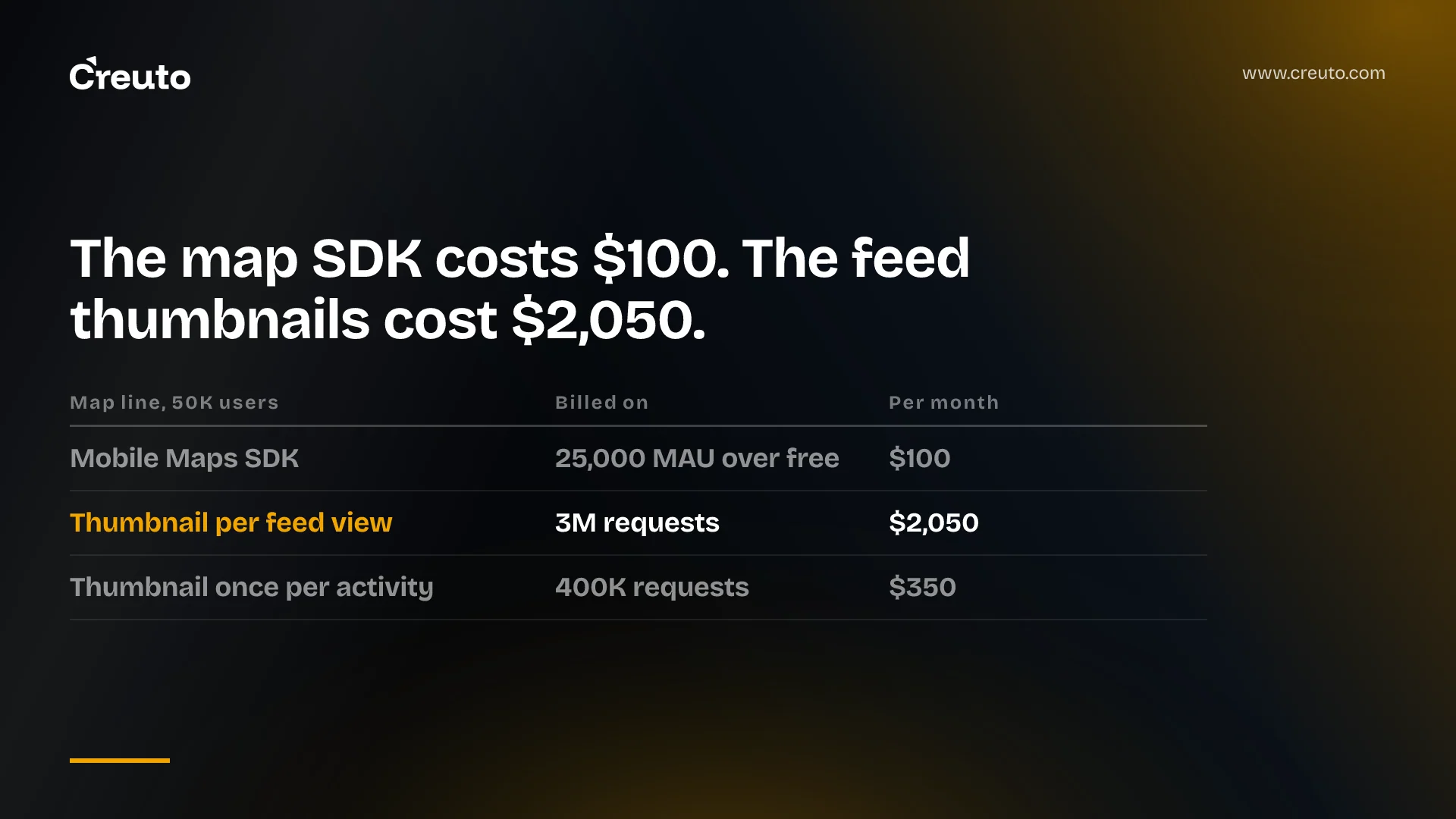
| 50,000 MAU | $100 | 3,000,000 requests: $2,050 | 400,000 requests: $350 |
At 50,000 users the thumbnails cost about 20 times the interactive map, and almost all of that is avoidable. Generate each route image once, when the activity is saved, and serve it from your own storage, which cuts the line by about 83% on our assumptions. Two caveats. Mapbox's Static Images API documentation sets a 12-hour cache header but does not say whether you may store the images long term, so confirm that against your plan's product terms. If you cannot, draw the thumbnail from your own GPS polyline on your own tiles, which costs nothing per view.
This is the part of a tracking app we know from first-hand work. Binimise, the IoT smart city platform we built, runs GPS vehicle tracking, route-deviation and GPS fence alerts and a live map of every collection vehicle across 4 platforms and 10 integrated modules. It is not a fitness app, but the cost of location data comes from the same place: what you render, how often, and from whose servers.
Fitness app running costs per month, beyond maps
Running costs scale with the build. GMTA puts annual maintenance at 15-30% of the initial build cost, rising with the product's stage. We cover why a flat percentage rule misleads in our piece on mobile app maintenance cost. RaftLabs estimates $500 to $3K+ a month for hosting, video, push notifications and billing, and adds 10-15% a year to keep each wearable integration working through OS and vendor API changes. OnGraph's FAQ adds $10,000 to $30,000 a year.
Add the map line from the table above and, if you sit on Strava, the developer subscription the getting-started guide requires. The map line is the one that grows fastest with users, which is why it belongs in the plan before launch rather than in the first surprised invoice.
What to settle before you take a quote for a Strava-like app
Ask any vendor four questions before comparing numbers: native or cross-platform for the GPS recorder, whether segments are in scope or a simple challenge leaderboard will do, which device platforms you integrate with and at which Garmin and Strava tier, and how route thumbnails are generated and cached. A quote that cannot answer the last one has not priced your running costs.
If you are deciding whether to build your own tracking and challenge app or integrate with Strava and Garmin, our mobile app development team scopes the GPS recorder, the device integrations and the map bill for your user numbers, so the build quote and the monthly bill arrive together.
Frequently asked questions
The cost to build an app like Strava ranges from about $15,000 to $75,000 for a GPS tracking MVP to $100,000-$280,000+ for an advanced platform, based on published 2026 vendor guides from RaftLabs, GMTA and Apptunix. Segments, wearable integrations and native versus cross-platform builds move a quote most.
A Strava-like fitness tracking MVP takes 10 to 14 weeks in RaftLabs' phase plan and 3 to 4 months according to GMTA. A full product with AI coaching and several wearables takes 6 to 9 months per GMTA. Wearable integrations are where these timelines most often slip, because each vendor runs its own approval.
Building on the Strava API is possible, but since June 1, 2026 Strava's Standard Tier is limited to 10 users, or 9,999 after review, and creating an app requires a Strava subscription. Apps above 10,000 users need Extended Access, granted case by case, and the Club endpoints were removed on September 1, 2026.
Garmin does not publish a price for the Garmin Connect Developer Program. Its Starter tier is push only, with limited user capacity and no historical data. Its Enterprise tier offers unlimited users and at least a month of history, with commercial terms that Garmin says are tailored to business and technical requirements.
Mapbox's Mobile Maps SDK is free up to 25,000 monthly active users, then $4.00 per 1,000. Route thumbnails cost more: the Static Images API is free to 50,000 requests, then $1.00 per 1,000. Our model puts thumbnails at $2,050 a month for 50,000 users if fetched on every feed view.
