Cost to build an app like Spotify: the 66% line
The cost to build an app like Spotify: $35K to $1M+ for a custom build, but Spotify's 20-F shows content takes 66% of Premium revenue. Bands and margin model.
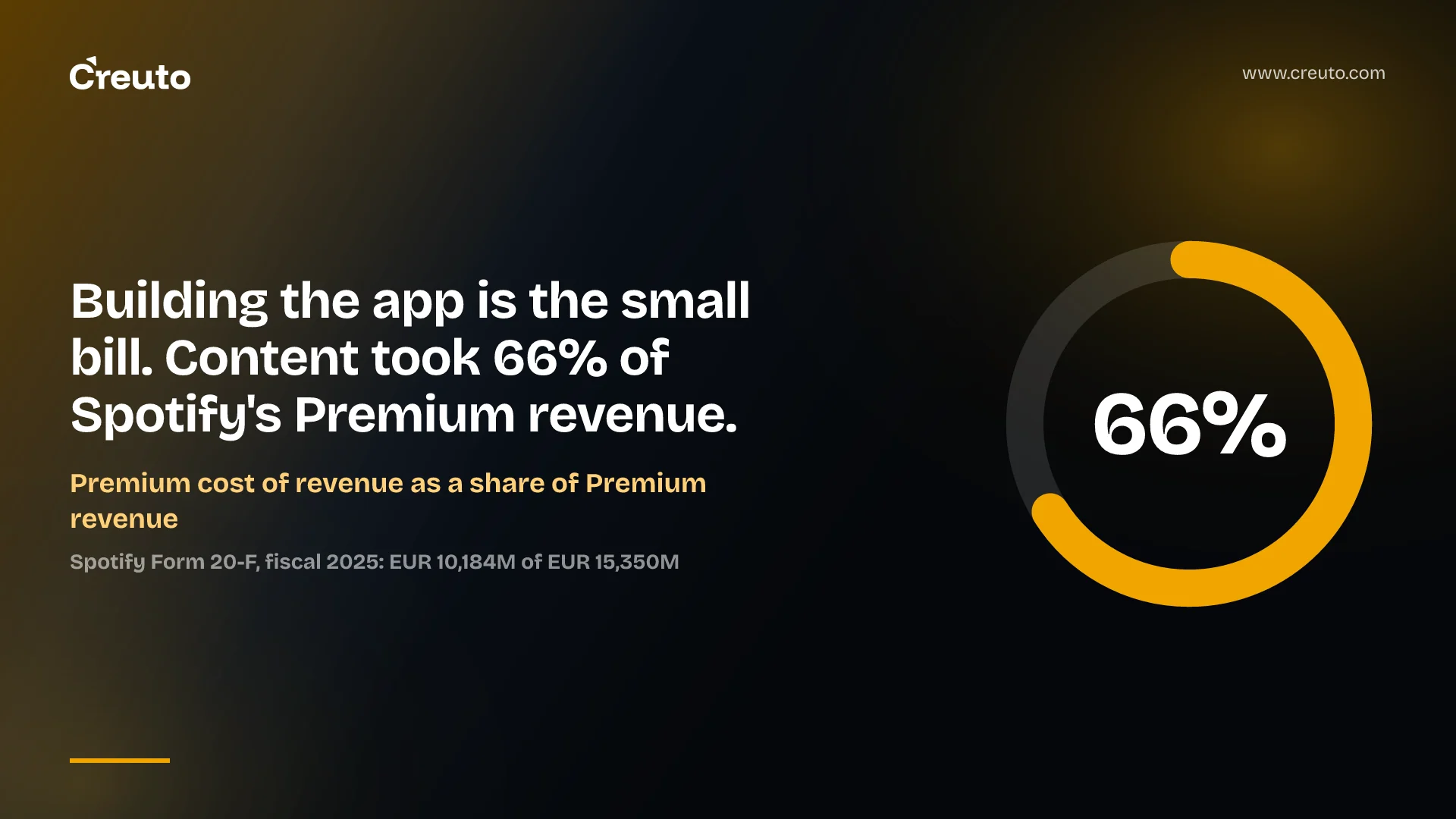
The cost to build an app like Spotify runs from under $100 a month on a no-code builder to past $1 million for a full custom clone, and the build is the smaller number. Spotify's own filing shows content costs taking 66% of its Premium revenue. For a niche audio app, the catalogue decides the budget.
By the end you will know which of three price bands your plan sits in, what the build line items cost, how long each band takes, and what licensed music does to your monthly margin compared with a catalogue you own. All figures are as of November 2026.
The cost to build an app like Spotify, in three price bands
An "app like Spotify" means three different products to the vendors who rank for this query. Here is what each publishes, sorted by what it is actually pricing:
| Band | What you get | Published price | Published timeline |
|---|---|---|---|
| No-code builder | A template music app with player, playlists and login on a builder's platform | "Less than $100 per month" (nandbox) | "1-2 weeks" (nandbox) |
| Niche MVP | Listener apps, catalogue, player, subscriptions, admin panel | $40,000 to $80,000 (Biz4Group), $35,000 to $80,000 (ProjectCostEstimator), $65K to $95K (RaftLabs), $75,000 to $150,000 (Chop Dawg) | 14 to 18 weeks (RaftLabs); five to eight months (Chop Dawg) |
| Full platform | Offline downloads, recommendations, creator tools, cross-device sync | $95K to $130K, or $130K to $200K+ at scale (RaftLabs); $200,000 to $400,000+ (Chop Dawg); $400,000 to $1M+ (nandbox) | 20 to 36 weeks (RaftLabs); ten to sixteen months (Chop Dawg) |
Every figure in that table comes from a company selling the thing it prices, so read each one as a quote with a motive, not a benchmark.
Why the full-build estimates differ by almost eight times
The top of the full-build band runs from RaftLabs' $130K for a full platform to nandbox's $1M+. The vendors are pricing different scopes, and two of them disagree with themselves. nandbox's cost table puts a full-featured clone at $400,000 to $1M+, while its FAQ on the same page says a custom clone costs "between $80,000 and $1 million". nandbox also sells the under-$100 builder, so a high custom number serves its pitch.
Chop Dawg's MVP band is about twice everyone else's: $75,000 to $150,000 against $40,000 to $80,000 at Biz4Group and $35,000 to $80,000 at ProjectCostEstimator. Its floor sits near the top of the other vendors' MVP ranges, and its ceiling is above all of them. Its own component table does not reconcile with its headline either. Adding the low ends of its twelve modules gives about $151,000, and the seven modules a lean MVP needs (onboarding, streaming, catalogue, player, playlists, subscriptions and backend) come to about $89,000 at their low ends, above its own $75,000 floor.
Where the build money goes: streaming backend, not the player
The backend and streaming infrastructure are the largest line in a music streaming app development cost breakdown. RaftLabs puts them at 35-45% of a niche MVP budget, against 20-25% for the listener apps, 15-20% for the admin panel and CMS, and 10-15% for subscription billing and DRM. The midpoints add to 92.5%, so treat these as rough shares, not a split.
ProjectCostEstimator prices each component in dollars at US rates:
| Component | ProjectCostEstimator range |
|---|---|
| Audio streaming and adaptive bitrate delivery | $14,000 to $36,000 |
| Music catalogue, search and metadata | $10,000 to $26,000 |
| Personalized recommendations and playlists | $14,000 to $36,000 |
| Offline download and playback | $9,000 to $22,000 |
| Subscription billing and free tier with ads | $10,000 to $24,000 |
| Cross-device sync and social sharing | $8,000 to $18,000 |
| Core feature set | $65,000 to $162,000 |
Source: ProjectCostEstimator, updated July 2026.
What a Spotify-like MVP includes, and what it can skip
A niche MVP needs a player with background playback, a catalogue your team can upload to, subscriptions, and an admin panel. Recommendations and offline downloads are the two lines to defer. RaftLabs prices offline downloads at $10K to $15K as a version-two add-on, and Chop Dawg puts a recommendation engine at $15,000 to $45,000. A meditation or course app with 200 tracks does not need machine learning to tell a listener what to play next.
Chop Dawg's bands assume a cross-platform build on React Native with native modules for audio. One codebase for iOS and Android is the main saving in the listener apps, and our React Native app development work follows the same reasoning. RaftLabs adds that native apps on top of a web-only launch cost $10K to $20K, which makes web-first a real option for a course or publishing audience that already reads on a laptop.
How long it takes to build a music streaming app
A niche Spotify-style MVP takes 14 to 18 weeks according to RaftLabs, whose phase plan gives two weeks to discovery, six to eight to the listener apps, eight to ten to the backend, two to three to integration and two to four to a pilot. Creator hosting adds six to eight weeks. Chop Dawg estimates five to eight months for a lean MVP, and Biz4Group gives four to twelve months overall without tying the range to a tier.
ProjectCostEstimator lists six to twelve months for both its lean MVP and its full build, which tells you its timeline column is not doing much work. On our side, a focused MVP typically takes 6-10 weeks; larger enterprise platforms 3-6 months depending on complexity, integrations and scope.
Is a Spotify clone or no-code builder worth it?
A no-code builder is worth it when the question is "will our members listen in an app at all". nandbox's plan lists a native iOS and Android app, a player, playlists, offline listening and push notifications for under $100 a month. That is a cheap way to test demand with your existing audience before committing $40,000 or more.
It is the wrong choice in three situations:
- Your product is the catalogue experience. If you win on how courses are sequenced, how progress is tracked or how sessions adapt, that logic sits inside someone else's template.
- You need your listening data. Completion rates and skip points are what an audio business improves on, and data you cannot query freely is data you cannot build on.
- You are licensing music. A builder does not remove the rights bill, and nandbox's own FAQ says you need legal rights to stream any music you upload.
The 66% line: what Spotify's filing says content costs
No ranking guide prices content from a primary source. Spotify's Form 20-F for fiscal 2025 does. Its Premium revenue was €15,350 million and its Premium cost of revenue €10,184 million, and the filing states that Premium cost of revenue "as a percentage of Premium revenue decreased from 67% to 66%". Ad-Supported cost of revenue fell from 88% to 82% of Ad-Supported revenue, and consolidated gross margin was 32%.
The filing says what that line is: "Cost of revenue consists predominantly of royalty and distribution costs related to content streaming." The split is lopsided. Higher royalty costs added €765 million in 2025, while streaming delivery costs rose by €23 million. Spotify also reports €2.7 billion in estimated future commitments under license agreements, and says its deals with minimum guarantees frequently run one to three years while subscribers can cancel at any time.
Spotify's newsroom, on 28 January 2026, put the same thing in dollars: it paid out "more than $11 billion" to the music industry in 2025, "almost 70% of what we take in". That is Spotify, with all the negotiating weight of its size, still handing about two-thirds of what it takes in to rights holders.
How much music licensing costs a streaming app
The vendor guides either skip this or guess. RaftLabs gives "$50K-$500K per year by catalog size and territories" for licensing, with no source attached to the figure or its band table, so treat it as unsourced. ProjectCostEstimator says licensing "sits outside the build budget entirely" and is "negotiated per catalog with rights holders", which is accurate and gives you no number. Chop Dawg calls licensing "a continuing business expense, not a one-time build cost" and also prices nothing.
A worked model: licensed music against an owned catalogue
Our assumptions: 10,000 subscribers at $9.99 a month, all billed through app stores at the 15% rate Apple's Small Business Program charges developers under $1 million in proceeds. Each subscriber listens 30 hours a month at about 160 kbit/s, Spotify's "High" quality setting. For licensed music, we assume rights holders take the same 66% of revenue that Spotify's Premium cost of revenue represents, which is generous to a new entrant without Spotify's scale.
| Monthly, 10,000 subscribers | Licensed music | Owned catalogue |
|---|---|---|
| Subscription revenue | $99,900 | $99,900 |
| App store commission at 15% | -$14,985 | -$14,985 |
| Content cost at 66% of revenue | -$65,934 | $0 |
| Audio delivery (about 21.6 TB) | -$200 | -$200 |
| Left for everything else | $18,781 | $84,715 |
The delivery line uses the $200 Business tier among CloudFront's flat-rate plans, which includes 50TB of data transfer a month. Your CDN choice barely moves the result, which matches Spotify's own €765 million against €23 million. These are our calculations from published rates, so rerun them with your own price, volume and catalogue deal.
The model also exposes RaftLabs' payback claim. It says a $110K build "pays for itself in 6 to 7 weeks" at 10,000 subscribers paying $8, which divides gross revenue by build cost. Deduct a 66% content line and a 15% store fee and the same build takes about seven months to pay back. With an owned catalogue it takes under two.
Audio streaming app running costs beyond content
The owned-catalogue column is not free money. Recording courses, meditations or audiobooks is a production cost the table leaves out, but it is fixed and paid once per title rather than on every stream. Podcasts and spoken word you commission or produce have the same shape.
The other lines are smaller and more predictable: hosting, storage, payment processing, monitoring and the team that keeps the apps current. None of the ranking guides prices them in dollars, so ask your vendor to, and size the infrastructure with someone who has run it. Our DevOps and cloud engineering team sets up CDN, storage and monitoring on AWS, and can size that side before you commit to a vendor.
What to decide before you take a quote for a Spotify-style MVP
The content model is the decision, and it comes before the build. Before you compare quotes, settle three things: whether release one streams licensed music or only content you own, the number of tracks and territories at launch, and whether recommendations and offline downloads can wait for version two. The first sets your margin. The other two move you between the $40,000 and $150,000 ends of the MVP band.
If you are an edtech, wellness or publishing team with a catalogue you already own, our MVP development team can scope a subscription audio MVP against those three answers, including the margin model above rerun with your own price and listening hours.
Frequently asked questions
The cost to build an app like Spotify ranges from about $35,000 to $150,000 for a niche custom MVP and from $95,000 to past $1 million for a full platform, based on vendor estimates published in 2026. No-code builders start under $100 a month. Licensed music is a separate ongoing cost on top of the build.
Spotify said it paid out more than $11 billion to the music industry in 2025, almost 70% of what it takes in. Its fiscal 2025 Form 20-F shows Premium cost of revenue, mostly royalties and distribution, at 66% of Premium revenue, down from 67% the year before.
A niche music streaming app MVP takes 14 to 18 weeks according to RaftLabs and five to eight months according to Chop Dawg. A full platform with offline downloads, recommendations and creator tools takes 20 to 36 weeks at RaftLabs and ten to sixteen months at Chop Dawg.
A streaming app needs licenses for any music it streams that you do not own, and those licenses are an ongoing cost outside the build budget. An app that streams only owned content, such as your own courses, meditations, podcasts or audiobooks, carries no royalty line, which changes its margin far more than the build cost does.
A Spotify clone app streaming licensed music keeps little margin: on our model, 10,000 subscribers at $9.99 leave about $18,781 a month after a 66% content cost, a 15% store fee and delivery. The same app with an owned catalogue keeps about $84,715 before production and running costs.
