Cost to build an app like Netflix, per HD hour
The cost to build an app like Netflix: $40K-$300K+ to build, then up to $0.33 per HD viewer-hour to deliver in India. Build vs Muvi or Uscreen, priced.
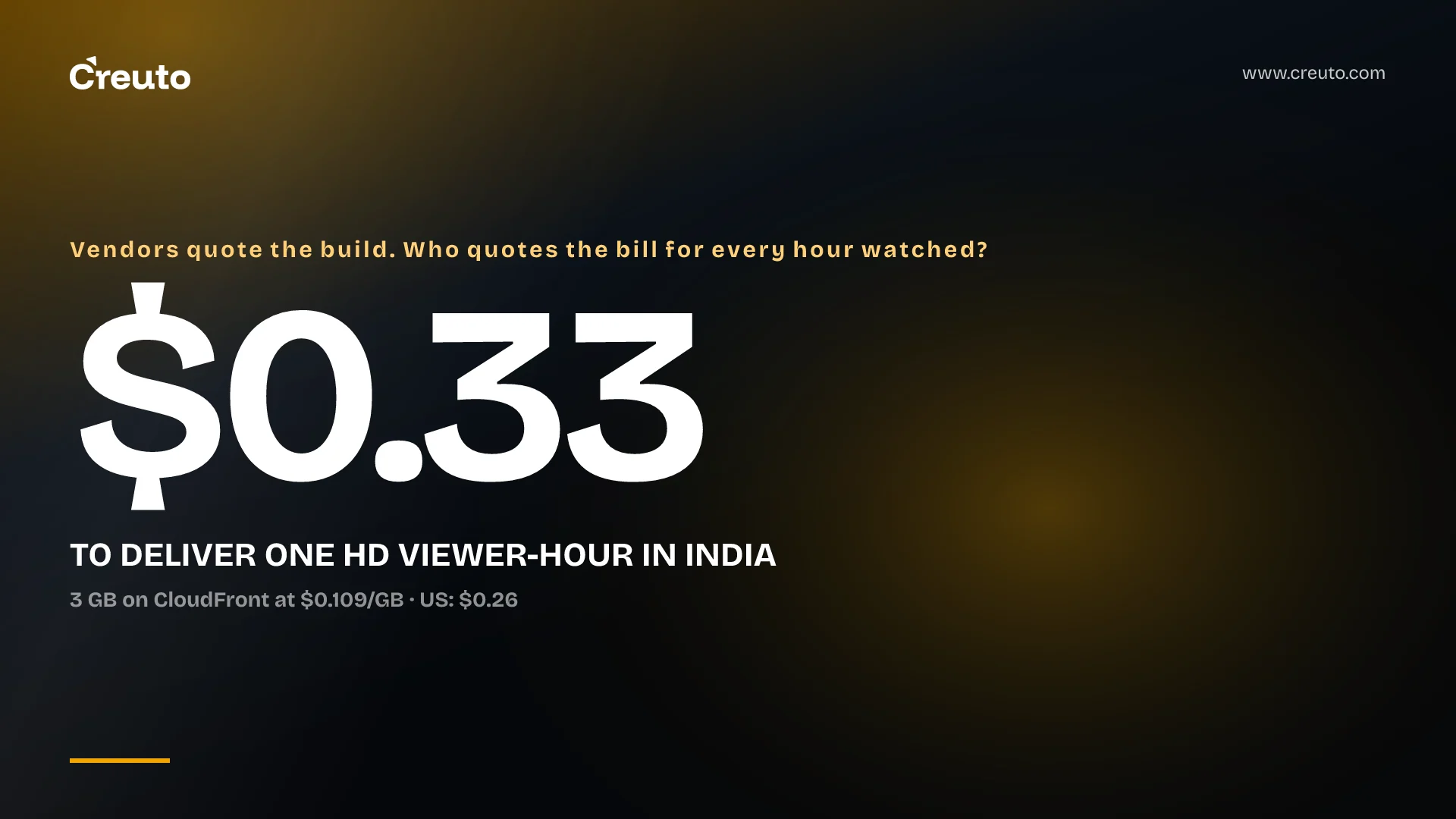
The cost to build an app like Netflix is $40,000 to $300,000+ in published vendor estimates, but the build is the smaller bill. Delivering one HD viewer-hour from Amazon CloudFront costs up to about 33 cents in India or the UAE at list price, so watch time, not code, decides whether you build or rent.
By the end you will know which of three bands your plan sits in, what DRM and encoding add, what a white-label platform such as Muvi or Uscreen really charges at your size, and what 200,000 HD hours a month costs to deliver in India, the UAE and the US. All figures are as of November 2026.
The cost to build an app like Netflix depends on which of three products you mean
An "app like Netflix" is three different purchases. Here is what the vendors ranking for this query publish, sorted by what they are pricing:
| Band | What you get | Published price | Published timeline |
|---|---|---|---|
| White-label OTT platform | A vendor's apps, player, CMS and CDN under your brand | Muvi: $399, $1,499 or $3,900 a month before variable fees; Uscreen: $49, $149 or $449 a month plus per-subscriber fees | Not published |
| Custom MVP | Web, iOS and Android, adaptive streaming, catalog, subscription billing | $55K to $100K (RaftLabs) or $40,000 to $70,000 (OnGraph) | 14 to 20 weeks (RaftLabs); 3 to 4 months (OnGraph) |
| Licensed-content or full platform | DRM, offline downloads, TV apps, personalization, live | $80K to $140K with DRM and downloads, plus $30K to $60K for TV apps (RaftLabs); $180,000 to $300,000+ (OnGraph) | 20 to 28 weeks, plus 8 to 12 for TV apps (RaftLabs); 8 to 12 months (OnGraph) |
Every number in that table comes from a company selling the thing it prices, so treat each as a quote with a motive. The decisions that move a build between bands are the same ones we set out in the four decisions that move the cost to build an app.
Why OnGraph's own numbers don't add up
OnGraph's headline says a Netflix-like app costs "$60,000 to $300,000+", while its complexity table starts the simple MVP at $40,000. Its stage-by-stage breakdown is higher again. Planning ($5,000), design ($10,000), mobile apps ($50,000), backend ($25,000), web app ($20,000) and testing ($10,000) sum to $120,000 at the bottom of every range. That is three times its own MVP floor. Read the $40,000 figure as a stripped single-platform build, not as web plus two app stores.
What goes into the build, and what DRM adds
The OTT app development cost splits into four parts: the apps people watch on, the video pipeline, billing and the catalog. The video pipeline is the part generic app quotes miss. Each upload is encoded into several quality levels and served over HLS, so the player can switch rendition as the connection changes. Subscription billing, catalog and accounts are ordinary app work.
DRM is the line that moves you into the third band. RaftLabs says DRM is required for any content licensed from studios, distributors or rights holders. It must cover Widevine (Android and Chrome), FairPlay (iOS and Safari) and PlayReady (Windows), and RaftLabs puts the work at four to six extra weeks. If your library is your own original content, it suggests deferring it.
TV apps are the other jump. Each TV platform is a separate codebase, and RaftLabs prices Apple TV and Android TV together at $30K to $60K. A cross-platform framework covers phones and tablets in one codebase, which is why OnGraph prices Flutter or React Native builds at $50,000 to $120,000 against $25,000 to $80,000 for Android alone and $30,000 to $90,000 for iOS alone.
How long it takes to build a Netflix-like app
A web, iOS and Android OTT MVP takes 14 to 20 weeks with four to six developers, according to RaftLabs. DRM and offline downloads stretch that to 20 to 28 weeks, TV apps add 8 to 12, and a full build with personalization and live streaming takes 12 months or more. OnGraph's ranges are similar: three to four months for a simple MVP, five to seven for a medium app and eight to twelve for an advanced platform.
The schedule risk is the content, not the code. RaftLabs reports that a one-hour 1080p video can take one to four hours to process, so a 100-title library can take days to transcode. Load your catalog weeks before launch, not two days before.
What one HD viewer-hour costs to deliver
No ranking guide prices delivery per viewer-hour, so we worked it out from the primary sources. Start with the data. Netflix's help center says HD streaming uses up to 3 GB an hour per device. Muvi's pricing FAQ uses 2 GB for a one-hour HD video. We use both as the range.
Then the price. CloudFront pay-as-you-go gives the first 1 TB a month free, then bills per GB by the region your viewers are served from. India and the Middle East cost more than the US at every tier, and the gap widens with volume:
| CloudFront region | First paid tier (next 9 TB) | Per HD hour at 2 to 3 GB | Over 5 PB a month | Per HD hour at 2 to 3 GB |
|---|---|---|---|---|
| India | $0.109/GB | $0.22 to $0.33 | $0.072/GB | $0.14 to $0.22 |
| Middle East (UAE) | $0.110/GB | $0.22 to $0.33 | $0.040/GB | $0.08 to $0.12 |
| United States | $0.085/GB | $0.17 to $0.26 | $0.020/GB | $0.04 to $0.06 |
At the top tier, India pays $0.072 a GB against $0.020 in the US, 3.6 times as much. An Indian service at Netflix scale never gets the US price curve.
Encoding and DRM are small next to delivery
Encoding is a one-off cost per title. AWS Elemental MediaConvert bills per normalized minute: an HD AVC output at 30 fps counts double, an SD output counts once. DRM output needs the Professional tier. AWS's worked example for US East (Ohio) prices it at $0.0120 a normalized minute for the first 50,000 and $0.0096 for the next 950,000; the live table varies by region, so check yours. A ladder of one SD and two HD renditions is five normalized minutes per content minute, or about $3.60 per hour of content. A 1,000-hour library comes to about $3,000, once.
DRM is recurring but modest. DoveRunner's multi-DRM plan on AWS Marketplace charges a $499 monthly base fee for the first 20,000 licenses, then $0.50 per 100 for the next 80,000. At 100,000 viewers, assuming one license per viewer a month, that is $899.
The bill at 100,000 viewers watching two hours a month
RaftLabs gives one delivery figure: at 100K monthly active users watching two hours a month, "CDN alone runs $5K-$15K per month." That is 200,000 viewer-hours, or 400 to 600 TB at 2 to 3 GB an hour. Run through CloudFront's published tiers, the list price is much higher:
| Region | 400 TB (2 GB an hour) | 600 TB (3 GB an hour) |
|---|---|---|
| United States | $19,965 | $26,965 |
| India | $32,581 | $48,381 |
| Middle East (UAE) | $34,190 | $48,190 |
These are our calculations from the list price, with the free 1 TB deducted. RaftLabs' $5K to $15K works out to between 0.8 and 3.75 cents a GB. The low end is below even the US rate for traffic over 5 PB. Its number can still be right in two ways. AWS says customers who commit to about 10 TB a month or more are eligible for discounted pricing. And at Netflix's "Medium" setting of up to 0.7 GB an hour, the same 200,000 hours is 140 TB: $9,365 in the US and $11,761 in India. For a mobile-first Indian audience, that may be the realistic case. Ask a vendor quoting RaftLabs' range which of the two it assumes.
CloudFront flat-rate plans: a cheaper route, with a caveat
AWS also sells CloudFront flat-rate plans: Pro at $15, Business at $200 and Premium at $1,000 a month, each with 50 TB of data transfer and "no overage charges". The CloudFront Developer Guide lets Premium rise to 600 TB for $10,000 a month, and the CloudFront FAQ says plan prices do not vary by region. On paper, that is $10,000 for the 600 TB that costs $48,381 in India on pay-as-you-go.
Don't build your budget on it yet. The guide says allowances "are not hard limits", but sustained excess can mean traffic is "served from fewer or more distant edge locations". AWS's Service Terms allow throttling or "requiring a change to your pricing structure". Neither the guide nor the FAQ says whether video streaming at this scale is an intended use. Get that answer from AWS in writing first.
Is a white-label OTT platform cheaper than building?
A white-label OTT platform is cheaper while your viewer-hours are small, and the included bandwidth shows where small ends. Muvi's Standard, Professional and Enterprise plans include 100 GB, 500 GB and 1 TB of bandwidth a month, and Ultimate 2 TB. By Muvi's own 2 GB figure, 100 GB is about 50 HD viewing hours. Above the allowance, Muvi's variable fees charge a standard overage of $0.09 a GB, with bulk rates down to $0.05 at 100 TB and $0.04 at 1,000 TB. DRM is $0.01 a view.
Those bulk rates undercut CloudFront's India list price at the same volume, so a custom build does not automatically win on bandwidth in India. Muvi's page also contradicts itself on discounts: the toggle says yearly billing saves 20%, the FAQ says 15%.
Uscreen prices by subscriber, not bandwidth. Starter is $49 a month with a 100-subscriber limit, Growth is $149 plus $1.99 per subscriber, and App Essentials is $449 plus $0.99 per subscriber with iOS and Android apps. TV apps come only on the quoted Custom plan. At 5,000 subscribers, App Essentials lists at $5,399 a month. RaftLabs says Uscreen runs "$149-$499/month plus 1-3% of revenue". Uscreen's pricing page shows no revenue percentage, and its top listed plan is $449, so check the contract rather than either summary.
Renting is the wrong choice in three situations:
- Your watch time is high and your price is low. A regional OTT service or sports league with long sessions and low subscription prices pays bandwidth fees on every hour and gets nothing extra for the viewer.
- You need TV apps early. Uscreen lists its five TV apps only on the quoted Custom plan, so check availability before you assume them.
- Your rights contracts set the rules. RaftLabs reports that rights holders with territorial restrictions often find white-label platforms cannot enforce them.
Building is the wrong choice when you have under 1,000 subscribers, RaftLabs' own threshold, and do not yet know whether people will pay for your library.
Monthly running costs of an OTT platform
RaftLabs puts monthly infrastructure (CDN, compute and storage) at $3K to $20K, and our table above shows how fast delivery alone outgrows that at list prices. OnGraph budgets ongoing maintenance at 15-20% of the build each year. Add DRM from $499 a month and encoding for each new title. For a service in India or the UAE, the CDN line usually decides whether you are profitable, so negotiate it before launch.
We have not built a video streaming platform. The non-video half of this work (multi-platform apps, a Node backend and AWS hosting) is what we delivered for the Škoda Auto sales training platform: three platforms for 100+ dealerships in 20 weeks. It does not stream video. We use the same method here as in our cost to build an app like Uber breakdown: price the usage bill from primary rate cards before the build.
What to work out before you take an OTT quote
Write down four numbers before you compare quotes: expected viewer-hours a month at month twelve, the quality your audience will actually stream at, the share of viewers in India, the Middle East and elsewhere, and whether any title is licensed and needs DRM. The first three set your delivery bill per hour. The last decides which build band you are in.
If you are deciding between Muvi or Uscreen and your own apps on AWS, our mobile app development team can scope the custom build against those four numbers. That includes rerunning the per-viewer-hour delivery model above with your own audience mix.
Frequently asked questions
The cost to build an app like Netflix runs from $40,000-$100,000 for a custom web and mobile MVP to $80,000-$140,000 with DRM and offline downloads, and $180,000-$300,000+ for an advanced platform, in RaftLabs' and OnGraph's 2026 estimates. TV apps add $30,000-$60,000. White-label platforms rent instead, from $49 to $3,900 a month.
Streaming one hour of HD video uses 2 to 3 GB, by Muvi's and Netflix's figures. On Amazon CloudFront list prices that costs $0.22 to $0.33 per viewer-hour in India or the Middle East at the first paid tier, and $0.17 to $0.26 in the US. Committed-use discounts and lower quality settings reduce it.
Multi-DRM for a streaming app costs $499 a month for the first 20,000 licenses on DoveRunner's AWS Marketplace plan, then $0.50 per 100 licenses up to 100,000. Muvi charges $0.01 per DRM view. RaftLabs estimates that building DRM support into a custom OTT app adds four to six weeks.
A Netflix-like app MVP for web, iOS and Android takes 14 to 20 weeks with four to six developers, according to RaftLabs, or three to four months according to OnGraph. Adding DRM and offline downloads extends it to 20 to 28 weeks, TV apps add 8 to 12 weeks, and a full platform takes a year or more.
A white-label OTT platform such as Muvi or Uscreen is cheaper while subscribers and viewer-hours are small. Muvi's plans include only 100 GB to 2 TB of bandwidth a month, and Uscreen adds $0.99 to $1.99 per subscriber. Building pays off when watch time is high, but negotiate CDN rates first.
