Cost to build an app like Instagram: 3 bands
The cost to build an app like Instagram runs from $15K to $250K+. Three price bands, and what each 30-second upload costs to transcode, scan and store.
The cost to build an app like Instagram runs from about $15,000 for a basic build to past $250,000 for a full platform, and the published quotes disagree because each vendor prices a different product. This post sorts them into three bands, then prices what no build quote does: the media bill that every user upload adds.
By the end you will know which band your plan sits in, where the build budget goes, how long it takes, and what each 30-second clip costs to transcode, scan and store on AWS list prices as of November 2026. That last number is the one that grows with every signup, whether or not anyone is watching.
The cost to build an app like Instagram depends on which product you mean
An "app like Instagram" can mean a photo feed for a niche community or a full short-video platform with Stories, Reels-style clips and ranked discovery. Here is what the vendors ranking for this query publish:
| Band | What you get | Published price | Published timeline |
|---|---|---|---|
| Clone script or white-label | A vendor's existing app under your brand | ₹44,616 to ₹52,066 lifetime (Hitasoft, excluding GST); "low to $20K" (RaftLabs) | Not published |
| MVP | Profiles, posting, feed, follows, likes and comments, basic moderation | $15,000 to $45,000 (Cubix, basic); $40K to $70K (RaftLabs); $60,000 to $130,000 (Chop Dawg) | 3 to 6 months (Cubix); 14 to 22 weeks (RaftLabs); 4 to 7 months (Chop Dawg) |
| Full platform | Algorithmic feed, video pipeline, Stories, messaging, advanced moderation | $70K to $130K (RaftLabs); $150,000 to $500,000+ (Cubix, advanced); past $250,000 (Chop Dawg) | 22 to 32 weeks (RaftLabs); a year or more (Chop Dawg) |
Every figure in that table comes from a company selling the thing it prices. Read each one as a quote with a motive, not a benchmark.
Why the vendors cannot agree on an Instagram MVP
The MVP floor alone moves fourfold, from $15,000 at Cubix to $60,000 at Chop Dawg. The bands also overlap in ways that make them hard to compare: RaftLabs' entire full platform tops out at $130K, the same figure where Chop Dawg's MVP tops out. One studio's finished product is another's first release.
Cleveroad's guide, last updated in May 2023, disagrees with itself. It gives $55,000 to $65,000 as the average cost of an Instagram-like app, then computes 1,180 hours at $50 an hour as $59,000 "for each application", meaning per platform, so iOS and Android double it. The same hours at North American rates come to $177,000-236,000+. That is three answers for one scope, separated only by platform count and hourly rate. Those two variables move a quote more than any feature does, which is the argument of our cost to build an app like Uber breakdown too.
Where the build budget goes: the media and feed modules
Chop Dawg is the only ranking page that prices an Instagram-like build module by module. Its ranges assume a cross-platform React Native build with a shared backend:
| Module | Chop Dawg range |
|---|---|
| Accounts and profiles | $8,000 to $20,000 |
| Photo and video upload | $12,000 to $30,000 |
| Feed and timeline | $12,000 to $35,000 |
| Likes, comments and shares | $8,000 to $20,000 |
| Stories and short video | $15,000 to $40,000 |
| Direct messaging | $12,000 to $30,000 |
| Notifications and discovery | $10,000 to $25,000 |
| Recommendation and ranking | $15,000 to $40,000 |
| Moderation and admin | $10,000 to $30,000 |
| Backend, media storage and security | $20,000 to $55,000 |
Source: Chop Dawg, July 2026.
The cheapest MVP cut is visible in that table. Stories, messaging and a ranked feed together account for $42,000 to $110,000 of it. A niche community can launch with a chronological feed and no direct messages, and learn whether people post before paying for ranking.
Can you build an Instagram MVP with React Native or Flutter?
Yes, and the ranking guides assume you will. Chop Dawg calls a shared React Native codebase "far more economical than two native teams", and RaftLabs puts the saving of cross-platform over separate native apps at $30K-$50K. Cubix prices cross-platform at $40,000 to $140,000 against $25,000 to $120,000 for iOS alone. Flutter gives the same one-codebase saving, and we explain how we choose between them in React Native vs Flutter in 2027. The camera and upload path is where cross-platform needs the most native work, which is why RaftLabs prices in-app camera recording separately at +$25K-$45K.
How long it takes to build an app like Instagram
A social media MVP takes 14 to 22 weeks according to RaftLabs, three to six months according to Cubix, and four to seven months according to Chop Dawg. The spread is scope again. A focused MVP typically takes us 6-10 weeks, and "focused" is the operative word: a video pipeline, a moderation queue and a ranked feed are three separate projects, and each one you defer to release two shortens release one.
Is an Instagram clone script worth buying?
An Instagram clone script is worth buying when the only question is whether your community will post at all. The case for it is real: Hitasoft's lifetime license is listed at ₹44,616 on Techjockey, a small fraction of any custom quote, and RaftLabs puts white-label options at "low to $20K" upfront.
Check what you are buying first. The same Techjockey listing names iOS and Android among its platforms, while its FAQ says "Instagram Clone app is not available". It does not say whether source code is included. Clone scripts are the wrong choice when:
- Your edge is the feed. If your community wins on what it shows people, the ranking logic is the product, and you would be renting it.
- Video is central. A script decides your rendition ladder, your storage layout and your moderation hooks, which are the lines priced below.
- You need to own the data. Engagement data you cannot query freely is data you cannot build a recommendation system on later.
The media bill: what every upload costs before anyone watches
A Netflix-style catalogue encodes each title once. A social app encodes everything its users post, keeps it, and scans it, so the media bill scales with signups and uploads rather than with a library you control. No ranking guide prices this per upload, so we did, from AWS list prices.
Three billing rules decide it:
- Transcoding bills per rendition. AWS Elemental MediaConvert charges per normalized minute of output, and every output in your adaptive-bitrate ladder is a separate output. HD at 30 fps or below counts double (a 2x multiplier), and SD counts once. The minimum billable duration is 10 seconds.
- Prices are tiered by volume. In AWS's US East (Ohio) worked example, Basic tier minutes cost $0.0075 for the first 100,000 normalized minutes a month and $0.0053 for the next 900,000. Professional tier starts at $0.0120.
- Storage never stops billing. S3 Standard costs $0.023 per GB-month for the first 50 TB in US East (N. Virginia), per AWS's price list published 19 November 2026. A clip uploaded in month one is billed again in month 24.
A worked month for 10,000 daily users
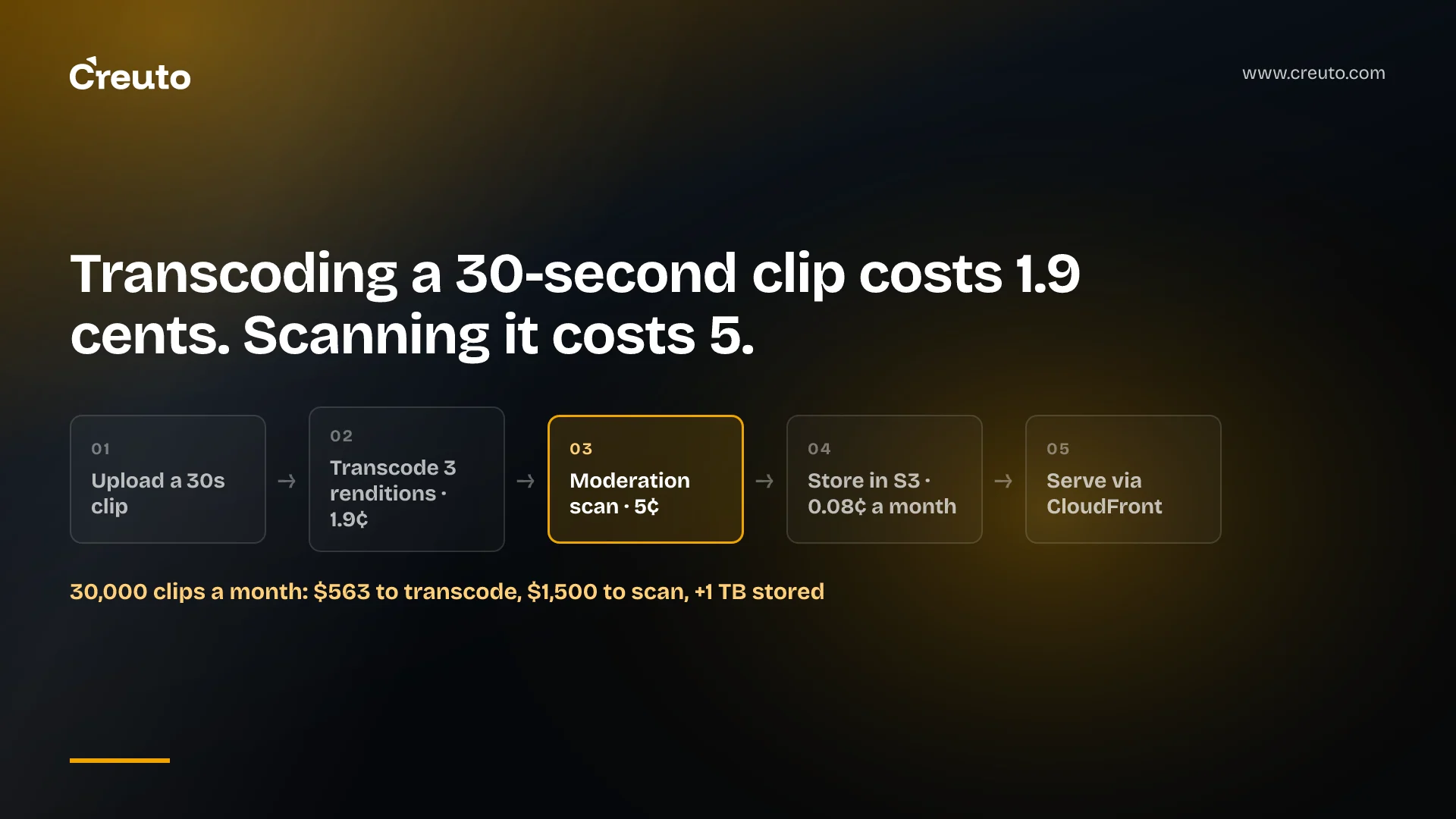
Our assumptions: 10,000 daily active users, one in ten posting one 30-second clip a day (30,000 clips a month). Each clip is transcoded into one SD and two HD renditions at 30 fps on the Basic tier, the same ladder AWS uses in its own pricing example. We assume rendition bitrates of 1, 3 and 5 Mbps, which makes about 34 MB stored per clip, and we delete the original after transcoding. Every clip is kept indefinitely.
| Line | Per 30-second clip | Per month at 10,000 daily users |
|---|---|---|
| Transcoding, Basic tier (2.5 normalized minutes per clip) | $0.019 | $563 |
| Transcoding, Professional tier | $0.030 | $840 |
| Automated moderation scan at $0.10 a minute | $0.05 | $1,500 |
| S3 Standard storage | $0.0008 a month, forever | $23 in month 1, $279 by month 12, $559 by month 24 |
The moderation line uses the $0.10 per minute content moderation rate in Amazon Rekognition's US East pricing example, applied to every second of every clip. These are our calculations from list prices, so rerun them with your own posting rate and ladder.
Two things stand out. First, scanning costs more than transcoding: at these rates, moderation is the largest per-upload line, and a community app cannot skip it. Second, every number in the table scales with uploads. At 100,000 daily users posting at the same rate, transcoding rises to $4,195 a month (the volume tier softens it), scanning to $15,000, and storage grows by about 10 TB every month.
RaftLabs is the only ranking page that prices moderation, at "$0.10 to $0.40 per minute of video analyzed", and then estimates 10K uploads of 30 seconds at "$50 to $200 per month". Its own rates give $500 to $2,000 for that volume. The arithmetic is out by a factor of ten, and it is the line most likely to surprise a founder's budget.
Serving it: CloudFront pay-as-you-go against the flat-rate plans
Delivery is the per-viewer side of the bill, and it depends on watching, not posting. On CloudFront's pay-as-you-go price list, the first 1 TB a month is free, then US delivery costs $0.085 per GB for the next 9 TB and $0.080 for the next 40 TB. India costs $0.109 and $0.085 for the same tiers.
RaftLabs estimates "roughly $2.7K per month in CDN costs alone" for 30TB of transfer. On today's US tiers we get $2,364 for 30,000 GB after the free terabyte. Its figure matches India rates ($2,684) or a flat $0.09 per GB more closely than the US list.
The bigger gap is the pricing model. CloudFront's flat-rate plans cost $15 (Pro), $200 (Business) and $1,000 (Premium) a month per distribution, each with a 50 TB data transfer allowance and "no overage charges". The same 50 TB on pay-as-you-go costs about $4,060 in the US. That is an order-of-magnitude difference, with conditions the CloudFront Developer Guide spells out:
- Allowances are not hard limits, and delivery can change. You are never billed overage. Your first spike up to 3x the allowance is accommodated once, but if you "continue to substantially exceed" it, traffic "might be served from fewer or more distant edge locations". Sustained excess is evaluated over two to three months.
- Requests run out before bandwidth. Pro allows 10 million requests a month, Business 125 million. Short video over HLS is many small files per view, so a video app hits the request cap long before 50 TB.
- Each plan covers one distribution and one apex domain, requires an AWS WAF web ACL, and excludes some features, including real-time access logs.
Neither the pricing page nor the guide says anything specific about video. If each of our 10,000 users watches 20 clips a day at about 11 MB a view, that is roughly 67.5 TB and, assuming seven files per clip, 42 million requests a month. Pay-as-you-go comes to about $5,038 in the US. Pro's request cap is exceeded, and Business would run at 135% of its data allowance, inside the one-off spike rule but not a safe baseline. The plan that fits is Premium at 75 TB, which the guide prices at $1,450 a month. Viewer-hour delivery economics belong to a catalogue app more than to this one, so treat this as the order of magnitude, not a plan choice.
Social media app running costs beyond the media pipeline
RaftLabs budgets $10K to $50K a month for video-first platforms at operating scale, and $5K to $20K for photo-first platforms at early scale. Our model puts a 10,000-user video app at roughly $3,800 to $7,400 a month for media by month 12 (transcoding, scanning, storage and delivery, on flat-rate or pay-as-you-go), below that floor; the range arrives as users grow. Cubix and Chop Dawg give no running-cost figures at all. Cubix does put maintenance at 15% to 20% of the build cost a year, a rule we test in why the 15-20% maintenance rule breaks.
What to decide before you take a quote for an Instagram-style MVP
The band you land in is decided before anyone writes code. Write down four numbers first: how many of your users will post each day, how long a typical clip is, how many renditions you will encode, and how long you will keep every upload. The first three set your transcoding and scanning bill; the last sets a storage line that never stops growing. Then decide which of Stories, messaging and ranked discovery can wait for release two.
If you are weighing a clone script against a custom photo-and-video MVP for a niche community, our MVP development team can scope both against those four numbers, including the per-upload media model above rerun with your own posting rate, ladder and retention policy.
Frequently asked questions
The cost to build an app like Instagram ranges from about $15,000 for a basic build to $40,000-$130,000 for a typical MVP and past $250,000 for a full platform, based on vendor estimates published in 2026. Platform count, hourly rates and features like Stories and ranked feeds explain most of the spread.
An Instagram-style MVP takes 14 to 22 weeks according to RaftLabs and four to seven months according to Chop Dawg, while full platforms run 22 weeks to a year or more. Deferring Stories, direct messaging and ranked discovery to a second release is the biggest lever on the first release's timeline.
On AWS list prices, a 30-second clip encoded into one SD and two HD renditions costs about 1.9 cents to transcode on MediaConvert Basic and 0.08 cents a month to store in S3 Standard. At 30,000 clips a month, transcoding costs about $563 and storage adds roughly a terabyte every month.
An Instagram clone script is worth buying only to test whether a community will post at all. Hitasoft's license is listed from ₹44,616, but its listing contradicts itself on mobile apps. A clone script is the wrong choice when your feed ranking, video pipeline or engagement data is the product you need to own.
CloudFront flat-rate plans include 50 TB of transfer for $15 to $1,000 a month with no overage charges, but allowances are not hard limits: sustained excess can mean slower delivery. Pro allows only 10 million requests, which short video over HLS can exhaust before the data allowance.