Cost to build an app like DoorDash: 4 bands
The cost to build an app like DoorDash runs $15K to $220K+. Price bands, timelines, and why renting Dashers at $6.99-$10.99 a drop decides the build.
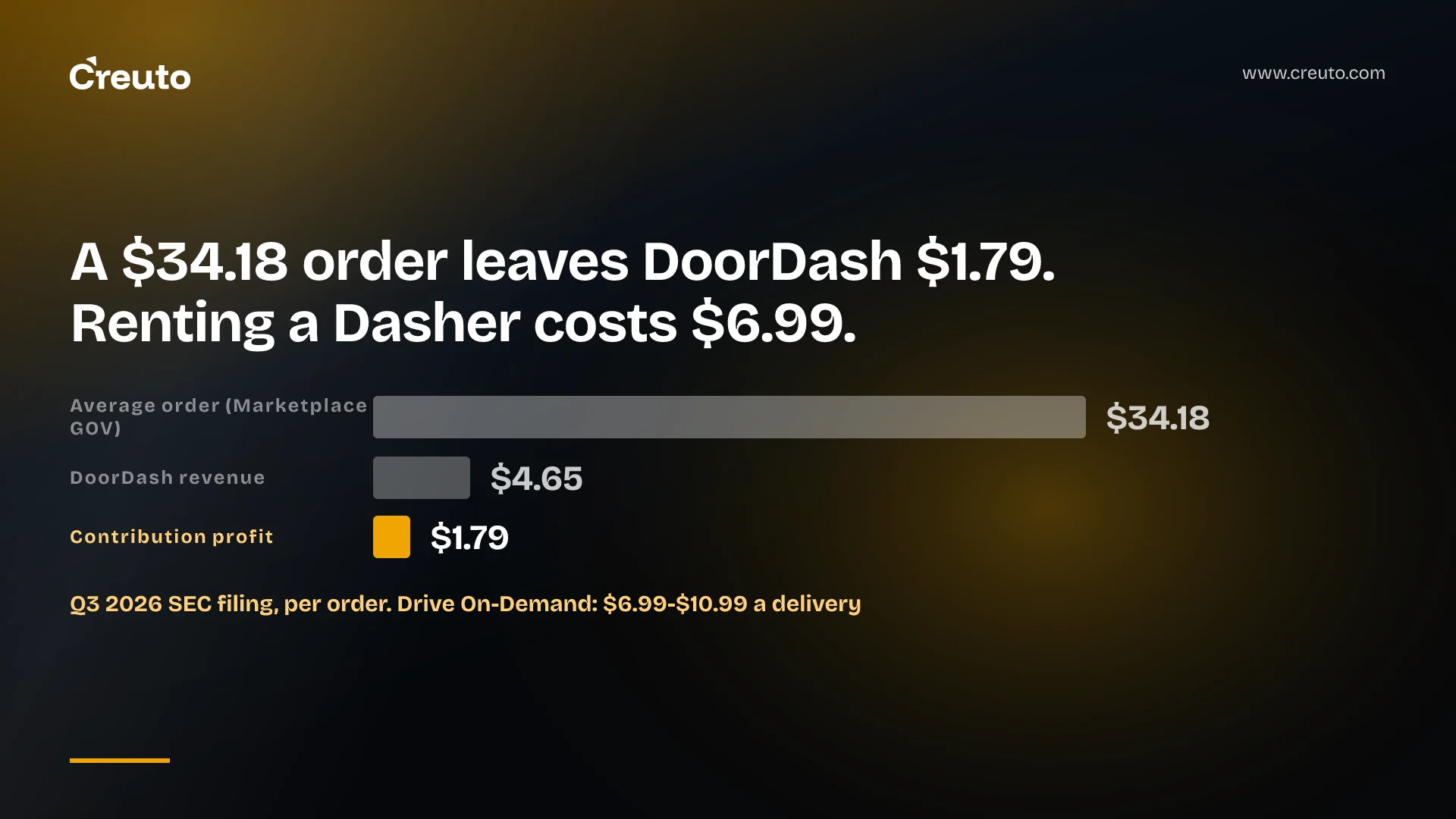
The cost to build an app like DoorDash runs from a $15,000 white-label clone to past $220,000 for a multi-city platform, depending on which vendor you ask. DoorDash's own filing shows the build is the cheap part: of an average $34.18 order, it books $4.65 as revenue and $1.79 as contribution profit.
By the end you will know which price band your plan sits in, where the build budget goes, how long it takes, and the decision that matters more than any of it: whether to build the courier side at all, or rent DoorDash's Dashers at $6.99 to $10.99 a delivery. Figures are as of November 2026.
The cost to build an app like DoorDash depends on whether you build the couriers
An "app like DoorDash" is four different products, and the published prices only make sense once you sort them. Here is what the agencies ranking for this query publish:
| Band | What you get | Published price | Published timeline |
|---|---|---|---|
| White-label clone script | A vendor's existing customer, restaurant, courier and admin apps under your brand | $15,000 to $40,000 (GMTA) | Not stated |
| Own ordering channel, no courier app | Web and app ordering for one brand, with delivery handed to a third party | $35K to $60K (RaftLabs) | 10 to 14 weeks |
| Marketplace MVP | Customer app, restaurant dashboard, courier app, dispatch and admin for one market | $70K to $120K (RaftLabs) or $30,000 to $80,000 (GMTA) | 16 to 22 weeks (RaftLabs); 2 to 4 months (GMTA) |
| Multi-city platform | Several markets, analytics, more payment and dispatch logic | $120K to $220K (RaftLabs); $80,000 to $200,000 mid-market and $250,000 to $850,000+ enterprise (GMTA) | 24 to 38 weeks (RaftLabs) |
The second row is the one most guides skip, and it is the one a restaurant group should look at first. It exists because DoorDash will rent you its couriers, which changes what you have to build.
Why the DoorDash clone app cost estimates disagree
The vendors do not agree with each other, and in places they do not agree with themselves. GMTA's main table puts a basic MVP at $30,000 to $80,000, yet its FAQ says you "may be able to build a base MVP and core app for as low as $300,000 – $120,000", a range whose floor sits above its ceiling. Under its average-cost heading, the same page says a full multi-sided app "typically ranges from $250,000 to over $850,000", which is the range of its own enterprise tier.
RaftLabs, updated on 12 November 2026, prices a marketplace MVP at $70K to $120K, more than double GMTA's floor for the same scope. VLink says an app like DoorDash "costs an average of $65,000", but that page dates from September 2023. Apptunix gives a minimum of $15,000 to $30,000 and puts its tier pricing in an image rather than text. Each number is a quote from someone selling the thing being priced. Read them as scopes, and ask any vendor which band their quote sits in. Our four decisions that move the cost to build an app apply here unchanged.
Where the build money goes: half of it is the courier side
The courier app and dispatch engine take the largest share of a DoorDash-style budget. RaftLabs splits a marketplace MVP like this: customer app 20-25%, restaurant dashboard and kitchen display 15-20%, driver app 20-25%, and admin panel plus dispatch engine 30-40%. GMTA is the only ranking page that prices each panel in dollars:
| Component | RaftLabs share of budget | GMTA dollar range |
|---|---|---|
| Customer app | 20-25% | $25,000 to $50,000 |
| Restaurant partner app or dashboard | 15-20% | $20,000 to $40,000 |
| Courier (Dasher) app | 20-25% | $20,000 to $35,000 |
| Admin panel and dispatch | 30-40% | $15,000 to $30,000 (admin panel only) |
Add RaftLabs' driver app share to its admin-and-dispatch share and the courier side accounts for 50-65% of the build. Not all of the admin line goes away if you rent couriers, since you still need refunds, menus and order support. The dispatch engine and the courier app do. That is why the build-or-rent decision moves the budget more than any feature list.
The four-app shape is familiar to us. We built FlashNow, a quick commerce and hyperlocal delivery platform with four platform roles across three platforms, and a dining super app covering ordering, reservations and restaurant operations for five user roles. In both, the customer-facing apps are the visible part; the operational logic behind them is where scope grows.
How long it takes to build a food delivery app like DoorDash
A DoorDash-style marketplace MVP takes 16 to 22 weeks according to RaftLabs. Its phase plan gives two weeks to discovery, six to eight to the customer app and restaurant dashboard, eight to twelve to the dispatch engine and driver app, two to three to integrations and hardening, and two to four to a pilot. The dispatch and driver work is the longest phase, which is one more reason the courier decision comes first.
Other estimates run longer. GMTA says two to four months for an MVP and four to eight months for a full-featured app. Apptunix says three to four months for a basic app and six to nine months for a medium one. Our own delivery fact is that a focused MVP typically takes 6-10 weeks and larger enterprise platforms 3-6 months, depending on integrations and scope. A single-brand ordering channel without a courier app is the shortest route on every vendor's numbers: RaftLabs puts it at 10 to 14 weeks.
Is a DoorDash clone script worth it?
A DoorDash clone script is worth it when the only question you need answered is whether customers in your market will order through you at all. The case is real: GMTA prices white-label builds at $15,000 to $40,000, a fraction of any custom MVP, and you get all four apps on day one.
It is the wrong choice in three situations:
- You are a restaurant group, not a marketplace. A clone gives you a multi-restaurant marketplace with a courier fleet you then have to recruit. If you sell your own food, you need ordering, not a marketplace.
- Your edge is in dispatch. Batching, delivery zones or catering runs are the logic a clone vendor owns, so you would be renting your advantage.
- You need the order data. Customer and order data you cannot query freely is data you cannot build loyalty or pricing on.
What DoorDash makes per order, from its own SEC filing
DoorDash keeps $4.65 in revenue from an average $34.18 order, and $1.79 of that survives as contribution profit. None of the ranking guides uses DoorDash's own numbers, so we worked them out from its third-quarter 2026 results, filed with the SEC as Exhibit 99.1 on 29 October 2026:
| Q3 2026 figure | Reported total | Per order (divided by 993M orders) |
|---|---|---|
| Total Orders | 993 million | 1 |
| Marketplace GOV | $33,941 million | $34.18 |
| Revenue (13.6% Net Revenue Margin) | $4,616 million | $4.65 |
| Contribution Profit (5.2% of GOV) | $1,780 million | $1.79 |
Marketplace GOV is the total value of orders, "including taxes, tips, and any applicable consumer fees". Contribution Profit is gross profit less sales and marketing, with some items added back. Two cautions on our division. The totals include Deliveroo, which DoorDash acquired, and Total Orders also counts Commerce Platform orders that sit outside Marketplace GOV. So these are blended averages, not the economics of one US restaurant order.
How much DoorDash Drive costs per delivery
DoorDash Drive On-Demand costs "$6.99 to $10.99 per delivery order", as listed in October 2026. DoorDash describes it as a flat fee per order with no subscription and "no commission rates", and customer tips pass entirely to the Dasher. (The live page sits behind a bot check, so we read DoorDash's page through an archived copy.) RaftLabs quotes third-party dispatch at "roughly $7 to $15" per delivery, a ceiling about $4 above DoorDash's own listed top price.
Set the two figures side by side. Renting one Dasher costs at least $6.99, while DoorDash books $4.65 of revenue on its average order. Delivery is the expensive part of this business, and DoorDash makes it work with order density you will not have in month one.
Build your own delivery fleet vs DoorDash Drive: the worked model
Our assumptions: 300 deliveries a day, 30 days a month, every delivery sent through Drive On-Demand at its listed range. That is 9,000 deliveries and $62,910 to $98,910 a month in delivery fees, or $754,920 to $1,186,920 a year. One month at the low end costs about as much as the bottom of RaftLabs' $70K marketplace MVP band.
That number is the benchmark for building the courier side. If your own fleet cannot deliver for less than $6.99 a drop all-in (courier pay, insurance, support, idle time and the dispatch software), the $20,000 to $35,000 courier app and the dispatch engine are money spent to lose money. None of the agency guides prices a fleet, and we are not going to guess one; you will know your labor costs better than any vendor.
Commissions are the other side of the ledger. DoorDash's marketplace charges restaurants a delivery commission of 15% on Basic, 25% on Plus and 30% on Premier, 6% on pickup orders, and nothing on orders through its own Online Ordering product. Those Partnership Plans apply to US restaurants with 75 or fewer locations. On Plus, Drive's $6.99 floor equals the commission on a $27.96 subtotal; on Basic, it equals 15% of $46.60. So a restaurant on Basic pays less in marketplace commission than Drive's cheapest delivery on any order under $46.60, before it has spent anything on an app. An owned channel pays off on larger baskets, on higher-commission plans, or when it moves pickup and repeat customers off the marketplace.
Running costs: payments, payouts and upkeep
A three-sided app also has to move money to restaurants and couriers. Stripe Connect, on the US price list, charges $2 per monthly active account, 0.25% + 25¢ per payout sent, and 1% of payout volume for Instant Payouts. That sits on top of card processing at 2.9% + 30¢ per successful transaction for domestic cards, which is about $1.29 on a $34.18 order. (Stripe's live pages serve Indian rupee pricing to our location, so both links are archived US copies from 1 November 2026.) Payout design gets complicated fast, and we cover it in why payouts decide multi vendor marketplace development cost.
RaftLabs puts monthly running costs for a marketplace MVP at $8K to $25K. For upkeep, GMTA tells you to reserve 15-25% of the initial build cost a year, and Apptunix says 15-20%. If your app shows live courier positions and ETAs, maps are a separate bill, which we priced per trip in our cost to build an app like Uber breakdown.
Decide the courier question before you take a quote
The band you land in is set before anyone writes code. Write down four numbers first: your expected daily deliveries in month six, your average basket, the DoorDash plan you are on today, and your all-in cost per delivery if you ran couriers yourself. If that last number is above $6.99, start with an owned ordering channel and rent Dashers; if it is well below, the courier app and dispatch engine earn their place in the budget.
If you are weighing an owned ordering app against a full four-app build with your own couriers, our mobile app development team can scope both against those four numbers, including the Drive-versus-fleet model above rerun with your own volumes.
Frequently asked questions
The cost to build an app like DoorDash ranges from a $15,000 to $40,000 white-label clone to $70K-$120K for a custom marketplace MVP and $120K-$220K or more for a multi-city platform, on published 2026 agency estimates. A single-brand ordering app that rents couriers instead costs $35K to $60K, according to RaftLabs.
DoorDash Drive On-Demand listed its price at $6.99 to $10.99 per delivery order in October 2026, as a flat fee with no subscription and no commission. Customer tips go entirely to the Dasher. At 300 deliveries a day, that range comes to $62,910 to $98,910 a month in delivery fees.
DoorDash made about $4.65 in revenue and $1.79 in contribution profit per order in Q3 2026, on an average Marketplace GOV of $34.18. These figures divide its reported $4,616 million revenue, $1,780 million contribution profit and $33,941 million GOV by 993 million total orders, including Deliveroo.
A food delivery marketplace MVP like DoorDash takes 16 to 22 weeks according to RaftLabs, with dispatch and the driver app the longest phase at eight to twelve weeks. A single-brand ordering app without its own courier app takes 10 to 14 weeks, and a multi-city platform 24 to 38 weeks.
A restaurant should build its own courier app only if its all-in cost per delivery beats DoorDash Drive's $6.99 floor. Otherwise an owned ordering app plus Drive is cheaper to build. On DoorDash's 15% Basic plan, the marketplace commission is below $6.99 on any order under $46.60.
