Cost to build an app like Airbnb: 3 price bands
The cost to build an app like Airbnb runs from a $500 clone to $240K+. Three price bands, timelines, and what Stripe really takes per booking, US vs India.
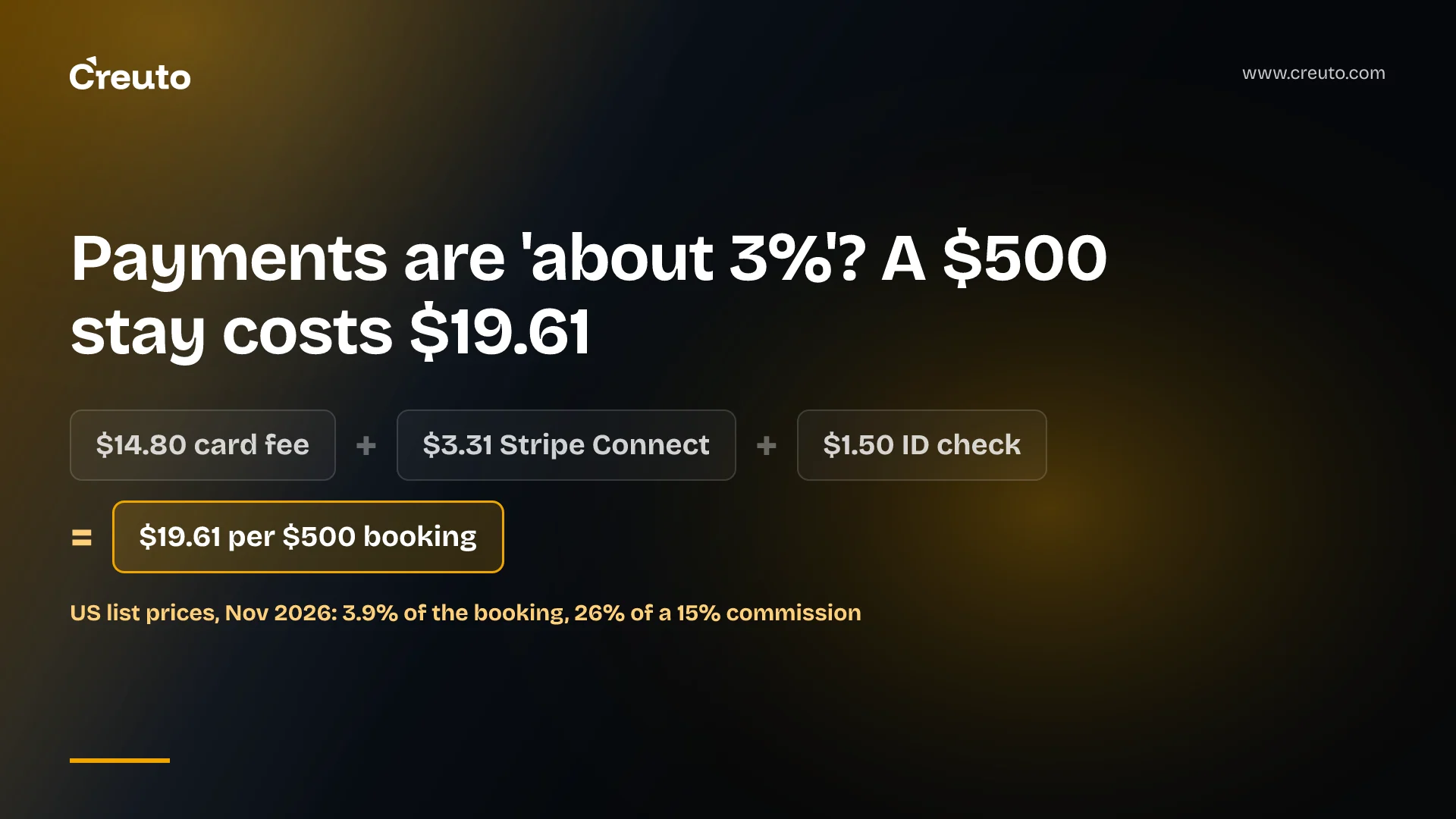
The cost to build an app like Airbnb runs from a $500 clone script to $240K and up for a multi-region platform, and the guides that quote those numbers contradict themselves on the same page. This post sorts their figures into three price bands. It then prices the line they wave away as "about 3%": what Stripe actually takes on each booking.
By the end you will know which band your plan sits in, what each part of the build costs, how long it takes, when a clone script or Sharetribe is enough, and what card processing, host payouts and an identity check cost on a $500 booking in the US and on Indian bookings. All figures are as of November 2026.
The cost to build an app like Airbnb depends on which product you mean
An "app like Airbnb" can mean a template with your logo, a web-only marketplace for one niche, or a multi-region platform with native apps and channel sync. Here is what the vendors ranking for this query publish, sorted by what they are actually pricing:
| Band | What you get | Published price | Published timeline |
|---|---|---|---|
| Clone script or Sharetribe | A prebuilt rental marketplace under your brand | $500 to $20K upfront for a clone, or $149 to $999 a month for Sharetribe (RaftLabs) | Days to 8 weeks |
| MVP | Listings, search, booking calendar, payments, messaging, reviews | $55K to $95K web-only (RaftLabs); $35,000 to $55,000 on one mobile platform (CMARIX) | 14 to 20 weeks (RaftLabs); 3 to 4 months (CMARIX) |
| Full or multi-region platform | Native apps, instant book, dynamic pricing, channel sync, fraud tooling | $100K to $160K full, $150K to $240K+ at scale (RaftLabs); $130,000 to $220,000+ enterprise (CMARIX) | 22 to 44 weeks (RaftLabs); 9 to 12 months (CMARIX) |
Every figure in that table comes from a company selling the thing it prices. Read each one as a quote with a motive, not a benchmark, and check which band a quote belongs to before comparing it with another.
Three vendors, two prices each: where the guides contradict themselves
The widest disagreement is not between vendors. It is inside them. Cleveroad's guide (updated October 2025) opens by saying a basic MVP "can start at around $30,000–$50,000". Its final estimate then says $65,000 to $95,000+ for a single-platform mobile app and $90,000 to $120,000+ for a web app. Its own hour table, priced at $50 an hour, totals $92,350 for web, $65,650 for iOS and $64,500 for Android. Build all three and Cleveroad's arithmetic comes to $222,500, more than four times the top of its MVP range.
CMARIX (updated September 2026) gives an MVP at $35,000 to $55,000 in its tier table and "$35,000 to $100,000" for a budget MVP in its FAQ on the same page. RaftLabs (updated November 2026) prices clone scripts at "$500 to $5K upfront" in one paragraph and "$500-$20K" in its comparison table.
None of this is dishonest, exactly. Each number answers a different scope: one platform or three, web or native, with or without KYC and calendar sync. The useful question for any quote is "which platforms and which features does this number include". The three price bands in the cost to build an app like Uber split the same way, for the same reason.
Where the build money goes: the booking and payment engine
The booking and payment engine is the largest line in an Airbnb-like app development cost breakdown. RaftLabs puts it at 30-40% of a web-only MVP, against 20-25% each for the guest product and the host dashboard and 10-15% for the admin panel. It prices the components from its own builds:
| Component | RaftLabs range |
|---|---|
| Booking and payments | $20K to $45K |
| Listing management | $15K to $35K |
| Search and discovery | $10K to $25K |
| Messaging | $8K to $18K |
| Admin | $8K to $20K |
| Reviews | $4K to $10K |
Source: RaftLabs, November 2026. The same page warns that founders who budget $5K to $8K for "Stripe integration" find that connected-account onboarding, payout scheduling, cancellations, deposit holds and disputes are each separate engineering work.
The availability calendar is the hardest real-time data
Two guests can start checkout for the same dates in the same second. RaftLabs prices the database-level booking lock that prevents a double booking at $10K-$20K and 4 to 6 weeks. If you also list on Airbnb or Booking.com, channel sync waits on connectivity partner approvals of 4 to 12 weeks per OTA, which are not self-service.
We have built this shape twice. MakeMyLook, a salon and wellness booking marketplace, onboarded 200+ vendors, cut drop-offs by 40% and reached market in 16 weeks. Skyeone, an event and venue booking platform, unifies 8-12 vendors per event. Neither is a home rental marketplace, but both share its two-sided booking core.
How long it takes to build an app like Airbnb
A web-only rental marketplace MVP takes 14 to 20 weeks with three to five developers, according to RaftLabs. Its phase plan gives two weeks to discovery, six to eight to the guest product and host dashboard, eight to ten to the booking and payment engine, two to three to hardening and two to four to a pilot with 10-20 real hosts. CMARIX says 3-4 months for an MVP, 5-7 for a mid-range app and 9-12 for enterprise.
A focused MVP typically takes us 6-10 weeks, and larger platforms 3-6 months. A two-sided booking marketplace with its own payment engine can run past that window: MakeMyLook reached market in 16 weeks. The number of platforms in release one moves the date more than any feature. RaftLabs' advice to launch web-first and add native apps later is the cheapest scope decision on the list.
Is an Airbnb clone script worth it?
An Airbnb clone script or Sharetribe is worth it when the question is "will hosts and guests transact with us at all". The case for it is strong. RaftLabs, which sells custom builds, still calls Sharetribe "the most legitimate starting point for marketplace validation", at $149 to $499 a month for Go and $299 to $999 a month for Flex plus developer costs. CMARIX sets a "$5,000 Airbnb clone" script against a $65,000 custom build.
Weigh the case against the clone with the seller in mind. RaftLabs says a clone with repairs "typically costs $80K-$120K to fix", and its 24-month comparison prices the custom build at $55K-$95K, the same as the build alone, with no maintenance. CMARIX puts annual maintenance at 15-25% of the build. Both sell the alternative to clones.
A clone or Sharetribe is the wrong choice in three situations:
- Your booking rules are the product. Hourly plus nightly pricing, conditional deposit releases or pre-qualified guests hit the limits RaftLabs describes at 50 to 200 listings.
- Your take rate is not one number. RaftLabs notes Sharetribe payment splits are limited to a single commission percentage.
- You need to own guest data. On Sharetribe Go, according to RaftLabs, you do not.
What a booking really costs in payments: not "about 3%"
RaftLabs lists a direct booking site's cost as "About 3% (Stripe processing only)". Cleveroad and CMARIX name Stripe Connect and Stripe Identity without rates. A marketplace pays three things on each booking, and only the first is the card fee. These are Stripe's US list prices, read from Wayback captures because Stripe's live page serves Indian pricing to us:
- Cards: 2.9% + 30¢ per domestic card payment, plus 1.5% for international cards and 1% if currency conversion is needed.
- Connect: when your platform sets the pricing, which Stripe recommends for marketplaces, it adds $2 per monthly active account and 0.25% + 25¢ per payout. An account is active in any month it receives a payout.
- Identity: document and selfie verification costs $1.50, charged only when a user completes it.
Stripe Connect cost per booking: a worked $500 stay
Our assumptions: a $500 booking on a domestic US card, a 15% host commission so the host receives $425 in one payout, a host with one booking that month, and one identity check for a first-time guest. RaftLabs' own example uses $500 bookings.
| Line | $150 booking | $500 booking |
|---|---|---|
| Card processing (2.9% + 30¢) | $4.65 | $14.80 |
| Connect payout (0.25% + 25¢ on 85%) | $0.57 | $1.31 |
| Connect active account | $2.00 | $2.00 |
| Identity check | $1.50 | $1.50 |
| Total | $8.72 (5.8%) | $19.61 (3.9%) |
"About 3%" of $500 is $15.00. The worked figure is $19.61, and against a $75 commission it is 26% of your revenue on the booking. Make the guest's card international with currency conversion and processing alone rises to 5.4% + 30¢, taking the total to $32.11, or 43% of the commission. On a $150 stay the fixed charges dominate and payments take 39% of the commission. These are our calculations from list prices; a host with four bookings a month spreads the $2 fee to 50¢ each, and a returning guest you have already verified adds no new check.
The strongest counter-argument is Stripe's other Connect model, in which Stripe bills your hosts for processing directly and your platform pays no account or payout fees. That suits platforms happy with Stripe's pricing. It does not suit a marketplace that wants to set its own guest and host fees, which is why Stripe recommends the paid model for marketplaces. For the payout mechanics themselves, see why payouts decide multi-vendor marketplace development cost.
Airbnb-like app development cost in India: the fixed fee bites harder
Stripe's India Connect page charges ₹150 per monthly active account and 0.25% + ₹20 per payout. India card pricing is 2% for Indian-issued Mastercard and Visa, 3% for cards issued abroad plus 2% for currency conversion, and 4.3% for international cards with USD presentment. On the same assumptions, a ₹20,000 booking costs ₹612.50 (3.1%) before any identity check. A ₹5,000 booking costs about ₹281 (5.6%), because ₹170 of fixed fees does not shrink with the booking. The India page does not list Stripe Identity, so price host verification with your provider separately.
Identity verification cost for rental marketplace hosts
Host verification is cheap per check and expensive to build badly. Stripe Identity's $1.50 covers a document and selfie match, and its $0.50 ID number lookup works only for US Social Security numbers. Verifying 200 hosts once costs $300. The build is the larger line: Cleveroad prices a KYC or ID verification integration at $2,000-$10,000+, and CMARIX places KYC in its $65,000-$120,000 mid-market tier rather than the MVP.
Decide two things early: whether guests are verified on every first booking or only above a booking value, and what happens to a host's listings while a check is pending. Those rules set your identity bill and your host drop-off far more than the per-check price.
Running costs of a rental marketplace app, beyond payments
RaftLabs puts monthly running costs (hosting, maps, messaging, ID verification) at $1K-$4K at launch and $5K-$15K at scale. Cleveroad puts cloud hosting alone at $1,000-$5,000+ a month at MVP stage. Neither prices payments per booking, which on the model above is the line that grows with every stay. Then there is upkeep after launch, which we cover in why the 15-20% maintenance rule breaks.
What to settle before you take a quote for a rental marketplace
The band you land in is decided before anyone writes code. Before you compare quotes, write down five things: web-only or native apps in release one, your booking rules beyond nights and price, whether you sync calendars with OTAs, your commission and who pays card fees, and your average booking value. The first three set the build cost. The last two decide whether Stripe takes a sixth or a third of your take rate.
If you are choosing between Sharetribe, a clone and a custom guest and host build, our mobile app development team can scope all three against those five answers, with the per-booking payment model above rerun on your own booking values and markets.
Frequently asked questions
The cost to build an app like Airbnb ranges from $500 to $20K for a clone script, $35K to $95K for an MVP and $100K to $240K or more for a full or multi-region platform, based on vendor estimates published in 2025 and 2026. Platforms and features in release one decide the band.
A web-only Airbnb-like marketplace MVP takes 14 to 20 weeks with three to five developers according to RaftLabs, and 3 to 4 months according to CMARIX. A full platform with native apps takes 22 to 34 weeks, and multi-region scale with channel sync takes 32 to 44 weeks or longer.
Stripe Connect costs a US marketplace that sets its own pricing $2 per monthly active account plus 0.25% and 25 cents per payout, on top of card processing at 2.9% plus 30 cents. In India the Connect fees are 150 rupees per active account plus 0.25% and 20 rupees per payout.
An Airbnb clone script or Sharetribe is worth it for testing whether hosts and guests will transact with you at all. It is the wrong choice when your booking rules are the product, when your commission is more than one percentage, or when you need to own guest data, which Sharetribe Go does not give you.
Host and guest verification with Stripe Identity costs $1.50 per completed document and selfie check on US pricing, and $0.50 for an ID number lookup that works only with US Social Security numbers. Building the verification flow costs more: Cleveroad prices a KYC integration at $2,000 to $10,000 or more.
