Coastal Aquaculture Authority registration: what farms record
Coastal Aquaculture Authority registration lasts five years, but Condition 6 of Form-IV is the real obligation: per-crop input and harvest records, reported.
Coastal Aquaculture Authority registration is a five-year certificate, and the obligation that actually reaches your software is printed underneath it. Condition 6 on Form-IV requires a record of inputs used in the farm — seed, feed, chemicals, probiotics, medicines — plus harvest details including production and the name and address of the buyer, maintained for every crop and reported to the Authority.
Nothing in the Coastal Aquaculture Authority Rules, 2024 (G.S.R. 33(E), which supersede the 2005 Rules) tells a farm what that record looks like. No prescribed register, no column list, no file format, no submission endpoint. The only place the Rules use the phrase "List of records maintained in the unit" is Schedule-III, item 15 — and Schedule-III applies to the company seeking a certificate of compliance for an aquaculture input, not to the farm that buys it.
That gap is the engineering problem. The certificate is a one-off administrative exercise. Condition 6 is a recurring data obligation that nobody standing at the pond is paid to meet, and it is the thing an export buyer eventually asks you to prove.
Who coastal aquaculture authority registration is for, and which committee decides
Registration under section 13 of the Act covers coastal aquaculture units and activities, not just shrimp ponds. The 2023 amendment pulled cage culture, seaweed farming, bivalve culture and ornamental rearing into the same regulatory ambit, and the 2024 Rules route each application by type and size rather than sending everything to one committee.
Applications for farms, nurseries, seaweed, pen, raft and cage culture, Recirculatory Aquaculture Systems and Bio-floc go on Form-I. Hatcheries, Nauplii Rearing Hatcheries, Live Feed Units, Broodstock Multiplication Centres and Nucleus Breeding Centres go on Form-II, directly to the Authority. Rule 10 then splits the Form-I cases by water spread area:
| Water spread area | Who scrutinises it | Inspection before recommendation |
|---|---|---|
| Up to 2.0 ha (and traditional farms, seaweed, cage, raft, pen, RAS, Bio-floc, nurseries of any size) | Sub-Divisional Level Committee, recommends direct to the Authority | Not required by rule 10(1)(a) |
| Above 2.0 ha up to 5.0 ha | Sub-Divisional Level Committee, recommends direct to the Authority | Inquiry including inspection as it thinks fit |
| Above 5.0 ha | Sub-Divisional Level Committee recommends to the District Level Committee, which recommends to the Authority | Inquiry plus further inquiries against the Guidelines |
How to register a shrimp farm with the CAA
File Form-I with the Member Convener of the Sub-Divisional Level Committee — or the District Level Committee where the district has no sub-division — with the Schedule-I fee and the Schedule-II documents. Online filing runs through the National Single Window System, which the Authority links from its own farm registration page.
The fee is small and the documentation is not. A farm up to 5.0 hectares pays ₹200 per hectare subject to a minimum of ₹500. Schedule-II wants the registered sale or lease deed with a self-attested English translation, the Field Measurement Book sketch, the farm layout, a No Objection Certificate from the local administration, and — above 10 hectares — an Environment Impact Assessment report, with an Environment Management Plan above 40 hectares.
Two deadlines matter. A defect in the application must be notified to you within seven days, and you get fifteen days to rectify it; miss that and rule 9(6) deems the application rejected. Grant or refusal then falls within sixty days from the date the Authority receives the application.
The CAA's own FAQ disagrees with the CAA's own Rules
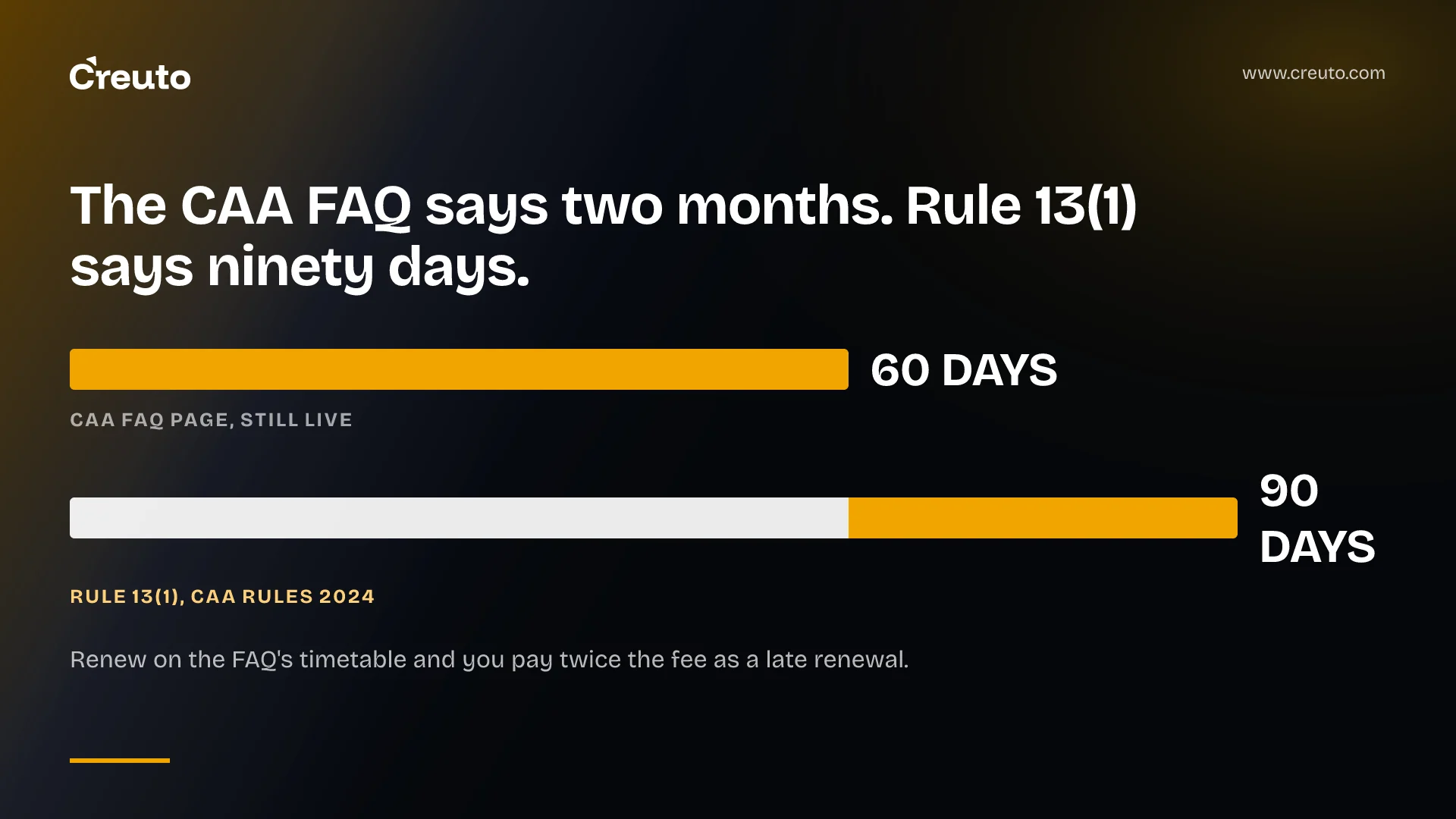
Rule 13(1) requires an application for renewal "before ninety days from the date of expiry of its period of validity". The Authority's public FAQ page still answers the same question with the superseded 2005 position: renewal "has to be made before two months of the expiry of extant registration". As of October 2026 both pages are live on caa.gov.in.
Thirty days is the difference between a renewal and a late renewal, and a late renewal is not free. Rule 13(3) requires the application to carry a request to condone the delay, the reasons for it, and an additional fee of two times the applicable renewal fee for the period from expiry.
The same FAQ page is the only place that gives farm reporting a cadence: quantity produced, quantity sold and processor details "reported to the CAA on quarterly basis as per format prescribe (Form V)". Under the 2024 Rules, Form-V is the registration certificate for hatcheries and broodstock facilities — not a return. Condition 6 of Form-IV says per crop, and says nothing about quarterly.
Build to the Rules, and make the cadence configurable. A system that captures per-crop records can always emit a quarterly roll-up; one that only stores quarterly totals cannot reconstruct the crop.
An aquaculture input is now a certificate number, not a product name
This is the change most farm software has not absorbed. Rule 18(3) states that no aquaculture input shall be made available or used in coastal aquaculture without certification from the Authority, except where specifically exempted. Certification is per product, costs ₹10,000 per application, is granted in Form-VI within ninety days, and is valid for five years.
So a record that says "probiotic, 5 kg, Tuesday" does not discharge Condition 6 in any way a buyer can use. The useful record stores the certificate of compliance, its validity window and the supplier, against the crop and pond where the product was applied. Rule 18(1)(c) also names twenty prohibited substances outright — chloramphenicol, the nitrofurans, neomycin, nalidixic acid, sulphamethoxazole, metronidazole, the fluoroquinolones and glycopeptides among them — so a product list that is merely free text cannot be validated against anything.
The commercial reason to care is traceback. In January 2026 MPEDA traced antibiotic residues in export consignments back to more than 40 individual farms across four states, with Andhra Pradesh accounting for 74% of them, and the Drugs Controller General wrote to states on 3 June 2026 asking what enforcement they had. Traceback of that kind only terminates at a farm when farm-level records exist. If yours do not, the trace stops at your processor, and your processor remembers that.
Specific Pathogen Free certification is mandatory — but probably not for your farm
Rule 19(1) makes Specific Pathogen Free certification mandatory for Broodstock Multiplication Centres, Nucleus Breeding Centres, and Live Feed Units for Artemia and polychaete worms, together with the stocks they hold. It is not, by that sub-rule, mandatory for an ordinary grow-out farm. The Authority may recommend SPF certification for other units, and the Central Government may specify more by order, but a farm reading a vendor pitch that implies SPF certification is already required of it is being sold something.
What does reach the farm is the seed. Rule 19 puts health monitoring, disease surveillance and chain-of-custody sampling under a dedicated guideline, and Form-II registration for a hatchery requires a certificate of freedom from disease for the facility covering a continuous period of at least two years. The farm's own obligation is to record which registered hatchery the seed came from and whether that registration was valid on the day of purchase — which is a date-range join, not a text field.
What non-registration costs, per hectare
The 2023 amendment decriminalised the Act, replacing imprisonment with graded monetary penalties on a polluter-pays basis. Section 14, as substituted with effect from 12 September 2023, sets them per hectare of water spread area and escalates them by offence count.
| Offence (farm) | First | Second | Third and subsequent |
|---|---|---|---|
| Non-registration | ₹10,000 per ha | ₹15,000 per ha | ₹25,000 per ha |
| Non-compliance other than non-registration | ₹5,000 per ha | ₹10,000 per ha | ₹15,000 per ha |
Read the second row again, because it is the one that applies to recordkeeping. Failing to maintain and report the Condition 6 record is non-compliance with a condition of the certificate, and it is priced per hectare per occurrence, not as a fixed fine. The authorised officer may also suspend activity, cancel registration, demolish structures or destroy the standing crop.
Against that, the registration itself is cheap, which is why the Authority ran a national campaign for it. When the CAA flagged the campaign off from Nagapattinam on 14 February 2024, it expected the amendment — registration on owned land, plus condonation of delayed renewals at twice the fee — to let more than 35,000 farms regularise. The stated purpose was not just legalisation but "to meet the requirements of traceability of farmed produce in the country".
Registration is a prerequisite your buyer enforces, not just your regulator
MPEDA's published conditions for processing plants, pre-processing centres and handling centres require that raw material of exotic shrimp species "shall be from a farm registered with Coastal Aquaculture Authority / State Department of Fisheries and the plant / centre shall maintain all documents to ensure 100% traceability" — stated identically in all three sets of conditions.
That sentence is why an unregistered farm is commercially unsellable into the export chain regardless of enforcement. It also sets the shape of the integration: your processor needs your registration number and its validity dates as data, at the point of each lot, not as a PDF someone emails once a year. The same discipline is what shrimp export traceability software has to produce for FSMA 204, and what the EU's proposed fisheries product passport would extend further up the chain. CAA registration is the domestic obligation that already exists today and that the others depend on.
What we would build, and what we would not
We built Aquapulse, an aquaculture platform live across Odisha, Andhra Pradesh and West Bengal with 6,000+ registered farmers and 8,000+ acres of ponds monitored, so the honest lesson first: the hard part is not the schema. It is that the person with the data is standing in a pond, often with intermittent connectivity, and every field you add to a capture screen is a field someone will leave blank or fake.
What follows from that, and from the Rules above:
- Model the crop, not the month. Condition 6 attaches to a crop cycle. Stock date, pond, species, stocking density, harvest date, quantity and buyer form one record; inputs attach to it. Quarterly reporting is then a view.
- Store the certificate, not the brand. Every input entry references a certificate of compliance and its validity dates, and every seed purchase references a hatchery registration and its validity dates. Both are joins that can be validated; neither is free text.
- Capture offline, reconcile later. A field agent who cannot record an input at the moment of application will record it from memory a week later, and that record is worth very little under a traceback.
- Do not build a compliance module. If the record only exists to satisfy the Authority, it will be filled in badly. The same per-crop data drives feed conversion, disease pattern and yield analysis, and that is what gets it entered accurately.
What we would not do is build this as a document store. Scanned forms satisfy an inspector standing in front of you and satisfy nothing else — not a traceback, not a buyer audit, not a renewal that needs the last five years of operational status.
If you farm above five hectares, your next decision is not which platform to buy. It is whether you can currently produce, for your last completed crop, the hatchery that supplied the seed with its registration validity, every input applied with its certificate of compliance, and the buyer of the harvest. If that takes more than an afternoon, the certificate on the wall is the smallest of your problems — and custom software built around the workflow you actually have is a more useful place to start than a renewal reminder.
Frequently asked questions
Coastal Aquaculture Authority registration is the mandatory certificate under section 13 of the Coastal Aquaculture Authority Act, 2005 that allows a coastal aquaculture unit to operate legally in India. The certificate is valid for five years and carries conditions, including a per-crop record of inputs and harvests.
Every coastal aquaculture unit needs CAA registration, not only shrimp farms. The 2024 Rules cover farms, nurseries, seaweed culture, pen, raft and cage culture, Recirculatory Aquaculture Systems and Bio-floc on Form-I, and hatcheries, live feed units, broodstock multiplication centres and nucleus breeding centres on Form-II.
Condition 6 of Form-IV requires a farm to maintain a record of inputs used, including seed, feed, chemicals, probiotics and medicines, together with harvest details such as production and the name and address of the buyer. These records must be kept for every crop and reported to the Authority.
CAA registration must be granted or refused within sixty days of the Authority receiving the application. Before that, a defect in the application is notified within seven days and the applicant has fifteen days to rectify it, after which rule 9(6) deems the application rejected.
CAA registration is required in practice for export. MPEDA conditions for processing plants, pre-processing centres and handling centres require raw material of exotic shrimp species to come from a farm registered with the Coastal Aquaculture Authority or the State Department of Fisheries, with full traceability documentation.
An application for renewal of CAA registration must be made before ninety days from the date of expiry, under rule 13(1) of the 2024 Rules. A late application must request condonation of delay, state the reasons, and pay an additional fee of two times the applicable renewal fee.
An unregistered farm faces a penalty of ten thousand rupees per hectare of water spread area for a first offence, rising to fifteen thousand and then twenty-five thousand rupees per hectare. An authorised officer may also suspend activity, cancel registration, demolish structures or destroy the standing crop.