Claude vs GPT vs Gemini: residency, limits, not benchmarks
Claude vs GPT vs Gemini compared on what each vendor documents: Gemini 4 Argon doubles on 1 December 2026, plus residency, retention and rate limits.
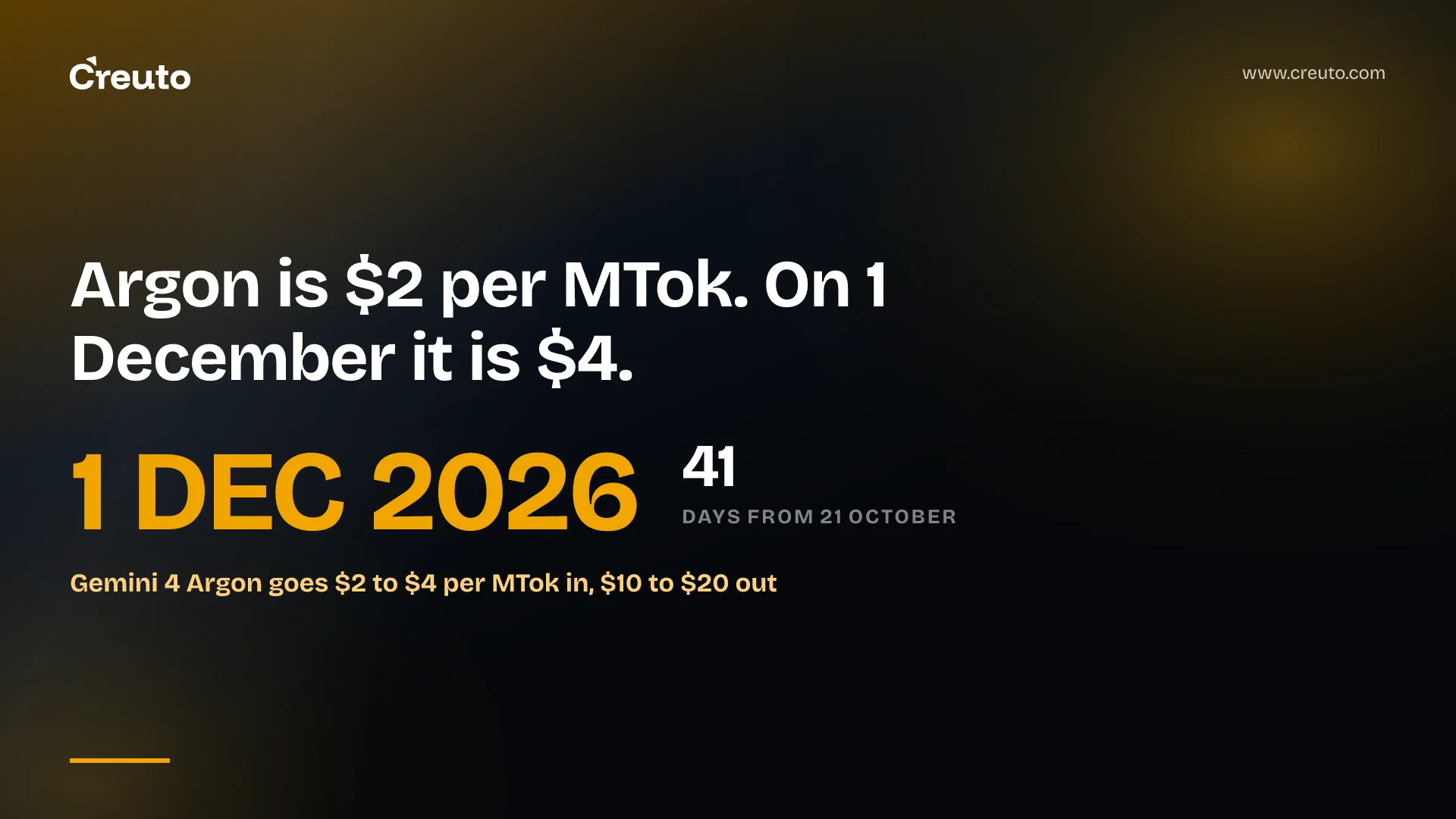
On 1 December 2026 Gemini 4 Argon stops costing $2 per million input tokens and starts costing $4, with output going from $10 to $20 — a 100% increase printed on Google's own Gemini API pricing page six weeks before it lands. If you are running the claude vs gpt vs gemini decision this quarter, that single dated line matters more than any score you will find on page one, because it is a commitment you can plan against. This post compares the three vendors only on what they themselves publish: announced prices and price dates, retention and training terms, where inference physically runs, rate-limit transparency and caching economics. Every figure here was read from the vendors' own pages on 21 October 2026.
The dated facts, up front
- Gemini 4 Argon (
gemini-4-argon): $2.00 input / $10.00 output per million tokens through 30 November 2026; $4.00 / $20.00 from 1 December 2026. Implicit caching costs $0.10 per MTok now, $0.20 after. Argon is not offered on Google's free tier at all. - Gemini 3.8 Flash (
gemini-3.8-flash): $0.75 / $3.75 through 31 December 2026, then $1.50 / $7.50 from 1 January 2027 — the same doubling, one month later. - GPT-6 Astra (
gpt-6-astra): $10.00 / $50.00, cached input $1.00. GPT-6.1 Sol (gpt-6.1-sol): $2.00 / $10.00. GPT-6 Luna (gpt-6-luna): $0.10 / $0.50. No end date is published against any of them. - Claude Opus 5.5 (
claude-opus-5-5): $4 / $20. Claude Sonnet 5.5 (claude-sonnet-5-5): $2 / $10. Claude Haiku 5.5: $0.10 / $0.50 for prompts up to 100,000 tokens, $0.50 / $2.50 over that line. No end date is published either.
All three discount batch work by 50%. Only one of them has told you, in writing, that its flagship doubles in six weeks.
Why claude vs gpt vs gemini is a documentation question this quarter
We went looking for an independent production comparison of these three models from the last four months and could not find one worth citing. The nearest thing is a self-published index. Reading Artificial Analysis's benchmarking methodology page on 21 October 2026, we found definitions, index names and the formulae for cost and time per task — but no enumeration of which benchmarks compose the headline Intelligence Index, and no date telling us when the page or the index was last revised. Every score we saw circulating reached us through secondary blogs, several of which disagreed with each other and none of which stated the reasoning-effort setting used. So we are not quoting scores. A number whose provenance you cannot reconstruct is not evidence.
The documentation is the more useful axis, because on it the three vendors differ far more than their marketing suggests. Here is what each commits to in public, as read today.
| What you need to know | Anthropic (Claude API) | OpenAI API | Google Gemini API |
|---|---|---|---|
| Announced price change | None published | None published for GPT-6 models | Argon doubles 1 Dec 2026; 3.8 Flash doubles 1 Jan 2027 |
| Conversation content retained by default | No, except Covered Models, which require 30 days | Abuse-monitoring logs up to 30 days per endpoint | Logged "for a limited period of time" — no number given |
| Used to improve the vendor's products | Never trained on without express permission | Not on API data by default | No on paid quota; yes on unpaid quota, with human review |
| Where inference runs | global or us only, at 1.1x for us | Storage in 10 regions; processing in US, EU and UAE at +10% | Deferred to the DPA; may be cached "in any country" |
| Per-model rate limits published | Yes — RPM, ITPM and OTPM per tier | Yes — RPM and TPM per tier | No — you are told to read them in AI Studio |
| Hourly fee to keep a cache warm | No | No | Yes, $0.50–$4.50 per MTok per hour by model |
Retention and training: OpenAI is the most explicit, Google the least specific
OpenAI documents retention endpoint by endpoint. Its data controls guide states that abuse-monitoring logs are generated for all API usage and kept up to 30 days by default, lists Zero Data Retention eligibility per endpoint, and explains that under ZDR the store parameter is forced to false even if your code sets it true. That table is the most auditable retention artefact any of the three publishes: you can point a compliance reviewer at a row.
Anthropic's position is stronger in substance and thinner in surface area. Its API and data retention page says conversation content is not retained by default, that retained data is never used for model training without express permission, and that the exception is Covered Models — Fable 5.1, Mythos 5.1 and their predecessors — which require 30-day retention and are unavailable under ZDR unless Anthropic expressly authorises it. HIPAA readiness with a BAA can be enabled from the Console rather than negotiated. Worth correcting in your own notes: the default is not 30-day deletion, it is no retention of prompts and responses, with 30 days attached to specific models.
Google draws the sharpest line between tiers and the vaguest line on time. Under the Gemini API additional terms, unpaid-quota content is used to provide, improve and develop Google products, and human reviewers may read and annotate your inputs and outputs. On paid quota, Google does not use prompts or responses to improve its products — but it logs them "for a limited period of time" and gives no number, and says that data may be stored transiently or cached in any country where Google or its agents maintain facilities. If your data protection impact assessment needs a retention figure, you will not get one from the documentation.
Which llm vendor offers data residency, and where inference actually runs
Storage location and processing location are different questions, and only OpenAI separates them for you. Its region table lists ten regions for storage at rest — the US, Europe, Australia, Canada, Japan, India, Singapore, South Korea, the UK and the UAE — and then says plainly that regional processing is supported only in the United States, Europe and the UAE. The UAE entry is narrower still: processing covers a named subset of snapshots, gpt-5.6-luna among them, not the GPT-6 flagship. Non-US regions require approval for abuse-monitoring controls and a Modified Retention amendment, the UAE requires separate sales approval, and residency endpoints carry a 10% uplift for models released on or after 5 March 2026. We have written before about what OpenAI data residency in India and the UAE does and does not cover, and the processing-versus-storage split is the whole of it.
Anthropic offers two values and no more. inference_geo accepts global or us, the us option costs 1.1x across every token category including cache reads and writes, and it only works on Claude 4.6 and later — earlier models return a 400. Workspaces can pin allowed_inference_geos so a stray request cannot leave the boundary. It is a narrow control, honestly described.
For Gemini we could not verify any Gemini-specific residency region list from the pages we read; the terms defer to Google's Data Processing Addendum. Treat that as unverified rather than absent, and ask your Google contact for it in writing before you design around it.
Rate limits: two of the three publish real numbers
The received wisdom that only Anthropic publishes tiers is wrong, and we were wrong to believe it before checking. Anthropic's rate limits page gives RPM, input tokens per minute and output tokens per minute for every model at the Start, Build and Scale tiers — 2,000,000 ITPM on Sonnet 5.5 at Start, 10,000,000 at Scale — plus monthly spend caps of $500, $1,000 and $200,000. It also documents something genuinely useful: cache reads do not count toward ITPM on most models, so an 80% cache hit rate turns a 2M ITPM limit into roughly 10M effective tokens a minute.
OpenAI publishes the equivalent. Its Build, Launch and Grow tiers qualify at $5, $100 and $500 of total credit purchases, carry monthly usage limits of $500, $5,000 and $200,000, and the page lists 5,000 RPM and 1M TPM for Astra and Sol at Build, rising to 15,000 RPM and 40M TPM at Grow.
Google is the outlier. It publishes usage tiers, billing tier caps of $250, $2,000 and $20,000–$100,000+, and spend rate limits of $10, $50 and $200 per rolling ten minutes — but for per-model RPM and TPM it tells you to view your active limits in AI Studio, and adds that specified rate limits are not guaranteed. You cannot capacity-plan a launch from that, and you cannot put it in a design document.
Caching is where the three pricing models stop resembling each other
All three cut the price of repeated context, and they charge for it in structurally different ways. Anthropic charges 1.25x base input to write a five-minute cache and 2x for an hour, then 5% of base input on a hit for Opus 5.5 and Sonnet 5.5 — $0.20 and $0.10 per MTok respectively. OpenAI charges $1.00 for cached Astra input against $10.00 uncached, with separate 30-minute and 12-hour write prices. Neither charges rent.
Google does. Context caching on Gemini 3.8 Flash costs $0.075 per MTok through 31 December 2026, plus a storage price of $0.50 per million tokens per hour, rising to $1.00 from 1 January 2027; on the Pro-class models that hourly figure reaches $4.50. A 500,000-token cache held warm across an eight-hour working day is a line item the other two vendors simply do not have. And on Argon, explicit caching is not supported at all — implicit only — so the lever you would reach for to blunt the December increase is not available on the model that is increasing. If caching drives your unit economics, our note on prompt caching as the cheapest LLM cost cut and the fuller LLM cost optimization breakdown do that arithmetic; the point here is that one vendor meters time and two do not.
When this comparison does not matter
Below roughly a few million tokens a month, stop reading and pick whichever API your team already has keys for. At that volume the price delta between Sonnet 5.5 and Sol is smaller than the meeting you would hold to choose between them, and a doubling of a small number is still small.
It also does not matter for prototypes you expect to throw away, or where switching cost is near zero — a single summarisation call behind an interface you own, with no tool definitions, no cached prefixes and no provider-specific structured-output behaviour. Our view on vendor lock-in as a reversibility problem is that you should measure the cost of leaving rather than agonise over the cost of arriving. Where reversibility is cheap, buy on convenience.
Where it does matter: regulated data, a residency commitment already written into a customer contract, agentic workloads whose cached prefixes dominate the bill, and any plan whose budget runs past 1 December 2026 on Argon or 1 January 2027 on 3.8 Flash.
What we would actually do with this, and what to re-check
Claude through the Anthropic API, the OpenAI API and Gemini all run in production systems we maintain, and we have shipped AI features into platforms like the Škoda Auto sales training platform across 100+ dealerships. The integration-level differences we feel are mundane and real: how the provider reports cache hits in usage, whether rate limits are legible enough to plan a launch against, and how much of a compliance questionnaire we can answer by linking a page instead of opening a negotiation. On those three, Anthropic and OpenAI are currently easier to build governance around than Gemini, and Gemini is the only one that has told us a price is about to double.
Three honest caveats. Every figure above is dated 21 October 2026 and any of it can change the week after this publishes — Google's own terms reserve the right to change pricing effective 30 days after posting. We did not verify long-context pricing tiers for GPT-6 Astra, because those sit behind a toggle we could not read statically, so do not plan around them on our word. And we have benchmarked nothing: this is a reading of public documents, not a bake-off.
The next decision is narrower than the vendor question. Work out what share of your monthly input tokens is cached prefix, then price that share against each vendor's cache terms including Google's hourly storage; if the answer moves your bill by more than a few per cent, that is your model choice made on evidence. If you want a second pair of eyes on the arithmetic or the residency wording before you commit, that is what our AI engineering services practice does.
Frequently asked questions
Gemini 4 Argon is cheaper than GPT-6 Astra and the same price as Claude Sonnet 5.5 and GPT-6.1 Sol until 30 November 2026, at $2 per million input tokens. From 1 December 2026 Argon doubles to $4 input and $20 output, which puts it above Sonnet 5.5 and Sol.
OpenAI offers the widest data residency: storage in ten regions, but inference processing only in the United States, Europe and the United Arab Emirates, at a 10% uplift. Anthropic offers US-only inference at a 1.1x multiplier. For Gemini, Google's API terms defer to its Data Processing Addendum.
Anthropic says retained data is never used for model training without express permission. OpenAI does not train on API data by default and retains abuse logs up to 30 days. Google does not use paid-quota Gemini data to improve products, but unpaid-quota content is used and may face human review.
Pick on documented terms rather than benchmark scores. If you need auditable retention, OpenAI publishes it endpoint by endpoint. If you need published rate limits and spend caps to plan capacity, Anthropic and OpenAI both give numbers. If cached prefixes dominate your bill, check Google's hourly cache storage fee first.
We found no credible independent production comparison of the three from the last four months. The nearest index does not enumerate the benchmarks behind its headline score or carry a revision date, and the figures circulating in secondary coverage disagree and omit reasoning-effort settings, so we compared documented terms instead.
Yes. Gemini context caching adds an hourly storage price, $0.50 per million tokens per hour on Gemini 3.8 Flash through 31 December 2026 and up to $4.50 per hour on Pro-class models. Neither Anthropic nor OpenAI charges an hourly fee for cached content.