ChatGPT Pro allowance halves on 30 October, same price
The ChatGPT Pro allowance for Work and Codex drops from 20x Plus to 10x on 30 October at the same $200. How to tell whether it binds your team.
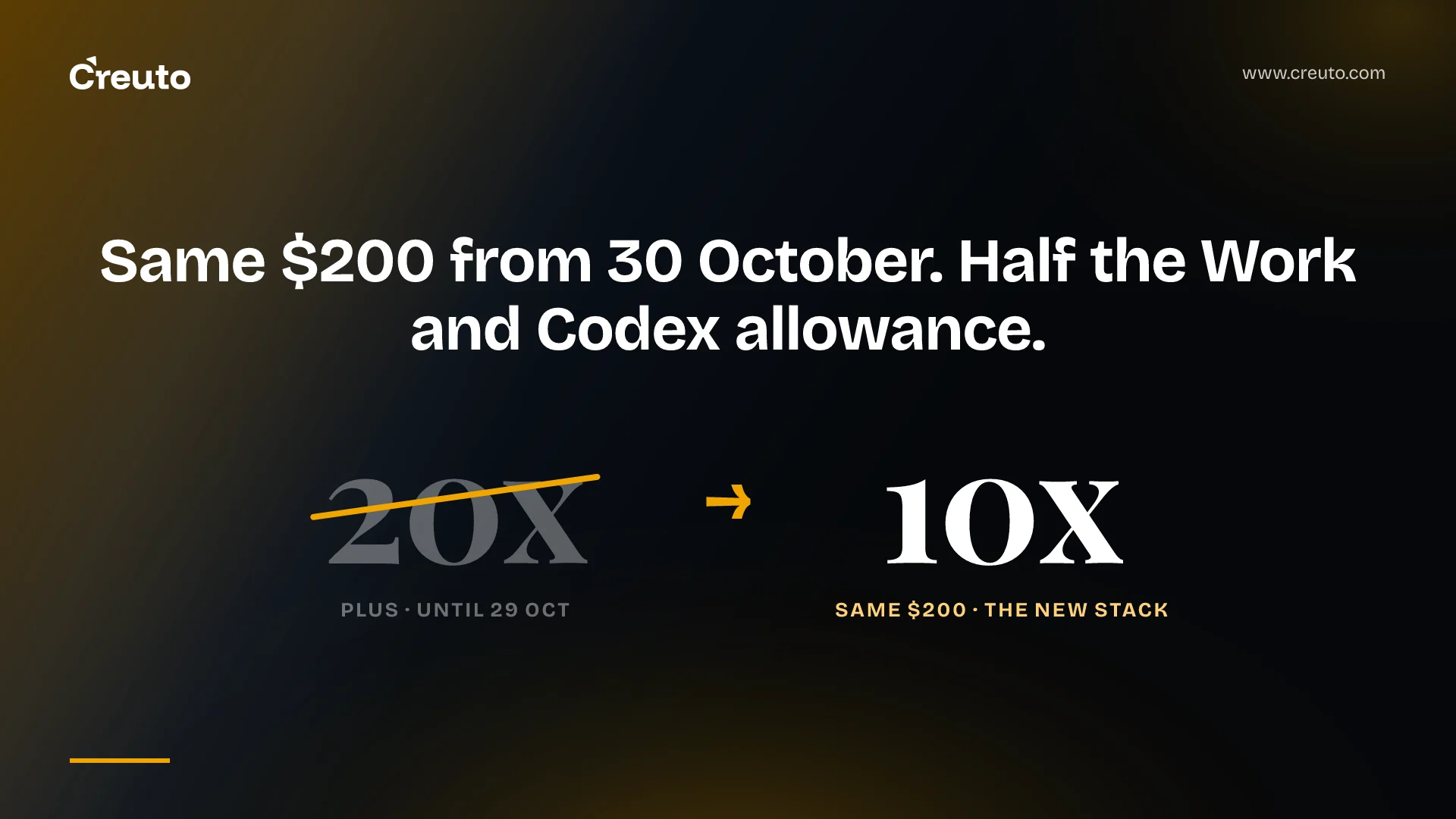
From 30 October 2026 the ChatGPT Pro allowance on the $200 plan drops from twenty times the Plus allowance to ten for ChatGPT Work and Codex, at an unchanged $200 a month. The interesting question is not whether that is fair. It is whether your team is anywhere near the old ceiling, and almost nobody has measured.
Here is what is actually dated and what is not.
| What | Detail | Where it is published |
|---|---|---|
| Pro tiers | Pro 100 at $100, Pro 200 at $200, Pro 500 at $500; Ultrafast included only on Pro 500 | OpenAI's own Pro tiers help article and Codex pricing page |
| Grandfathering | A Pro 200 subscription active at the eligibility cutoff, or in the seven days before it, keeps the previous included allowance through 29 October 2026 while it stays active | OpenAI's Pro tiers help article |
| Price | Unchanged at $200 a month after the allowance drops | OpenAI's Pro tiers help article |
| The multipliers | Work and Codex from 20x Plus to 10x; the Pro model's Chat limit from 200 to 100 messages a week | Trade coverage and the email OpenAI sent affected subscribers — not any public OpenAI page we could read |
| Credit grant | 62,500 usage credits, valued at $2,500, expiring 31 December 2026 | Same: coverage and the subscriber email |
OpenAI's own pages do not carry the numbers everyone is quoting
This is worth saying plainly, because it changes how much weight the figures deserve. OpenAI's About ChatGPT Pro tiers article confirms the three price points, confirms that Ultrafast is Pro 500 only among Pro plans, and confirms the grandfathering window and the unchanged price. It says: "After that date, your subscription will move to the lower included usage allowance. Your subscription price stays at $200/month. Only users affected by this change will receive an email with additional details."
It never says how much lower. Neither does the public ChatGPT pricing page, which describes Pro as "your choice of 3 usage tiers" and marks features as Expanded or Maximum rather than giving a multiple. The 20x-to-10x figure and the 200-to-100 weekly messages come from The New Stack's report of 30 September and from the email affected subscribers received. So does the credit grant. We have not found them on a page OpenAI publishes, and that is the honest status of the most-quoted numbers of the week.
What the ChatGPT Pro allowance actually meters — and the two pools
There are two separate cuts here and they hit different people. OpenAI's Codex pricing documentation is explicit that ChatGPT Work usage inside ChatGPT uses the same pricing, credits and usage limits as Codex. That is pool one: agentic work. The weekly Pro-model message cap in ordinary Chat is pool two, and it is a message count, not a token budget.
If your team's use of the $200 plan is an engineer running Codex all day, the first cut is the one that matters and the second is noise. If it is a partner or an analyst asking the heaviest reasoning model a handful of hard questions a week, the reverse is true. A team that reads the coverage and assumes both cuts bind everyone will overbuy.
The first pool is also harder to predict than people expect. OpenAI's own guidance says that tasks which look similar can consume very different amounts, because model choice, context, reasoning, tool use, retrieval and caching all affect it, so prompt length alone is not a reliable estimate. Cloud tasks may use more of your allowance than local messages. Pro plans currently have no five-hour limit, which means a single long agent session can draw down a week's allowance in an afternoon with nothing stopping it.
Give OpenAI's argument its strongest form first
Tibo Sottiaux, OpenAI's head of product and platform, previewed the change on X and framed it as a recalculation rather than a cut: "if you do the math, it will net out at half the dollar in API spend compared to the old Pro $200 plan," arguing that subscribers will "still get more work done than if you were on the Pro $200 subscription one month ago," as The New Stack quotes him.
That argument is not empty. An allowance pegged to API dollar value gets cheaper in real terms every time a model gets more efficient at the same task, so a subscriber on a fixed multiplier captures a windfall the vendor funds. Pricing a flat subscription against an unmetered agent that can run for hours is genuinely hard, and OpenAI did not reintroduce the five-hour cap it could have. Repricing the plan once is more honest than quietly degrading quality.
The weakness is the counterfactual. "More work than a month ago" is unfalsifiable from the outside: nobody can audit it, because OpenAI does not publish the allowance in units a subscriber can check. The grandfathering also lands oddly — it rewards whoever happened to hold a subscription on one undisclosed cutoff date, not whoever uses the product most.
How to measure per-seat consumption before 29 October
You have under four weeks, and what you can see depends entirely on which product you bought. Be clear about that before you plan a measurement exercise.
If your seats are individual Pro subscriptions, there is no admin view. Pro is a personal plan. Each person has to open their own usage dashboard at chatgpt.com/codex/settings/usage, where OpenAI publishes current limits and reset times, or run /status inside a Codex CLI session. OpenAI's pricing page tells users to check that dashboard every week or two to understand their pace and remaining capacity. The practical method is unglamorous: have every seat screenshot the dashboard on the same two dates a week apart, before 29 October, and record the percentage of allowance consumed. That is your baseline against the old 20x number. Halve it, and you know whether the change binds.
If you are on Business or Enterprise, you have real reporting. OpenAI's Usage Insights documentation describes Admin Console analytics under Analytics > Insights that group activity into use cases and tasks and show messages, share of credits and active users together, with model, reasoning and speed breakdowns inside each category. The governance guide adds an Analytics API for aggregated reporting into a warehouse and a Compliance API for audit records, and is careful to say those are different surfaces for different questions.
Three caveats OpenAI states itself and most write-ups skip. Insights history only exists from when classification began, so you cannot backfill a baseline you did not start. Where a sampling notice appears, the counts reflect sampled activity and must not be scaled up. And one category can contain several workflows, so a credit share is not a process cost until you have opened its tasks.
OpenAI also publishes the only per-seat consumption figures we have seen from the vendor side, for first-time enterprise ChatGPT Work adopters in Marketing: a median of roughly $53 in annualised consumed-credit value per employee per year, an average of about $309, and a 90th percentile near $1,154. OpenAI labels these directional, annualised from one week of adoption-period usage, and not a bill. Read as a shape rather than a number, they make the point: the average is six times the median because a thin tail of people consume nearly everything. That is why a blanket upgrade is almost always the wrong response to an allowance cut, and why we treat per-seat distribution, not headcount, as the input to any AI spend monitoring decision.
Pro 200, Pro 500, or the API
Three honest answers, in the order most teams should test them.
| Choice | Right when | Wrong when |
|---|---|---|
| Stay on Pro 200 | Measured consumption sits comfortably under half the old allowance, or the heavy users are a small, named group | You are guessing, and the first week of November is when you find out |
| Move the heavy seats to Pro 500 | A handful of people genuinely run out, and latency on interactive work is on someone's critical path — Ultrafast is Pro 500 only among Pro plans | Applied to the whole team because two people complained |
| Move the work to the API | The consumption is automated, batched or scheduled rather than a human waiting at a keyboard | The work is exploratory and conversational, where a seat is cheaper than engineering time |
The third option is the one the outrage cycle is burying. An allowance is a ceiling you cannot see; API usage is metered, attributable per workload and billable to a cost centre. OpenAI's published API pricing puts gpt-6-astra at $10 per million input tokens and $50 per million output in short context, with cached input at $1 and Batch pricing at exactly half the standard rate — $5 input and $25 output. Nothing in a subscription allowance gives you that 50% lever, because batch work inside a seat still spends the same allowance. For anything that runs on a schedule rather than in front of a person, that is the move, and it is the same reasoning we apply when choosing between ChatGPT workspace agents and a custom build on the API, or when deciding which model a given path should actually run. We published separately this week on Ultrafast, where the same test applies in reverse: a premium speed tier only converts to value when a human is waiting.
Treat the 62,500 credits as a deadline, not a gift
The grant reported by trade coverage expires on 31 December 2026. Credits that expire are a window, not a balance, and the default outcome is that they lapse unnoticed while everyone argues about the multiplier.
Spend them on the measurement, not on business as usual. Two things are worth the budget. First, run the heavy workloads you have been rationing — the long refactor, the full-repository review — and record what they actually cost, so your 2027 plan rests on observed consumption rather than a vendor's role-based benchmark. Second, run the migration you would otherwise defer: port one scheduled or batch workflow off the seat and onto the API, and compare the metered bill against the allowance it was quietly eating. You have until 31 December to do that experiment on someone else's money.
If you get to 30 October without a per-seat number, you have not avoided the decision. You have just arranged to make it in November, from a help desk ticket, at whatever price is on the page that week. If working out which half of your AI workload belongs on a seat and which belongs on metered infrastructure is the decision in front of you, that is the kind of thing our AI engineering practice is hired to settle.
Frequently asked questions
Eligible existing Pro 200 subscribers keep their previous included allowance through 29 October 2026 while the subscription stays active, according to OpenAI's Pro tiers help article. The lower allowance applies from 30 October 2026, and the subscription price stays at $200 a month.
Trade coverage and the email OpenAI sent affected subscribers put the ChatGPT Work and Codex allowance at 10 times Plus, down from 20 times, and the Pro model's Chat limit at 100 messages a week, down from 200. OpenAI's published pages do not state either figure.
The one-time grant of 62,500 usage credits reported by The New Stack, valued at $2,500, expires on 31 December 2026. Treat that as a use-it-or-lose-it window: run the heavy workloads you have been rationing and measure what they really consume before the date.
Pro 500 is justified for the small number of seats that genuinely exhaust the allowance, and it is the only Pro plan that includes Ultrafast. Upgrading a whole team because two people complained is the common and expensive mistake, since consumption is heavily concentrated.
Individual Pro subscriptions have no admin console, so each person reads their own usage dashboard at chatgpt.com/codex/settings/usage or runs /status in the Codex CLI. Business and Enterprise workspaces get Admin Console Insights, an Analytics API for aggregated reporting, and a Compliance API for audit records.
Move automated, batched or scheduled work to the API, where usage is metered and attributable per workload rather than drawn from an invisible allowance. Keep exploratory, conversational work on a seat, where a subscription is cheaper than the engineering time an integration costs.