A leading product engineering company, creating adaptive software solutions to improve operations, providing businesses with expert development services from across domain.
Quick Commerce
A full-stack quick commerce platform โ consumer mobile app, vendor management dashboard, and super admin control panel โ designed and delivered by Creuto from scratch.

10โ30
Minute Delivery4
Platform Roles3
Platforms Delivered0
Centralised Warehouses NeededClient
FlashNow
Industry
Quick Commerce / Hyperlocal Delivery
Services
Mobile App Development
Vendor Dashboard
Super Admin Panel
Backend Architecture
Real-Time Delivery System
Platform
User Android AppPlatform
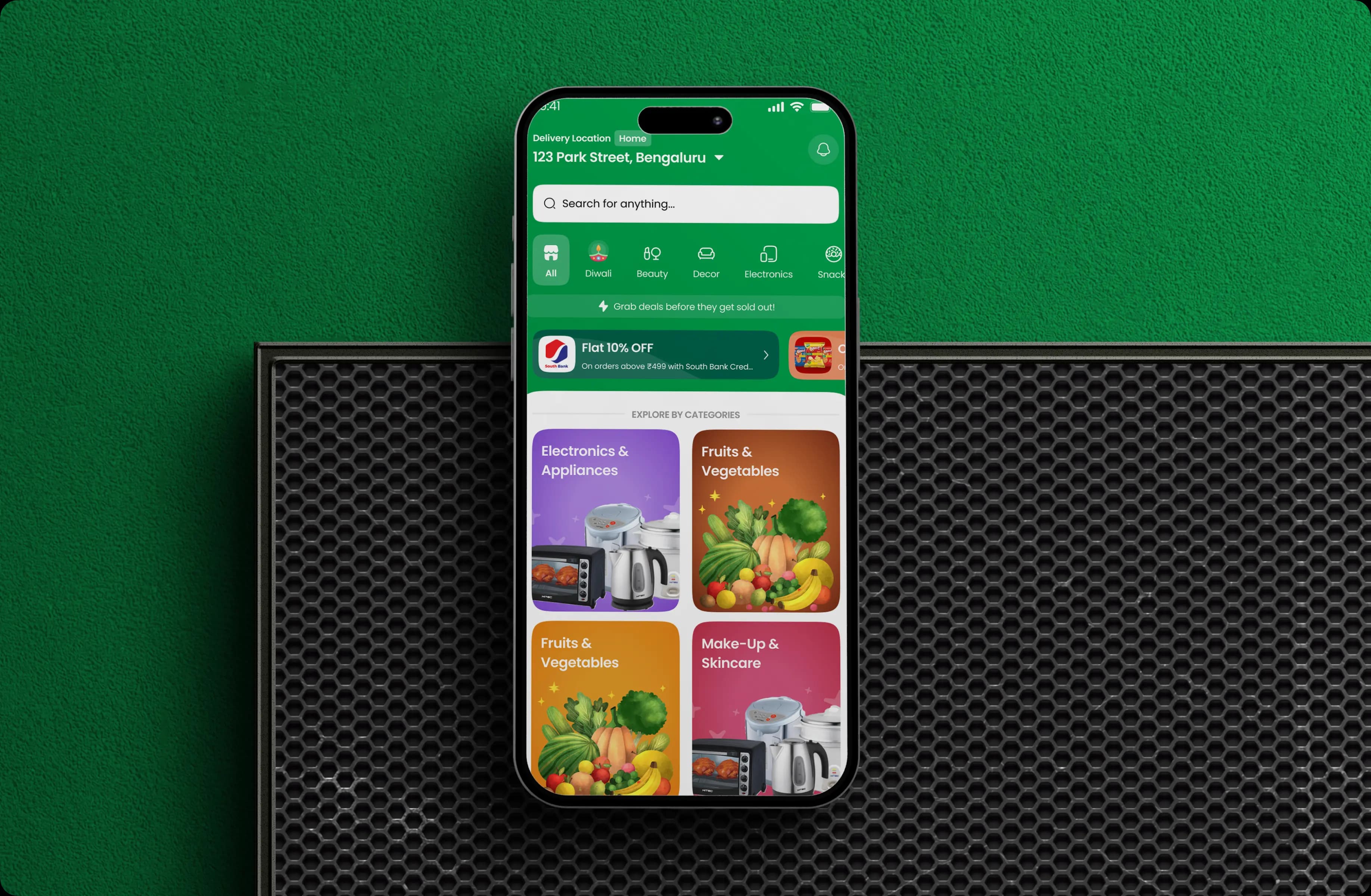
User IOS AppFlashNow is a hyperlocal quick commerce platform built to deliver groceries, daily essentials, and household products to customers within 10 to 30 minutes. Modelled on the operational logic of platforms like Blinkit and Zepto, FlashNow is specifically designed to route demand through local shop owners rather than large centralised warehouses โ giving neighbourhood vendors a live digital storefront and a structured fulfilment system for the first time.
The platform connects four distinct participants: end users placing orders through a mobile app, local vendors managing inventory and orders through a dedicated dashboard, delivery partners handling last-mile fulfilment, and an operations team administering the entire ecosystem.
Creuto designed and delivered the complete product end to end:
A consumer-facing mobile app for iOS and Android
A vendor self-management panel for local shop owners
A super admin dashboard for the FlashNow operations team
A real-time order and delivery management system connecting all four participants
Creuto acted as a full product partner โ shaping the feature architecture, designing the multi-role user experience, engineering the backend for real-time operations, and deploying everything to production on a scalable cloud infrastructure.
Local vendors were excluded from quick commerce
By 2024, the Indian quick commerce market had consolidated rapidly around a handful of well-funded platforms. Blinkit, Zepto, and Swiggy Instamart were capturing demand that had historically gone to neighbourhood kirana stores. For the local shop owner, the shift was brutal: their customers were ordering online, but none of those orders were going to them.
โ
Local vendors had no digital presence or online ordering capability
โ
They could not compete with the speed, discoverability, or convenience of funded platforms
โ
Their only channel remained offline walk-ins, which were declining in frequency
โ
No quick commerce infrastructure existed designed to serve and onboard small local shops
From the customer side, the experience of buying from local shops was deeply fragmented โ no single place to discover what nearby stores carried, compare prices, or place an order without picking up a phone.
No real-time inventory or order visibility
Neither customers nor vendors had any real-time visibility into what was available or where an order stood. The result was a fulfilment process that was slow, error-prone, and completely opaque to everyone involved.
โ
Vendors managed stock manually, with no live inventory system
โ
Customers had no way to check whether an item was available before ordering
โ
Order handling was done by phone or WhatsApp, with no structured fulfilment flow
โ
No tracking system existed for delivery โ customers could not see where their order was
Logistics and delivery had no structure
Last-mile delivery from local shops was entirely ad hoc. Without a dispatch system, route logic, or delivery partner management layer, fulfilment was inconsistent and the customer experience suffered every time.
โ
No structured system for assigning delivery partners to orders
โ
No estimated delivery time calculation or real-time status updates
โ
Delays were frequent, untracked, and unresolvable without manual intervention
โ
No feedback loop to measure or improve delivery performance
01
The app uses GPS to surface nearby vendors in list and interactive map views. Every store card shows distance, estimated delivery time, product categories, and live availability. Geospatial query logic returns results within a configurable delivery radius.
Stores outside delivery range are visually suppressed to prevent frustrating order attempts. Map view with store pins helps users understand their local vendor landscape at a glance.
02
Every vendor manages their own product catalogue through the vendor dashboard. Stock levels, pricing, and availability are reflected in the consumer app in real time โ no manual syncing and no stale listings.
Out-of-stock items are automatically suppressed from customer-facing listings. Vendors can update availability instantly from their dashboard or mobile browser.
03
The entire order flow from first item to confirmed payment was engineered to complete in under two minutes. Reducing checkout friction was a primary engineering priority from sprint one.
Saved addresses cut repeat-user checkout time to under 30 seconds. Multiple payment methods supported: UPI, cards, wallets, and cash on delivery. Order confirmation with estimated delivery time displayed immediately.
04
Every order moves through a structured, trackable status pipeline: Pending, Accepted, Packed, Out for Delivery, Delivered. Push notifications are sent at each state transition.
Vendors receive instant in-app alerts for new orders with accept/reject controls. Customers can track order progress on a live status screen without contacting support. Cancellation and rejection logic handled with automated refund triggers.
05
Structured dispatch assigns delivery partners based on proximity to vendor and availability. Route optimisation calculates the most efficient path from vendor to delivery address. Live delivery partner location is shared with customers once the order is out for delivery.
Estimated delivery time updates dynamically based on actual route progress.
06
Local shop owners get an order management dashboard, real-time sales analytics, revenue visibility, and tools to create offers and promotional bundles. For the first time, neighbourhood vendors have the same operational infrastructure as a Blinkit-level product.
FlashNow gave our local vendors something they never had before โ a real platform. Not a WhatsApp group, not a phone call queue. An actual system where orders come in, get tracked, and get delivered. Creuto built exactly what we needed, and shipped it ready for real load.
Founding Team, FlashNow
Quick commerce platforms are technically demanding โ real-time inventory, live order tracking, multi-sided marketplaces, and sub-30-minute fulfilment SLAs. Here is what makes Creuto the right partner.
Inventory updates, order status transitions, delivery tracking, and vendor alerts all happen in real time. The system is architected for low-latency state management from day one โ not retrofitted after launch.
Consumer, vendor, delivery partner, and super admin each have distinct needs. We design and build purpose-built experiences for all four within one coherent platform under one contract.
Consumer app, vendor dashboard, delivery partner interface, super admin control panel, and the backend that connects all four โ delivered as one coherent product, not four separate builds.
After discovery, Creuto provides a detailed scope document and a fixed-cost proposal. No vague estimates, no change order surprises โ just predictable delivery.
Every technology chosen for sub-second order state transitions, real-time inventory sync, and the ability to handle hyperlocal operational scale.
From product architecture for four distinct platform roles to production deployment โ with real-time systems validated at every step before going live.
Defined the product across all four participant types โ consumer, vendor, delivery partner, and ops team. Mapped the complete order lifecycle and real-time inventory model. Identified integration requirements for payments, maps, and notifications.
End-to-end designs for consumer app, vendor dashboard, delivery partner interface, and super admin panel. Checkout flow designed for sub-2-minute completion. Vendor onboarding flow designed for non-technical shop owners.
Backend API, real-time order pipeline, inventory management system, and authentication. Consumer app and vendor dashboard shells built in parallel. Real-time WebSocket connections for order status and delivery tracking established early.
Dispatch engine, route optimisation, delivery partner assignment logic, and live location sharing. Order lifecycle state machine built and tested with edge cases including cancellation, rejection, and partial fulfilment.
End-to-end testing across all four platform roles and device types. Load testing of real-time order and inventory systems under concurrent consumer load. Payments security review and refund flow validation.
Production infrastructure deployment with App Store and Play Store submissions. Vendor onboarding support with guided catalogue setup. Two-week hypercare window with dedicated on-call for live operational issues.
We treat real-time as a first-class engineering concern, not a feature label. Every architectural decision โ from the WebSocket layer to the order state machine โ is made with the assumption that the system will run hot from day one. We don't build for staging-room demos.
FlashNow shipped to production handling sub-30-minute delivery SLAs across four user roles, with zero post-launch architecture rewrites required.

Everything you need to know about building a product like this with Creuto.
The platform's geospatial discovery layer only surfaces vendors within a configurable delivery radius of the customer's location. Each vendor manages their own real-time inventory, so orders are placed directly against local shop stock โ no centralised warehouse or aggregation layer is involved.
The vendor dashboard is designed for non-technical shop owners. Product catalogue management, stock updates, and order acceptance are all single-tap actions on mobile. Vendor onboarding includes guided setup support and the interface is available in regional languages.
Yes. The platform is designed for multi-city deployment from day one. Each city operates its own geospatial delivery zones, vendor registry, and delivery partner pool. The super admin panel provides cross-city operational oversight and analytics.
A full quick commerce platform with consumer app, vendor dashboard, delivery system, and super admin panel typically takes 4โ5 months from discovery to launch. We always begin with a scoping sprint to produce an accurate fixed-price estimate before committing.
A multi-role quick commerce platform with real-time order management and delivery tracking typically costs between $50,000 and $120,000 USD depending on geography, payment integrations, and feature surface area. Creuto provides a fixed-cost proposal after discovery.
Whether you are powering one neighbourhood or one hundred โ Creuto builds hyperlocal commerce platforms that empower local vendors and deliver real-time experiences to consumers.
Real-time at the core. Multi-role. Built for actual load. One team. Fixed price.
Book a free consultation11th Floor, O-Hub, Chandaka Industrial Estate, Infocity, Bhubaneswar, Odisha 751024
Level 4, 11 York Street Sydney Startup Hub Sydney, NSW โ 2000
30 N. ฤinh Nghแป, Phฦฐแปc Mแปน Sฦกn Trร , ฤร Nแบตng / Da Nang City โ 550000
Level 25, AIDP Business Tower, Dubai Marina, United Arab Emirates
50 Beauchamp Street, Wellington, WGN 5028, New Zealand
ยฉ 2026 Creuto All Rights Reserved