A leading product engineering company, creating adaptive software solutions to improve operations, providing businesses with expert development services from across domain.
Smart City / IoT
A cloud-native, IoT-powered smart city platform — web command dashboard, citizen mobile app, field staff app, and full IoT integration designed and delivered by Creuto from the ground up.

10
Integrated Modules25–30%
Reduction in Vehicle Trips4
Platforms Delivered100%
Real-Time Operational VisibilityClient
Binimise
Industry
Smart City / GovTech / IoT
Services
Web Dashboard Development
Mobile App Development
IoT Integration
Backend Architecture
Cloud Deployment
Binimise is a cloud-native, mobile-first, IoT-powered platform designed to modernise urban local body (ULB) operations across waste management, fleet tracking, citizen services, and city infrastructure. The platform replaces fragmented, manual, paper-based systems with a unified digital command centre that gives municipal officials, field staff, contractors, and citizens a single, connected experience.
The platform is production-ready and deployed across urban local bodies in India. It operates across multiple functional domains — from bin-level fill detection and vehicle GPS tracking to geo-tagged citizen complaints and automated property tax workflows — all managed through one centralised system built and delivered entirely by Creuto.
Creuto designed and delivered the complete product end to end:
A command and control web dashboard for city commissioners, engineers, and operations managers
A field staff mobile app for waste collection workers, supervisors, and fleet operators
Full IoT integration with SmartBins, GPS vehicle tracking, RFID weighbridge systems, and underground drainage sensors
Analytics and MIS infrastructure for compliance reporting, performance monitoring, and government dashboards
This was not a development-only engagement. Creuto acted as a complete product and technology partner — shaping the feature architecture, designing operational workflows, building the integrations, and deploying everything to a scalable cloud infrastructure.
Waste collection operations were manual and inefficient
Urban local bodies across India manage millions of tonnes of waste annually and operate fleets of hundreds of vehicles. In the absence of integrated digital systems, these operations depended on manual processes, fragmented software tools, and informal communication channels.
→
Collection routes were static — assigned once, rarely revised regardless of ground conditions
→
Vehicles made trips to bins that were either empty or not scheduled for collection
→
Supervisors had no mechanism to verify whether a vehicle had actually visited a location
→
Bin overflow in densely populated wards went undetected until reported by residents
→
There was no system to detect fires within compactor units or bins
The operational and financial cost of this fragmentation was significant — wasted fuel, wasted driver hours, and chronic public sanitation issues.
No visibility into fleet, staff, or fuel usage
Vehicles operated without any real-time tracking. Route histories were maintained manually in paper registers. Fleet managers had no way to verify whether a driver had taken an authorised route, completed their assigned circuit, or idled unnecessarily.
→
No real-time GPS tracking of municipal vehicles
→
Fuel consumption records maintained by hand, creating opportunity for misreporting
→
No system to flag unauthorised stops, after-hours usage, or route deviations
→
Citizen complaints reported through phone calls, walk-ins, and informal WhatsApp messages
Municipal systems were fragmented with no shared data layer
Different departments operated different tools — or no tools at all. Waste management, fleet administration, property tax collection, streetlight maintenance, and drainage monitoring each ran independently. City commissioners had no single view of operations.
→
Reports compiled manually from multiple sources, taking hours and producing outdated information
→
No real-time dashboards, predictive alerts, or performance metrics for leadership
→
Decisions based on historical precedent rather than current data
→
SBM compliance reporting required substantial manual effort each cycle
01
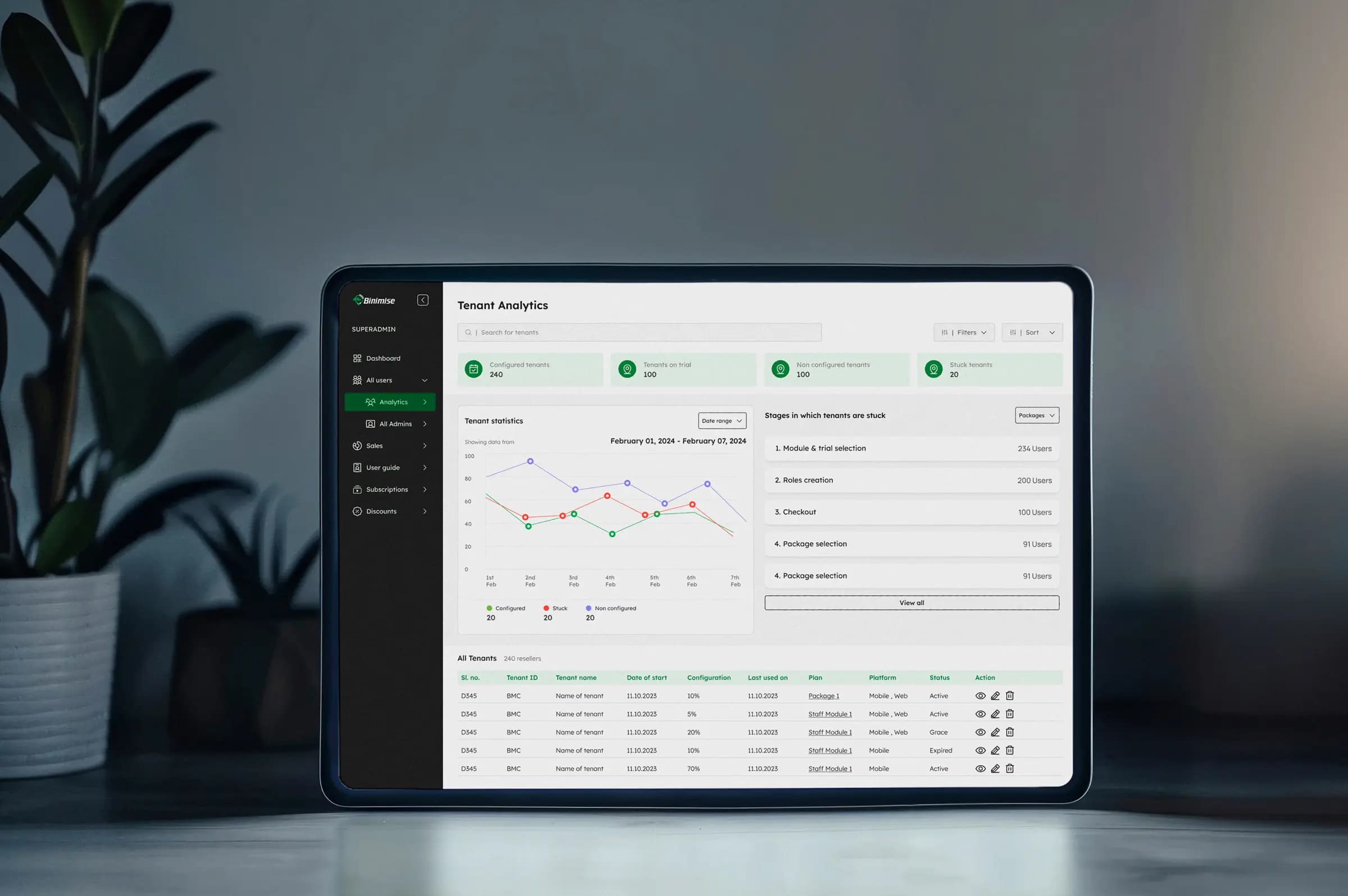
The operational core of Binimise. A live, map-based view of all collection vehicles, field staff, and IoT-connected assets across the city. Aggregates data from all platform modules into a single real-time dashboard for city commissioners.
Triggers automated alerts when threshold conditions are breached: bin overflow, vehicle breakdown, GPS fence violation, unresolved complaint SLA breach. Role-based access ensures each user sees data relevant to their function and jurisdiction.
02
Ultrasonic fill-level sensors transmit bin capacity readings at configurable intervals to the Binimise cloud backend. When a bin reaches 80% capacity, the system flags it for collection and automatically adjusts the day's route plan for the nearest available vehicle.
Temperature sensors detect heat anomalies indicative of fire and trigger immediate alerts. Dynamic route optimization reduced unnecessary vehicle trips by 25–30% in pilot deployments. Fire detection alerts eliminated a safety blind spot that previously depended on visual inspection.
03
Every vehicle in the municipal fleet is tracked in real time using GPS hardware installed at the depot. Vehicle coordinates are transmitted at 30-second intervals to the Binimise backend, rendered live on the command dashboard map.
Geofences are configured around authorised operational zones, depots, and routes. Fuel consumption is tracked against expected rates and flagged when anomalies appear. Route histories, idle time, and driver behaviour are all logged and reportable.
04
Citizens submit geo-tagged complaints through the mobile app with photo attachments. Each complaint is assigned to a field worker with a defined SLA. Resolution progress is tracked in real time. Citizens receive status notifications and can verify closure.
The city has a full audit trail connecting every complaint to assignment and resolution — replacing the previous mix of phone calls, walk-ins, and WhatsApp messages with a structured intake and accountability layer.
05
Waste collection workers, supervisors, and fleet operators receive their assignments, route maps, and task checklists through the field staff app. Collections are timestamped and geotagged automatically. Supervisors can verify completion without physical inspection.
06
Platform-wide analytics enable performance monitoring, SBM compliance reporting, and cross-ward comparisons. City commissioners can identify underserved wards, underperforming vehicles, and complaint categories driving the highest volume — with data rather than verbal reports.
Before Binimise, we were managing an entire city's operations on phone calls and paper registers. Now our team can see every vehicle, every bin, every complaint on one screen — in real time. The visibility has transformed how we make decisions, and the IoT integration alone has cut our operational waste by nearly a third.
Operations Commissioner, Urban Local Body
Smart city platforms are among the most complex software products to build — IoT hardware, real-time data, multi-role access, and deployment across live government operations. Here is what makes Creuto the right partner.
From sensor hardware integration and MQTT data ingestion to real-time dashboards and alert engines — Creuto delivers the complete IoT architecture, not just the front-end application layer.
A smart city platform serves commissioners, engineers, field workers, contractors, and citizens simultaneously. We design distinct, role-appropriate experiences for each user type within one coherent system.
Binimise is live and operational across multiple urban local bodies in India. We don't build demos — we build platforms that handle real operational load from day one of deployment.
After discovery, Creuto provides a detailed scope document and a fixed-cost proposal. No vague estimates, no change order surprises — just predictable delivery.
Every technology chosen for IoT-scale data ingestion, real-time geospatial rendering, and the ability to handle live municipal operations 24/7.
A phased build from municipal workshops to live deployment across urban local bodies — with IoT hardware integration running in parallel with software development.
Structured workshops with city commissioners, operations managers, and field supervisors to map existing workflows, define module scope, and understand IoT hardware constraints. Identified compliance reporting requirements and stakeholder access model.
Role-specific interfaces designed for command dashboards, field staff mobile app, and citizen app. Map-heavy layouts prototyped and validated with operations teams before development. Mobile designs optimised for field use on Android devices.
Backend API, real-time data pipeline, IoT ingestion layer, and role-based access system. Web dashboard and mobile apps developed in parallel using shared component libraries and API contracts.
Integration with SmartBin fill-level sensors, temperature detectors, GPS vehicle tracking hardware, RFID weighbridge systems, and underground drainage sensors. MQTT to AWS IoT Core data flow validated end to end.
End-to-end testing across all modules, roles, and device types. Load testing of real-time alert and geofence systems. Security review covering role-based access, data encryption, and audit trail integrity.
Phased deployment across urban local bodies with field staff training and on-ground support. AWS cloud infrastructure with CI/CD pipelines for reliable ongoing releases. Creuto provides post-launch support and module iteration.
Smart city deployments are not typical software projects. Field staff need training. Hardware partners need coordination. Compliance reporting cycles need to be respected. We embed engineers on-site during rollout, not just during development, because a system that breaks during a Monday morning collection round is a system that fails the city.
Binimise is operational across multiple urban local bodies, processing live IoT data and citizen complaints every minute of every day.

Everything you need to know about building a product like this with Creuto.
Yes. The platform's IoT integration layer is hardware-agnostic and communicates via standard protocols including MQTT and REST. We have integrated with multiple sensor vendors and GPS hardware suppliers. Integration scope and compatibility are assessed during the discovery phase.
The field staff mobile app supports offline data capture with automatic sync when connectivity is restored. IoT devices use configurable transmission intervals and local buffering to handle intermittent connectivity. Critical alerts are delivered via SMS as a fallback channel.
Yes. Binimise is built on a modular architecture. New operational domains — drainage monitoring, streetlight management, property tax integration — can be added without rebuilding existing modules. The command dashboard aggregates data from all active modules automatically.
A full Binimise deployment including IoT integration, all core modules, and field staff onboarding typically takes 5–7 months from discovery to go-live. Timeline varies based on the number of active modules, IoT hardware complexity, and data migration requirements from legacy systems.
Smart city platforms of this scope — multi-module dashboard, citizen and field staff apps, IoT integration, and analytics — typically cost between $80,000 and $200,000 USD depending on number of modules, IoT hardware complexity, and rollout scope. Creuto provides a fixed-cost proposal after discovery.
Whether you operate a single ULB or a network of cities — Creuto builds IoT-powered platforms that turn fragmented municipal operations into one connected system.
IoT integration. Real-time dashboards. Field-ready mobile apps. One team. Fixed price.
Book a free consultation11th Floor, O-Hub, Chandaka Industrial Estate, Infocity, Bhubaneswar, Odisha 751024
Level 4, 11 York Street Sydney Startup Hub Sydney, NSW – 2000
30 N. Đinh Nghệ, Phước Mỹ Sơn Trà, Đà Nẵng / Da Nang City – 550000
Level 25, AIDP Business Tower, Dubai Marina, United Arab Emirates
50 Beauchamp Street, Wellington, WGN 5028, New Zealand
© 2026 Creuto All Rights Reserved