Benefits of Agile Methodology in Custom Software Development
Benefits of Agile methodology in custom software development: flexibility, earlier value, quality and transparency, and how Agile goes wrong.
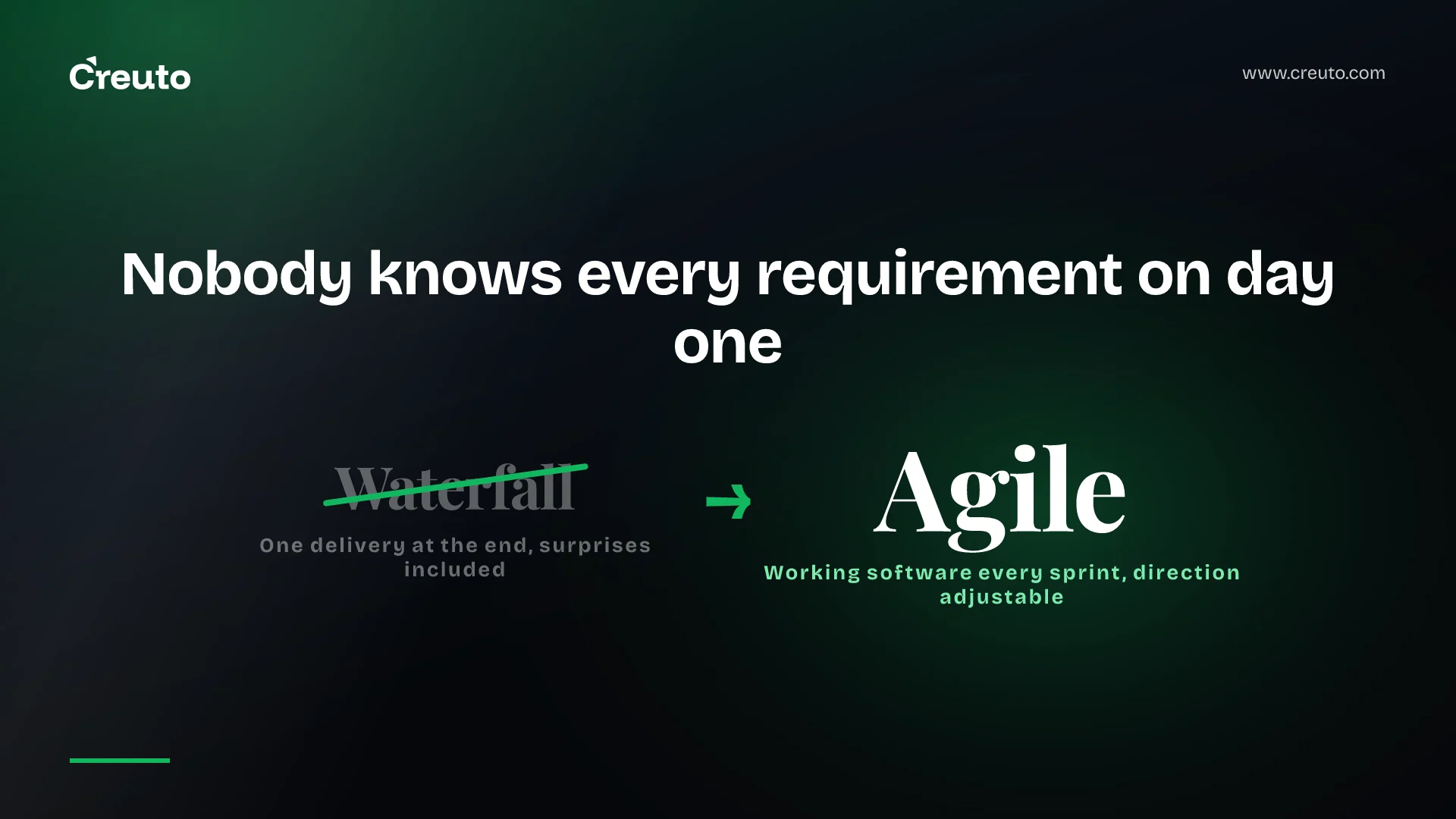
Custom software is built to requirements that are rarely complete on day one. Businesses learn what they need by seeing working software, markets change mid-project, and users surprise everyone. That is why Agile methodology has become the default way to deliver custom software: it is designed for learning as you go. This guide explains what Agile is, its real benefits, and how to make it work with a development partner.
What is Agile methodology?
Agile is an approach to software development based on the Manifesto for Agile Software Development, published in 2001. It values individuals and interactions, working software, customer collaboration and responding to change. In practice, teams deliver in short cycles — sprints of one to four weeks in Scrum — each ending with working, reviewed software, instead of a single delivery at the end as in the traditional Waterfall model.
The benefits of Agile in custom software development
1. Flexibility when requirements change
Priorities can be reviewed every sprint. New insights change the plan without derailing the project.
2. Earlier value
Usable features ship early and continuously, so the business benefits — and learns — long before the full scope is finished.
3. Closer client collaboration
Regular demos and reviews keep the client involved, so misunderstandings are caught in days rather than months.
4. Better quality
Testing and integration happen continuously, so defects are found when they are cheapest to fix. Automated tests and CI/CD make this sustainable.
5. Controlled cost and risk
Because work is prioritised by value, the most important features are built first. If the budget or timeline tightens, you stop with a useful product rather than an unfinished one.
6. Transparency
Sprint boards, burndown charts and demos show real progress, making it harder for problems to hide.
7. Better team ownership
Cross-functional teams that plan their own work and see its impact tend to take more ownership of the outcome.
When Agile goes wrong
- No product owner with authority. Without someone who can make priority decisions quickly, sprints stall.
- Ceremonies without substance. Stand-ups and retrospectives that change nothing are overhead.
- No definition of done. Work is "finished" but untested or undeployable.
- Fixed scope, fixed price, called Agile. If nothing can change, it is not Agile.
- Weak requirements. Agile does not remove the need for clear acceptance criteria — especially with AI-assisted coding, as we explain in acceptance criteria review.
How to implement Agile with a development partner
- Start with discovery. Agree goals, users and a prioritised backlog before the first sprint.
- Name a product owner. One person on the client side who can make decisions.
- Agree a definition of done. Tested, reviewed, documented and deployable.
- Hold regular demos. Review working software every sprint.
- Use retrospectives. Change one thing each sprint based on what the team learned.
- Choose a commercial model that fits. Time-and-materials or phased budgets work better than rigid fixed scope.
Agile works best alongside good architecture and product thinking; see product-first engineering and why software projects fail. Our custom software development teams work in short, demo-driven sprints so you see progress — and can change direction — every few weeks.
Frequently asked questions
Agile is an approach to software development based on the 2001 Agile Manifesto. Teams deliver working software in short cycles, often one- to four-week sprints, collaborate closely with the client and adjust priorities as they learn.
Agile gives custom software projects flexibility when requirements change, earlier delivery of useful features, closer client collaboration, continuous testing, better cost and risk control through prioritisation, and transparent progress.
Waterfall delivers software in sequential phases with one delivery at the end, assuming requirements are known upfront. Agile delivers working software in short iterations and adapts the plan based on feedback, which suits projects where requirements evolve.
Agile projects often fail because there is no empowered product owner, no clear definition of done, ceremonies without real change, weak acceptance criteria, or a fixed-scope contract that prevents the plan from adapting.