Aquaculture water quality monitoring system: the hidden cost
Buying an aquaculture water quality monitoring system? DO probe upkeep and 3 a.m. phone-call alerts matter more than the dashboard. Thresholds and costs.
The oxygen number most shrimp farms quote as their alarm threshold, 3 mg/L, comes from a standard written for pond effluent, not for the water the animals live in. An aquaculture water quality monitoring system is only as good as the threshold it alarms on, the probe that measures it and the person it wakes up. By the end of this piece you will know which of those three your buy-or-build decision actually turns on, and why it is rarely the dashboard.
The short version: dissolved oxygen (DO) is the parameter that kills a crop overnight, DO probes need maintenance on a schedule most farm budgets ignore, and the alert at 3 a.m. has to be a phone call, not an app notification. Price those three things and the subscription-versus-custom question mostly answers itself.
What dissolved oxygen level is safe for shrimp? Less settled than the dashboards suggest
There is no agreed lethal-free floor. Claude Boyd and Terry Hanson, writing for the Global Seafood Alliance, state plainly that accepted minimum dissolved-oxygen criteria for warmwater aquaculture species have not been developed. Every threshold on a vendor dashboard is therefore a choice somebody made, and you should know whose.
The oldest widely used figures come from the FAO-hosted Manual on Pond Culture of Penaeid Shrimp (1978). It notes that many workers cite 2 ppm as the minimum for good shrimp growth, then adds that there are inadequate data to support it. It suggests growth should be best above 3 ppm, records stress signalled at 1.4 ppm in P. japonicus when the animals start burrowing, and treats 1.2 ppm as the level at which shrimp start to die. (For dissolved oxygen in water, ppm and mg/L are effectively the same unit.)
The same manual carries the detail that should worry anyone setting an alarm at the lethal line: it records a pond die-off when oxygen reached a night-time low of only 2.7 ppm, well above the 1.2 ppm mortality figure. Averages and lab thresholds do not describe what a pond does at its worst hour.
Where the popular 3 mg/L figure really comes from
The 3 mg/L number is real, but its context usually gets lost. In a 2001 article on the Global Seafood Alliance's programme, Boyd describes a minimum of 3 mg/L with a target of 4 mg/L for shrimp farm effluents, the water leaving the farm. It is a discharge standard. Treating it as a validated in-pond survival threshold reads more into it than the source says.
And many working ponds sit below it routinely. Boyd and Hanson write that aerated channel catfish and shrimp ponds often have minimum daily dissolved oxygen concentrations below 3 mg/L, and that the daily minimum, the lowest concentration during the night, is the figure of greatest concern. That is the operational point for a monitoring system: the number that matters is the pre-dawn trough, and it arrives when your staff are asleep.
| Figure | What the source actually says | Source |
|---|---|---|
| 2 ppm | Commonly cited minimum for growth; "inadequate data to support this conclusion" | FAO-hosted manual, 1978 |
| 3 ppm | Growth should be best above this level | FAO-hosted manual, 1978 |
| 1.4 ppm | Stress signalled by burrowing in P. japonicus | FAO-hosted manual, 1978 |
| 1.2 ppm | Base at which shrimp start to die | FAO-hosted manual, 1978 |
| 3 mg/L min, 4 mg/L target | Standard for shrimp farm effluent | Boyd, 2001 |
Practically, this means your alarm thresholds should be configurable per pond, per species and per stage, and should fire on the trend towards the trough rather than only on crossing a line. A system that hard-codes one number is making a biology decision on your behalf.
The aquaculture water quality monitoring system cost is in the probe, not the app
Every pond water quality sensor that measures DO is one of two broad types, and they fail differently. HORIBA's technical note on galvanic vs optical dissolved oxygen sensors lays out the trade-off clearly.
Optical vs galvanic DO sensor for aquaculture
| Property | Galvanic DO sensor | Optical DO sensor |
|---|---|---|
| Consumable replacement | Tip about every 6 months, depending on application and handling | Sensor cap about every 12 months, depending on application and handling |
| Calibration drift | Tends to drift; frequent calibration required | Holds calibration better; regular calibration still recommended |
| Water flow | Stirring or flow required | Not required |
| Response time | Faster | 2-4x slower than electrochemical sensors |
| Upfront price | Cheaper | More expensive |
Two lines in that note matter more on a pond than in a lab. First, the galvanic anode is continuously consumed even when the sensor is not in use, so a spare probe on a shelf is wearing out too. Second, galvanic sensors need water moving across them, which a still pond at night, with an aerator that has tripped, does not provide. The sensor is least reliable exactly when you need it most.
Optical caps are not set-and-forget either. YSI says an EXO optical DO cap is replaced once the previous cap has exhausted its usable life, typically about one year, and that each cap ships with calibration coefficients specific to that cap, which must be entered into the instrument. Across hundreds of ponds, that is a parts-and-records process, not a one-off purchase.
Biofouling is the maintenance line nobody budgets
Pond water is rich in organic matter, and probes foul. An Auburn University review of automated DO sensing and aerator activation from 2000 describes membranes fouling quickly, one commercial design releasing chlorine to oxidise buildup and another sweeping the membrane with a brush every couple of seconds. It lists the ways these installations drifted or broke: faulty pumps, faulty temperature sensors, dirty membranes, algae and barnacles encrusting moving parts, and lightning. The hardware has improved since, but the failure list reads as current to anyone who has pulled a probe out of a shrimp pond.
The consequence for your decision: whoever owns the sensor fleet owns a recurring field-service job. Count the probes, multiply by the replacement interval, add a cleaning round, and decide who in your organisation does it. That number belongs in the comparison before any software does.
A shrimp pond low oxygen alert system has to ring a phone
The 2000 Auburn review is blunt: "Warning systems should not be optional", listing flashing lights, buzzers, computer messages and telephone calls, and recommending that sensors also monitor whether the aerators are actually running. It also notes that aerator malfunctions and electrical supply problems have caused crop losses. A DO reading is only half the picture; the other half is whether the aerator you think is on is turning.
Indian vendors have built along the same lines. Eruvaka's Floating Sensor Buoy, measuring dissolved oxygen and pH, was described in 2014 as a system that alerts farmers immediately on their mobile phones. AquaExchange's system, profiled by the Global Seafood Alliance in September 2023, alerts a farm supervisor first and escalates to the farmer by mobile alert or call if the problem is not fixed, and the company reported more than 500,000 alert calls made to farmers.
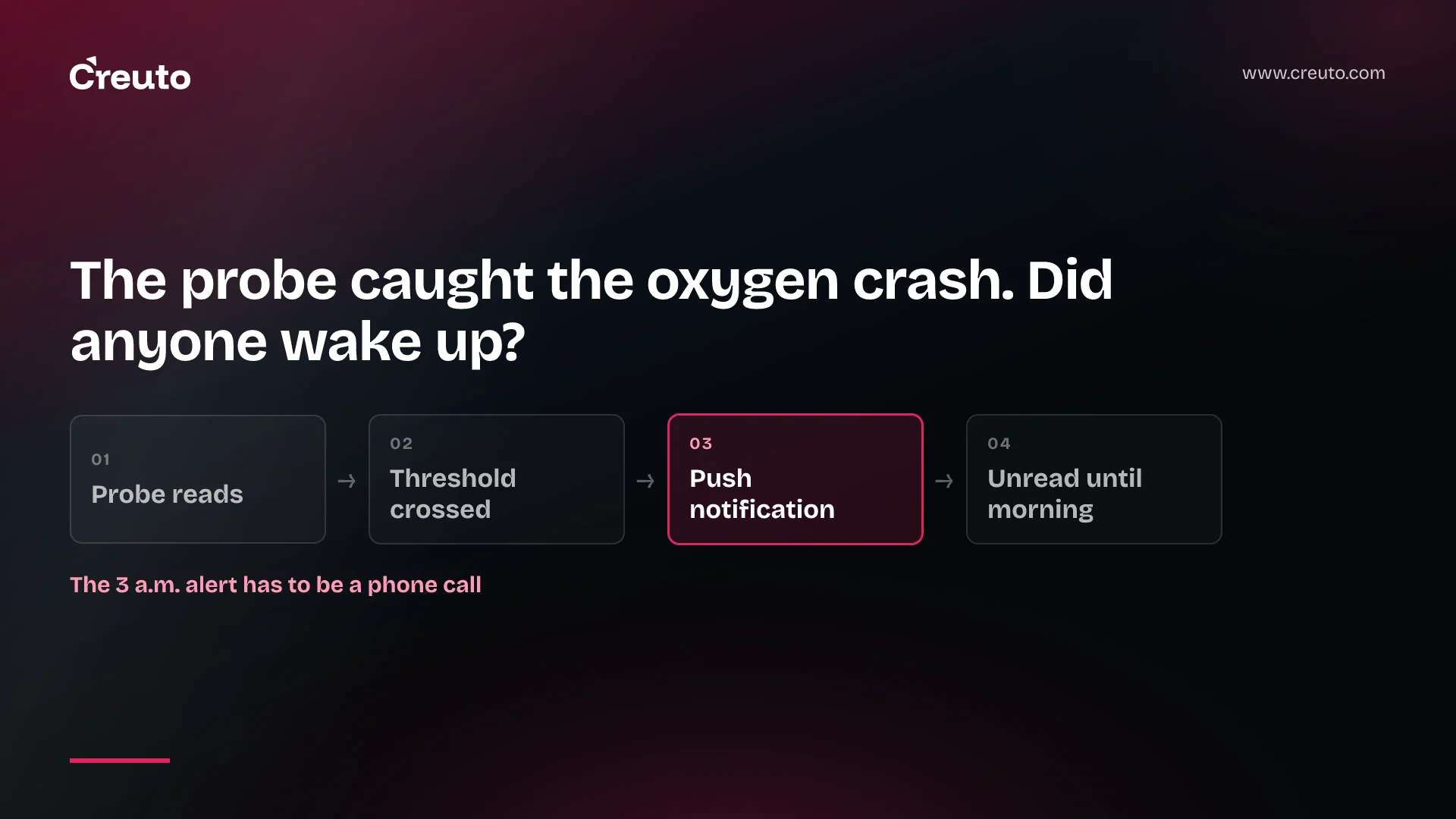
The pattern is the requirement. A push notification is easy to build and easy to sleep through: phones go on silent, apps get killed by battery optimisation, and the notification sits unread until morning. The flow that saves a crop is: the probe reads, the threshold is crossed, the call goes to the pond supervisor, it escalates if nobody acknowledges, and someone confirms the aerator is running. If any vendor or internal build stops at the push notification, the 3 a.m. failure is still open.
IoT aerator control on a shrimp farm
Closing the loop, switching aerators on when DO falls, is where monitoring starts paying for itself in power as well as survival. AquaExchange describes PowerMon as a device for live aeration monitoring and power factor management, paired with an automatic power factor controller. If you build, aerator control is the part to treat most carefully: a control loop driven by a drifting galvanic probe can switch aerators off when it should not, so it needs a fail-safe default to "on" and a watchdog on stale readings.
LoRaWAN or GSM for farm sensors: pick by where the gateway can live
Connectivity is a site decision more than a technology one. LoRaWAN puts low-power radios on each buoy and one or more gateways on the farm, which then need power, a mast and a backhaul link of their own; it suits contiguous pond blocks where you control the land. GSM or NB-IoT puts a SIM in every node and leans on the operator's tower, which suits scattered ponds across villages but makes each node's coverage and data plan your problem. The academic literature on LoRa pond deployments is mostly short prototype trials, so we would not quote range figures from it; test your own site with a gateway on the mast you actually have.
Whichever you choose, the alerting path should not share a single point of failure with the sensor path. If the gateway loses power in the same outage that stops the aerators, the system goes silent at the worst possible moment. Buffer readings on the node, alarm on missing data as loudly as on low DO, and keep the voice-call trigger in the cloud where an outage on the farm cannot suppress it.
How much does shrimp pond monitoring cost per acre?
The one published per-acre subscription price we could find is AquaExchange's: a pay-as-you-use subscription of two dollars per acre per month, as reported in September 2023. At that rate, a 300-acre operation would pay about $600 a month, or $7,200 a year, with no upfront hardware purchase. The same profile says more than 15 percent of India's shrimp farms had subscribed. Check current pricing directly; a 2023 figure is a reference point, not a quote.
For the build side, the only published system cost we found is old: the 2000 Auburn review put automated DO systems at between $2,000 and $3,500 per 5-ha pond, and argued that energy savings alone were unlikely to pay for one within five years, while avoiding a single oxygen-related pond kill in five years would. Hardware prices have changed a great deal since 2000; the logic has not. The return on monitoring is the crop you do not lose, not the electricity you save.
Build vs buy aquaculture monitoring: the strongest case for subscribing
The case for buying is stronger than most build advocates admit. A subscription vendor carries the probe inventory, the cap replacements, the field technicians and the voice-call infrastructure. AquaExchange, for one, reports about 40,000 acres automated, which is a lot of field experience to replicate. Per-acre pricing turns capital into operating cost. If your ponds are standard, your team has no appetite for running a sensor fleet and you have no farm software that needs the data, subscribe. That is the right call for many operators.
Building becomes the better choice when the data has to live somewhere else. If you already run farm management, feed, hatchery or processing software, a vendor dashboard becomes another silo your staff have to check. We covered that wider decision in aquaculture farm management software: build, buy or both. The same logic applies to records you must keep for regulators, which we looked at in what farms record for Coastal Aquaculture Authority registration. Our own Aquapulse platform puts pond monitoring in the same system as disease prediction, advisory and supply chain, with separate views for farmers, field agents and operations staff, because a reading is only useful once it reaches the person who has to act on it.
There is also a middle path: buy sensors and connectivity from a hardware vendor that exposes raw readings through an API, and build the thresholds, escalation calls, aerator logic and integration yourself. You keep control of the decisions that are specific to your farm and leave the field hardware to people who service it for a living. Ask any vendor, before signing, whether you can pull raw time-series data out programmatically. If the answer is no, you are buying a dashboard, not a data source.
What to decide before you talk to a vendor or a developer
Four questions settle most of the decision. Who replaces and cleans the probes, and on what interval? Who gets the 3 a.m. call, and who gets it if they do not answer? Does the aerator fail safe when readings go stale? And where does the data need to end up? Answer those and the real water quality monitoring requirements are on paper, whichever way you go.
If the answers point to building, or to the hybrid where you own the alerting and integration layer around vendor hardware, our custom software development team can scope it with you: the escalation logic, the aerator control rules, and the integration into the farm and processing systems you already run.
Frequently asked questions
No accepted minimum dissolved oxygen criterion exists for warmwater aquaculture species. An FAO-hosted 1978 shrimp manual suggests growth is best above 3 ppm, stress appears around 1.4 ppm and shrimp start dying at 1.2 ppm, but it also records a die-off at a night-time low of 2.7 ppm, so alarms should sit well above the lethal line.
Dissolved oxygen sensors need regular calibration whichever type you use. HORIBA says galvanic sensors drift and need frequent calibration, with tips replaced about every six months, while optical sensors hold calibration better and need a new cap about every twelve months. YSI optical caps also carry cap-specific calibration coefficients.
A shrimp pond low oxygen alert should escalate to a phone call, because dissolved oxygen is lowest during the night and app notifications are easy to miss while staff sleep. AquaExchange, for example, alerts a supervisor first and then calls the farmer if the problem is not fixed, and reported over 500,000 alert calls.
Shrimp pond monitoring from AquaExchange was priced at two US dollars per acre per month on a pay-as-you-use subscription, as reported by the Global Seafood Alliance in September 2023. For a 300-acre operation that is about 600 dollars a month. Confirm current pricing with the vendor before budgeting.
An optical DO sensor suits unattended aquaculture ponds better in most cases, because it needs no water flow across it and drifts less than a galvanic sensor. Galvanic sensors are cheaper and respond faster, but their anode is consumed even when idle and they need stirring, which a still pond at night may not provide.
LoRaWAN suits contiguous pond blocks where you can power and mount your own gateway, while GSM or NB-IoT suits ponds scattered across villages that rely on operator towers. Whichever network you choose, buffer readings on the node and raise an alarm on missing data as loudly as on low dissolved oxygen.