Aquaculture farm management software: build, buy or both
Aquaculture farm management software in India: what AquaExchange, FarmMOJO and Skretting 360+ cover, and when a farmer network should build its own.
AquaExchange says its tools support automation across more than 25% of India's shrimp farming acreage, and technology is still a minority of its revenue. In its March 2026 Series B coverage, the company put its technology share at around 13% of revenue, up from about 3% in FY25. That tells you how aquaculture farm management software is sold in India: as the front end of a device, feed or advisory business. By the end of this post you will know what each platform actually covers, where the gaps sit for a company that works with hundreds of farmers, and when licensing beats building.
If you run operations or digital at a feed company, exporter, FPO or agri-fintech, the choice is not between good and bad apps. It is between running your farmer network on someone else's data model or on your own.
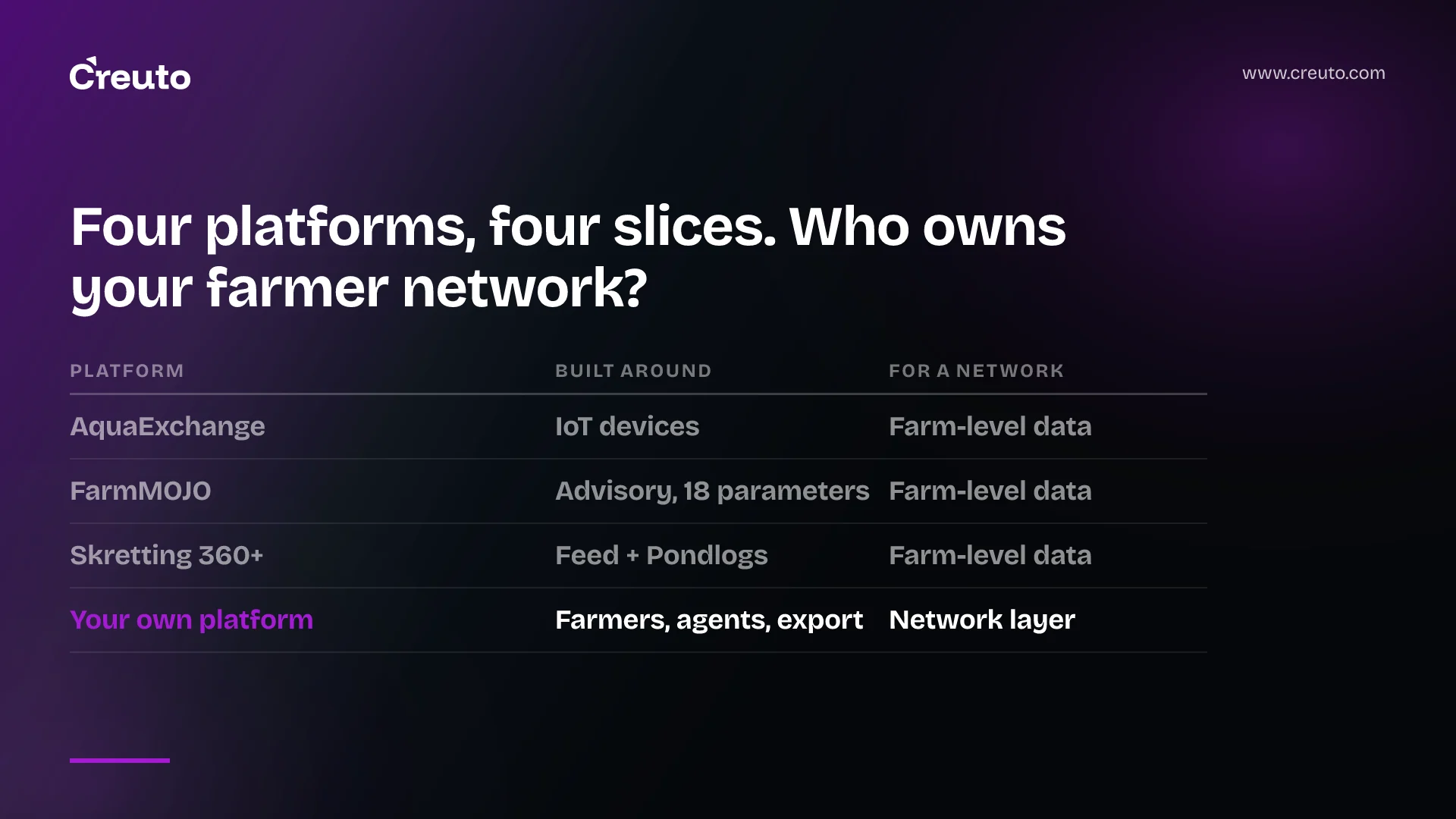
Aquaculture farm management software in India is four businesses, not one category
Each of the platforms a buyer meets first was built to serve its owner's main line of revenue. That is not a criticism; it is the most useful lens for comparing them. The table below uses only what each company or its press coverage has published, with the date of the figure, because several of these numbers are years old.
| Platform | What it centres on | Published scale and model |
|---|---|---|
| AquaExchange (NextFarm app) | IoT devices, farm automation, finance and insurance, market linkage | About 70,000 acres and 5,600 farmers across five states in India; farmers pay upfront subscription fees for hardware and services (Inc42, March 2026) |
| Aquaconnect (FarmMOJO) | AI farm advisory on pond data the farmer enters, product recommendations, marketplace | Paid version at Rs 2,000-10,000 per pond per cycle; 6,000 farmers (Outlook Business, February 2020) |
| Skretting 360+ (Pondlogs) | Feed, feeding control through the PondMother feeder, pond records | Bundled with Skretting feed and technical support; no farmer count published (Skretting India) |
| Aquapulse (built by us) | Farmer app, field agent dashboard, disease prediction, supply chain and export linkage | 6,000+ registered farmers, 150+ villages, 8,000+ acres monitored across Odisha, Andhra Pradesh and West Bengal |
Two things stand out. First, the figures move fast and the press is not always current: AquaExchange reported about 40,000 automated acres in a September 2023 Global Seafood Alliance profile and about 70,000 acres in India by March 2026. Second, FarmMOJO's own numbers disagree with each other depending on when you read them. A NASSCOM case study that refers to pilots planned for July 2019 says the app worked with 3,000 farmers; the February 2020 Outlook Business piece says 6,000. We found no current figure, so treat any farmer count you are pitched as a claim to check, not a fact.
What the device-led platform covers
AquaExchange's NextFarm app, as listed on the App Store, covers crop updates, stocking and shifting, netting to track AWG, ABW and FCR per pond, harvesting, dissolved oxygen and pH monitoring, water and feed reminders, and data from its own devices such as PowerMon and AquaBot. The company describes a portfolio of around 17 IoT products. If your farmers already run those devices, this is a strong farm-level tool.
What the advisory-led platform covers
FarmMOJO's model judges water quality on 18 parameters, including salinity, pH, dissolved oxygen and bloom levels, from data the farmer enters or a staffer enters for them. The NASSCOM case study adds that its farm-care algorithm compares feed, probiotic and mineral products and recommends them to farmers, which is where a marketplace business earns its margin.
What the feed-led platform covers
Skretting 360+ pairs Skretting feeds with Pondlogs, which it describes as a pond performance tracker that monitors and controls feeding, records farm activities and gives remote access to the PondMother feeder. The stated goals are a lower feed conversion ratio, shorter cycles and better survival. Skretting's parent, Nutreco, took full ownership of Eruvaka, a Vijayawada company that builds cloud pond management tools and smart feeders, so that Skretting could deliver on-farm software in-house.
Why a feed company or exporter hits the edge of these apps
Each of these products is shaped around a single farmer and a single pond. That is the right shape for the farmer. It is the wrong shape for a company whose work happens between farms: allocating field agents, aggregating harvest forecasts, tracing a lot back to its pond for a buyer, and deciding which villages need a visit this week.
Look at what the business models imply for you. If you sell feed and you license a farm app owned by another feed brand, your farmers' feeding data sits with a competitor. If you are an exporter and the app's owner runs its own market linkage, you are building your supply base on a channel that also sells to your rivals. If you lend to farmers, you need pond history in a form your credit model can read, not a dashboard you can log into. None of this is in a vendor's terms of service as a warning; it follows from who earns what.
Export pressure makes the record-keeping matter more. Frozen shrimp earned about US$5.18 billion in 2024-25, 69.46% of India's seafood export dollar earnings, and the US took 311,948 tonnes of it, according to MPEDA. Buyers in those markets ask for pond-level records, and the regulatory side is moving too. We covered what farms already record for Coastal Aquaculture Authority registration and what the proposed fisheries product passport would add. A farm-level app can hold those records; it does not necessarily hand them to you in the shape your export team needs.
What features does aquaculture farm software need?
Aquaculture farm software for a network operator needs five layers, and the vendors above each cover one or two well. This is the list we would scope against.
- Pond records. Stocking, netting samples (ABW, AWG, FCR), feed, treatments and harvest per pond and per crop cycle. Every platform above does some of this; the question is whether you own the records.
- Pond water quality monitoring software. Dissolved oxygen, pH, salinity and temperature, from IoT sensors where farmers have them and manual entry where they do not. Your system has to accept both, because most networks are mixed.
- Disease prediction and advisory. Alerts built on the pond history, routed to the farmer and to the field agent who covers that pond.
- An aquaculture field agent app. Visit planning, farm lists ranked by risk, and a record of what the agent saw and advised. This is the layer the farmer-first apps leave out.
- Traceability and market linkage. Harvest forecasts, lot records and buyer, processor and exporter connections, held as data your export and finance teams can query.
The fourth layer is where the operating economics sit. On the network we built, one field agent supports 150-200 farms, against 30-40 under visit-based models, according to our Aquapulse case study. That gain comes from the agent dashboard and the risk ranking, not from the farmer app.
When licensing an existing shrimp farm management software is the right call
The strongest case for buying is real. AquaExchange, Aquaconnect and Skretting have years of pond data and agronomy behind their models, which a new build does not have on day one. A pay-as-you-use subscription of two dollars per acre per month, the model AquaExchange described in 2023, is cheap next to engineering salaries. And the hardware is the hard part: designing, manufacturing and servicing sensors and feeders in Andhra Pradesh pond conditions is a business in itself.
Licensing is the right choice if your relationship with farmers is a single transaction, such as feed supply, and you do not need to run field agents or own pond history. It is also right if your farmers already use one vendor's devices and you only need to see their data. Building is the wrong choice if you cannot name the workflow that crosses farms, agents and buyers, because that workflow is the only thing a custom build gives you that a licence does not.
The hybrid is often the honest answer: let farmers keep the devices they trust and build the network layer above them. That depends on whether the vendor will give you the data. Ask for that in writing before you sign, and ask for the format, the frequency and who owns it if you leave.
What we learned building Aquapulse for 6,000+ farmers
Aquapulse is the platform we built for an aquaculture network that is live across Odisha, Andhra Pradesh and West Bengal. Before it, operations ran on spreadsheets, messaging groups and phone calls, and field agents could not reach their farms often enough. The platform has four user roles: farmers on a mobile app, field agents and extension workers on a web dashboard, operations and supply chain teams, and super admins.
Three engineering decisions shaped it. Sensor data arrives through AWS IoT Core over MQTT and lands in TimescaleDB alongside PostgreSQL, because pond readings are a time series and the business records are not. The farmer app is React Native with Expo, and it supports manual logging so that farms without sensors still produce usable history. The prediction layer runs on Python and TensorFlow, and its risk alerts go to the agent as well as the farmer, which is what changes how the extension network works.
The case study records disease risk flagged 5-10 days before visible symptoms and a 12-18% reduction in feed cost per crop cycle. Those are outcomes for one network with its own agronomy team, not a promise for yours. The part that transfers is the structure: the network operator owns the data, and the farmer, the agent and the exporter all work from the same pond record.
How much does it cost to build an aquaculture app?
Building an aquaculture platform for farmers costs what its integrations cost. Our Aquapulse case study gives an indicative build cost of $60,000-$150,000, and the spread is mostly decided by three questions: whether you integrate existing sensors or design your own, how many roles beyond the farmer you serve, and whether disease prediction is a rules engine or a trained model.
On timing, a focused MVP typically takes us 6-10 weeks, and larger enterprise platforms 3-6 months depending on complexity, integrations and scope. For a network operator, a sensible first release is the farmer app with manual logging, the field agent dashboard and pond records you own; sensor integration and prediction follow once there is history to train on. Our breakdown of the four decisions that move app cost applies here too.
Build, buy or both: deciding for your farmer network
Write down the three workflows your team runs across farms today, such as agent visits, harvest planning and buyer traceability. If none of them exist, license a farm app and revisit in a year. If they exist and run on spreadsheets and phone calls, that is the system to build, and the farm-level apps can feed it.
If you are weighing a platform for farmers, field agents and export linkage in one system, our custom software development team built Aquapulse on that shape and can scope your network layer against the apps your farmers already use.
Frequently asked questions
The best shrimp farm management software in India depends on what you sell. AquaExchange's NextFarm suits farms using its IoT devices, FarmMOJO focuses on advisory from pond data, and Skretting 360+ bundles Pondlogs with Skretting feed. A company running field agents and export linkage across many farms often needs its own network layer above these.
Building an aquaculture app costs what its integrations cost. Creuto's Aquapulse case study gives an indicative build cost of $60,000 to $150,000, with the spread driven by sensor integration, the number of user roles beyond farmers, and whether disease prediction uses rules or a trained model.
Aquaculture farm software for a farmer network needs five layers: pond records per crop cycle, water quality monitoring from sensors and manual entry, disease prediction and advisory, a field agent app for visit planning, and traceability with buyer and exporter linkage held as data the operator owns.
A shrimp exporter should license a farm app when it only needs to see farm data and has no workflow across farms. It should build when it runs field agents, harvest planning or buyer traceability across many farms, because that cross-farm workflow is what a licensed farmer app does not provide.
An aquaculture platform for farmers can start as a focused MVP, which Creuto typically delivers in 6 to 10 weeks. Larger enterprise platforms with sensor integration, several user roles and export linkage typically take 3 to 6 months, depending on complexity, integrations and scope.