API integration cost: what the price ranges leave out
Why API integration cost quotes run from $2,000 to $40,000 for the same job: partner API quality, webhooks, versioning and the maintenance tail.
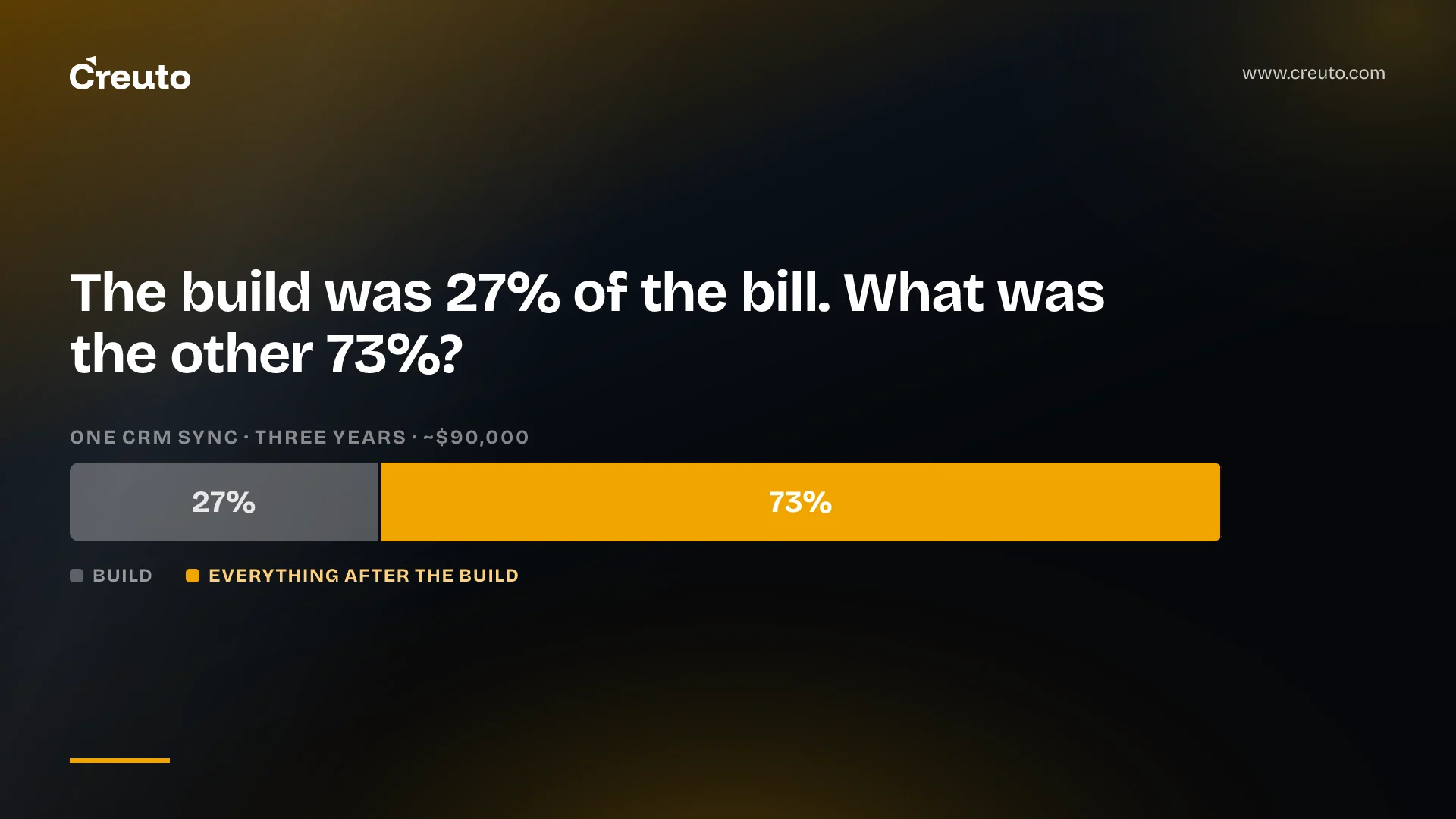
The same "basic" API integration is priced at $2,000 to $10,000 by one agency and $2,000 to $15,000 by another, while an integration vendor's own three-year model puts one two-way CRM sync at roughly $90,000, with the build only 27% of it. API integration cost is decided mostly by the partner API and the years after launch, not by the number of endpoints. By the end you will know which lines of a quote to check, and why two vendors pricing the same integration can sit $20,000 apart.
That matters if you are holding two quotes right now. The cheaper one is not necessarily naive, and the expensive one is not necessarily gouging. They are usually pricing different things: one prices the build, the other prices the build plus the first year of owning it.
| Source (who publishes it) | Headline range | Maintenance assumption |
|---|---|---|
| Scopic (development agency), July 2026 | $2,000 to $250,000+ across five tiers | No percentage given |
| Tekrevol (development agency), May 2025 | $10,000 to $150,000 or more in the USA | 10% to 20% of the build a year |
| Merge (integration platform) | nearly $50,000 per integration | 300 maintenance hours against 150 build hours |
| viaSocket (integration platform), September 2026 | $2,000 to $150,000 as the published spread | 30 to 120 fixed hours a year, plus per-customer support |
Why API integration quotes vary so much: they measure different things
Most published API integration pricing comes from someone with something to sell. viaSocket, itself an embedded integration platform, says plainly that most cost estimates published on this topic come from companies selling integration platforms, and that includes the most widely quoted one. That does not make the numbers wrong. It means each one is built on assumptions that favour a conclusion, and you should read the assumptions before the total.
Merge's "nearly $50,000 per integration" is the clearest example. It assumes an engineer salary of $150,000, 150 hours to build, 300 hours to maintain, and 150 support tickets a year at two hours each. Twice as many hours go into keeping the integration alive as into building it. If your integration is a one-way push to a stable API, those inputs overstate your cost badly. If it is a customer-facing CRM sync, they may be close.
The agencies disagree with each other on the maintenance tail too. Tekrevol puts annual upkeep at 10% to 20% of the initial development cost. viaSocket calls the enterprise rule of thumb of 15% to 25% of build cost the “wrong heuristic” for customer-facing integrations, because support load scales with the number of connected customers, not with what the build cost. Both can be right; they describe different kinds of integration.
The strongest argument for the ranges is that a buyer needs a starting number, and a tiered table gives one. We agree that the tiers are useful for that. The problem is what the tiers count. Scopic's own tier labels are "one-way sync, one system, simple auth" against "two-way sync" against "real-time sync", and its figures are described as directional planning estimates, not fixed quotes. None of the tiers tells you how well the partner API behaves, which is where the hours actually go.
What drives third party API integration cost: the API on the other side
The partner API's quality multiplies the effort more than the number of endpoints adds to it. viaSocket's model makes this explicit: a baseline of hours per tier, then a difficulty multiplier from ×0.7 for an easy API to ×2.2 for a hostile one. Its worked examples show an enterprise ERP deep integration landing at about 1,200 hours, which it calls five times the cost of a 220-hour CRM sync.
| Integration depth (viaSocket tier) | Baseline build hours | Calendar time |
|---|---|---|
| Tier 0, notify (push an event out) | 15 to 40 | Not stated |
| Tier 1, read | 60 to 130 | One to two engineer-weeks |
| Tier 2, two-way sync | 150 to 300 | Four to eight weeks |
| Tier 3, deep | 400 to 1,000+ | A quarter or more |
Scopic's list of cost factors is the honest version of what sits inside that multiplier: API maturity and documentation, sandbox availability, authentication method, rate limits and pagination, webhook support, error handling and retry logic, and vendor version changes. Here is what those look like when you are the one writing the code.
Webhooks: the contract you have to honour, not just consume
Razorpay's webhook rules are a good, concrete example of the work a price range hides. Your endpoint must respond within 5 seconds or the event is treated as unprocessed and resent. Delivery is at-least-once, so the same event can arrive twice and your handler must be idempotent, keyed on the x-razorpay-event-id header. Events can arrive out of order. If your endpoint keeps failing, Razorpay retries with exponential backoff for 24 hours and then disables the webhook until someone re-enables it in the Dashboard.
None of that is exotic, and all of it is engineering: a queue so the endpoint can acknowledge fast, a deduplication store, reconciliation that can poll the payment API when webhook order cannot be trusted, and an alert for the disabled-webhook email. A quote that prices "payment gateway integration" as a few endpoints has left this out, or will bill it later as a change request.
Auth and versioning: decisions made in the first week, paid for in year two
Stripe recommends you specify the API version in your code instead of relying on your account's default. Its webhook endpoints carry their own API version, and upgrading one means creating a new endpoint, running both in parallel while every event arrives twice, then cutting over and disabling the old one. If the original build pinned the version and made the handler idempotent, that upgrade is routine. If it did not, the upgrade is a project.
An API integration estimate breakdown you can check
Most quotes are hours multiplied by a rate, so put the two side by side. viaSocket derives effective rates from the BLS median developer wage of $135,980 in May 2025, loaded and divided by about 1,600 deliverable hours a year: roughly $65 an hour offshore or nearshore, $113 at the US median and $165 for a senior engineer in a high-cost metro. Tekrevol quotes $75 to $150 an hour for freelancers and $150 to $250 or more for agencies.
Run viaSocket's own 220-hour CRM sync through those rates and you get about $14,300 at $65 an hour and about $36,300 at $165 an hour. That is our arithmetic on their published figures, not a quote, but it answers the question most buyers arrive with. A $2,000 quote and a $40,000 quote for the same integration usually differ in scope and rate before they differ in honesty, and the low one is often a Tier 0 notify integration priced as if it were a sync.
What is the ongoing cost of an API integration?
The ongoing cost of an API integration is set by how often the other side changes, and you do not control that. viaSocket's three-year model for one Tier 2 CRM sync runs $36,080 in year one, $20,240 in year two and $33,800 in year three. The build is a minority of that total; the rest is maintenance, support and the customer-facing overhead around them.
Partner deprecations are the part nobody can schedule. HubSpot moved its /v1/, /v2/ and /v3/ endpoints to unsupported status on 15 September 2026, with enforcement in September 2027 and v4 support ending on 30 March 2027. It stopped legacy private app creation for existing accounts on 26 October 2026. We covered what that means in practice in our post on the HubSpot API deprecation and the private app change. If your CRM integration was quoted in 2025, its maintenance line did not include a forced migration of every endpoint it calls.
At portfolio scale this compounds. viaSocket's 12-integration roadmap example carries a run rate of around $152,000 a year, or one full-time engineer, before any new integration is built. Whether you agree with its inputs or not, the shape is right: the cost of an integration programme is a salary, not a project fee.
What we see in the integrations we run
Our own integration work rarely looks like the agency tiers, because the hard partner is often not a SaaS API at all. On the Nomina payroll platform, attendance comes in from biometric devices, web check-in and GPS-based mobile attendance for field staff, and feeds payroll directly. The payroll run produces bank transfer files, and the compliance engine generates PF ECR files, ESIC challans, PT returns and TDS worksheets. PF limits, ESI thresholds and state PT slabs are built into the engine and updated when government rules change.
That last sentence is the maintenance tail in its purest form. No endpoint changed, yet the integration needs work every time a statutory rule does. A quote priced on endpoint count would have missed it entirely.
On Binimise, the smart city platform we built, the integrations are hardware: SmartBin fill-level sensors, GPS vehicle trackers transmitting every 30 seconds, RFID weighbridge systems and underground drainage sensors, with MQTT into AWS IoT Core validated end to end. Device integration ran in parallel with software development rather than after it. Field hardware has failure modes no sandbox reproduces, so this work is scoped device by device. We do not publish a per-integration price for either project, and we would distrust anyone who priced this kind of work from a table.
Build vs buy an integration platform: when iPaaS is cheaper
An iPaaS or unified API is usually cheaper when you need many standard connectors in one SaaS category and your customers expect them. Published entry prices, as viaSocket listed them in September 2026, run from about $50 a month for Nango and $249 for viaSocket Embed to $650 a month base for Merge and about $999 for Cyclr, while enterprise embedded contracts run well into five figures annually. Against one engineer-year of maintenance, those are easy numbers to justify.
Buying is the wrong choice when the integration is the product's core workflow, when the other side is a device, a bank file format or a government schema that no connector catalogue covers, or when you need control over retries and reconciliation that a platform abstracts away. It is also the wrong choice for one or two integrations, where the subscription outlives the problem it solved.
| Your situation | Leaning | Why |
|---|---|---|
| 10+ customer-facing connectors to common CRMs or HRIS tools | Buy | Maintenance across many vendors is the platform's job |
| One or two ERP, payment or logistics partners, core to the workflow | Build | You need control over error handling and data mapping |
| Devices, bank files, statutory formats | Build | No connector catalogue covers them |
How to tell which API integration cost estimate is realistic for yours
The realistic quote is the one whose assumptions you can see. Before you compare totals, ask each vendor for four things, and treat a vendor who cannot answer them as giving you a guess.
- Depth. Is this a notify, read, two-way sync or deep integration? Scope mismatch explains most of the spread.
- Partner API assessment. Have they read the partner's docs for auth model, rate limits, sandbox and webhook behaviour, and what did they find?
- Failure handling. What happens on a timeout, a duplicate event or an out-of-order event, and where does that show up in the hours?
- The tail. How many maintenance hours a year are assumed, and what happens when the partner deprecates a version, as HubSpot did with v1 to v3?
If you are weighing two quotes for an ERP, CRM, payment or logistics integration and the gap between them is not explained by those four answers, our API development and integration team can review the partner API and the scope with you and tell you which tier you are actually in, before you sign either.
Frequently asked questions
An API integration costs anywhere from about $2,000 to over $150,000 in published agency guides, but the range mostly reflects scope. A one-way notification sits at the bottom, a two-way CRM sync in the middle, and a deep ERP integration at the top, with the partner API's quality multiplying the hours.
API integration quotes vary because vendors price different scopes and rates. One may quote a simple event push while another prices a two-way sync with retries, reconciliation and first-year support. Hourly rates also differ widely, from about $65 offshore to $165 for a senior engineer in a high-cost US metro.
The ongoing cost of an API integration depends on how often the partner changes its API and how many customers use it. Agency guides put upkeep at 10% to 20% of the build each year, while integration platforms model fixed maintenance at 30 to 120 hours a year plus per-customer support.
An iPaaS is usually cheaper when you need many standard connectors to common SaaS tools, since the platform absorbs vendor changes. Building is cheaper and safer when the integration is core to your workflow, involves devices, bank files or government formats, or when you only need one or two integrations.
An API integration estimate breakdown should state the integration depth, the partner API's auth model, rate limits, sandbox and webhook behaviour, how timeouts and duplicate events are handled, and the maintenance hours assumed each year, including what happens when the partner deprecates an API version.
