AI product recommendation engine: build or buy
An AI product recommendation engine on Amazon Personalize bills about $389 a month per campaign at zero traffic. Algolia's AI tier costs 3.5x. When to build.
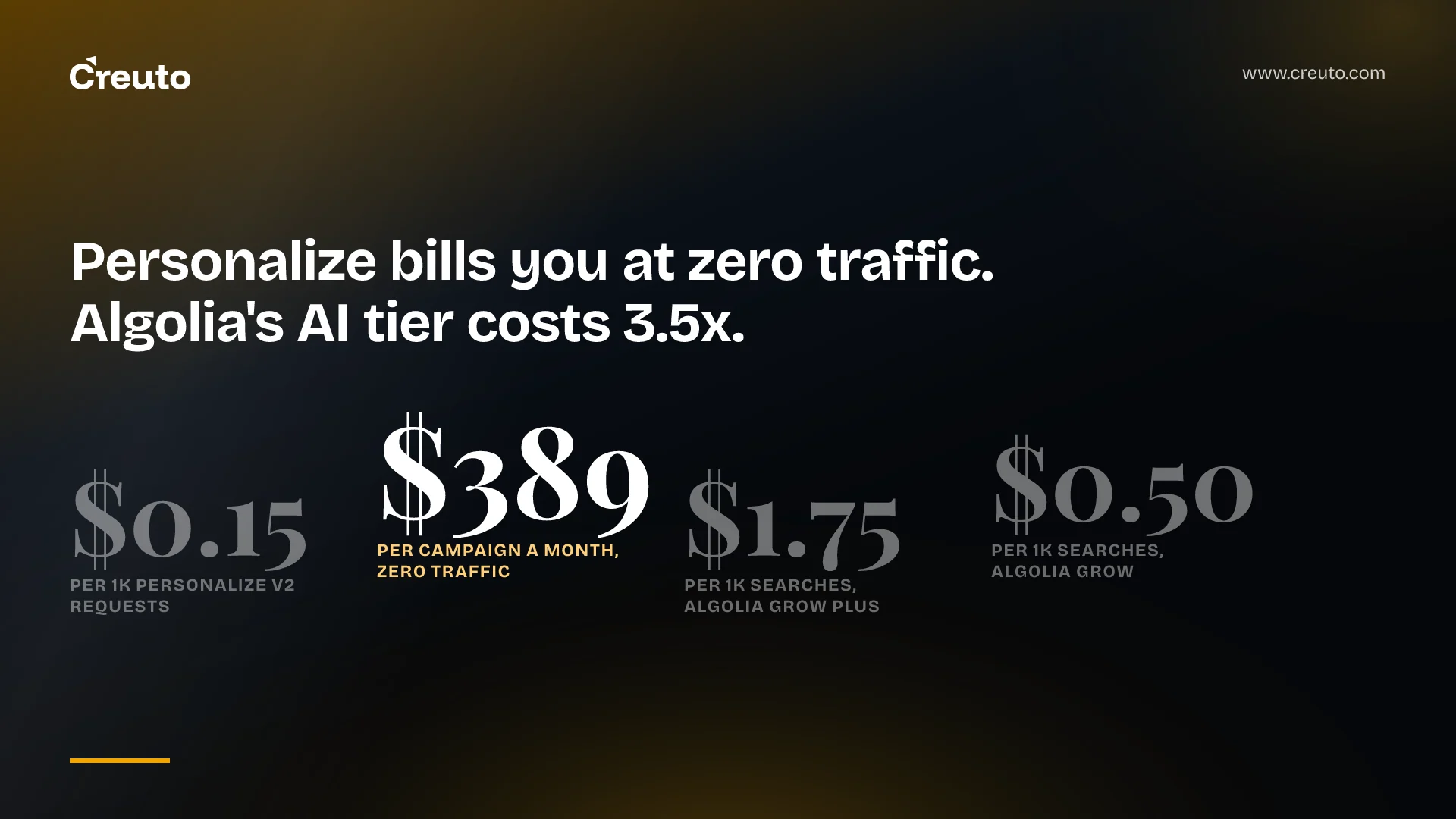
An AI product recommendation engine from Amazon Personalize costs $0.15 per 1,000 requests, plus a floor of about $389 a month for every active campaign, even with no traffic. Algolia charges $1.75 per 1,000 searches for its AI tier against $0.50 without it. Those published rates, not agency build quotes, set when building your own pays.
By the end of this post you will know what each vendor bills at your traffic, where the two rate cards hide their floors and multipliers, and which signals make a custom engine worth owning. All prices are from the vendors' own pricing pages as of November 2026, and every total below is our arithmetic on those rates.
| Line item | Published rate (November 2026) |
|---|---|
| Amazon Personalize v2 recipes, real-time or batch | $0.15 per 1,000 recommendation requests |
| Amazon Personalize v2 training | $0.002 per 1,000 interactions |
| Amazon Personalize minimum per active campaign | 1 request per second, billed even with no requests |
| Algolia Grow, keyword search | $0.50 per 1,000 searches after 10,000 free |
| Algolia Grow Plus, with AI Ranking and Advanced Personalization | $1.75 per 1,000 searches after 10,000 free |
| Algolia Recommend | $0.60 per 1,000 requests after 10,000 free |
How Amazon Personalize prices an AI product recommendation engine
Amazon Personalize prices its v2 recipes (User-Personalization-v2 and Personalized-Ranking-v2) at $0.15 per 1,000 recommendation requests for both real-time and batch recommendations. Training costs $0.002 per 1,000 interactions ingested, and data ingestion $0.05 per GB. On those three lines alone, Personalize looks cheap.
The line that changes the decision sits further down the same page. Personalize "charges a minimum of 1 recommendation request transaction per second (TPS) for all active campaigns by default", and "this minimum 1 TPS charge applies even if you make no requests." You are billed for the greater of the provisioned minimum and the traffic you actually served.
Amazon Personalize minimum TPS cost: $388.80 a month per campaign
One request per second for a 30-day month is 2,592,000 requests. At $0.15 per 1,000, that is $388.80 per active campaign per month before a single visitor arrives. This is our calculation, but AWS's own worked example confirms the method: in its v2 Example 1, a carousel getting fewer than 3,600 visits an hour off-peak is "billed for 3,600 recommendation requests per hour during this period", and the example's monthly total comes to $2,016.80.
The floor applies per campaign, and a typical storefront wants more than one. A "recommended for you" row on the home page runs on User-Personalization-v2, while re-ranking a category page for each shopper runs on Personalized-Ranking-v2. Two active campaigns put $777.60 a month on the bill at zero traffic, and a staging campaign left running for QA adds another $388.80. Delete campaigns you are not using; that habit matters more than any tuning.
The v2 recipes cost more per request than the older ones
AWS publishes two price lists on one page, and they disagree by a wide margin. Older Personalize recipes bill real-time recommendations at $0.0556 per 1,000 for the first 72 million requests a month, and training at $0.24 per training hour. The v2 rate of $0.15 is about 2.7 times higher per request, in exchange for training billed per interaction instead of per hour. If your traffic is high and your catalog changes slowly, price both before assuming the newer recipe is the cheaper one. New accounts get two months of free tier, including 50,000 real-time v2 requests a month, which covers a prototype and nothing more.
Algolia charges 3.5 times more per search for its AI tier
Algolia's pricing page lists two self-serve plans that differ mainly by AI. Grow includes 10,000 searches a month and then charges $0.50 per additional 1,000. Grow Plus includes the same 10,000 and then charges $1.75 per 1,000. The Grow Plus plan page lists what the extra $1.25 buys: AI Synonyms, AI Ranking, Advanced Personalization, Query Categorization and Collections. Both plans bill monthly with no contract.
The features most teams picture when they say "AI search" are not on either self-serve plan. NeuralSearch and real-time personalization appear only on Elevate, which has no published price and "requires an annual contract." Algolia Recommend, the carousel product, is $0.60 per 1,000 requests after 10,000 a month included on Grow and Grow Plus.
Algolia Grow Plus vs Grow pricing at one million searches
At one million searches a month, Grow costs $495 and Grow Plus costs $1,732.50, after the 10,000 free searches on each. The multiplier is exactly 3.5 at every volume above the free tier, so the AI tier's premium grows in step with your traffic. Algolia defines a search request as "a group of one or more search operations sent in a single exchange", so count what your search box actually sends per visitor before you trust a forecast.
What an AI product recommendation system costs at your traffic
Here is a worked model for a mid-sized D2C brand or marketplace. Our assumptions: 2 million sessions a month, three recommendation requests per session (home page, product page and cart), one search request per session, 20 million interactions retrained four times a month, 10 GB ingested, and a catalog under Algolia's 100,000 included records. Change any of these and rerun the arithmetic; the rates are the fixed part.
| Monthly line | Route A: Personalize v2 + Algolia Grow | Route B: Algolia Recommend + Grow Plus |
|---|---|---|
| 6 million recommendation requests | $900.00 | $3,594.00 |
| Training (80 million interactions) | $160.00 | Included |
| Ingestion (10 GB) | $0.50 | Included |
| 2 million search requests | $995.00 (keyword only) | $3,482.50 (AI Ranking, Advanced Personalization) |
| Monthly total | $2,055.50 | $7,076.50 |
| Annual total | $24,666 | $84,918 |
Route A understates its bill slightly, because the Personalize floor still applies in quiet hours: any hour in which a campaign serves fewer than 3,600 requests is billed at 3,600. Route B buys AI ranking in search as well, which Route A does not, so the gap is not purely price. Even so, Algolia Recommend at $0.60 per 1,000 costs four times Personalize v2 per request, and on this model the recommendation line is the largest single difference between the two routes.
Both bills scale linearly. Double the sessions and both totals roughly double, because neither self-serve price list has volume tiers for these lines. That linearity is what eventually makes a custom engine worth costing.
Should you build or buy a recommendation engine?
Buy, in most cases, and the honest version of that argument is strong. At $24,666 a year, Route A is a small line next to the salaries of the team that would maintain a custom engine, and it comes with training pipelines, scaling and filtering you would otherwise build and maintain. A custom engine is not just the model: it is event tracking, a retraining job, a serving layer, cold-start handling for new SKUs and A/B testing to prove it lifts click-through rate. If your catalog and traffic are ordinary, the vendor has solved your problem already.
The case for building rests on three conditions, and you need at least one of them to hold.
- Your bill is on Route B and growing. At $84,918 a year and rising with traffic, the AI search tier and the Recommend line together begin to pay for an engine you own, especially if you already run your catalog in your own database.
- Your ranking depends on live state the vendor sees late. Stock, delivery radius and vendor availability change by the minute in quick commerce and marketplaces.
- Your best signals are not clicks. Price behavior, occasion and context often predict better than view history, and a vendor's schema may not carry them.
Real-time inventory: the 20-minute gap in a 30-minute delivery
Amazon Personalize filters can exclude items, but their freshness depends on how the data arrives. Events sent through PutEvents reach filters "within seconds of import", while all other data, imported in bulk or individually, updates filters within 20 minutes. A stock change on an item record is the second kind.
That window matters when the whole order is fast. We built FlashNow, a quick commerce platform that delivers from local shops in 10 to 30 minutes, where stock levels reach the consumer app in real time and out-of-stock items are suppressed automatically. A recommendation layer added to a platform like that cannot lag the inventory by 20 minutes, so either you filter the vendor's results again in your own service, or the ranking lives next to the stock data. We break down the four apps behind that kind of platform in our quick commerce app development cost breakdown.
A custom recommendation engine for a marketplace: what we built
For a dining super app in Dubai, we built an AI recommendation and chat engine that analyzes order history, cuisine preferences, price behavior and ambience choices to rank restaurant discovery for each user. It also uses contextual signals such as time of day and occasion type, and it was trained on the platform's own user behavior data with Python, the OpenAI API and custom ML models. The gap the platform set out to close was that personalization in its market was "limited to reordering", with discovery rankings driven by ad spend. A generic product carousel could not express ambience or occasion; the engine had to be built around the platform's own data model.
This is the wrong choice when…
A custom engine is the wrong choice if your vendor bill on the model above is a few thousand dollars a year, if you have no clean event stream yet, or if nobody on your team will own retraining after launch. In those cases buy Personalize or Algolia, delete idle campaigns, and spend the effort on tracking events properly; that work carries over if you build later. If you sell through Shopify and are weighing where AI shopping is heading next, our piece on whether to let shopping agents into checkout covers the other half of that decision.
Bring your traffic numbers to the build-or-buy decision
The decision comes down to four numbers you already have: sessions a month, recommendation slots per session, searches per session and how often your stock or availability changes. Put the first three into the table above and you have the vendor bill; the fourth tells you whether a vendor can rank on live data at all.
If you are deciding between Personalize, Algolia and an engine of your own, our e-commerce solutions team can rerun this model on your traffic and catalog, and scope a custom recommendation engine against the vendor bill it has to beat. A focused MVP typically takes 6-10 weeks, so you can compare a first version with the vendor on live traffic before committing to either.
Frequently asked questions
An AI product recommendation engine from Amazon Personalize v2 costs $0.15 per 1,000 requests plus training at $0.002 per 1,000 interactions, while Algolia Recommend costs $0.60 per 1,000 requests after 10,000 free. On our model of 2 million sessions a month, the vendor routes cost about $2,056 and $7,077 a month.
Amazon Personalize prices its v2 recipes at $0.15 per 1,000 recommendation requests, $0.002 per 1,000 interactions for training and $0.05 per GB ingested. Each active campaign is billed for at least one request per second, even with no traffic, which is about $389 per campaign over a 30-day month.
Algolia charges $1.75 per 1,000 searches on Grow Plus, which adds AI Ranking, AI Synonyms and Advanced Personalization, against $0.50 on Grow, as of November 2026. That is 3.5 times the price per search. NeuralSearch and real-time personalization are only on Elevate, which requires an annual contract.
A custom recommendation engine pays off when the vendor bill grows with traffic into tens of thousands of dollars a year, when ranking must respect live stock or availability that a vendor sees late, or when your best signals, such as price behavior or occasion, are not in a vendor's schema.
Amazon Personalize filters update within seconds for events sent through PutEvents, but other imported data, including item record changes such as stock status, can take up to 20 minutes to reach filters. For quick commerce with 10 to 30 minute delivery, that lag usually needs a second filter in your own service.
