Integrating AI and Machine Learning into Custom Software Solutions
Integrating AI and machine learning into custom software: where they add value, what good integration needs, the risks to manage, and where to start.
Artificial intelligence and machine learning have moved from research projects to everyday features in business software: reading documents, answering customer questions, forecasting demand, recommending products and assisting staff. For companies building their own systems, the question is no longer whether to use AI but where it adds value and how to integrate it safely. This guide covers integrating AI and machine learning into custom software in practical terms.
AI, machine learning and generative AI
- Artificial intelligence is the broad field of systems that perform tasks associated with human intelligence, such as recognising language or images and making decisions.
- Machine learning is a subset in which systems learn patterns from data rather than following hand-written rules — for example, predicting which customers are likely to churn.
- Generative AI, including large language models, produces text, code and images, and can understand instructions in plain language.
Custom software often combines them: a traditional ML model for forecasting, and an LLM for reading documents or answering questions.
Where AI and ML add value in custom software
1. Document and data processing
Extracting information from invoices, contracts, forms and emails, with people reviewing exceptions.
2. Predictive analytics
Forecasting demand, cash flow, maintenance needs or churn from historical data, so teams act earlier.
3. Personalisation and recommendations
Suggesting products, content or next actions based on behaviour, in e-commerce, learning and media products.
4. Natural language interfaces
Support assistants, internal knowledge search and conversational interfaces that answer questions from your own data.
5. Automation of routine work
Classifying, routing and completing repetitive tasks, freeing staff for work that needs judgement.
6. Domain-specific intelligence
In agritech, for example, AI can support farm monitoring and advisory; we built this kind of capability into the AquaPulse agritech platform.
What it takes to integrate AI well
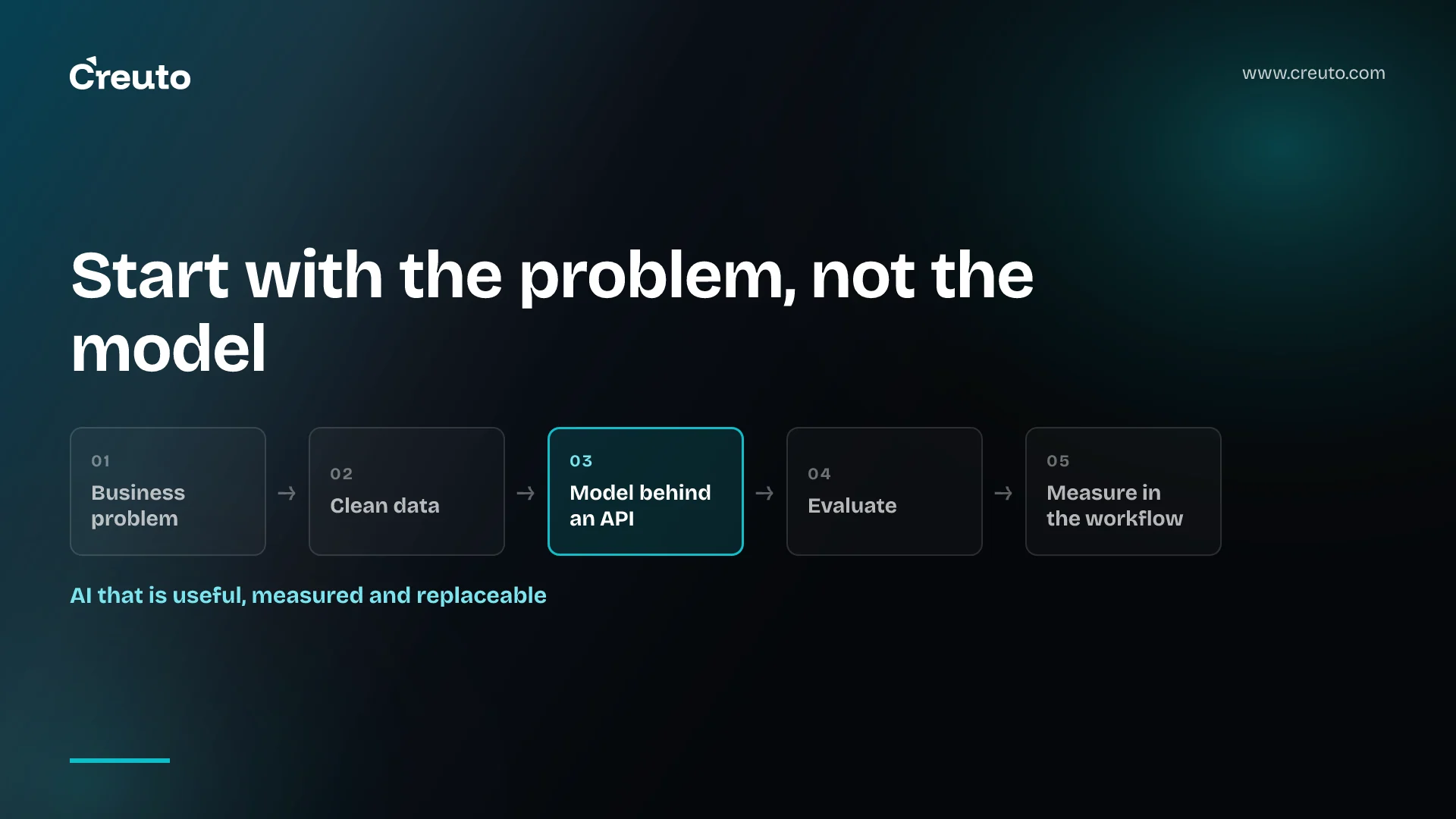
- Clear use cases and metrics. Start from a business problem with a measurable outcome.
- Good data. Clean, accessible, permitted data is the foundation; see building AI-ready software.
- An integration layer. Keep models behind APIs or a gateway so you can change them without rewriting the application.
- Evaluation. Test on real examples before and after every change; AI behaviour varies between runs, as we show in AI agent consistency testing.
- Cost control. Model usage is billed per request; match model size to the task.
Risks to manage
- Privacy and security. Control what data reaches which model and provider, and where it is stored.
- Accuracy. AI can be confidently wrong; keep people in the loop where errors matter.
- Bias and fairness. Check decisions that affect people for unfair patterns.
- Prompt injection. AI that reads untrusted content can be manipulated; limit what it can do with what it reads.
- Vendor change. Models are updated and retired; design so you can switch.
Where to start
Pick one process with clear volume and cost, build a small proof with real data and an evaluation set, integrate it into the actual workflow, and measure. Then extend. Our AI engineering services and generative AI teams build AI features into custom software with that discipline — useful, measured and replaceable.
Frequently asked questions
AI can be used in custom software for document and data extraction, predictive analytics, recommendations, natural language assistants and knowledge search, automation of routine tasks and domain-specific intelligence such as farm monitoring or quality inspection.
Artificial intelligence is the broad field of systems performing tasks associated with human intelligence. Machine learning is a subset where systems learn patterns from data instead of following hand-written rules. Generative AI and large language models are a further category.
Before adding AI, you need a specific use case with a measurable outcome, clean and permitted data, an integration layer that lets you change models, an evaluation set of real examples, and a plan for monitoring accuracy and cost.
Risks include data privacy and security, inaccurate outputs presented confidently, bias in decisions affecting people, prompt injection from untrusted content, and dependence on models that providers update or retire.